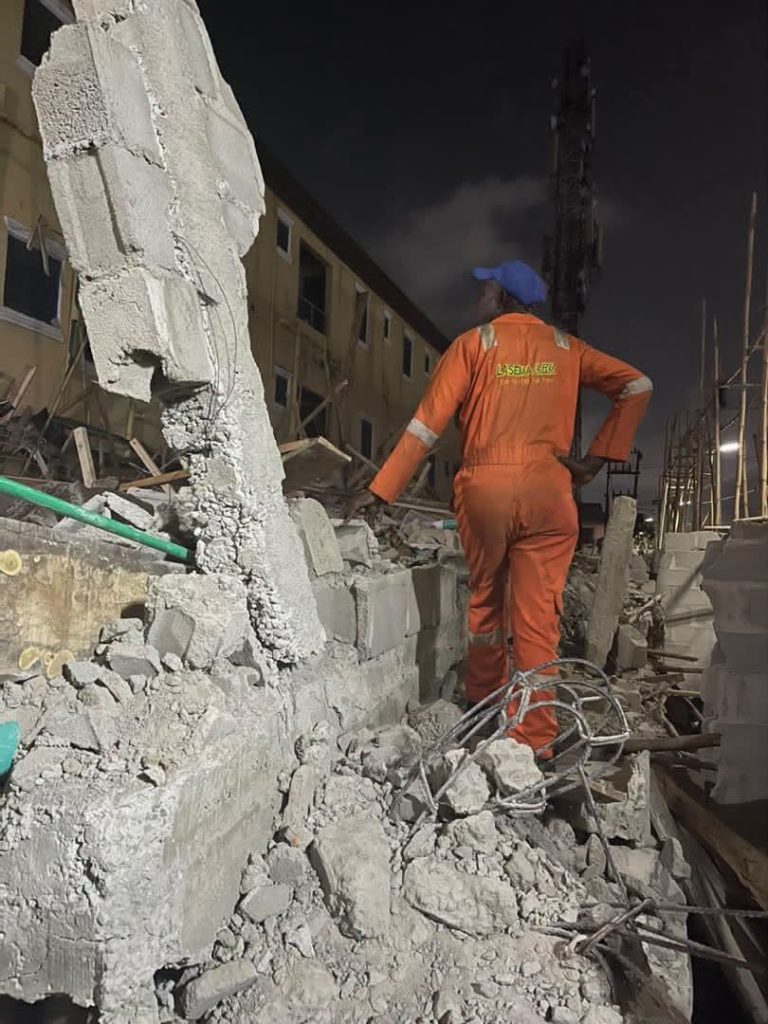
A two storey building under construction has collapsed early Friday morning at Akinola Street by Fadeyi Bus Stop, off Ikorodu Road, Lagos.
Report says three persons suspected to be construction workers have been rescue alive by Lagos state emergency response team and a dead body recovered.
The rescued victims were given immediate pre-hospital care before taking them to the hospital.
Search and rescue operations are still ongoing to ascertain if there are more persons trapped beneath the rubble.
Responders at the scene include LASEMA Response Team, LRU Paramedics, Lagos State Fire and Rescue Service, LASAMBUS and officers of the Nigeria Police Force from Alagbon Division.
The cause of the collapse is yet to be ascertained and is expected to be subjected to detailed investigation by relevant regulatory agencies.
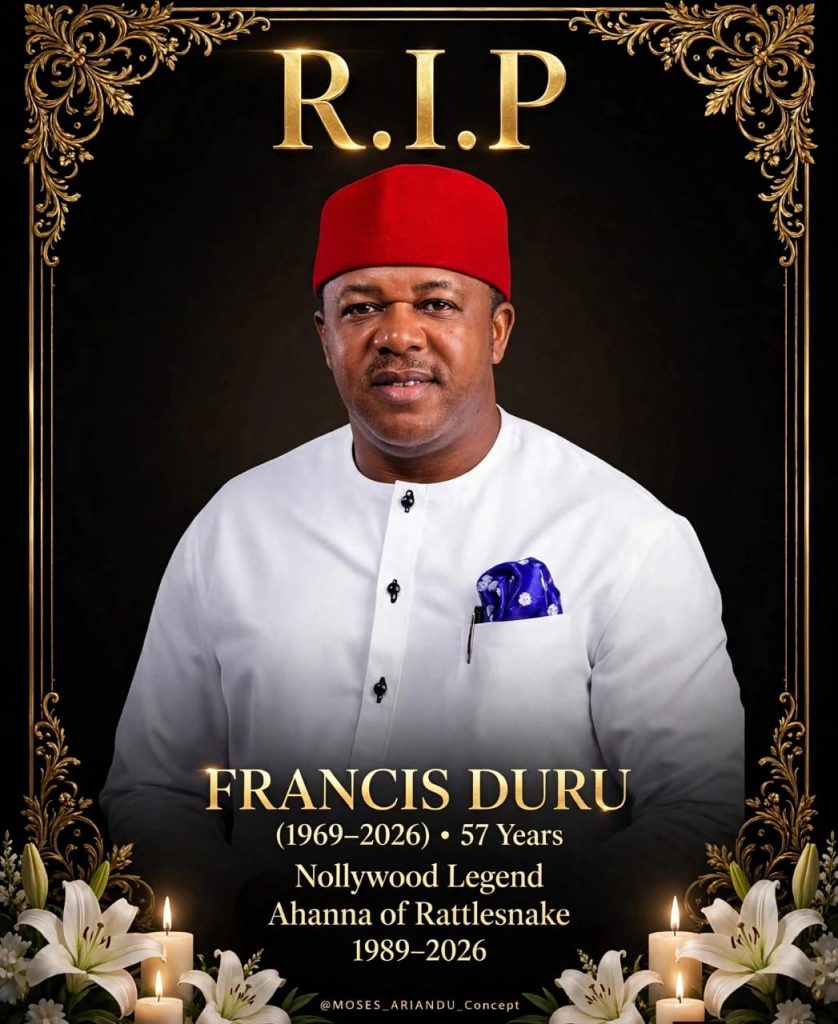
The family of veteran Nollywood actor, Francis Duru, has announced his passing in the early hours of Friday, October 23, 2026.
According to a statement shared via his official verified Instagram page @francis.duru, the actor d!£d after a brief illness.
The statement read:
“We, the family of Francis Duru, regret to announce his passing following a brief illness. We appreciate your prayers, love, and understanding. May his soul rest in perfect peace. Amen”
This comes about two years after the actor lost his youngest son, Ifeanyi, in 2024.
Africa’s ambition to become a global industrial powerhouse depends on its ability to mobilise long-term financing, provide reliable electricity and implement policies that transform its vast natural resources into manufactured products, President/Chief Executive of Dangote Industries Limited, Aliko Dangote, has said.
Dangote, who has outlined a $50 billion investment programme for 2026 to 2030, said the continent must strengthen its financial institutions, expand electricity infrastructure and adopt policies that promote domestic manufacturing, value addition and economic diversification.
Speaking at the 2026 Financial Times Africa Summit in London during a conversation with the newspaper’s Africa Editor, David Pilling, the industrialist said Africa had the natural resources, population and investment opportunities required to become a global manufacturing powerhouse but needed stronger institutions and infrastructure to realise its potential.
Responding to a question on why Africa had produced relatively few industrial enterprises of global scale despite its enormous economic potential, Dangote stressed the need for deliberate policies and institutions capable of supporting long-term industrial investment.
He said, “I think the number one thing that the continent has to concentrate on doing is having very strong financial institutions, their own financial institutions, and also to have very strong agricultural policy, and also industrial policy.” Dangote identified infrastructure development as another critical requirement, particularly electricity, which he described as one of the most urgent needs for unlocking the continent’s industrial potential.
“For Africa, what we need the most today is actually power,” he said. According to him, inadequate electricity supply continues to undermine Africa’s ability to process its mineral resources locally, forcing countries to export raw materials instead of capturing the greater economic value associated with manufacturing and processing.
He cited the mining industry as a notable example, explaining that unreliable electricity supply often discourages companies from establishing processing facilities close to extraction sites.
Dangote said approximately 650 million Africans remained without access to electricity, a deficit he described as incompatible with the continent’s industrial ambitions.
He argued that addressing the power crisis would improve manufacturing prospects, attract investment in mineral processing and create employment opportunities.
The industrialist also drew on his experience developing the Dangote Petroleum Refinery in Lagos to illustrate the challenges of financing large-scale industrial projects in Africa. He disclosed that the Group had to finance the refinery from its own balance sheet because conventional project financing was extremely difficult to secure for major industrial investments on the continent.
According to him, prolonged financing negotiations can undermine the viability of industrial projects by delaying implementation, increasing costs and exposing investors to changing economic conditions.
Dangote said the refinery project also faced significant financial risks arising from currency depreciation and the cost of developing supporting infrastructure.
He disclosed that the exchange rate moved from approximately ₦136 to the dollar to as high as ₦1,800 during the project’s development, while about 90 per cent of the Group’s revenue was denominated in naira.
He said the Group’s proposed $50 billion investment programme for 2026 to 2030 was partly intended to demonstrate the opportunities available across Africa and encourage other investors to commit resources to the continent’s development.
“The legacy we are trying to set up is how do we industrialise our continent?” he said. Dangote explained that the planned investments were aimed at demonstrating that African businesses could execute large-scale projects while helping to build a broader industrial ecosystem capable of supporting businesses, generating employment and retaining more economic value within the continent.
He also urged African governments to reconsider their approach to industrial protection, warning that allowing cheap imported products to undermine domestic manufacturers could weaken the continent’s productive capacity.
He argued that emerging African industries required appropriate policy support to compete with established international manufacturers, particularly where imported products were sold at prices that discouraged investment in local factories.
However, Dangote distinguished industrial protection from restrictions on trade between African countries, advocating a regional approach that would strengthen manufacturing while preserving the objectives of the African Continental Free Trade Area.
He maintained that African economies should trade more freely among themselves while developing a common framework to protect their industries against unfair external competition.
The industrialist also questioned why Africa continued to experience widespread poverty despite its extensive agricultural land, mineral resources and youthful population.
He argued that the continent’s economic challenges were not primarily due to a lack of resources but to insufficient productive investment and industrial capacity.
“Why should we remain poor?” he asked. Dangote expressed confidence that Africa was entering a period in which governments, entrepreneurs and investors were becoming increasingly determined to develop the continent’s productive capabilities and establish a stronger industrial base.
…Reiterates Warning Against ‘Political Gamblers’, Backs Tinubu, Aduda
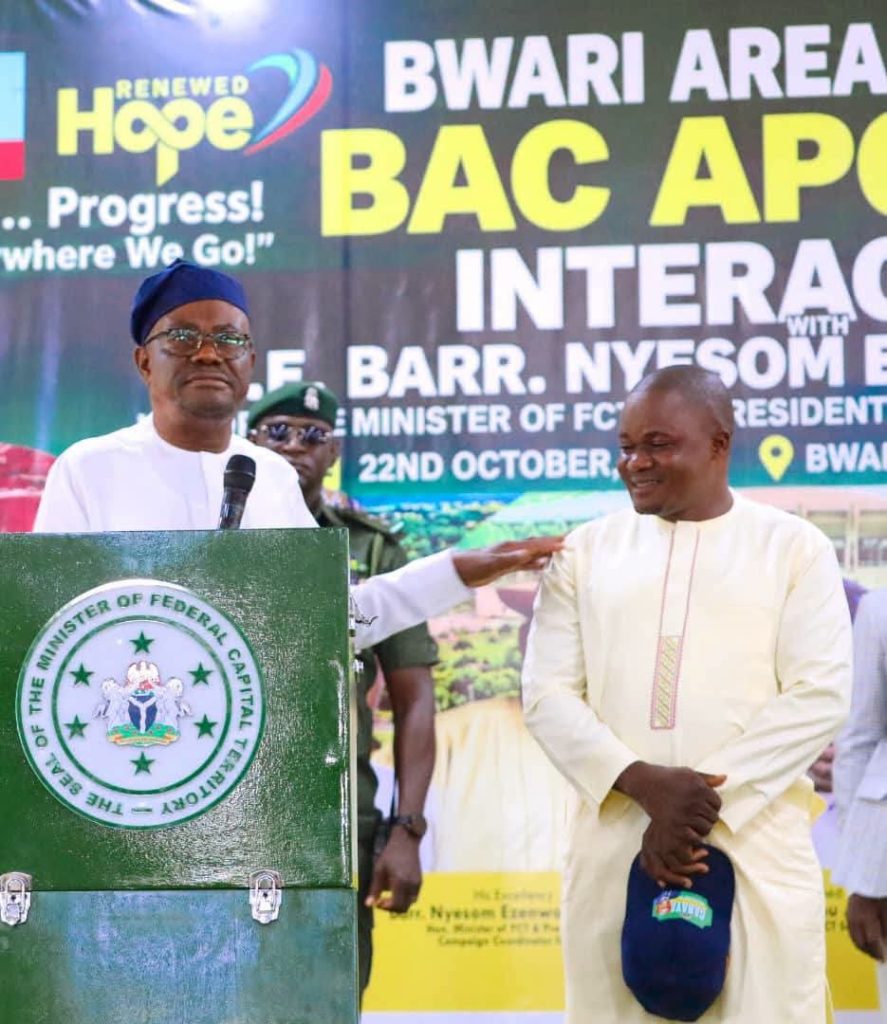
The Minister of the Federal Capital Territory (FCT), Nyesom Wike, has declared that residents of the territory will not repeat the political mistakes of the 2023 general elections, urging them to support President Bola Tinubu’s re-election bid in 2027.
Wike, who spoke on Thursday, at an interactive session organised by the Rainbow Coalition of the All Progressives Congress (APC) and the Peoples Democratic Party (PDP) in Bwari Area Council, Abuja, also endorsed Senator Philip Aduda and John Gbadaya under the coalition’s political arrangement.
He cautioned residents against politicians he described as “political gamblers”, insisting that the ongoing infrastructure projects and other interventions in the FCT justified support for the Tinubu administration.
“The mistake we made in 2023, would we make that mistake again? If it was an error, would we make that error again?” Wike asked, drawing a negative response from the audience.
The minister said the Rainbow Coalition was established to unite politicians across party lines and promote the interests of FCT residents, arguing that political affiliation should not take precedence over development.
“It doesn’t matter the party. After all, party is a vehicle that conveys you to where you are going. When you get there, you come down from the vehicle and you now work for the interest of the people,” he said.
Wike urged residents to assess their political representatives based on their accessibility and commitment to addressing the needs of communities across the territory.
Questioning the performance of the senator representing the FCT, Ireti Kingibe, the Minister asked whether residents felt the impact of their representative and whether she had visited traditional rulers, women and youths to understand their challenges.
“Today, the people of FCT, do you feel the impact? Do you feel the presence of the senator representing FCT today?” he asked.
Presenting Aduda to the gathering, Wike described the former senator as a politician who understood the concerns of FCT residents and urged participants to support him.
“So, I am here today to present to you your own son. The man who understands when you are sleeping. The man who knows when you are crying. The man who knows when Gombe people are in need. Senator Philip Aduda,” he said.
The minister also endorsed Tinubu’s second-term ambition, attributing the progress recorded in the FCT to the President’s support and approval of major projects.
According to him, the President’s commitment had enabled the administration to address infrastructure deficits and longstanding demands across the territory.
“All these things are being done because somebody is responsible. If the person does not agree with the minister doing anything, nothing will happen,” Wike said.
He further announced that the Gombe-Kubwa road project would be ready for use by December, assuring residents that the administration would continue to address their infrastructure concerns.
“Let me authoritatively tell you today, by the grace of God, this December, you will do Christmas on this road, Gombe to Kubwa,” he said.
Wike also disclosed that political negotiations had led to the PDP Chairmanship Candidate in the last Area Council elections, Julius Adamu, stepping down in favour of Joshua, chairman of Bwari Area Council, describing the decision as an example of putting collective interests above personal ambition.
He said the move was intended to strengthen political unity and consolidate support for Tinubu ahead of the 2027 elections.
The minister added that he would recommend Julius Adamu for a position in the FCT Universal Basic Education Commission, saying cooperation among political stakeholders was necessary to achieve the coalition’s objectives.
Meanwhile, a women leader from Bwari Area Council, Deborah Ayorinde, commended Wike for his political intervention in the territory but appealed to him to sustain his support for the council.
Ayorinde described Bwari as one of the area councils that had suffered prolonged marginalisation, expressing hope that the minister’s interventions would improve the situation.
“Among the six Area Councils we have in FCT, Bwari Area Council is the most neglected. Because Bwari Area Council has been marginalised for long. Your arrival reawakens our hope,” she said.
She praised Wike for supporting Joshua’s emergence as chairman, recalling that the minister had previously asked Julius Adamu, a political stakeholder, to step down in the interest of the council’s political arrangement.
Citing the biblical principle that people rejoice when the righteous are in authority, Ayorinde said residents were encouraged by Wike’s involvement in their affairs.
“The Bible that I believe says, when the righteous person is in power, the people rejoice. We are rejoicing because we have you as our father,” she said.
She, however, appealed to the minister to continue supporting the area council to ensure a peaceful and successful electoral process.
“Please, sir, I am here this morning to plead, to beg, to solicit. We want to win our election in Bwari Area Council smoothly,” she added.
Ayorinde also expressed confidence that residents would support Tinubu in the forthcoming election.
Earlier, FCT APC Chairman, Tanko Yamawo, commended Wike for fostering cooperation among politicians from different parties, recalling how political divisions had previously prevented members of rival parties from openly associating with one another.
Yamawo narrated an experience in which a former PDP chairman declined a ride in his car because he feared that entering the vehicle of an APC member could cost him his position.
He said the situation had changed, with politicians from both parties now working together under the Rainbow Coalition.
“What you have done today is not for Aduda, Gabaya and Chiya to benefit, but all of us as politicians in FCT are going to benefit from what you have started today,” he said.
Yamawo expressed confidence that Bwari residents would support APC candidates in the 2027 elections.
Similarly, FCT PDP Chairman, Ismaila Dogara, said the Rainbow Coalition had come to stay, adding that party members had embraced the arrangement and were ready to work together in support of Tinubu.
Dogara urged Wike to convey the expectations of FCT residents to the President, describing the period as an opportunity for the territory to reciprocate the administration’s interventions.
Traditional rulers at the gathering also commended the minister for ongoing infrastructure projects while appealing for additional attention to roads and other facilities in their communities.
The Sarkin Bwari, Alhaji Awwal Musa Ijakoro II, praised the administration for water projects and road construction around Tokulo, Ushafa and the Bwari-Zuba axis.
He appealed for the rehabilitation of the road linking the Army Checkpoint to central Bwari, describing it as a major concern for residents.
The Esu of Bwari, Dr Ibrahim Yaro, also commended the minister’s infrastructure efforts and called for attention to roads linking Karu, Mpape and neighbouring communities.
In his welcome address, Bwari Area Council Chairman, Joshua, thanked Wike for his political support, recalling that residents had responded positively when the minister previously urged them to support his candidacy.
He said ongoing projects across the FCT had strengthened public confidence in the administration and pledged continued cooperation with the minister.
The meeting formed part of the Rainbow Coalition’s political mobilisation ahead of the 2027 general elections, with APC and PDP stakeholders pledging to work together in support of Tinubu and candidates endorsed under the coalition’s arrangement.
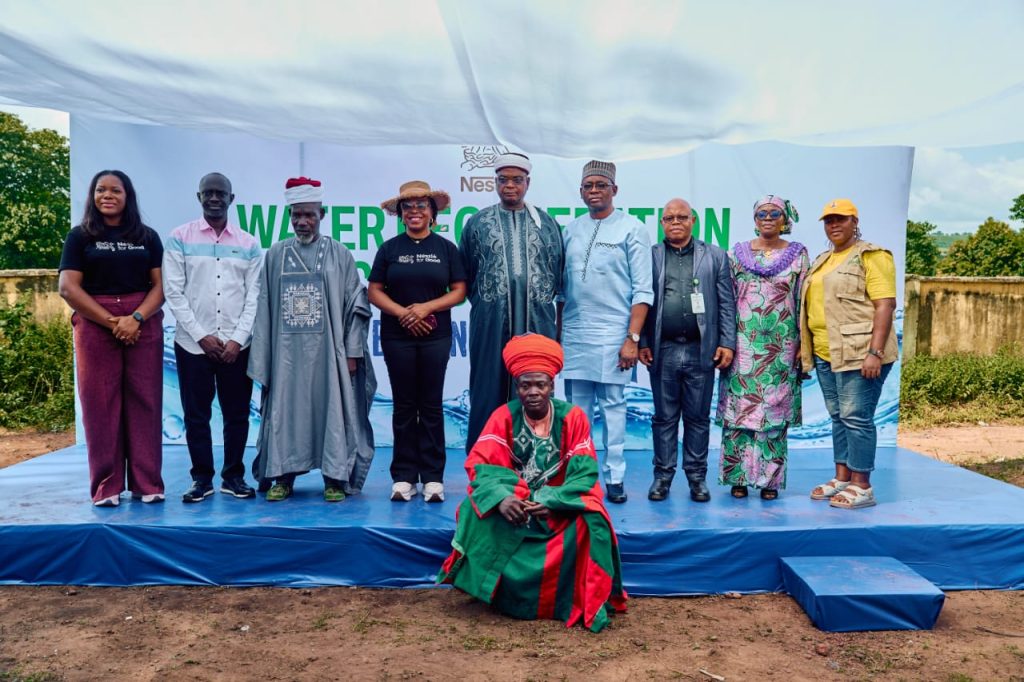
Nestlé Nigeria Plc has commissioned eight climate-smart boreholes and water treatment plants in communities within the Agbara catchment area of Ogun State as part of its Water Regeneration Project aimed at improving access to safe and sustainable water.
The facilities form part of a broader initiative covering the Agbara catchment in Ogun State and the Abaji catchment in the Federal Capital Territory (FCT). The Water Regeneration Project is built around four pillars: water access, water quality, water conservation and water governance.
Under the programme, 24 climate-smart boreholes are being provided, with eight in Agbara and 16 in Abaji. Water quality is supported through treatment plants, routine monitoring, the National Water Quality Advocacy Campaign and practical water safety guidance. Water conservation measures include rainwater harvesting systems, while water governance is strengthened through community water, sanitation and hygiene (WASH) committees and governance training. These measures are designed to establish local oversight, define responsibilities for safe operations and preventive maintenance, encourage prompt fault reporting and ensure regular water quality checks to sustain the facilities.
Speaking at the commissioning, Olutayo Olatunji, Business Executive Officer, Nestlé Waters and Premium Beverages, Nestlé Nigeria Plc, described the event as an important milestone in the company’s broader commitment to regenerating local water cycles.
“The Agbara commissioning is an important milestone within our wider Water Regeneration Project and reflects Nestlé’s commitment to helping regenerate local water cycles,” he said.
Olatunji added that combining treated water infrastructure with local governance and performance monitoring would improve access, strengthen watershed resilience and deliver lasting value to communities while supporting business continuity.
He said the company remained focused on rigorous implementation and measurable outcomes as it finalised the remaining components of the project.
The Minister of Water Resources and Sanitation, Engr. Prof. Joseph Terlumun Utsev, said the sustainability of the facilities would depend on their continued provision of safe and reliable services.
“Commissioning a facility is only the beginning; ensuring that it continues to provide safe, reliable and sustainable service is the true measure of success,” Utsev said.
He commended the initiative’s emphasis on governance and water stewardship, particularly the development of a governance training manual for water regeneration and stewardship.
Also speaking, the Minister of Environment, Balarabe Abbas Lawal, said the project demonstrated the benefits of strategic public-private collaboration.
He noted that Nestlé’s partnership with regulators, local authorities and host communities had supported efforts to ensure sustainable and equitable access to safe drinking water.
According to him, the initiative advances Sustainable Development Goal 6, which focuses on clean water and sanitation, and aligns with Nigeria’s environmental priorities. The Alagbara of Agbara Kingdom, His Royal Majesty, Oba (Barr.) Lukman Jayeola Agunbiade, Olute III, expressed gratitude for the intervention, describing safe water as essential to children’s health, household well-being and community development.
He urged traditional leaders, WASH committees and residents to take responsibility for protecting the facilities, preventing misuse and reporting faults promptly to ensure their continued operation for future generations. Victoria Uwadoka, Corporate Communications, Public Affairs and Sustainability Lead, Nestlé Nigeria Plc, said the company’s water safety advocacy efforts were designed to extend knowledge beyond project sites to homes, schools, communities and institutions.
She explained that the National Water Quality Advocacy Campaign and the National Water Quality Handbook, developed in collaboration with the Federal Ministry of Water Resources and Sanitation and OPS-WASH, were helping to promote responsible water management. “Access alone is not enough. Water must be safe, it must be protected, and communities must have the knowledge to manage it responsibly,” Uwadoka said.
The commissioning highlighted collaboration among public authorities, regulators, traditional institutions, community leaders, WASH committees, OPS-WASH and other technical partners.
Nestlé Nigeria said it would sustain its focus on effective implementation, transparent validation and community ownership as work progresses towards completing and handing over the Abaji facilities.
The company added that the initiative was expected to create lasting value for communities, strengthen watershed resilience and support long-term business sustainability.
The Economic and Financial Crimes Commission, EFCC, Lagos Zonal Directorate 1, Ikoyi, has secured a court order to freeze an account belonging to Yili Fu Liang Trading Co. Ltd over allegations of conspiracy and stealing.
The account is allegedly linked to the transfer of N1,065,500,000 from Renmoney Microfinance Bank following a reported electronic banking incident.
Justice Yelim Bogoro of the Federal High Court, Lagos, granted the order on Friday, October 16, 2026, following an ex parte application by the EFCC in a suit marked FHC/LAG/MISC/1392/2026.
The Commission, through its prosecuting counsel, Z.B. Atiku also sought an order to place six Bank Verification Numbers (BVNs) on a watchlist pending the conclusion of investigations or possible prosecution.
The application was brought pursuant to Section 44(2)(k) of the Constitution of the Federal Republic of Nigeria, 1999 (as amended), Sections 26 and 28 of the EFCC Act, and the inherent jurisdiction of the court.
Specifically, the EFCC sought an order authorising it to direct the manager of the account listed in Schedule A of the application to freeze the account pending the conclusion of investigations or possible prosecution.
The account, bearing the name Yili Fu Liang, is reportedly linked to a Kora Payment Network collection account number domiciled with a new generation bank as a virtual account.
The Commission also sought an order to watchlist six BVN numbers pending the conclusion of investigations or possible prosecution:
Moving the application, Atiku informed the court that it was supported by an affidavit deposed to by Gbolahan Olabayo Dada, an investigating officer with the Commission.
According to the affidavit, Dada is attached to the Bank Fraud Section and was assigned to investigate a petition submitted by Blackwood Law on behalf of Renmoney Microfinance Bank Limited against Yili Fu Liang Trading Co. Ltd over allegations of stealing.
The affidavit stated that the Commission received the petition on September 21, 2026, following an alleged incident on September 18, 2026, involving unauthorised electronic transfers of N1,065,500,000 through the bank’s application environment.
The petitioner alleged that the suspicious transactions occurred between approximately 4:52 p.m. and 8:00 p.m., with 12 transactions identified during the period and the total financial exposure estimated at N1.065 billion.
The affidavit further stated that the amount represented the financial exposure identified during the bank’s preliminary review of its systems.
According to the investigating officer, preliminary findings indicated that the funds were transferred to beneficiary accounts under the name Yili Fu Liang Trading Co. Ltd, linked to the Kora Payment Network collection account.
The affidavit added that investigators identified nine tranches of inflows, totalling N1,065,500,000, into the collection account on September 18, 2026.
Dada further stated that preliminary investigations suggested that the account holders did not have corresponding funds in their accounts before the alleged incident, making it necessary to secure the funds pending further investigation and possible prosecution.
On the BVNs listed in the application, the investigating officer stated that preliminary checks on the BVN portal and account-opening documents allegedly linked their holders to Yili Fu Liang Trading Co. Ltd.
He further alleged that the individuals behind the company were Nigerian nationals operating under the umbrella of a Chinese company, adding that they needed to be brought in for questioning as part of the ongoing investigation.
The affidavit maintained that the application was necessary to preserve the funds and prevent their possible dissipation while investigations into the alleged stealing and money laundering continued.
President Bola Tinubu has reaffirmed his determination to unlock Nigeria’s gas resources to power industries, improve electricity supply, create jobs and boost export earnings.
A statement by the Special Adviser to the President, Information and Strategy, Bayo Onanuga says the President said this amid the indigenous engineering firm Lee Engineering’s achievement of building two compressor stations to enable the Escravos–Lagos Pipeline System to operate at its full capacity of 2.3 billion standard cubic feet of gas per day.
The President spoke while receiving the Founder and Chairman of Lee Engineering Group, Dr Leemon Ikpea at the State House, Abuja.
President Tinubu reaffirmed his administration’s Nigeria First policy and urged international oil companies operating in the country to give competent Nigerian engineering and manufacturing firms greater opportunities to participate in major energy projects.
Lee Engineering is handling the Engineering, Procurement and Construction (EPC) of two midline compressor stations in Edo State. Although the pipeline’s designed capacity was increased from 1.1 billion to 2.3 billion standard cubic feet of gas per day under the ELPS II expansion, the compressor stations are needed to raise operating pressure and enable the pipeline to deliver at its full capacity.
The project is expected to strengthen gas transportation to power plants and industries along that corridor, support increased gas supplies to neighbouring West African countries through the West African Gas Pipeline, and create opportunities for additional export revenue.
President Tinubu said Nigeria First must translate into more contracts for capable Nigerian firms, greater use of locally manufactured equipment and more skilled jobs for Nigerians.
He encouraged international oil companies to build stronger partnerships with indigenous engineering companies that have demonstrated the capacity to deliver complex projects.
The Economic and Financial Crimes Commission, EFCC, on Monday, October 19, 2026, presented its First Prosecution Witness, PW1, Arnold Mozia, in the trial of one Joseph Igbeka over an alleged obtaining by false pretence and stealing to the tune of $200,000 before Justice Mojisola Dada of the Lagos State High Court sitting in Ikeja.
Igbeka was arraigned by the Lagos Zonal Directorate 2 of the EFCC on June 17, 2026 on a four-count charge bordering on an alleged obtaining by false pretence and stealing to the tune of $200,000.
One of the counts reads: “Joseph Igbeka, on or about the 9th day of September, 2025 in Lagos, within the jurisdiction of this Honourable Court, obtained the sum of N274,140,000 (Two Hundred and Seventy Four Million, One Hundred and Forty Thousand Naira) being the naira equivalent of $180,000, by false pretence, from Arnold Mozia, thereby committed an offence obtaining money by false pretence, contrary to Section 1(1)(2) (3) of the Advance Fee Fraud and Other Fraud Related Offences Act, 2006.”
Another count reads: “Joseph Igbeka, on or about the 9th day of September, 2025 in Lagos, within the jurisdiction of this Honourable Court, with dishonest intent, did steal the sum of N274,140,000( Two Hundred and Seventy Four Million, One Hundred and Forty Thousand Naira), being the naira equivalent of $180,000, property of Arnold Mozia, thereby committed an offence of stealing, contrary to Section 280 and punishable under Section 287 of the Criminal Law of Lagos State, 2015.”
He pleaded “ not guilty” to the charges when they were read to him.
At the resumed siting on Monday, the first prosecution witness, Mozia, who is the petitioner, told the court that Igbeka, on February 26, 2025, provided three bank accounts into which the naira equivalent of the sum of $20,000, amounting to N29,940,000, was to be paid.
Giving details of the accounts, Mozia, led in evidence by the prosecution counsel, Ebareotu Pereagbe, said: “ The accounts were Saint_OTS Limited’s account number 1306636072 domiciled in Providus Bank; Owolabi Temitayo Samuel’s account number 1381361382 domiciled in Access Bank and Olagoke Hammed’s account number 8169308659 domiciled in PalmPay.”
Asked how he transferred the money to the defendant, he said: “I “ transferred, through my Zenith Bank account, a sum of N10 million to Saint_OTS Limited; N12 million to Samuel and N7.94 million to Hammed on Igbeka’s instruction.”
In his further testimony regarding a separate transaction in September 2025, the PW1 stated that Igbeka instructed him to transfer the naira equivalent of an additional $180,000 for investment in forex trading.
“Specifically, on September 9, 2025, he provided me with three bank accounts for the transfers. They were Saint_OTS Limited’s Kuda Bank account number 3002630666; Owolabi Temitayo Samuel’s Access Bank account number 1381361382; and Oluzo Adeglo Bal Limited’s Access Bank account number 1773485812.
“ So, I transferred N90 million to Saint_OTS Limited, N14.14 million to Samuel, and N170 million to Oluzo Adeglo Bal Limited.”
The PW1 added that Igbeka neither repaid the loan and interest nor returned the investment capital and the agreed profit.
The case was adjourned till December 8, 2026 for continuation of trial.
The Director-General of the Africa Centres for Disease Control and Prevention (Africa CDC), Dr Jean Kaseya, has blamed limited international interest in Africa’s health challenges for the absence of an approved vaccine against the Bundibugyo strain of Ebola.
Kaseya argued that vaccine development might have progressed faster if the current outbreak were affecting Western countries, accusing some international partners of treating the disease as an exclusively African problem.
“If this outbreak was in Western countries, vaccine would already be available,” he said during an interview on Channels Television’s The Morning Brief on Thursday.
The Africa CDC chief said the Bundibugyo strain had attracted less attention partly because it had caused fewer outbreaks than the Zaire strain, which has been responsible for more than 16 outbreaks.
“Why this vaccine today is not available? Because some of our partners, they decided to consider this issue as an African issue, they were not interested,” Kaseya said.
He disclosed that the Africa CDC had taken steps to address the gap by supporting clinical trials of potential vaccines, including a candidate being developed by an African manufacturer in Egypt specifically for the Bundibugyo strain.
The agency is also working with the Democratic Republic of the Congo and Uganda to make Ervebo, a vaccine developed against the Zaire strain, available for clinical trials and compassionate use.
Kaseya said the efforts were part of a broader push to strengthen Africa’s capacity to develop and manufacture vaccines, medicines and diagnostic tools rather than depend heavily on external partners during public health emergencies.
“We don’t want to see again Africa left behind. We have the knowledge, we have people with intelligence, we have capacity to manufacture vaccine. We need to move on,” he said.
He urged African governments and international partners to sustain investment in vaccine research, improve coordination and increase domestic funding for disease prevention and response.
The Africa CDC chief also disclosed that 28 African countries had contributed funds towards the response to the current outbreak, describing the support as a significant step towards greater continental responsibility for public health emergencies.
“This is the first time I saw 28 African countries coming to provide funding to support the response, more than 50 per cent of African countries,” he said.
He added: “After Ebola, Bundibugyo will not be like before Bundibugyo.”
Nigeria confirmed its first imported case of Bundibugyo Ebola in the Federal Capital Territory on October 20. The patient, a woman who had recently travelled from Uganda, was receiving medical care, while health authorities had identified 44 contacts for monitoring.
As hearing resumed on Thursday at the Imo State High Court over the abduction of 20 prospective National Youth Service Corps (NYSC) members, an Investigating Officer of the Department of State Services (DSS), Ikem Emmanuel, has revealed that 11 suspects were involved in the operation.
Three suspects – Mohammed Ali, Usman Aliyu and Babangida Aliyu – have so far been arraigned in court over the incident while others are still at large. Giving his testimony, Emmanuel told the court that from confessional statements, intelligence gathering and identification by victims, the DSS established the involvement of 11 persons in the abduction.
Narrating how the incident occurred, he said the corps members were travelling from Ibadan to their orientation camps in Akwa Ibom and Abia States. They left Ibadan on 30 September 2026 and around 10 pm, a female passenger alighted at Oba, Anambra State.
According to him, they continued the journey the next morning, 1 October, at about 4:30 am. Heading to Imo State through the Onitsha-Mgbidi-Owerri Expressway, they came under attack around 6:30 am by a gang of kidnappers wielding AK-47 rifles. Twenty corps members were abducted and taken into the forest.
Emmanuel said following the incident, security agencies including the military, DSS and police deployed technical assets and intelligence analysis aimed at securing the safe return of the corps members. After one week in captivity, the victims were released after payment of ransom.
He said intelligence was gathered from the time of ransom payment to where the victims were released, adding that investigation revealed that some suspects had fled the state and were hibernating between Rivers and Abia States. Consequently, between 11 and 14 October 2026, the three accused were arrested in those states.
He said during investigation, intelligence gathering, record checks, interviews and confessional statements taken under caution were conducted. Statements of the hostages, witnesses, drivers and the person who delivered the ransom were also taken.
Further data analysis, he said, was conducted on the mobile phones of the accused persons, and the hostages were able to identify the suspects.
According to him, a motorcyclist identified as Timothy identified Usman Aliyu, the first defendant, and Babangida Aliyu, the second defendant, as those present and armed with AK-47 rifles at the point of ransom exchange.
One of the bus drivers, identified as Sunday Udok, also identified Usman Aliyu as the person who approached his bus wielding an AK-47 rifle. He said the driver escaped into the bush and was not among those abducted.
Emmanuel said some of the hostages identified as Esther Olade, Mary Makinde and Abdul Temi Sarah were able to identify the three suspects as those who abducted them, though they could not give a description of others still at large.
He said Mohammed Ali, popularly known within his gang as “Small Pepper”, was identified because of his complexion and facial appearance, although some of the kidnappers wore face masks.
The DSS officer said in their confessional statements, all three suspects admitted participating in the abduction.
The court adjourned hearing to 27 October 2026.
Meanwhile, two other suspects, Tange Ibrahim, aka Jiji, and Aminu Haliru, were also arraigned for another abduction on the same axis and same day. They were arrested on 9 October 2026.
The DSS investigating officer revealed that both were arrested in Rivers State over the abduction of Winner Ogidi, Timothy Okpara, Ogechi Harrietha Ogbonna and one other person whose name he declined to mention. He said the victims were kept in the forest at Umuwaka-Okpu, Mbaitoli Local Government Area of Imo State and at Ndegwu Forest before being released on 9 October.