Home Blog Page 727

Jakande Estate Residents Protest Planned Demolition, Seek Sanwo-Olu’s Intervention

0

BY TAIWO OGUNMOLA -OMILANI


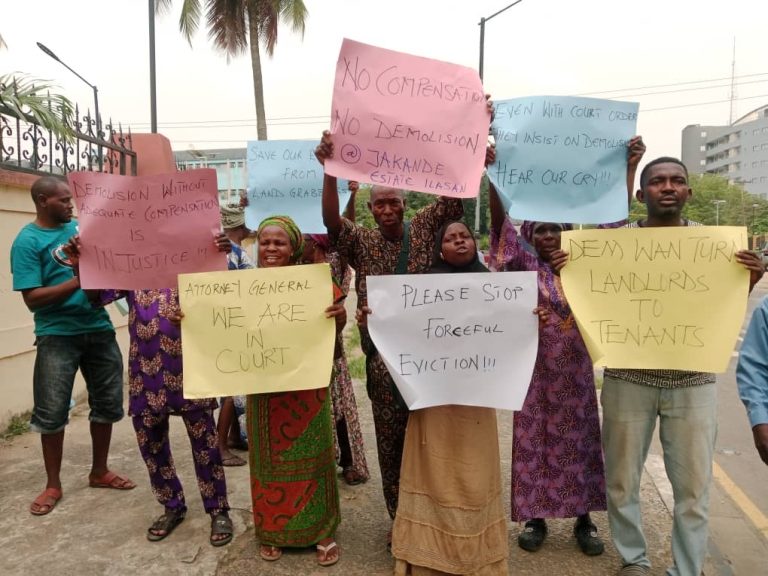
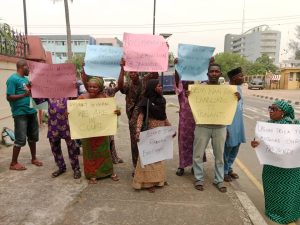
Residents of Jakande Estate in Lagos on Tuesday staged a protest against an alleged planned demolition of their homes, calling on Governor Babajide Sanwo-Olu to urgently intervene and halt further actions pending the determination of a court case.


Speaking to journalists during the protest at the Lagos State House of Assembly, the leader of the residents, Alhaji Abdulhameed Shuaib, accused some individuals he described as “so-called landlord leaders” of attempting to evict residents from the estate under the guise of government action.

Shuaib explained that the dispute began last year when residents were informed that they would be driven out of the estate and offered compensation.

According to him, the initial offer of ₦6 million per three-bedroom flat was rejected as grossly inadequate, noting that the flats were originally allocated by the government and duly signed by a former governor.

“How can a three-bedroom flat be valued at ₦6 million when similar government-built houses were going for about ₦15 million at the time?” he asked.

He said subsequent offers of ₦7 million and later ₦11 million were also rejected, especially as residents were allegedly asked to submit original property documents with a promise of payment three months later.

“We refused because it is risky. Once demolition starts, nobody can stop the caterpillar,” Shuaib said.

According to him, while residents were still arranging legal representation, about 50 buildings in the estate were demolished in March last year.

He said the residents later obtained a court injunction restraining further demolition.

Despite the injunction, Shuaib alleged that threats continued, with warnings that anyone who failed to accept the offer before demolition would lose all entitlements.

He added that the court has since extended the injunction until February 4, 2026.

The residents further alleged that some tenants were recently offered ₦50,000 to vacate their homes, while heavy machinery was again sighted entering the estate.
Shuaib also claimed that two residents were arrested after confronting the demolition team with court papers and letters from the Ministry of Physical Planning, and are currently being held at a police facility in Oshodi.

He expressed concern that Lagos State Government officials, including the governor and the attorney-general, neither appeared in court nor sent representatives, despite being listed as parties in the suit.

The protesters appealed to Governor Sanwo-Olu to stop any demolition activities, respect the court injunction, and ensure a fair and transparent resolution of the matter.

“Our request is simple,” Shuaib said. “No demolition while the matter is in court, and if relocation is inevitable, compensation must reflect the true value of our homes.”

Inscriptions on the placards include: “Demolition without adequate compensation is injustice , Please stop forceful eviction, No compensation, no demolition @ Jakande estate Ilesan”.
Onabanjo Family Announces Passing of Former Ogun First Lady, Chief (Mrs) Lucia Onabanjo, at 100

0


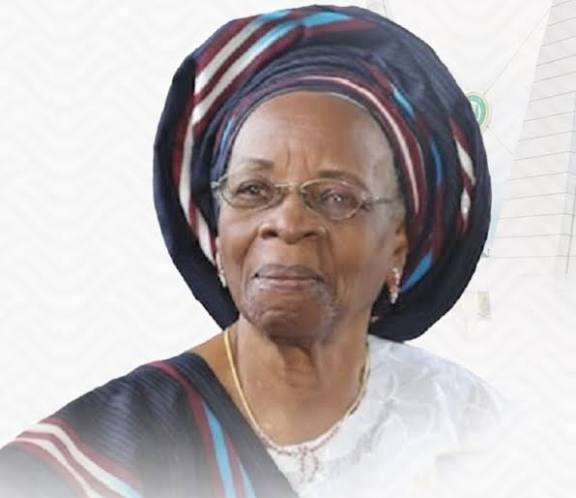
The family of Chief Victor Olabisi Onabanjo has announced the passing of their matriarch and wife of the former governor, Chief (Mrs) Lucia Onabowale Onabanjo.

She was aged 100.
In a brief statement released on Tuesday, the family said: “With deep regret but gratitude to Almighty God, we announce the passing of our beloved mother, grandmother and great-grandmother, Chief (Mrs) Lucia Onabowale Onabanjo (1925–2026), who was called to glory on Monday, January 11.”
The family expressed gratitude to God for her fulfilled life, describing her legacy as one marked by love, strength and faith, and prayed for the peaceful repose of her soul.

Chief (Mrs) Onabanjo was the wife of the late Chief Olabisi Onabanjo, the first civilian governor of Ogun State, who served during Nigeria’s Second Republic from October 1979 to December 1983.
Funeral arrangements, the family said, will be announced in due course.

President,Museveni, seeks 7th term after 4 decades in power

0


When Yoweri Museveni seized power in Uganda in 1986, he said “the problem of Africa in general and Uganda in particular is not the people but leaders who want to overstay in power.”

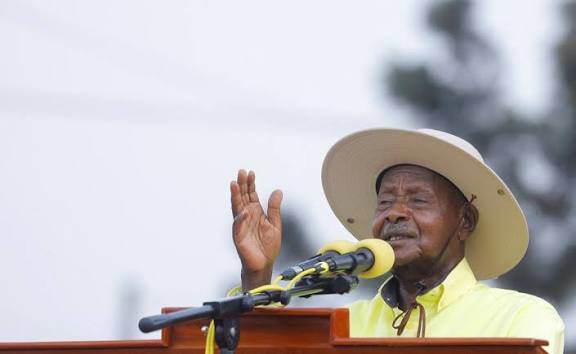
The 81-year-old president and former rebel is seeking a seventh term in office on Thursday after nearly four decades leading the East African nation, the vast majority of whose citizens have never known any other leader.

Museveni came to power on a wave of optimism after leading insurgencies against autocratic governments.

That goodwill was soon squandered amid allegations of graft and authoritarianism.

“Corruption has been central to his rule from the beginning,” Kristof Titeca, a professor at the University of Antwerp, told Reuters.
Museveni has acknowledged that some government officials have engaged in corrupt practices but says all those who have been caught have been prosecuted.

The canny political strategist has also cultivated foreign allies by embracing the security priorities of Western powers, deploying peacekeepers to hotspots such as Somalia and South Sudan and welcoming huge numbers of refugees to Uganda.
In his own country, his record has been mixed.

His government won praise for tackling the AIDS epidemic and for beating back the Lord’s Resistance Army rebel group that brutalised Ugandans for nearly 20 years.
But widespread corruption hollowed out state services and just one in four Ugandan children entering primary school makes it to secondary school, according to the United Nations children’s agency,UNICEF, while well-paid jobs remain largely out of reach for many.

There, he founded a militant movement that eventually helped force out President Idi Amin, with Milton Obote taking over as Uganda’s leader in 1980.
Obote was toppled in a coup in 1985.
The following year, the military wing of Museveni’s National Resistance Movement overthrew Tito Okello, who had become president.

“This is not a mere change of guard,” Museveni said at his swearing-in. “This is a fundamental change in the politics of our government.”
His efforts to attract foreign investment, establish order and raise the standard of living were initially applauded by the West.

But as Uganda’s economy picked up, so did public anger over corruption.
Under a privatisation programme, dozens of state enterprises were sold to Museveni’s relatives and cronies at fire-sale prices, according to parliamentary reports which said some of the proceeds were embezzled.

Kizza Besigye, Museveni’s doctor during his years in the bush, fell out with him, accusing him of presiding over corruption and rights abuses.
Museveni has won all six presidential elections he has contested, including four against Besigye, who was arrested in 2024 and faces treason charges.

In 2005, parliament scrapped presidential term limits, a move critics said was aimed at letting him keep power for life.
Museveni’s election opponents rejected election results over alleged irregularities.l, but the authorities denied the allegations and police cracked down on demonstrations by opposition supporters.
Museveni dismissed criticism from Western powers, saying in 2006: “If the international community has lost confidence in us, then that is a compliment because they are habitually wrong.”
He also sought to cultivate ties with other countries, including China, Russia, Iran and the United Arab Emirates, to reduce Uganda’s dependence on the West.
The discovery of substantial oil deposits buoyed his status, leading to agreements with energy giants TotalEnergies and CNOOC to build an export pipeline.

Muzeveni’s main rival in Thursday’s presidential election is Boni Wine, a 43-year-old pop star.
Political analysts say that while victory for Museveni is all but certain, the road ahead is clouded by uncertainty, with the president starting to show signs of frailty.

“The big question looming over the election is the question of succession,” university professor Titeca said, reflecting on the rapid rise of Muhoozi Kainerugaba, Museveni’s son and Uganda’s military chief.

Uganda’s opposition has accused Museveni of fast-tracking Kainerugaba’s military career to prepare him to eventually succeed him, even with the 51-year-old frequently taking to X to make inflammatory remarks, while veteran politicians who once fought alongside Museveni in the bush have been sidelined.

The election outcome could determine Museveni’s next move, with a poor showing potentially prompting him to promote other party members and deflect criticism of an outright dynastic succession, said former newspaper editor Charles Onyango-Obbo.

“This is less about the results that will be announced, and more about the mood on the ground,” Onyango-Obbo, added, saying that a handover could be some years away.

“Museveni is more frail now, but he is a workaholic… he will not leave even if he needs to use a walking stick,” he said.

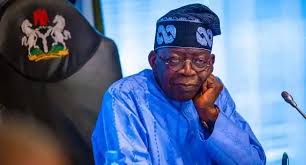
Tinubu not missing nor absent, APC tells Obi

0


The All Progressives Congress (APC) on Tuesday said President Bola Tinubu was neither missing nor absent from his duties.

This followed comments credited to Mr Peter Obi, the Labour Party (LP) presidential candidate in the 2023 presidential election, who questioned the president’s visibility.

The party, in a statement signed by its Lagos State Spokesman, Mr Seye Oladejo, made available to the News Agency Lagos on Tuesday, said the President remained fully engaged in the business of governance, both within and outside the country.

Oladejo urged political actors to focus on issues of substance rather than optics.

According to him, the president is not missing, neither is he absent from his constitutional responsibilities.

“He is actively involved in the complex and demanding work of statecraft, which includes policy coordination, security oversight, diplomatic engagements and economic reforms.

”Governance is not measured by constant public appearances or media check-ins. It is assessed by the quality of decisions taken, the policies implemented and the outcomes delivered in the national interest.”

He also said that Tinubu had continued to discharge his duties with focus and resolve, guided by the constitutional mandate given to him by Nigerians.

“His schedule and engagements are driven by national priorities, not by the need to satisfy political commentary,” he said.

Oladejo added that the Tinubu administration had remained active on several fronts, including economic reforms, security coordination and international diplomacy.

He noted that these efforts were aimed at repositioning Nigeria for sustainable growth and global relevance.

He advised political leaders to engage constructively by offering ideas and alternatives that would contribute to national development, rather than raising questions that could create unnecessary public anxiety.

It was reported that Obi also a former Anambra governor had questioned the whereabouts of Tinubu amid what he described as deepening economic hardship, insecurity and leadership silence.

In a statement posted on his verified X account on Monday, Obi said his concern was driven by the scale of challenges confronting the country and the perceived absence of direct presidential engagement at a critical time.

He alleged that President Tinubu spent 196 days outside the country in 2025, adding that this exceeded the time he spent within Nigeria during the same period.

He also claimed that Nigerians had not heard directly from the President since December 2025.

It would be recalled that Tinubu on Dec. 28 departed Lagos for Europe to continue his end-of-year break and in preparation for an official visit to Abu Dhabi in the United Arab Emirates.

The president was invited by Sheikh Mohamed bin Zayed Al Nahyan, President of the UAE, to participate in the 2026 edition of Abu Dhabi Sustainability Week (ADSW 2026).

Tinubu on Sunday arrived in Abu Dhabi, United Arab Emirates, to attend the 2026 Abu Dhabi Sustainability Week which began on Monday.

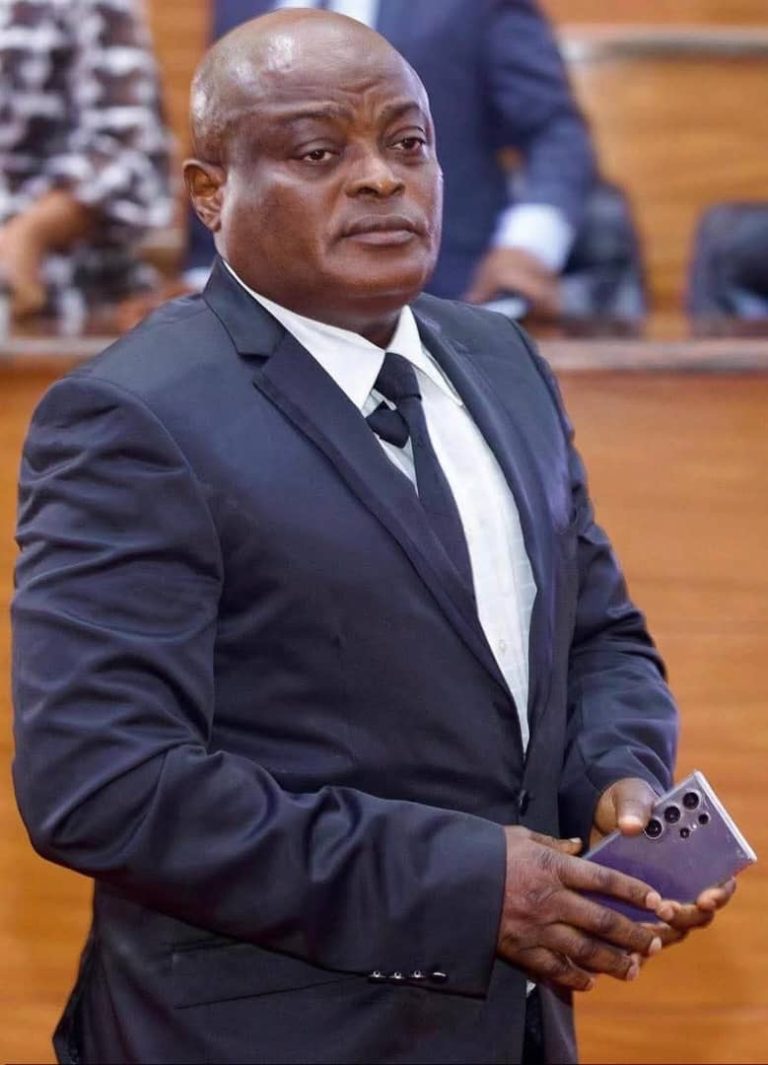
Obasa’s Ouster and Return: Inside the Turbulent Power Struggle at the Lagos Assembly

0


The Lagos State House of Assembly witnessed one of the most dramatic political crises in its history in 2025, following the removal and eventual reinstatement of Rt. Hon. Mudashiru Ajayi Obasa as Speaker.

On January 13, 2025, lawmakers of the Assembly, dominated by the All Progressives Congress (APC), moved to impeach Obasa, who had served as Speaker since 2015 and represented Agege Constituency I.

The impeachment took place during a plenary session held while Obasa was reportedly out of the country, returning from the United States, a development that immediately sparked controversy over due process and legality.
During the session, between 32 and 36 of the 40 lawmakers reportedly voted in favour of Obasa’s removal on allegations of gross misconduct, abuse of office, financial mismanagement and high-handed leadership. The Deputy Speaker, Mojisola Lasbat Meranda, was subsequently elected as Speaker, making history as the first female to occupy the position in Lagos State.

The Clerk of the Assembly was also suspended, alongside other leadership changes.
While supporters of the move described it as a corrective step for good governance, critics condemned it as a political ambush. Obasa alleged that the Assembly complex was broken into, that a “fake mace” was used, and that security operatives were deployed to intimidate lawmakers loyal to him.

Beyond the official allegations, political observers linked the crisis to internal APC dynamics. Obasa’s long tenure and reported 2027 governorship ambitions were believed to have unsettled key interests within the party. Tensions over succession planning and party cohesion were said to have deepened rifts between the Speaker and influential party stakeholders.

The impeachment plunged the Assembly into turmoil, dividing lawmakers and drawing intense public and media scrutiny, given Lagos State’s political and economic importance.

Legislative activities slowed, while the crisis heightened intraparty tensions and raised concerns about executive–legislative relations in the state.
On February 12, 2025, Obasa approached the Lagos State High Court in Ikeja, challenging the legality of his removal. He argued that the impeachment was carried out while the Assembly was on recess, without proper authority to convene the session, and in violation of constitutional provisions and the Assembly’s standing rules.

In a landmark judgment delivered on April 16, 2025, the High Court declared the January 13 proceedings illegal, unconstitutional, null and void. The court held that due process was not followed, stressing that only duly authorised House leaders could convene a valid sitting. It also awarded Obasa ₦500,000 in damages and nullified all resolutions reached during the controversial session.
Even before the judgment, political negotiations had begun to resolve the crisis. On March 3, 2025, after 49 days in office, Mojisola Meranda resigned as Speaker in what was widely seen as a move to restore stability. Obasa was subsequently re-nominated and re-elected as Speaker, while Meranda returned as Deputy Speaker following a reshuffle of principal offices.

Upon his reinstatement, Obasa thanked his colleagues and party leaders for their intervention and called for unity and renewed focus on legislative service to the people of Lagos State.

The episode has since been viewed as a defining moment in Lagos politics, underscoring the importance of due process, constitutionalism and judicial oversight in legislative affairs. It also highlighted the judiciary’s role as a critical check on political actions that fall short of established procedures.

By Lanre Ogunyemi, former Lagos Assembly lawmaker.

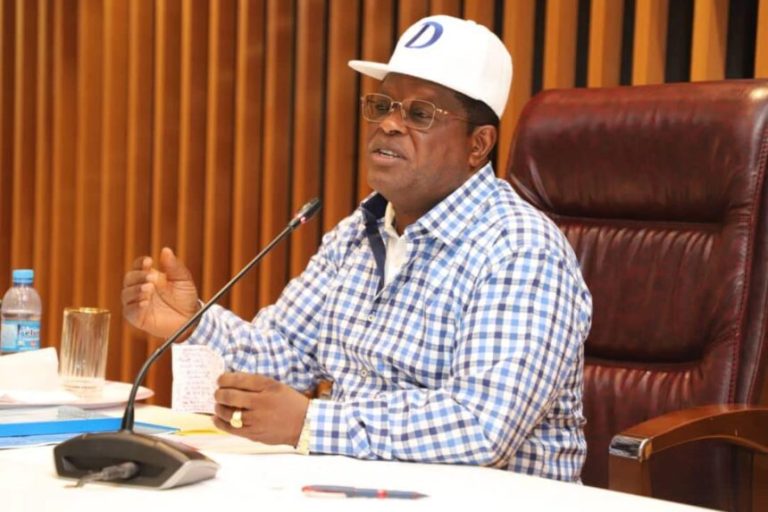
Umahi orders night repair of Lagos-Ota-Abeokuta Road

0


The Federal Government has ordered immediate commencement of palliative works on the Lagos-Ota-Abeokuta Road to address critical failures and restore traffic flow.

‎

‎The Minister of Works, ‎Sen. Dave Umahi, gave the directive during an inspection of the federal highway linking Lagos and Ogun states.

‎

‎He said that although about 22km were assessed, active intervention would focus on about 18km of the most distressed sections of the road.

‎

‎Umahi said that the Federal Government was already handling about 60km on the corridor and they were being executed in phases based on urgency.

‎

‎He attributed the road’s failures to unresolved concession issues and misjudged engineering parameters during an earlier construction.

‎

‎The minister said that the repair would begin immediately, mostly at night, targeting sections that prevented free movement of vehicles.

‎

‎According to him, low-lying failed areas will be reconstructed with concrete to ensure durability.

‎

‎Umahi said that the Ota-bound carriageway suffered more severe damage than the Lagos-bound carriageway.

‎

‎He said that a second phase would involve full resurfacing, replacement of bridge expansion joints, and installation of solar streetlights.

‎

‎The minister gave the assurance that the concessionaire would operate and maintain the road as soon as works on it would be completed.

Stocks rally as investors gain N745bn on bullish open

0


The Nigerian stock market opened the week on a bullish note on Monday, with investors gaining N745 billion as market capitalisation climbed to N104.5 trillion.

The rally was driven by sustained demand for stocks such as Etranzact, Red Star Express, McNicholas, RT Briscoe and Deap Capital Management, alongside 45 other advancers.

Market capitalisation, which opened at N103.775 trillion, rose by 0.58 per cent, or N745 billion, to close at N104.520 trillion.
The All-Share Index gained 946.61 points, closing at 163,244.69, compared with 162,298.08 recorded at the previous session’s close.
Market breadth closed positive, with 50 gainers outweighing 20 losers, reflecting broad-based investor optimism across key sectors.

Etranzact, Red Star Express, McNicholas, RT Briscoe and Deap Capital Management led the gainers, each rising by 10 per cent.
They closed at N16.50, N11.55, N6.05, N3.96 and N3.30 per share, respectively.

Champion Breweries topped the losers’ chart, shedding 8.51 per cent to close at N15.05 per share.
Eunisell Interlinked declined by 8.01 per cent to N156.20, while Ikeja Hotel fell by eight per cent, ending at N36.80 per share.
Guinea Insurance dropped by 7.30 per cent to N1.27, while Omatek slipped by 3.13 per cent to close at N1.24 per share.
Trading activity improved, with 1.15 billion shares valued at N19.23 billion exchanged in 59,359 transactions.

This compared with 624.08 million shares worth N18.5 billion traded in 43,816 deals in the previous session.
Sovereign Trust Insurance recorded the highest volume, trading 307.47 million shares, representing 26.75 per cent of total volume.

Fidelity Bank led in value terms, with trades worth N3.14 billion, accounting for 16.32 per cent of total value.
An analyst said the rally reflected “renewed confidence, supported by bargain hunting and expectations of stronger corporate earnings.”

U.S. revokes 100,000 visas in 1 year —State Dept

0


The U.S. Government says it has revoked more than 100,000 visas within the past one year of President Donald Trump’s second term in office.

This is contained in a statement posted by the U.S. State Department on its official X handle on Monday.

It explained that the visa revocation affected about 8,000 student visas and 2,500 specialised work permits.

The State Department described the decision as a broad crackdown targeting foreign nationals with criminal records or legal violations.

“The Trump administration has no higher priority than protecting American citizens and upholding American sovereignty.

“We will continue to deport these thugs to keep America safe,” State Department spokesman, Tommy Pigott said.

He said that “thousands” of the visas were revoked over crimes, which included assault and drunk driving.

Piggot further said that the visa revocations were part of a wider campaign of mass deportations, carried out aggressively through a surge of federal agents.

The Trump administration has also tightened vetting for visas, including moving to screen social media postings of visitors, it added.

It was reported that President Donald Trump took over office for his second term on an anti-migrant platform on Jan. 20, 2025.

According to figures from the Department of Homeland Security, the Trump administration has deported more than 605,000 people, while 2.5 million others are left on their own.

Marco Rubio, U.S. Secretary of State, recently rationalised the revocation of visas from students who protested against Israel.

He emphasised that the country’s law allows it to block entry to foreigners who are seen as going against U.S. foreign policy.

SIGNED BUT NOT ENFORCED: THE CONSEQUENCES OF NIGERIA’S FAILURE TO DOMESTICATE GENDER JUSTICE TREATIES

0


By Oluwatoyin Omotayo Esq

Nigeria has repeatedly affirmed its commitment to protecting women and girls from domestic and gender-based violence (DGBV) by ratifying key international and regional human rights instruments. Yet, for millions of survivors across the country, these commitments remain largely symbolic. The failure of the Nigerian government to domesticate critical international laws has created a dangerous legal lacuna, one that continues to undermine survivor protection, weaken accountability, and perpetuate impunity.
Under Nigerian constitutional law, international treaties do not automatically become enforceable domestically. Section 12 of the 1999 Constitution explicitly requires domestication by the National Assembly before treaty provisions can have the force of law. It is within this legal gap that survivors of domestic and gender-based violence are left exposed.
International Commitments Without Domestic Force
Nigeria is a signatory to the Convention on the Elimination of All Forms of Discrimination against Women (CEDAW) and has also ratified the Maputo Protocol on the Rights of Women in Africa. Both instruments impose clear obligations on states to prevent violence, protect survivors, prosecute perpetrators, and address the structural inequalities that enable abuse.
CEDAW, particularly through General Recommendation No. 35, defines gender-based violence as a form of discrimination and introduces the principle of state due diligence. The Maputo Protocol goes further by explicitly requiring states to criminalise violence against women and provide effective remedies and support services.
Despite ratification, neither CEDAW nor the Maputo Protocol has been domesticated in Nigeria. As a result, their provisions are not directly enforceable in Nigerian courts. Survivors cannot rely on them to compel government action, and judges are not legally bound to apply their standards.
The Legal Lacuna and Its Human Cost
The consequences of this non-domestication are not abstract; they are lived realities for survivors.
First, access to justice becomes geographically unequal. While the Violence Against Persons (Prohibition) Act (VAPP Act) provides a progressive framework, it applies only in the Federal Capital Territory and in states that have domesticated it. Survivors in states without equivalent legislation are often left to rely on outdated criminal and penal codes that fail to recognise psychological, economic, or coercive abuse.
Second, state accountability is significantly weakened. International law requires governments to act with due diligence in preventing and responding to violence, including failures by police, prosecutors, or social services. In Nigeria, survivors rarely succeed in holding the state accountable for institutional failures because the legal basis for such claims, that is the international treaties, has not been domesticated.
Third, survivor remedies are limited and inconsistent. International instruments emphasise holistic redress, including compensation, rehabilitation, and guarantees of non-repetition. Nigerian law, by contrast, remains largely punitive rather than restorative, offering little in the way of state-funded survivor support.
Cultural Defences and Legal Silence
The absence of domesticated international standards also allows harmful cultural and social norms to continue shaping legal outcomes. Without binding treaty obligations, domestic violence is too often trivialised as a “family matter,” mediation is prioritised over justice, and survivors are pressured to reconcile with abusers.
Domestication would strengthen judicial interpretation, empowering courts to reject victim-blaming narratives and recognise domestic and gender-based violence as a violation of fundamental human rights.
Policy Promises Without Legal Backing
Nigeria has developed policies, action plans, and institutional frameworks addressing gender-based violence. However, without domesticated international obligations, these initiatives remain vulnerable to political changes, inconsistent funding, and weak enforcement.
Domesticated treaties would elevate these commitments from policy aspirations to legal mandates, compelling sustained government action and resource allocation.
Why Domestication Matters
Domestication is not about importing foreign values; it is about translating Nigeria’s own commitments into enforceable law. It would harmonise protections across states, strengthen survivor-centred justice, and align Nigeria’s domestic laws with international best practices.
Most importantly, domestication would shift the narrative from government goodwill to government obligation.
Conclusion
Nigeria’s failure to domesticate critical international instruments on domestic and gender-based violence represents more than a legislative oversight, it is a systemic failure that leaves survivors inadequately protected. Ratification without domestication creates the illusion of commitment while denying survivors meaningful access to justice.
Until Nigeria closes this legal gap, domestic and gender-based violence will continue to thrive in the shadows of unenforced promises. True protection begins not with signatures on international documents, but with the courage to transform those commitments into binding, enforceable law that places survivor dignity, safety, and justice at the centre of governance.

Oluwatoyin Omotayo Esq is the
Founder TOOF

INEC Chairman Begins Early Preparations for 2027 Elections, Inspects Lagos Facilities

0


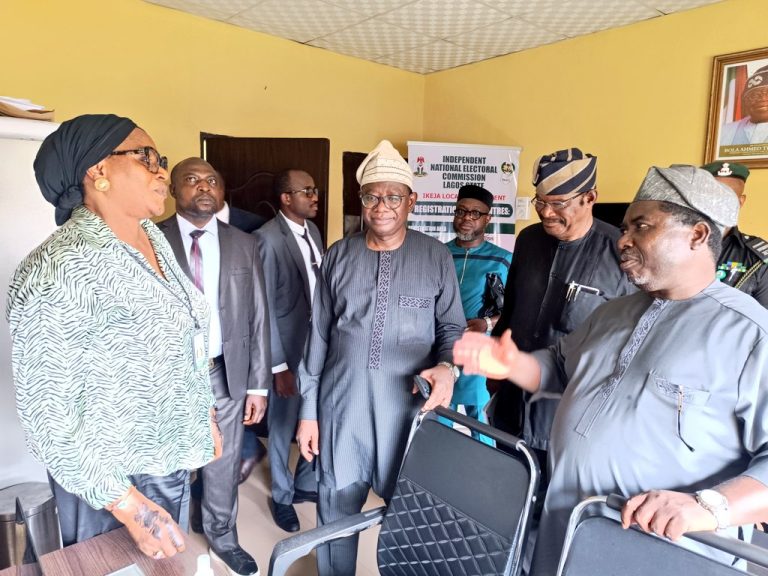
The Chairman of the Independent National Electoral Commission (INEC), Professor Joash Amupitan, SAN, has declared that preparations for the 2027 General Elections have officially begun, following a strategic retreat and an extensive inspection of INEC facilities in Lagos State.

Professor Amupitan’s visit on Monday, January 12, 2026, signalled the Commission’s renewed emphasis on early planning, technological advancement and improved staff welfare.

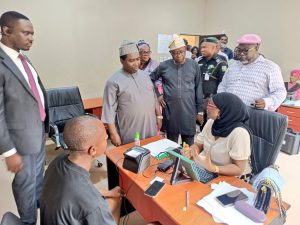
Accompanied by key aides — including his Chief of Staff, Mr Akin Fagbemi; Chief Technical Adviser, Professor Dimis Mailafiya; and Chief Press Secretary, Mr Adedayo Oketota — the INEC chairman commenced his tour at the Ikeja Local Government Area office. He was received by the Electoral Officer, Hajia Haolat Mustapha, who briefed him on the technological innovations introduced for the second phase of the Continuous Voter Registration (CVR) exercise.

Professor Amupitan noted a significant increase in citizen turnout and commended the streamlined registration process.

The tour continued at the Surulere LGA office, where the Electoral Officer, Mr Yakubu Olugbenga, took the chairman around various registration points.

The INEC boss interacted directly with field officers to assess the progress and challenges of the ongoing exercise.

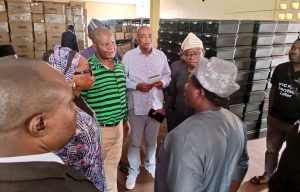
At the INEC Zonal Store in Lagos, the Head of the Zonal Store, Mr Raphael Okezie, guided Professor Amupitan through the facility and highlighted critical logistical challenges requiring urgent attention ahead of the next election cycle.

The inspection concluded at the INEC Lagos State Headquarters in Sabo-Yaba, where the chairman addressed members of staff and unveiled a reform-driven vision for the Commission, built on three major pillars.
Under specialisation and institutional strengthening, Professor Amupitan announced plans to reposition INEC as a specialised agency, moving away from the traditional civil service structure.
On staff welfare, he acknowledged the financial pressures faced by state offices and field personnel, disclosing that he had already intervened to enhance allowances for staff participating in the second phase of the CVR.

He also promised a comprehensive review of funding for state offices and reaffirmed his commitment to implementing improved conditions of service, including exploring home ownership schemes for staff.

Addressing public confidence and early preparation, the chairman candidly admitted that INEC faces challenges with public perception, urging staff to recognise the importance of their role in strengthening Nigeria’s democracy.

“If we want to fix this country, let’s first start with a very good, free, credible election,” he said.

He stressed the need to learn from previous experiences, particularly the 2023 general elections, and charged staff to remain proactive. “Preparation for the 2027 election has started. We cannot afford to wait until the last minute,” he warned.
In her vote of thanks, the Lagos State Administrative Secretary, Mrs Oluyemi Adeyemi-Showunmi, speaking on behalf of the Resident Electoral Commissioner, Professor Salami Ayobami, and the entire staff, praised Professor Amupitan’s hands-on leadership style and receptiveness.
She assured that the Lagos State INEC office would live up to expectations and surpass its previous performance in future electoral exercises.