Home Blog Page 496

NAFDAC Raises Alarm Over Distribution of Suspected Counterfeit Colgate Toothpaste in Kaduna

0


The National Agency for Food and Drug Administration and Control (NAFDAC) has issued a public alert warning Nigerians about the circulation of unregistered and suspected counterfeit toothpaste products in Kaduna State.

In a statement tagged Public Alert No. 022/2026, the agency disclosed that its Post-Marketing Surveillance (PMS) Directorate received a complaint regarding the sale of fake products falsely branded as Colgate toothpaste.

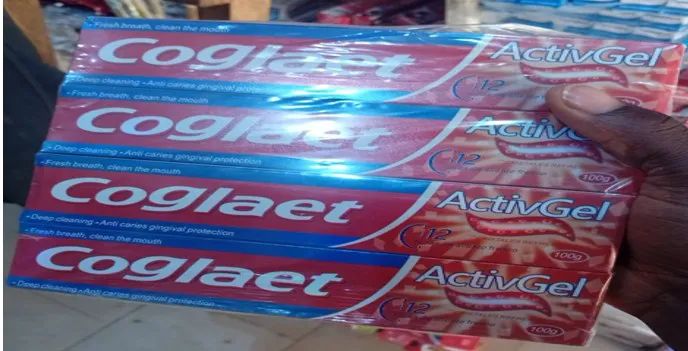
Following the report, NAFDAC officials conducted an inspection at the identified retail outlet, where they discovered two suspected counterfeit products labeled “Coglaet ActivGel 100g” and “Coglaet Herbal 100g” on sale.

According to the agency, the shop owner claimed the items were purchased from a door-to-door sales representative but was unable to provide any proof of purchase.

NAFDAC warned that the products have not undergone the required regulatory processes for registration and quality assurance, raising concerns about potential risks to public health and safety.

The agency confirmed that the items have been removed from circulation while investigations continue to trace their source and distribution network.

The agency urged consumers to remain vigilant and report any suspected sale of substandard or counterfeit regulated products to the nearest NAFDAC office. Complaints can also be made via its hotline or official email channel.

NAFDAC reiterated its commitment to safeguarding public health by ensuring that only safe, quality, and properly registered products are available in the Nigerian market.

Obaseki Mourns Former Edo Commissioner Joshua Omokhodion

0


Former Edo State Governor, Godwin Obaseki, has expressed deep sorrow over the death of former Commissioner for Environment, Joshua Omokhodion, describing his passing as a significant loss to the state and those who knew him.

In a statement, Obaseki said he was “extremely bewildered” by the news of Omokhodion’s demise, noting that the late commissioner was a devoted public servant who served Edo State with dedication and integrity.
He described the deceased as a distinguished architect and a loyal, humble individual whose passion for service left a lasting impact.

According to the former governor, Omokhodion played a key role during his administration, contributing to environmental sustainability reforms and initiatives that improved the lives of residents across the State.

Obaseki further noted that Omokhodion’s work ethic and commitment earned him widespread respect among colleagues and constituents, adding that he carried out his responsibilities with diligence, always prioritising the welfare of the people and environmental sustainability.

“His legacy is one of service marked by sincerity and impactful action,” Obaseki stated, highlighting the late commissioner’s approachable nature and ability to connect with people from all walks of life.

He extended his condolences to the family of the deceased, as well as friends and the people of Edo State, describing Omokhodion as a remarkable individual whose contributions would not be forgotten.

Obaseki prayed for the repose of his soul and urged those he left behind to find comfort in the enduring impact of his life and service.

CCII Confirms Resolution of Makinde–Olubadan Rift

0


The Central Council of Ibadan Indigenes (CCII) has announced that the recent dispute between Oyo State Governor, Seyi Makinde, and the Olubadan of Ibadanland, Oba Rashidi Ladoja, has been amicably resolved.

The council disclosed this in a statement issued on Sunday by its Publicity Secretary, Kola Olomide, amid concerns over reported tensions between the state government and the traditional institution.

Quoting the CCII President-General, Ajeniyi Ajewole, the statement noted that the disagreement was successfully addressed through internal dialogue and established traditional conflict-resolution mechanisms in Ibadanland.

According to the council, the resolution reflects the commitment of stakeholders to maintaining unity, peace, and mutual respect between political authorities and traditional leadership in the ancient city.

Tinubu Agenda: FG targets advertising debt defaulters

0


• Orders strict enforcement

The Federal Government has launched a sweeping crackdown on the long-standing crisis of advertising and media debt, signalling a new era of financial discipline across Nigeria’s communications industry.

The decisive move was announced by the Minister of Information and National Orientation, Mohammed Idris, who directed the Advertising Regulatory Council of Nigeria (ARCON) to work in tandem with the National Broadcasting Commission (NBC) and sectoral stakeholders to enforce a zero-tolerance policy on unpaid advertising obligations.

The directive, described by industry players as both bold and long overdue, was disclosed in a statement issued by ARCON’s Director-General, Olalekan Fadolapo.

At the heart of the government’s intervention is a clear message: persistent debt within the advertising ecosystem will no longer be tolerated. The policy, authorities say, is closely aligned with the economic priorities of President Bola Ahmed Tinubu’s Renewed Hope Agenda, positioning financial accountability in the media sector as critical to broader national development.

Central to the new enforcement framework is a strict credit policy requiring all advertising-related payments to be settled within 45 days. The rule, anchored in the Advertising Industry Standards of Practice (AISOP), applies to all Media Purchase Orders and Local Purchase Orders.

Failure to comply will attract interest at prevailing market rates, a move regulators say is designed to deter habitual defaulters and instill discipline across the value chain.

The Minister emphasized that compliance is not optional, warning that adherence to the timeline is essential to safeguarding media houses, attracting investment, ensuring job security, and stabilizing revenue streams within the industry.
Beyond payment timelines, the directive also targets a major source of industry friction—agency disengagements.

Under the reinforced protocol, advertisers are prohibited from appointing new agencies until all outstanding debts owed to previous agencies are fully settled. Both outgoing and incoming agencies are mandated to conduct due diligence, including financial and ethical back-checks, before onboarding new accounts.

Regulators insist this process is now statutory, underscoring the government’s intent to close loopholes that have historically enabled debt evasion.

Acknowledging that not all debts arise from bad faith, ARCON has strengthened its Alternative Dispute Resolution (ADR) framework to facilitate quicker and less adversarial settlements.

The ADR desk will provide mediation, conciliation, and arbitration services, offering stakeholders a structured pathway to resolve disputes before they escalate into prolonged financial standoffs.

ARCON has pledged full enforcement of the Minister’s directive, vowing to sanitize the industry and restore professionalism to advertising transactions.

Stakeholders across the advertising ecosystem—including advertisers, agencies, and media owners—have been urged to align with the new framework, which government officials say is designed to create a more transparent, stable, and investment-friendly environment.

With the zero-tolerance policy now in force, industry observers say the era of unchecked advertising debt may be drawing to a close, replaced by a stricter regime aimed at restoring credibility and financial integrity to Nigeria’s media landscape.

Sun

Oguntimehin, former ICAN president, for burial May 8

0


The final rites for High Chief Simeon Olusola Oguntimehin, former President of the Institute of Chartered Accountants of Nigeria (ICAN), and the Lisa and Traditional Prime Minister of Ondo Kingdom, have been fixed for May 8, 2026, when he will be laid to rest at his country home in Ondo, Ondo State.

Sir Oguntimehin passed away on Monday, March 30, 2026.

His daughter, Mrs Omonike Omonubi, in a statement on behalf of the family, described the late elder statesman as a towering figure whose death marked a significant loss not only to Ondo State, but also to the entire nation.

The late Oguntimehin, a revered traditional leader and accomplished professional, was a prominent Chartered Accountant who served as ICAN President between 1995 and 1996. He also served as a board member of the Independent Corrupt Practices and Other Related Offences Commission (ICPC) from 2007 to 2011, which further underscored his commitment to transparency and accountability in public service.

A recipient of the national honour of Officer of the Order of the Niger (OON), he was widely respected for his integrity, leadership, and unwavering commitment to public service.

He made history as the first Chairman of the Ondo State Public Accounts Committee in 1978, following the creation of the state, and went on to play key roles in both public and private sector governance.

Throughout his lifetime, he chaired several organisations, leaving lasting footprints in corporate governance and national development.

Oguntimehin was also a Justice of Peace and a Knight of St. Christopher.

The family noted that his town, Ondo State, and indeed Nigeria will deeply miss his wealth of experience, wise counsel, and exemplary leadership qualities, especially at a time when such values are most needed.

They added that he would be fondly remembered for his immense contributions to the accountancy profession, dedication to justice, and enduring impact on community development.

He is survived by his children, grandchildren, and a wide network of associates.

Sun

Tantita uncovers illegal export jetties shipping stolen crude offshore – Report

0


• Wooden boat networks operate under cover of darkness, mangrove canopies
The Joint Committee On Petroleum Resources of the Senate and House of Reps, has been presented with a report detailing how Tantita Security Services Nigeria Limited discovered a sophisticated illegal export channel that has been funnelling vast quantities of stolen Nigerian crude oil to offshore vessels through clandestine jetties and wooden boat networks operating under the cover of darkness and mangrove forest canopies.

The report presented to the joint committee described how Tantita’s marine patrol teams, during expanded operations across the Niger Delta waterways, intercepted multiple boats specifically designed and constructed for the sole purpose of ferrying stolen crude to ships loitering offshore. These vessels, committee members were told, are not ordinary fishing boats pressed into occasional criminal service but rather purpose-built craft optimised for the unique demands of stealth petroleum transport.

According to testimony in the report, Tantita operatives discovered hundreds of sacks filled with crude oil and condensate awaiting shipment at hidden locations along the region’s extensive coastline. These sacks, the report explained, had been carefully positioned at clandestine jetties constructed in remote areas where visibility from both land and sea was limited. The jetties themselves were rudimentary but functional, built from local materials in a manner that allowed them to blend into the surrounding environment.

The joint committee was presented with chilling testimony about how these illegal export operations function as a parallel crude oil marketing system, completely outside any legitimate regulatory framework. Ships loitering in international waters, the report indicated, send smaller vessels to collect stolen crude from the clandestine jetties. These ships, reportedly seeking discounted Nigerian crude, then transport the illicit cargo to refineries and markets around the world, depriving Nigeria of billions of dollars in legitimate revenue.

The report before the joint committee emphasised the scale of this illicit trade. The wooden boats, commonly referred to as “banana boats” in local parlance due to their long, narrow design, are capable of transporting significant quantities of stolen crude in each trip. Multiple trips per night, coordinated across multiple jetties, can result in the movement of tens of thousands of barrels of stolen crude to offshore vessels over the course of a single week.

Committee members were shown evidence of how the criminal networks have optimised every aspect of this illegal supply chain. The banana boats are constructed from lightweight materials that allow them to navigate shallow waters where larger enforcement vessels cannot follow. Their engines are carefully maintained for reliability, and their crews are trained in evasion techniques designed to avoid detection by security patrols. The entire operation, the report noted, runs with a level of logistical coordination that would be impressive in any legitimate commercial enterprise.

The joint committee was further informed that Tantita’s marine patrols have had to develop specialised tactics to counter these illegal export operations. Unlike land-based theft, which can be addressed through pipeline monitoring and ground patrols, the maritime dimension requires capabilities including high-speed interceptor boats, night-vision equipment, and intelligence networks that can track vessel movements across vast stretches of coastline.

In one notable operation detailed in the report before the joint committee, Tantita personnel spent weeks gathering intelligence about a particularly active illegal jetty before moving to interdict it. The operation involved coordination with naval assets and resulted in the seizure of thousands of litres of stolen crude and the arrest of multiple suspects. The jetty itself was subsequently destroyed to prevent its continued use, though the report noted that criminal networks have shown a frustrating ability to reconstruct such facilities quickly.

Testimony before the committee highlighted the international dimension of this criminal enterprise. The ships receiving stolen Nigerian crude are often flagged in countries with minimal enforcement of maritime regulations, the report indicated. Their ownership is frequently obscured through complex corporate structures designed to evade tracing. This international character of the crime, committee members were told, complicates enforcement efforts that are necessarily focused on Nigerian territory and waters.

The report before the joint committee called for enhanced international cooperation to address the offshore dimension of crude oil theft. Specifically, it recommended that Nigeria work with regional and international partners to identify, track, and interdict the vessels that receive stolen crude. It also suggested that ports suspected of accepting illegally obtained Nigerian crude should face diplomatic and economic pressure to cease such practices.

Committee members expressed particular concern about the implications of these illegal export operations for Nigeria’s reputation in global oil markets. If buyers can reliably obtain discounted Nigerian crude through illegal channels, the report noted, it undermines the legitimate market for Nigerian oil and potentially encourages further theft. Several committee members indicated that they would raise this issue with relevant international partners and organisations.

The joint committee was also informed about the environmental risks posed by the illegal export operations. The transfer of crude from sacks to boats to offshore vessels, conducted without any of the safety protocols required in legitimate operations, frequently results in spills that contaminate marine ecosystems. These spills, the report noted, add to the cumulative environmental damage already inflicted on the Niger Delta by decades of oil industry operations and criminal activity.

Despite these challenges, the report before the joint committee expressed confidence that continued enforcement can significantly reduce illegal exports. The success Tantita has already achieved in interdicting boats and destroying clandestine jetties has reportedly disrupted the operations of multiple criminal networks, forcing them to expend more resources on evasion and reducing the profitability of their illicit activities.

Sun

NDLEA Intercepts Cocaine Hidden in Food Flasks at Lagos Airport, Arrests Multiple Suspects Nationwide

0


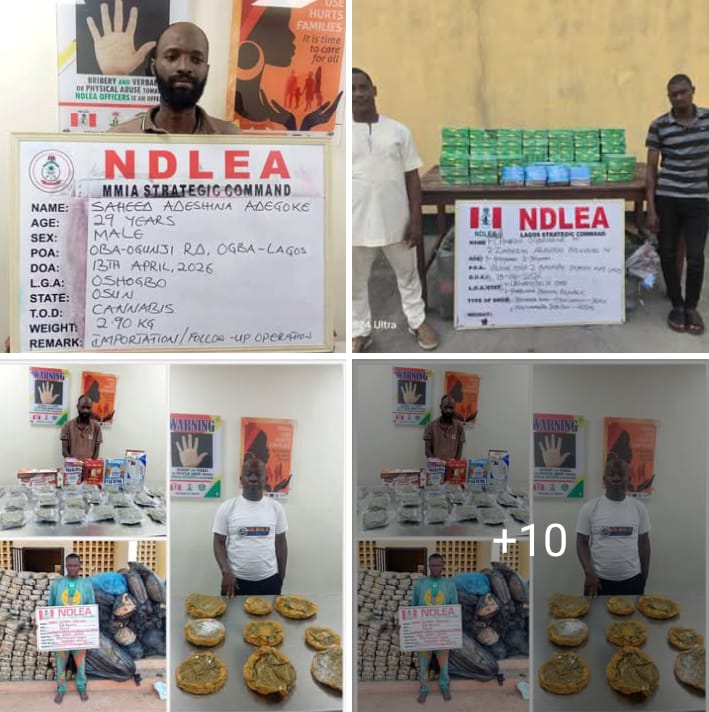
Operatives of the National Drug Law Enforcement Agency (NDLEA) have intercepted 12 parcels of cocaine concealed in the false bottoms of food flasks destined for the United Kingdom via a Virgin Atlantic flight from the Murtala Muhammed International Airport, Ikeja, Lagos.

The cocaine consignment, weighing 2.80 kilograms, was seized on April 9, 2026, by NDLEA officers at the airport’s export shed. Two cargo agents, Ama Obinna Ufeim, 33, and Ogabi Monday Akorede, 39, were arrested in connection with the attempted shipment. Further investigations led to the arrest of the alleged sender, 52-year-old freight forwarder Agoro Tajudeen Moninuola, during a follow-up operation.

In a separate operation a day earlier, NDLEA operatives at the import shed intercepted 2.90 kilograms of “Loud,” a potent strain of cannabis, hidden in snack packs on a Delta Airlines flight from the United States. Two clearing agents, Animashaun Moshood Adetunji and Mercy Gabriel Oluwasegun, were initially arrested, while the consignee, Saheed Adeshina Adegoke, a 29-year-old fashion designer, was later apprehended at his residence in Ogba, Lagos.
Outside Lagos, NDLEA operations recorded major seizures across several states. In Kaduna, officers on patrol along the Kaduna-Zaria highway intercepted a truck conveying cement to Jigawa State. A search uncovered 760 blocks and 33 jumbo bags of skunk, weighing 847 kilograms.

The driver, Umar Garba Haruna, 33, was arrested.
In Cross River State, a 53-year-old suspect, Alice Sunday Udoh, was apprehended after NDLEA operatives, supported by soldiers, raided a cannabis farm in Uwet community, Akamkpa Local Government Area. During the raid, 15,000 kilograms of cannabis cultivated on six hectares were destroyed, while 119 kilograms were recovered.
Similarly, in Edo State, operatives raided a cannabis farm in Saboro camp, Ovia North East LGA, destroying 2,281.43 kilograms of the substance. Three suspects—Nweke Smart, 27; Christopher Egbe, 62; and Monday Ayan, 45—were arrested. Additional arrests were made in Delta State, where two suspects were caught with 87.838 kilograms of skunk and seeds.

Back in Lagos, NDLEA operatives arrested two suspects, Chinedu Ogbekene and Zindozin Aloukou Bienvenu, along the Mile 2–Badagry Expressway while attempting to transport 11,900 capsules of tramadol and 400 ampoules of phenobarbital injection to Ghana. On the same day, officers raided a building in Lagos Island, recovering 95.8 kilograms of cannabis.

The agency also intensified its War Against Drug Abuse (WADA) sensitization campaign across the country, conducting awareness programmes in schools, workplaces, and communities, including institutions in Niger, Cross River, Kogi, Katsina, Kano, and Lagos States.

NDLEA Chairman and Chief Executive Officer, Mohamed Buba Marwa, commended officers across various commands for their efforts in drug supply reduction and public sensitization, urging them to sustain the momentum in ongoing operations.

Omokri Warns Against Politicising Religious Platforms, Calls for Clear Separation

0


A former presidential aide, Reno Omokri, has cautioned religious leaders against turning places of worship into platforms for political campaigning, warning that such practices could destabilise Nigeria’s fragile social balance.

In a strongly worded statement sent on his Facebook page, Omokri argued that mosques, churches, and other religious centres should remain dedicated to spiritual guidance rather than partisan politics.

He said Nigeria would be “much better, stabler, and more secure” if clerics focused on preaching and moral instruction instead of endorsing or condemning political candidates during sermons.

While acknowledging that religious leaders have a responsibility to speak against corruption and moral decline, he stressed that openly directing congregants on how to vote or demonising opposing political parties and religions goes beyond their core mandate.

Omokri maintained that clerics who wish to engage in politics should do so outside religious settings, urging them to separate their spiritual roles from political ambitions.

According to him, blending religion and politics in a multi-religious and multi-ethnic society like Nigeria could create tension and heighten the risk of conflict.

He further described places of worship as sanctuaries meant to provide peace and inclusivity, warning that turning them into arenas for political attacks could provoke retaliatory messaging from leaders of other faiths, thereby escalating divisions.

The former aide also emphasised the importance of respecting institutional boundaries, noting that elections are the proper avenue for leadership selection, while the judiciary exists to resolve disputes.

He warned that clerics who use sermons to call for the resignation of elected officials without broader public consultation risk overstepping their roles.

Reaffirming Nigeria’s democratic identity, Omokri concluded that the country must avoid drifting toward a theocratic system, urging all stakeholders to respect the distinct functions of religion and governance.

CSO gives IGP 24-hour ultimatum to release Hammed Akanbi

0


Civil society Organisation has raised concern over a disturbing sequence of events that point to an alleged high-level conspiracy within the Nigeria Police Force led by Jimoh Moshood Olorundare (AIG Zone 2), targeted at Mr. Hammed Tajudeen Akanbi.

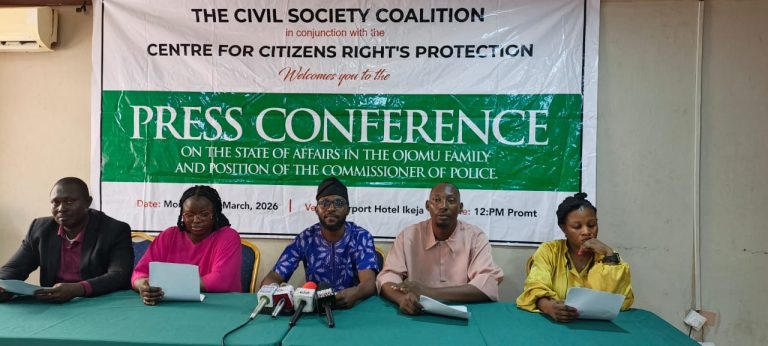
The CSO in a press conference addressed by its leader Com Kolawole Emmanuel , gave the Inspector General of Police a 24-hour ultimatum, demanding the immediate transfer of Mr. Hammed Tajudeen Akanbi to a neutral and independent investigative unit and unrestricted access to his legal representatives and family members.

It said: “Our findings reveal that this matter is not isolated but deeply rooted in the long-standing crisis within the Ojomu Royal Family of Ajiran in Eti-Osa Local Government Area of Lagos State; a crisis that predates the tenure of Jimoh Moshood Olorundare as Commissioner of Police, Lagos State.

“At the core of this crisis is the control and allocation of vast ancestral lands spanning over 22 communities. This dispute has polarised the community into factions: those aligned with the Kabiesi and those loyal to Mr. Hammed Tajudeen Akanbi, who serves as Chairman of the Youth Wing of the Ojomu Royal Family.

“A troubling dimension emerged with the alleged ambition of Bashir Fakorede to ascend the Ojomu stool while the current monarch remains alive. Credible allegations indicate that Bashir Fakorede identified Mr. Akanbi as the principal obstacle to this ambition and openly declared his intention to “crush” him.

“It is further alleged that Bashir Fakorede enlisted the support of Muiz Banire (SAN), who purportedly assured him of leveraging institutional connections, including the office of the Attorney General of Lagos State, to ensure the prosecution and conviction of Mr. Akanbi.

“In furtherance of this alleged scheme, Bashir Fakorede reportedly conspired with Jimoh Moshood Olorundare who was then the Commissioner of Police, Lagos State, now Assistant Inspector General (AIG) Zone 2.

“It is alleged that inducements, including four plots of land at Chevron Drive valued at about ₦1.2 billion, were offered to Jimoh Moshood to secure cooperation in orchestrating Mr. Akanbi’s arrest and eventual elimination.

“Subsequently, a previously investigated and resolved murder allegation was resurrected under questionable circumstances. Individuals were allegedly arrested at random and coerced into making incriminating statements falsely linking Mr. Akanbi to the death of one Sheriff Salami.

“Despite Mr. Akanbi being outside Nigeria on medical grounds, he was declared wanted on 19th February 2026 by Jimoh Moshood Olorundare, a move widely regarded as procedurally defective. This declaration allegedly triggered sponsored acts of violence, including the destruction of his property in Ajiran.

“Legal proceedings initiated by Mr. Akanbi at the Ikeja High Court (Suit No: ID/21447MFHR/2026) challenged this action. Notably, an earlier arrest and remand order obtained through Charge No: Misc/60A/2026 was set aside by the same court due to misrepresentation and concealment of material facts.

“A subsequent application (Charge No: MISC/126/2026) was also refused, with the court directing proper procedure upon his return.

“Following a petition dated 23rd February 2026, the Inspector General of Police directed that the matter be transferred to the X-Squad, FCID, Alagbon. However, in a controversial turn of events, Jimoh Moshood Olorundare, now AIG Zone 2, allegedly insisted on retaining control over the matter.

“Following the clear directive of Court in charge no: MISC/126/2026 that proper procedure be followed by inviting Mr. Akanbi, he was enroute Nigeria from France through Benin Republic when he was eventually arrested in the Benin Republic but the Police on the claim that they have information that he was declared wanted by Jimoh Moshood.

“He was thereafter transferred to Nigeria on 17th April 2026. Since then, he has allegedly been subjected to degrading and inhumane treatment, including:

“Being publicly exposed in handcuffs by associates linked to Bashir Fakorede, particularly one Rukayat Omolara who is alleged to have over the internet with the photographs and video of Akanbi in hand and leg chain, a recording she made while he was in custody of Jimoh Moshood; denial of access to legal counsel and family; interrogation in the presence of individuals allegedly linked to the law firms of Muiz Banire (SAN) and Olumide Fusika (SAN), who are not law enforcement officers; personal supervision of his detention by Jimoh Moshood Olorundare, including signing detention orders and placing him in a private cell at SCID Panti; continuous use of hand and leg restraints while in custody.

“Most alarming are intelligence reports suggesting a deliberate plot to poison Mr. Akanbi with substances designed to cause delayed fatal consequences after release.

“These actions, if proven, constitute egregious violations of the Constitution of the Federal Republic of Nigeria and fundamental human rights protections.

“In light of the foregoing, we hereby issue a 24-HOUR ULTIMATUM to the Inspector General of Police demanding: the immediate transfer of Mr. Hammed Tajudeen Akanbi to a neutral and independent investigative unit; unrestricted access to his legal representatives, family members, and medical professionals; a thorough, transparent, and independent investigation into the roles of all officers and individuals implicated, particularly Jimoh Moshood Olorundare; full compliance with subsisting court rulings and strict adherence to due process.

“Failure to comply within 24 hours will compel us to escalate this matter through all lawful protest and institutional mechanisms, including judicial actions, petitions to oversight bodies, and coordinated civil advocacy at both national and international levels.

“This is a defining moment for the rule of law in Nigeria. We call on the Inspector General of Police to act decisively and restore public confidence in the integrity of the Nigeria Police Force.”