Home Blog Page 240

Olubadan Ladoja installs four new Mogajis, warns against land grabbing, drug abuse

0


His Imperial Majesty, the Olubadan of Ibadanland, Oba (Dr.) Rasidi Adewolu Ladoja, Arusa I, has installed four new Mogajis to oversee their respective family compounds in Ibadan.

The installation ceremony was held at the Banquet Hall of the Olubadan Palace, Oke Aremo, Ibadan, on Monday.

In his installation message delivered by the Ekerin Balogun of Ibadanland, Oba Akeem Mobolaji Adewoyin, Oba Ladoja congratulated the newly installed Mogajis on their elevation to their new traditional positions.

The Olubadan, however, warned the new Mogajis against engaging in activities capable of tarnishing the image of the Olubadan institution and Ibadanland.

He specifically cautioned them against land grabbing, hatred, vendetta, drug abuse, corruption and other forms of criminality, stressing that they would be held responsible for criminal acts committed within their respective domains.

According to him, the Mogajis are representatives and ambassadors of the Olubadan wherever they operate and must conduct themselves in ways that promote the dignity of the traditional institution.

“You are my ambassadors anywhere you are. Consequently, you should key into my vision of taking Ibadanland to a greater height,” the Olubadan said.

Oba Ladoja also charged all traditional rulers in Ibadanland to preserve and promote the traditional and cultural values of the ancient city.

He noted that the primary responsibility of any properly installed or coronated traditional ruler was to uphold, preserve and promote the cultural heritage of his people.

The newly installed Mogajis are Olusegun Emmanuel Ogunyemi of Ogunwelu Compound, Oke-Adu area, Ibadan North-East; Akeem Olalekan Alade of Oju-Abere Compound, Inalende, Ibadan North-West; Aderinto Adesoji of Sangodeyi Ikuola Compound, Idi-Arere, Ibadan South-West; and Adewale Idowu Akanmu Abonde of Abonde Compound, Ibadan North-East Local Government Area.

The ceremony was attended by several members of the Olubadan-in-Council and other traditional leaders, including the Otun Olubadan of Ibadanland, Oba (Sir) Eddy Oyewole; Otun Balogun, Oba (Dr.) Kolawole Adegbola; Ashipa of Ibadanland, Oba Salawudeen Amidu Ajibade; Ashipa Balogun, Oba Dauda Abiodun Azees; Ekerin Balogun, Oba Akeem Mobolaji Adewoyin; and Ekarun Balogun, Oba Sarafadeen Abiodun Alli.

Representatives of the Iyalode Line, Mogajis, Baales and other traditional stakeholders also attended the installation ceremony.

Sun

Lagos Assembly Congratulates Oba Akiolu on 23rd Coronation Anniversary

0


The Lagos State House of Assembly has congratulated the Oba of Lagos, His Royal Majesty, Oba Rilwan Babatunde Osuolale Akiolu, CFR, on the occasion of his 23rd coronation anniversary.

The lawmakers, during plenary on Monday, described the monarch’s 23-year reign as one characterised by dedicated service, honour and an unwavering commitment to the development and unity of Lagos State.

The Speaker of the House, Rt. Hon. Mudashiru A
Obasa, acknowledged Oba Akiolu’s longstanding service to the state and commended his commitment to the people of Lagos, even before ascending the throne.

Obasa noted that the monarch’s contributions to the state could be traced to his distinguished career in the Nigeria Police Force, where he rose to the rank of Assistant Inspector-General of Police (AIG) before retiring from active service.

The Speaker also expressed appreciation to the Oba for his continued support for the Lagos State House of Assembly and his contributions to the peace, stability and development of the state.
He described Oba Akiolu as a man of honour who continues to play a significant role in the affairs of Lagos State.

The Majority Leader of the House, Hon. Noheem Adams, also congratulated the monarch and prayed for his continued good health, wisdom and longevity.

Similarly, Hon. Kehinde Joseph commended Oba Akiolu for his contributions to the development of Lagos, particularly during the period when the Federal Government under former President Olusegun Obasanjo withheld the statutory allocation due to the state.

Joseph recalled that the monarch stood firmly with the Lagos State Government during the period and contributed to efforts that eventually led to the resolution of the matter, in collaboration with the then Governor of Lagos State, Asiwaju Bola Ahmed Tinubu, who is now President of Nigeria.

Other lawmakers who spoke during the plenary described Oba Akiolu as a straightforward and forthright traditional ruler, as well as a man of honour who had served the people of Lagos diligently and continued to do so.

Following the tributes, Speaker Obasa directed the Clerk of the House, Mrs. Adenike Oshinowo, to convey the Assembly’s congratulatory message to the Oba of Lagos in a formal letter.

WHO APPOINTED US GOD’S DEPUTIES

0


By Akin Fadeyi

A very close friend of mine recently gave her daughter a beautiful wedding in Abuja. Classy. Joyful. Well attended.
My two friends, Ademola H Adigun, energy policy expert, and Adejoke Stephanie Alabi, Woman Editir, the Leadership Newpaper were there. It was the kind of wedding where parents look at the child they raised, remember the years, the prayers, the worries, the school fees, and then, the occasional stomach-butterfly moments of, “Hey God, this child is making me proud”. —and the day finally came to say: Today, let us celebrate. Then somebody saw the pictures. A “Christian sister” in faraway London. Thousands of kilometres away, she saw pictures and videos on another person’s WhatsApp status and immediately constituted herself into a one-woman Supreme Court on Christian Morality. No lawyer. No witnesses. No right of appeal. But judgment commenced immediately. “Why were they lavishing money like that?” “It is very ungodly.” Oh, they were playing worldly music!” “Haha! Christians should not behave like this.” “They were showing off.” Then came the nuclear weapon: “I am ashamed of the mother of this bride!” Haaaaa! Ashamed of another adult for spending money you did not contribute, at a wedding you did not organise, and for a daughter you did not raise? My friend’s husband, by all standards is extremely affluent and financially net-worthy. He and his wife worked hard, raised their children intentionally and decided to celebrate their daughter beautifully. My friend herself is remarkably kind and loved by many. The crowd at that wedding was perhaps as much an affirmation of relationships built over decades as it was a celebration of money. But somebody looked at a few WhatsApp videos from London. She could not stand the positive energy, the unbounded joy and the excitement that rented the air. As far as she was concerned, she had obtained enough evidence to audit another person’s “Christianity”. And it got me thinking: At what point does faith end and hubris begin? When does personal conviction quietly become spiritual superiority? And who, exactly, appointed some of us God’s deputies? THE PEOPLE WHO FOLLOWED A STAR There is an irony inside one of Christianity’s most beloved stories. According to Bible account in the book of Matthew 2;11, Magi, from the East saw a celestial sign and travelled in search of the child Jesus. They came bearing expensive gifts: Gold. Frankincense. Myrrh and they bowed before the child while delivering the gifts. And after being warned in a dream not to return to the hostile King Herod, they went home through another route. The precise identity of the Magi has been debated for centuries, but they are associated with an ancient, learned tradition in which observation of the heavens and astrology were intertwined. Now imagine some of today’s Christians transported backwards into Bethlehem. “Astrologers ke?” “Following stars?” “Wetin den de find?” “Blood of Jesus!” “A beg, no bring those kin people near this child o!” “Frankincense from where? I cast and bind it!” Yet, this well founded history, recorded in the Bible we read every day shows people emerging from a knowledge-system many modern believers would instinctively condemn occupy an honoured place inside the nativity story Christians themselves cherish. I think sometimes, we are more religious than the history of our own religion. And that brings me home. This same hubris we witnessed from our “sister” in London shapes how many Africans treat practitioners of Ìṣẹ̀ṣe and other traditional religions with contempt. We ridicule them and call them primitive. We describe their rituals as demonic. Some of us have even allocated them accommodation in hell—as though heaven outsourced celestial real estate to our denomination. An Ìṣẹ̀ṣe practitioner performs a ritual and somebody screams: “Ritual! God forbid!” Wait first. Which major religion has no rituals? Prayer is ritual. Fasting is ritual. Baptism is ritual. The Eucharist is ritual. Pilgrimage is ritual. Sacred meals are rituals. Incense, purification, holy days, special garments and communal prayers are rituals. Judaism has rituals. Christianity has rituals. Islam has rituals. Hindu traditions have rituals. African traditional religions have rituals. The fact that my ritual is familiar to me while yours looks strange does not automatically make mine holy and yours demonic. Familiarity is not theology. And unfamiliarity is not evil. Religion has always been bigger and more complicated than the tiny geographical corner from which each of us encounter God. So why do we Africans sometimes behave as though we understand religion better than the civilizations through which the religions we embraced travelled to us? Perhaps we need less pontification. More curiosity. Less condemnation. More humility. Let me enter another room. An uncomfortable one. In 2 Kings 2:23–24, Prophet Elisha was travelling towards Bethel when a group of youths mocks him. “Go up, baldhead!” “Go up, baldhead!” Elisha turns, curses them in the name of the Lord, and two female bears emerge from the woods and mauled forty-two of them. Forty-two. The passage doesn’t say all forty-two died. But even without exaggerating it, that is a startling story. Yet, when believers encounter difficult passages like this in their own sacred tradition, what do we do? We seek context. Theology. Interpretation. History. Meaning. We don’t immediately conclude: “What a barbaric religion! Ban Christianity!”. Because Elisha was a prophet, we quickly grant the “touch not my anointed” immunity. We allow ourselves the indulgence of sacrificing morality for dogma. We seek to “forgive and forget” what our collective consciousness is interrogating as horrifying, because once religion is involved, we do not challenge status quo. Why then, when we encounter something difficult in another person’s spiritual tradition, does context and objectivity suddenly become avoidable? Why does our complexity become theology, but their complexity becomes barbarism? That is not discernment. That is a double standard wearing religious robes. And please don’t misunderstand me. I am NOT saying every practice should be accepted because somebody attaches “culture” or “religion” to it. No. Any practice—Christian, Muslim, traditional or otherwise—that violates law, human dignity or another person’s rights should be challenged. But disagreement does not require contempt. Conviction does not confer a licence to humiliate. The Apostle Paul says something fascinating in 1 Corinthians 9.19-22 To the Jews, he became as a Jew. To those under the law, as one under the law. To those outside the law, as one outside it—while remaining accountable to God. To the weak, he became weak. Why? Because Paul understood something about human beings that many of today’s religious warriors appear to have forgotten which is: You cannot reach people whose humanity you have first denigrated. You cannot persuade people you refuse to understand. You cannot begin every conversation with: “I am right. You are lost. Now listen to me.” That is not evangelism. That is arrogance with a microphone. Now let us come to Nigeria Our country fascinates me. We carry beautiful Christian names. Beautiful Muslim names. Our streets are dotted with churches and mosques from bus stop to bus stop. Friday, everywhere full. Sunday, everywhere full. Night vigils. Tahajjud. Crusades. Conventions. Prayer mountains. Religious television morning, afternoon and night. Yet the traditional LÉKULÉJA industry continues to thrive and expands. So I have one innocent question: Who are the customers? Ghosts? The answer is simple: Somebody shouting “Holy Ghost fire!” publicly may be making enquiries somewhere else privately. Somebody condemning traditional religion in daylight may be consulting one practitioner after sunset. Human beings are more complicated than the religious labels on our social-media biographies. People search for meaning. They search for hope. They search for healing. They search for answers and they often remain where experience persuades them that they found something soothing and that grants them an unprecedented sigh of relief. Faith, family, fear, culture, history, desperation, hope and personal experience intersect in ways far more complicated than our public declarations admit. Which is why this idea that everybody who isn’t Christian, Muslim—or even a member of our own particular denomination or sect—must be morally inferior should have no respectable place in our collective consciousness. And this is where i return to the wedding Perhaps my friend’s wedding was a showcase of wealth. Maybe our “concerned” Londoner would have spent one-tenth of what they spent. Perhaps another Christian would not have played the music they played. Fine. But please remember: Your conscience is not a universal remote control. God created us in varieties. He did not clone us one prototype after another like robotic shigidis (carved wood) You may practise austerity without despising celebration. You may worship Jesus without humiliating the Ìṣẹ̀ṣe practitioner. You may follow Islam without dehumanising the Christian. You may embrace traditional spirituality without mocking the Muslim. And you may reject religion entirely without treating believers as intellectually defective. If societies want old practices to disappear, sustainable change comes through education, dialogue, review of encumbering laws, community leadership, generational negotiation and time. Cultures evolve. Beliefs evolve. Interpretations evolve. Even religious institutions evolve. But arrogance shuts the very door through which persuasion needs to enter. Civilization begins where conviction learns manners. The world has suffered enough from people who believed possessing truth entitled them to deny everybody else dignity. So please, believe deeply. Worship sincerely. Preach passionately. Question boldly. Disagree vigorously. But leave some room for humility. Leave some room for the possibility that the Creator of billions of human beings, thousands of cultures and centuries of human searching may be slightly larger than the tiny window through which you and I have encountered Him. Maybe spiritual maturity is not measured by how loudly we announce that we have found God. Maybe it is also measured by how gently we treat those who say they found Him by another route. And if your faith truly gives you light… why must you extinguish another person’s candle to prove that yours is burning? Where should society draw the line between religious conviction and religious intolerance? It’s not rocket science for us to jettison the self righteous spirit of “dominate and conquer”. James 4:12 says: “There is only one who is Lawgiver and Judge, the one who is able to save and to destroy. But you, who are you to be judging your neighbor?” Do you understand ? I am sure the Quran also emphasizes peace, right? Worship is not war and God did not appoint us the Chief Judge of his heavenly Federation. Akin Fadeyi

Akin Fadeyi is Behavioral Change Specialist and citizens engagement expert.

Lagos Assembly Moves to Regulate Artisans, Craftsmen, Proposes Regulatory Board

0


BY TAIWO OGUNMOLA -OMILANI

The Lagos State House of Assembly has commenced moves to regulate the activities of artisans and craftsmen across the state with the consideration of a bill seeking to establish the Lagos State Artisans and Craftsmen Regulatory Board.

The bill, titled the “Lagos State Artisans and Craftsmen Regulatory Board Bill 2025,” seeks to provide a legal framework for the registration, training, certification and regulation of artisans and craftsmen operating in Lagos.

Presenting the bill for second reading, the Majority Leader of the House, Noheem Adams, said the proposed legislation was aimed at bringing dignity, order and accountability to the informal sector while protecting consumers from unqualified practitioners.

Adams said Lagos, as Nigeria’s commercial hub, depended significantly on the contributions of artisans and craftsmen to its economy, but noted that the sector had operated for too long without adequate structure, standards and protection.

He said, “Over 70 per cent of our informal economy is driven by the sweat, skill and enterprise of artisans and craftsmen. Yet, for too long, this critical sector has operated without structure, standards and protection.

“This bill recognises a simple truth: to regulate our artisans and craftsmen is to dignify them, to protect our people, and to strengthen the very foundation of our economy.”
He said the proposed board would be responsible for registering, training, certifying and protecting artisans and craftsmen, while also safeguarding consumers who engage their services.

Adams explained that Section 2 of the bill would empower the proposed regulatory framework to regulate, coordinate and standardise the training, certification and professional conduct of artisans and craftsmen operating in Lagos.

He said the provision would help curb quackery by ensuring that practitioners met verifiable standards of competence and safety.
The lawmaker added that the bill would protect consumers by ensuring that they had access to a register of certified artisans, enabling them to verify the competence and professional status of practitioners before engaging their services.
On the functions of the proposed board, Adams said Section 5 would empower it to provide loans and financial assistance to registered artisans and craftsmen under terms and conditions prescribed by the board.

He said registered practitioners would also be linked to government empowerment programmes, soft loans, insurance schemes and skills-upgrading initiatives designed to improve their competitiveness and enable them to meet global standards.
He further said the board would maintain a comprehensive register of qualified artisans and craftsmen across the State.

“For the first time, the government will have reliable data on the size, location and needs of our artisans,” he said.

According to him, the board would also be empowered to receive complaints from members of the public concerning the activities of artisans and craftsmen and take appropriate action.
Adams said formal registration would promote accountability and assist law enforcement agencies in addressing criminal activities associated with the sector.

“Registration creates accountability. It reduces crime, makes it easier to track stolen goods, and gives law enforcement a verifiable database of practitioners across local governments and LCDAs,” he said.

He also highlighted provisions relating to the protection of artisans and craftsmen, noting that the powers of the proposed board were contained in Section 6 of the bill.

The Majority Leader said the bill contained safeguards against arbitrary exercise of power by the regulatory board. He cited Section 19(1) and (2), which provide for oversight and directions concerning the operations of the board, including the power of the governor to issue directions of a general or specific nature regarding the discharge of its functions.

Adams urged his colleagues to support the bill, describing it as an important step towards formalising the artisans and craftsmen sector, protecting consumers and creating opportunities for practitioners to access government support.

However, lawmakers who debated the bill at plenary called for amendments to address concerns bordering on environmental safety, the composition of the proposed board, certification, registration fees, age requirements and possible overlap with existing vocational training agencies.
Representing Oshodi/Isolo 1, Stephen Ogundipe, commended the sponsors of the bill, particularly the provisions empowering the proposed board to handle licensing and renewal of licences.
Ogundipe said proper licensing would help reduce disputes between clients and artisans, while clear identification and recognition of registered artisans would enable members of the public to distinguish qualified professionals from unskilled practitioners.
He urged the Assembly to give the bill speedy consideration, describing it as legislation that could improve standards within the sector.

Also speaking, Adebola Shabi raised concerns about environmental hazards associated with some artisanal activities, particularly welding.

He urged the lawmakers to ensure that environmental safety was incorporated into the regulatory framework, noting that some artisans might unknowingly create hazards in the course of their operations.
Shabi also suggested that the Lagos State Safety Commission and the Ministry of Environment be represented on the proposed regulatory board, given the bill’s emphasis on safety and professional standards.
Another lawmaker, Lukmon Olumoh, representing Ajeromi 1, said the proposed bill would enable the government to obtain accurate information about artisans and facilitate government support and funding for skilled workers.
However, he sought clarification on a possible overlap between the proposed board and the Lagos State Vocational Education Board (LASVEB), particularly because of LASVEB’s role in vocational training and certification.
Another lawmaker, Femi Saheed, representing Kosofe 2, said certification was crucial to establishing the competence of skilled workers.

He, however, questioned the qualification requirements for the proposed chairman of the board, noting that while the bill stipulated experience requirements for some members, it did not clearly state the academic qualifications expected of the chairman.

Similarly, Kehinde Joseph, representing Alimosho 1, suggested that the minimum age for registration as an artisan be reduced from 18 to 16 years, arguing that many young people begin acquiring vocational skills at an early age.
He also urged the Assembly to scrutinise the proposed registration fees under Section 33 to ensure that the regulatory framework did not impose excessive financial burdens on artisans.

Responding to the contributions, the Speaker of the Assembly, Mudashiru Obasa, commended the lawmakers for supporting the bill, describing it as an important piece of legislation with implications for several sectors of the state.
Obasa said proper regulation of artisans could contribute to security, economic growth, employment generation and increased internally generated revenue for the state.
He noted that creating a comprehensive database of artisans would help the government identify and monitor people operating in the sector, thereby improving security.

According to him, the database would also enable the government to better understand the size and capacity of the artisanal workforce and develop policies capable of supporting its growth.

The Speaker said Lagos should explore ways of bringing informal, “over-the-counter” artisans into the formal regulatory system, noting that their registration could also broaden the state’s revenue base.
On calls for government funding and support for artisans, Obasa urged caution, stressing that any financial intervention must be properly structured to avoid creating additional challenges for the government.

He also emphasised the need to leverage technology and partnerships to expose Lagos artisans to advanced skills and international opportunities.

Obasa said linking local artisans with counterparts in technologically advanced countries could help improve their skills, productivity and competitiveness in the global market.

He cited countries such as China and Taiwan as examples of economies that had developed their technical and manufacturing capacities and successfully penetrated international markets.
He said the proposed legislation could therefore provide a platform for Lagos to develop its artisans and integrate them into broader economic and technological development programmes.

Following the debate, the bill was committed to the House Committee on Commerce and Industry for further legislative scrutiny and to report back to the Assembly.
Lagos Assembly Urges Stronger Security, Prosecution of Those Behind Infrastructure Vandalism

0


BY TAIWO OGUNMOLA -OMILANI

The Lagos State House of Assembly has called on the state government to strengthen security across the state and intensify efforts to curb the vandalisation of public infrastructure.

The lawmakers also urged the government to go beyond arresting suspected vandals by identifying and prosecuting individuals and businesses that buy, sell and profit from vandalised public property.

Speaking during plenary on Monday, the Speaker of the House, Mudashiru Obasa, urged the state government to ensure that perpetrators of infrastructure vandalism and their collaborators were appropriately dealt with.

Obasa also called on relevant ministries and agencies responsible for enforcing environmental and infrastructure-related laws to ensure that such laws were properly disseminated and effectively implemented.

The House further urged the government to strengthen the activities of local security outfits, including the Neighbourhood Watch, as well as other enforcement agencies, by providing them with adequate equipment, training and resources.

The call followed a motion moved by Mr Aro Moshood, who expressed concern over the increasing vandalisation of Lagos State infrastructure and other public facilities.

Moshood said it was disturbing that public facilities provided with taxpayers’ money were being vandalised, thereby imposing additional financial burdens on residents.

He said, “It baffles me that some residents of Lagos ought to be experiencing this kind of situation, knowing that we are paying for these facilities with our money.”

The lawmaker also called for closer scrutiny of individuals and businesses purchasing scraps from suspected vandals, noting that those involved in the illegal trade should be investigated.

According to him, persons arrested for vandalising public infrastructure should not be released without proper prosecution and, where found guilty, should be sentenced accordingly.

“Public funds are being used to provide these facilities, and when they are damaged or vandalised, public funds are again required to repair them. This places an additional burden on taxpayers,” he said.

Moshood stressed the need for the state government to put proper measures in place to protect public infrastructure and ensure that residents could effectively utilise the facilities provided for them.

He urged the government and relevant authorities to develop sustainable measures to tackle the menace.

Moshood also called for greater collaboration among government agencies, saying citizens and their representatives must take the issue seriously.

“We, as citizens and representatives of the people, need to take this matter seriously. All the relevant agencies need to sit down, collaborate and respond appropriately to these challenges,” he said.

Contributing to the debate, Lawal-Olumegbon said the state government should work closely with all local government areas to address the problem effectively.
Similarly, Ogundipe noted that the vandalisation of public infrastructure was affecting constituencies across the State.

He called for greater collaboration among relevant government agencies and enforcement authorities to bring the menace to an end.

PENGASSAN President: Refineries Were Shut Down Over Losses, Not Because They Were Not Functioning

0


BY TAIWO OGUNMOLA -OMILANI

The outgoing President of the Petroleum and Natural Gas Senior Staff Association of Nigeria (PENGASSAN), Comrade Festus Osifo, has said Nigeria’s refineries were shut down primarily because they were operating at a loss, rather than because they were incapable of functioning.

Osifo made the disclosure while speaking on the state of the country’s refineries and the association’s contributions to the oil and gas industry during a chat with labour writers on Monday in Lagos.

According to him, for many years, Nigerians were repeatedly told about rehabilitation and turnaround maintenance of the Port Harcourt, Warri and Kaduna refineries, but little actual work was done until 2021.

He said the situation changed when rehabilitation contracts were signed, particularly for the Port Harcourt Refinery.
“Until what started happening in 2021, if you interview somebody or people that have worked in Port Harcourt, Kaduna and Warri refineries 15 years before 2021, they will all tell you that they have never seen any rehabilitation or any turnaround maintenance compared to what they’ve seen from 2021,” Osifo said.

He explained that the rehabilitation of the Port Harcourt Refinery was extensive, describing the facility at the time as resembling a construction site.
According to him, about 90 to 95 per cent of PENGASSAN members working at the refinery were transferred to different strategic business units (SBUs) of the Nigerian National Petroleum Company Limited (NNPC Ltd.) during the rehabilitation.

Osifo said the old Port Harcourt Refinery was eventually separated from the new facility because a critical component required for the new refinery had a delivery lead time of about three and a half years.

He explained that the old refinery could produce products such as Automotive Gas Oil (AGO), Dual Purpose Kerosene (DPK) and aviation fuel, but could not produce Premium Motor Spirit (PMS) to the required specification without further processing.

He said the decision to decouple the old refinery from the new one paved the way for the old facility to resume production.
However, Osifo said the subsequent management of NNPC Ltd. discovered that the refinery was not economically viable because the value of crude fed into it was not commensurate with the value of the products being produced.

“The refineries were actually shut down, not that they were not functioning. Most of the time, the old Port Harcourt refinery and even the Warri refinery were actually shut down because they were losing money,” he said.

He likened the situation to a farmer spending N2 million to plant tomatoes but eventually getting products worth only N1.7 million, saying such a business would require reassessment to identify and block the loopholes causing the losses.

On the proposed partnership involving NNPC Ltd. and Chinese investors, Osifo said PENGASSAN supports the move, describing it as being in the right direction.
He said the association had consistently advocated the adoption of an equity partnership model similar to that of Nigeria LNG Limited (NLNG), with private investors taking a controlling stake while government retains a minority interest.

According to him, Chinese companies being brought into the refinery arrangements are expected to become equity partners rather than merely maintenance contractors.
Osifo said PENGASSAN would prefer investors to acquire up to 51 per cent equity while government retains 49 per cent, arguing that such an arrangement would reduce government interference and ensure that business decisions are driven by commercial considerations.

He said the model would also attract investment, improve the sustainability of the refineries, create jobs and enhance Nigeria’s energy security.

On the association’s relationship with journalists, Osifo acknowledged the critical role played by labour writers, editors, correspondents and advocates in promoting workers’ welfare and shaping society.

He said PENGASSAN recognised the difficult environment facing Nigerian workers, including labour journalists, and expressed confidence that the partnership between the union and the media would grow stronger under its incoming leadership.

“We can’t do it alone. So we need stakeholders, we need partners that will continuously foster that relationship together,” he said.
Osifo also highlighted what he described as the achievements of the outgoing Central Working Committee (CWC), particularly in protecting workers’ jobs and improving remuneration.

He said the union successfully protected the jobs of its members despite several divestments in the oil and gas industry.
According to him, workers were retained during transactions involving the divestment of ExxonMobil’s joint venture, Shell’s joint venture, Agip’s joint venture and other assets.

He said PENGASSAN not only protected jobs but also ensured that workers’ remuneration was maintained and improved.
“Our objective was clear: How do we protect the job of our members, and how do we enhance their pay?” Osifo said.

He added that the level of remuneration in Nigeria’s oil and gas industry had reached a new height under the current leadership.
Osifo also spoke about the union’s engagement with the Dangote Refinery, saying PENGASSAN had been able to resolve issues involving workers and ensure that about 600 affected employees returned to work at the refinery.

He said the union had chosen to engage management constructively rather than allow the matter to escalate publicly.
According to him, the affected workers are currently back at the refinery and contributing to its continued operation.
Osifo reaffirmed PENGASSAN’s commitment to protecting companies and workers within Nigeria’s oil and gas industry, saying the union would continue to work with stakeholders to ensure the growth and sustainability of the sector.

Gombe: Yahaya appoints 19 permanent secretaries

0


Governor Muhammadu Inuwa Yahaya of Gombe State has approved the appointment of 19 new Permanent Secretaries to fill vacancies in the state civil service and strengthen administrative capacity across government ministries.

The Head of the Civil Service of the State, Prof. Mu’azu Shehu, announced the appointments on Monday, saying the decision followed a shortage of Permanent Secretaries and the recent creation and restructuring of ministries by the state government.

Shehu said the appointments would provide the affected ministries with competent administrative leadership and enhance their capacity to deliver on their mandates.

According to him, the government considered geographical spread, professional experience, competence and the specific requirements of the ministries in selecting the new Permanent Secretaries.

He said the appointees were drawn from 11 local government areas and had demonstrated satisfactory performance, professionalism and commitment throughout their careers.

“The officers were carefully assessed and found suitable to occupy the positions, having acquired relevant experience and demonstrated commitment, professionalism and capacity in their respective areas of service,” Shehu said.

He added that the officers’ satisfactory performance ratings and clean service records formed the basis for their elevation to the Permanent Secretary cadre.

The newly appointed Permanent Secretaries are Haruna Mohammed Danburam and Mohammed Auwal Ahmed from Akko; Alheri Yoriyo and Haruna Bello Gelengu from Balanga; Ruth Caleb Maina from Billiri; Auwal Abduljalal and Kasimu Umar from Dukku; and Musa Muhammad Babaji and Adamu Audi, Esq., from Funakaye.

Others are Dr Hadi Mohammed and Ali Yaya Ahmed from Gombe; Kabiru Mohammed Mahdi from Kwami; Balarabe Musa and Tabitha B. James from Kaltungo; Haruna Dadum Hamza, PhD, and Ibrahim Mohammed Gombe from Nafada; Tahir Adamu Sadiq from Shongom; and Shuai’bu Chiroma Muhammad and Musa Idi Batari from Yamaltu-Deba.

Governor Yahaya charged the new Permanent Secretaries to deploy their experience and professional competence towards building a more responsive, efficient and results-oriented civil service.

Sun

Customs intercepts N3.24bn worth of hard drugs, elephant tusks, others

0


Customs intercepts N3.24bn worth of hard drugs, elephant tusks, others
The Nigeria Customs Service (NCS) Federal Operations Unit Zone ‘A’ (FOU ‘A’), Ikeja, has intercepted 220 consignments of prohibited and smuggled goods valued at N3.24 billion in Duty Paid Value (DPV), while recovering N728.976 million in revenue.

The smuggled goods include hard drugs, elephant tusks, imported rice, petroleum products and other prohibited items.

In a statement issued on Monday by the Unit’s Public Relations Officer, Hussaini Abdullahi, the NCS said the operation, anchored on sharpened risk profiling, rigorous compliance checks and targeted strikes against suspicious declarations, underscores the Unit’s commitment to protecting local industries, securing government revenue and keeping Nigeria’s trade corridors free of contraband.

“The seizures recorded during the period include 4,956 bags of foreign parboiled rice weighing 50kg each, equivalent to eight trailer loads; 12 foreign-used vehicles; 2,683 parcels of synthetic cannabis (Sativa) weighing 1,439.9kg; 49 parcels of Ghanaian Loud weighing 26.1kg; one parcel of crystal methamphetamine weighing 0.35kg; 13 parcels of granular cannabis weighing 1.35kg.

“Others are 240,000 tablets of Tramadol; 12,000 tablets of Hypnox; 22 pieces of elephant tusks weighing 130.84kg; 964 25-litre jerrycans of Premium Motor Spirit (PMS), equivalent to 24,100 litres; 26 cartons of foreign vegetable oil containing four 5-litre units each; 686 cartons of foreign poultry products; 414 bales of used clothing; and 2,947 pieces of used tyres, among other prohibited and smuggled items intercepted through intelligence-led operations,” the statement read in part.

However, the Comptroller of FOU ‘A’, Comptroller Gambo Aliyu, described the revenue recovery as encouraging and reaffirmed the Unit’s determination to identify and recover revenue lost through under-declaration, false declarations and other forms of customs fraud.

He urged importers, exporters and licensed customs agents to ensure accurate declarations and full compliance with extant customs laws and regulations, stressing that the Unit would continue to facilitate legitimate trade while taking decisive action against individuals and businesses engaged in smuggling and revenue evasion.

Furthermore, the Unit stated that the interception of foreign parboiled rice, vegetable oil, poultry products, foreign-used vehicles, used clothing and other prohibited goods would contribute to protecting domestic industries, supporting national food security and safeguarding legitimate government revenue.

Similarly, the interception of illicit drugs, unregulated pharmaceutical products and other controlled substances contributes to protecting public health and preventing the circulation of substances capable of undermining the wellbeing of citizens, particularly young Nigerians.

The recovery of elephant tusks also reinforces the Service’s role in supporting national efforts to combat illegal wildlife trafficking and protect endangered species.

In the same vein, the Comptroller emphasised that the Unit’s enforcement activities are being undertaken within a balanced framework that combines robust border enforcement with trade facilitation.

He attributed the successes recorded during the period to enhanced intelligence gathering, risk profiling, inter-agency collaboration, intelligence fusion, and the cooperation of stakeholders and members of the public.

He assured compliant traders of the Service’s continued commitment to creating a fair, predictable and transparent trading environment, while warning that the Unit would sustain its zero-tolerance approach to smuggling, revenue fraud and other forms of economic sabotage.

To this end, the NCS, through FOU ‘A’, reiterated its commitment to supporting the Federal Government’s economic objectives by protecting domestic production, promoting compliance, facilitating legitimate trade and preventing the entry and circulation of prohibited and harmful goods.

The Unit appreciated the continued support of sister agencies, stakeholders, border communities and members of the public, whose intelligence and cooperation contribute significantly to its enforcement efforts.

Comptroller Aliyu called for sustained partnership from the business community and the general public, noting that collective compliance and vigilance remain essential to consolidating the gains recorded in revenue recovery, border protection, public safety and national economic development.

Sun

Abia: Ikoh backs APC, Tinubu despite primary dispute

0


A governorship aspirant of the All Progressives Congress (APC) in Abia State and former Minister of Science and Technology, Chief Henry Ikoh, has said he is drumming support for the party and President Bola Tinubu ahead of the 2027 general elections despite allegedly being schemed out of the primaries.

Chief Ikoh, who is also the Abia Coordinator of Renewed Hope Ambassadors, stated this when he met with his supporters in Umuahia to thank them for their support during the recent primary election.

Ikoh, noting that what happened during the primaries was “selection instead of election”, however urged his supporters to remain united and loyal to the party and work for the re-election of the President.

He stated that many of his supporters were aggrieved by the outcome of the primaries because they felt their mandate had been denied.

Recall that Ikoh had been announced as the consensus candidate of the party by 13 out of 18 State Working Committee (SWC) members during the primary before Chief Eric Opah was later announced by the party as its candidate for the 2027 Abia governorship election.

Ikoh declared that the APC will take over Abia in 2027, adding that the party remains one formidable family focused on victory.

“My core mandate is to deliver Mr. President and all APC candidates,” he said.

He added that Renewed Hope Ambassadors, Ozurumba Movement, Old Aba Division and other pro-groups must remain committed to the APC.

The former minister said the APC must reconnect with the federal government for Abia’s benefit.

He acknowledged the current hardship in the country but expressed optimism that President Bola Tinubu’s reforms would yield results soon.

He urged Nigerians to be patient, adding that Nigeria would move from a consumption-driven economy to a production-driven one.

The State Organising Secretary of the APC and Isuikwato LGA Coordinator of Renewed Hope Ambassadors, Mr Emeka Okoroafor, commended Ikoh for not compromising his integrity and for calling for support for the party.

Sun

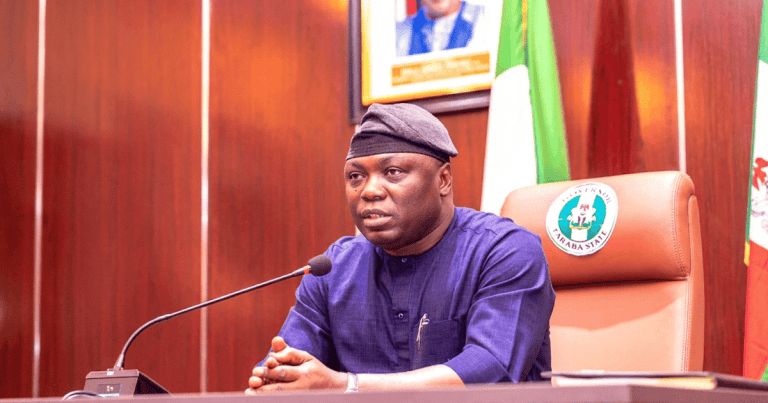
Taraba Govt dismisses ₦N1.2trn debt claims

0

The Taraba Government has dismissed claims that the state borrowed N1.2 trillion within three years.

Addressing newsmen on Sunday in Jalingo, Dr Sarah Adi, the Commissioner for Finance described the figure as inaccurate and misleading.

Adi said that the latest data from the Debt Management Office (DMO), Taraba’s domestic debt stood at N85.51 billion as of Dec. 31, 2025.

“The figure represents a reduction of about N2.45 billion from the N87.96 billion domestic debt recorded in DMO data available before Gov. Agbu Kefas assumed office,

“The DMO publication released in March 2023 reflected Taraba’s debt position as of Sept. 30, 2022, rather than its debt position at the time the report was published.

On external debt, the commissioner said the state’s obligations increased from about 46.47 million dollars as of Dec. 31, 2022, to approximately 48 million dollars of Dec. 31, 2025.

Adi described the increase as relatively modest, while acknowledging the potential impact of foreign exchange fluctuations on external obligations.

The commissioner also addressed the N206.78 billion commercial bank financing facility approved by the Taraba State House of Assembly in 2023.

She said the facilities, involving Zenith Bank, United Bank for Africa, Fidelity Bank and Keystone Bank, were backed by designated revenue streams.

Adi stressed that the original approved value of a credit facility should not automatically be treated as the state’s current outstanding debt, as repayments, restructuring and the actual amount drawn could have altered the liability.

“The true outstanding balance can only be established by examining the amount actually disbursed, repayments made, any restructuring undertaken and the current balances on the respective facilities,” she added.

Adi also dismissed claims that Taraba received N350 billion under a proposed capital-market financing programme.

According to the commissioner, the programme remains subject to regulatory, statutory, market and disclosure requirements and is designed to raise funds in stages.

She said an initial tranche of about N35 billion was under consideration, stressing that the full N350 billion programme size should not be interpreted as funds already received or as an existing drawn liability.

She further clarified three financing agreements worth about 268 million dollars signed with the ECOWAS Bank for Investment and Development (EBID) on June 26, 2026.

“The facilities are intended to finance an integrated industrial park, irrigated rice production and processing, and a 50-megawatt solar power project,” she said.

While arguing that the signing of the agreements did not mean that the funds had been immediately disbursed, she explained that the facilities remained subject to conditions precedent, regulatory procedures and statutory approvals before any drawdown could take place.

She said that four categories should be considered separately when assessing Taraba’s financial position: existing debt stock, approved facilities, outstanding balances, and proposed or undisbursed financing.

The commissioner warned that simply adding headline figures from the four categories together would produce a misleading picture of the state’s actual debt burden.

According to the commissioner, the Kefas administration’s borrowing policy is guided by development needs, repayment capacity, transparency and accountability.

The commissioner said the state government welcomed scrutiny of its finances but insisted that such scrutiny should be based on verified facts