Home Blog Page 176

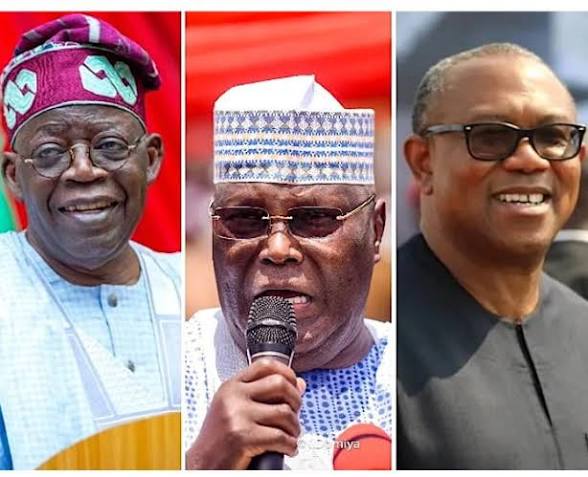
2027: Opposition parties seek alliance to defeat Tinubu

0

Opposition parties and political actors will converge on Abuja on Monday for a summit aimed at building a common strategy to challenge President Bola Tinubu and the ruling All Progressives Congress in the 2027 presidential election.

The summit, organised by the G-100 political pressure group led by former Director-General of the Progressives Governors Forum, Salihu Lukman, is expected to focus on cooperation among opposition parties, including the possibility of coordinating their campaigns and working towards a consensus candidate.

The Social Democratic Party and Peoples Redemption Party have confirmed their participation, while the Peoples Democratic Party has rejected the gathering, saying it was neither aware of the summit nor involved in any opposition alliance discussions outside its structures.

The G-100 said the summit was necessary because a divided opposition could struggle to defeat an incumbent party with substantial organisational and financial resources. It urged opposition leaders to place areas of common interest above their individual ambitions without requiring participating parties to surrender their identities.

“The experience of elections in Nigeria and elsewhere has repeatedly demonstrated that a divided opposition often strengthens the incumbent,” the group said, adding that “Division is a choice. Cooperation must now become a strategy.”

Confirming the SDP’s participation, its National Publicity Secretary, Rufus Aiyenigba, said the party and its presidential candidate, Prince Adewole Adebayo, would attend the summit at the Shehu Musa Yar’Adua Centre.

He said the meeting would provide an opportunity to explore practical areas of cooperation with other political groups seeking an alternative political direction for Nigeria.

The PRP also confirmed its participation, with its National Publicity Secretary, Bello Ishaq, simply stating, “We are attending.” The African Democratic Congress and Nigeria Democratic Congress could not be reached for their positions as of the time of filing the report.

The PDP, however, drew a clear line between itself and the initiative. Its National Caretaker Committee spokesman, Jungudo Mohammed, said, “The PDP is not aware of any gathering in the name of opposition summit,” adding, “We are also not in any planned arrangement with any political party for any possible alliance. Any opposition discussion where the PDP is not party to is dead on arrival.”

The summit comes amid growing debate over the possibility of a single opposition candidate in 2027, with competing presidential ambitions, party structures and disagreements over the terms of any alliance remaining major obstacles.

The G-100 said Monday’s meeting would not be about determining winners within the opposition, but about creating practical mechanisms for dialogue and coordination ahead of the election.

Sun

Benue, Ebonyi, Enugu, C’River, Kogi, others should appreciate Tinubu -Umahi

0

Minister of Works, Senator David Umahi, has urged Benue, Ebonyi, Enugu, Cross River communities and other parts of the country to acknowledge and appreciate President Bola Tinubu for executing massive infrastructure in the communities.

Umahi said the President is a miracle to the communities because without his intervention, many of the communities would not have been able to move their agricultural produce, vehicles and machinery within their localities.

He stated this weekend while inspecting the ongoing construction of federal government Tran-Saharan Highway, which cuts across Ebonyi, Benue, Cross River, Enugu, Kogi and other states of the federation.

Umahi opined that Tinubu was concerned about the welfare of the masses, which accounted for why he was directed to do everything possible, in collaboration with the relevant state governments, to address problems affecting the people through provision of massive infrastructure.

He commended the President for providing mobilisation for the project in spite of the financial challenges the country was passing through and the quantum of projects currently ongoing across the nation.

He assured that all the projects being executed by the Federal Government would be completed by the end of 2031, stressing that if previous Presidents did what Tinubu is doing in infrastructure, Nigeria wouldn’t have been in the kind of situation it is today.

“President Tinubu has taken the bull by the horns and intervened in many issues. We cannot have all the money to do all the projects at once, so we will continue to do the much we can based on our available resources.

“By the end of 2031, which will be the end of President Tinubu’s second tenure if he is re-elected, these projects and roads would have been fully completed. I commend the President very highly.

“If previous presidents had intervened in this manner, perhaps, we would not be in the kind of situation we are facing today. We have been to Ibadan, Ijebu Ode, the Coastal Highway and other locations to intervene in road projects and bypasses.

“The President is concerned about the welfare of the people. That is why he directed us to do everything possible, in collaboration with the relevant state governments, to address problems affecting the people.

“I want to thank the President very highly, especially in spite of the financial challenges and the quantum of projects in our hands. He has approved and provided mobilisation for this project.

“When people say, ‘You are constructing roads,’ they should come and see these communities in Benue. Some of these communities have no federal roads leading to them.

“I think the President is a miracle to these communities because without this intervention, many of them would not have been able to move their agricultural produce, vehicles and machinery.

“I want the public to appreciate what the President is doing. I appeal to the communities in Benue, Enugu, Ebonyi, Cross River and other parts of the country to acknowledge and appreciate the Federal Government’s intervention,” he said.

Umahi, a former Governor of Ebonyi State, urged the people of the country to re-elect Tinubu in 2027.

Speaking during the inspection, the traditional ruler of Ndiagu Ishieke autonomous community in Ado Local Government Area of Benue State, Idenyi Agbo, commended the Federal Government for the project, describing it as a demonstration of responsive governance and a major intervention capable of transforming the economic fortunes of the communities along the corridor.

Agbo eulogised Umahi for applying his engineering expertise, administrative experience and sensitivity to the cultural heritage of the host communities in the execution of the project.

He said the minister’s decision to ensure that his palace was not demolished in the course of the road construction demonstrated wisdom, maturity and respect for the traditional institution.

According to the monarch, Umahi’s approach had shown that critical infrastructure could be delivered without unnecessarily undermining the historical and cultural assets of host communities.

He expressed appreciation to President Tinubu and Umahi for the road intervention, assuring the Federal Government of the community’s cooperation and support for the successful completion of the project.

He consequently declared the community’s support for the re-election of President Tinubu, Governor Hyacinth Alia of Benue State and other APC candidates in the 2027 general elections.

“There is no other person we would rather support at this moment outside President Bola Tinubu, Governor Hyacinth Alia and the APC candidates because we have seen the impact of their administration in our communities,” the monarch said.

He, however, urged residents and youths to protect the road infrastructure and cooperate with contractors, engineers and government officials to ensure that the project was delivered within schedule and according to specifications.

The Project Manager of Section Two of the Trans-Sahara Highway, Rabih Munayer, said the contractor was implementing directives issued by the Minister of Works to minimise property damage and avoid unnecessary demolition along the road alignment.

Munayer said Section Two covered approximately 173.4 kilometres, subject to adjustments arising from the ongoing design review.

“This is Section Two of this major superhighway,” he said, explaining that the section traverses parts of Benue, Enugu and Kogi states before terminating at the Benue River and Nasarawa boundary.

He said the contractor would deploy additional pipes and temporary measures, particularly during the rainy season, to maintain trafficability and facilitate construction activities without unnecessarily disrupting communities.

According to him, the measures would enable construction equipment to move through the corridor, while reducing the need to demolish structures and cause avoidable damage to property.

Also speaking, the consultant and designer for Section Two, Akelakpa Edra, said the project design was being reviewed to incorporate the minister’s directives, including the replacement of some culverts with bridges and adjustments to the alignment where necessary to avoid properties.

Edra said the revised design would take into account all the instructions issued by the minister in order to minimise the impact of the project on communities along the corridor.

A stakeholder from Odoke Ishieke in the community, Chief Patrick Agbo, described the road project as a major Federal Government’s intervention with the potential to stimulate economic activities, improve connectivity and open up the area to greater commercial opportunities.

He urged Umahi to convey the community’s appreciation to President Tinubu and all relevant authorities responsible for the project.

He said improved road connectivity would facilitate the movement of agricultural produce, people and goods while creating new opportunities for commerce and other socio-economic activities.

The community stakeholder also declared his support for the APC candidates, stressing that the people would continue to identify with administrations whose policies and projects had tangible impacts on their lives.

He assured the Federal Government, contractors and workers of the community’s cooperation and support for the security of the project, while calling on residents and youths to protect construction personnel and equipment deployed to the area.

Sun

2027: Choose cooperation over division, G-100 tells Atiku, Obi, others

0


A group of opposition politicians pushing for a consensus presidential candidate in the 2027 polls, G-100, has charged the opposition leaders, including the presidential candidates of the major opposition political parties, to choose cooperation over division.

The G-100, in a statement by Salihu Lukman, yesterday, ahead of the Summit of Opposition Political Parties, scheduled for today, in Abuja, urged the parties to approach the parley with the understanding that they are stronger together.

The G-100 recently initiated moves to get Atiku Abubakar, Peter Obi, Seyi Makinde, presidential candidates of the African Democratic Congress (ADC), Nigeria Democratic Congress (NDC) and Allied Peoples Movement (APM), respectively, as well as the leadership of their political parties to work together for the 2027 presidential election.

Also included in the proposed opposition alliance are the Peoples Democratic Party (PDP), Social Democratic Party (SDP) and its presidential candidate, Adewale Adebayo and the Peoples Redemption Party (PRP) and its presidential candidate, Donald Duke, as well as the Minority Caucus of the House of Representatives.

The G-100 had in an August 2 open letter to the opposition political parties, their presidential candidates and running mates, as well as leaders of thought and civil society organisations (CSOs), titled, “The Doctrine of a Necessary Democratic Opposition,” appealed to the opposition leaders to put the national interest above personal ambition. It stated that there was a need for the opposition parties to forge a common front for the 2027 presidential contest so as to improve their chances of defeating President Bola Tinubu and the All Progressives Congress (APC) in next year’s poll.

The group noted that today’s summit affords the opposition leaders an opportunity to build a framework for cooperation in the run up to the 2027 polls, while respecting the identity and structures of participating parties. It noted that “there will be disagreements, competing ambitions and difficult conversations. These are natural in politics, but none should prevent us from recognising the greater danger of allowing our differences to deny Nigerians a credible alternative.”

The G-100 explained that “across the country, millions of Nigerians are looking to the opposition not merely to criticise the government of the day, but to demonstrate the maturity, discipline and sense of national purpose required to offer a credible alternative.

“The G100 recognises that every political party has its own history, identity, ambitions and legitimate interests. Cooperation does not require any party to surrender these. Nor does it require political leaders to abandon their aspirations. It simply requires the wisdom to recognise that there are moments when what unites us must become more important than what separates us.”

Furthermore, the group noted that “The experience of elections in Nigeria and elsewhere has repeatedly demonstrated that a divided opposition often strengthens the incumbent. When parties competing for the same broad constituency fragment their energies, resources and votes, they risk turning their differences into an unintended advantage for those they seek to replace.

“Division is a choice. Cooperation must now become a strategy. The G100, therefore, appeals to every participating party and leader to come to the table in good faith, with an open mind and with the larger interests of Nigeria at heart

“Tomorrow is not about declaring winners or losers within the opposition. It is about beginning the work of ensuring that Nigerian democracy wins. Alone, each opposition party can make its case. Together, the opposition can change the course of the country.”

Sun

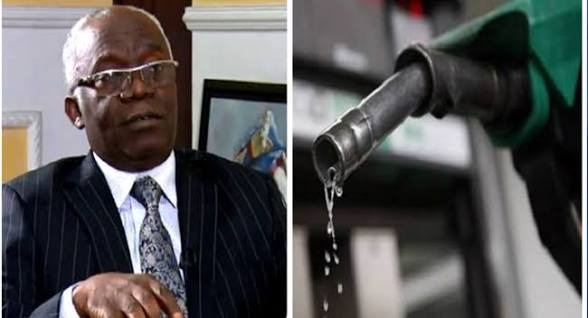
Subsidy removal: Falana warns against return to ‘scam’ era

0

Human rights lawyer Femi Falana has warned the Federal Government against allowing the removal of petrol subsidy to become another avenue for financial mismanagement, demanding accountability over the increased revenue now available to governments.

The Senior Advocate of Nigeria said Nigerians were entitled to know how the additional funds generated following the subsidy removal were being spent, especially as many citizens continue to struggle with rising living costs.

Falana spoke on Channels Television’s Sunday Politics, where he questioned the justification for asking Nigerians to endure economic hardship without seeing corresponding improvements in public services and infrastructure.

He pointed to the poor condition of a road in Ekiti State leading to Afe Babalola University as an example of what he described as a failure to translate increased government revenue into development.

Falana said the affected local government reportedly received about N5.4 billion between January and May and questioned why a road requiring less than N500 million to repair remained in poor condition.

“So you can’t fix a road with less than 500 million naira? And in any case, state governments were fixing roads, and they would then go to Abuja to ask for a refund,” he said.

The lawyer said accountability should extend across all three tiers of government, particularly because the Federal Government, states and local governments now receive more revenue following the policy change.

“If you say we are making more money, we don’t want to go back to the era of the fuel subsidy scam. Where are the benefits?” Falana asked.

He added: “It’s a fallacy being told to wait and wait and wait. People are dying.”

Falana said Nigeria was generating more revenue from crude oil and that the funds previously earmarked for petrol imports should have provided significant fiscal space.

He estimated that about $10 billion previously allocated annually for fuel importation could have been saved, but said much of the government’s additional revenue was instead being absorbed by debt servicing.

“Now, the money earmarked for fuel importation by the government—$10 billion per annum—ought to have been saved, but the bulk of this money goes for servicing of debt. That’s where the problem lies,” he said.

He urged Nigerians to scrutinise government finances and demand explanations for how increased allocations are being used.

“Yes, state governments are getting more money. The Federal Government is getting more money. Local governments are getting more money on paper. It is the duty of the Nigerian people now to demand accountability,” he said.

Tinubu announced the removal of petrol subsidy in May 2023, shortly after taking office. The decision resulted in a significant increase in the price of petrol and has remained one of the most controversial economic policies of his administration.

The Federal Government has maintained that subsidy removal was necessary to redirect resources towards development and reduce pressure on public finances.

However, opponents of the policy have argued that the benefits have not sufficiently reached ordinary Nigerians, particularly amid persistent inflation and high living costs.

The subsidy question is also expected to feature prominently ahead of the 2027 presidential election.

Atiku Abubakar has pledged to restore the subsidy if elected, while Peter Obi has backed its removal but called for the savings to be transparently and efficiently invested.

Sun

Tinubu’s lawyer dismisses concerns over withheld FBI, DEA records

0


A member of President Bola Tinubu’s legal team in the United States, Wole Afolabi (SAN), has dismissed concerns over the continued withholding of portions of records held by the Federal Bureau of Investigation (FBI) and Drug Enforcement Administration (DEA) concerning the Nigerian president.

Afolabi said the legal team’s position was based on the provisions of United States law and was not an attempt to shield Tinubu from damaging information.

The Senior Advocate of Nigeria stated this during an appearance on Channels Television’s Sunday Politics, amid a legal battle over the release of records linked to allegations of drug trafficking involving Tinubu.

The dispute revolves around hundreds of pages of documents that investigative journalist Aaron Greenspan is trying to get released in their complete form.

According to Afolabi, the US government has already released documents relating to the matter but is resisting the disclosure of information it considers exempt under the Freedom of Information Act.

He said the FBI and DEA had raised concerns that releasing some of the information could compromise their agents, confidential sources and investigative methods.

Afolabi said Tinubu’s lawyers would be failing in their professional duties if they did not rely on the protections available under US law.

“It will amount to professional malpractice on our part if we don’t take advantage of what the law offers.”

He also rejected suggestions that the government’s decision to withhold portions of the records was intended to protect Tinubu personally.

According to him, the US government’s filings focused on protecting agents, sources and investigative techniques rather than shielding the Nigerian president.

“They are saying that if we discuss this publicly, we would compromise our agents; we would compromise the techniques that we use to get information,” Afolabi said.

He added that the agencies were also concerned about exposing informants.

“They have sources, they have informants. They don’t want them to be compromised,” he said.

Addressing allegations that Tinubu was involved in drug trafficking, Afolabi maintained that the evidence did not establish criminal culpability.

He argued that if US authorities had sufficient evidence to prosecute Tinubu for drug trafficking, he would have been indicted.

“If he was culpable, he simply would have been indicted. There’s no shortcut around it.”

Afolabi also stressed that being investigated by law enforcement did not necessarily mean that a person had committed an offence.

“Anyone can be a subject of investigation. That’s just how it goes,” he said, adding that the presumption of innocence remained applicable.

The lawyer was, however, unwilling to disclose details of Tinubu’s explanation concerning the $460,000 that was forfeited to the US government in the 1990s.

He cited attorney-client privilege, saying he could not reveal confidential information provided to him by the president.

“Unfortunately, I can’t divulge any information that my client had disclosed to me confidentially,” Afolabi said.

Afolabi also dismissed concerns that the controversy over Tinubu’s US records could affect the president’s political standing or fitness for office.

Responding to questions about whether withholding the documents was unfair to Nigerians, he said voters would ultimately assess Tinubu based on his performance and campaign promises.

“The Nigerian people knew who they voted for.”

“At the end of the day, the election will not be decided on what document exists where,” he added.

According to him, the 2027 election would instead be determined by “promises made, promises kept, what is going on, what are the costs.”

The lawyer also defended the argument that Tinubu retained privacy rights despite being Nigeria’s president.

He cited the example of US President Donald Trump, who previously sought to prevent the release of his academic records, arguing that public office does not automatically eliminate an individual’s legal right to privacy.

Afolabi said the legal team was therefore acting within the law in challenging the release of material it considered protected.

“Basically, what we are doing is we are staying within the confines of the law. And we advise our client to do so. It’s what the law avails him.”

Afolabi said the legal proceedings over the records were still ongoing, with the plaintiff expected to file a response by September 11.

He said the US Department of Justice would have until September 18 to respond, after which the judge would consider the matter.

The lawyer also maintained that the fact that the FBI or DEA may have investigated Tinubu should not, on its own, be interpreted as evidence of wrongdoing.

He reiterated that the legal team would await the court’s decision rather than speculate about what could happen if the judge orders the release of additional records.

“In my business, we don’t speculate. We have to wait until the decision is handed down.”

The legal dispute over Tinubu’s records has continued to attract attention in Nigeria, particularly because of the allegations surrounding the $460,000 forfeiture and questions over whether additional US government records could shed light on the circumstances surrounding the matter.

Sun

Fake agencies and ghost workers saga

0


By Ehi Braimah

​


The latest scandal involving fake government agencies and ghost workers should not be dismissed as another corruption story in Nigeria’s seemingly endless catalogue of public-sector abuses. It is better to treat itas a critical inquiry into the quality of governance. President Bola Ahmed Tinubu’s decision to order a comprehensive forensic audit of the Integrated Personnel and Payroll Information System (IPPIS), federal agencies and related government systems is therefore timely.


The audit, to be coordinated by Finance Minister and Coordinating Minister of the Economy, Taiwo Oyedele, is expected to examine payroll records, personnel and pension systems, bank accounts, government agencies and the connections between IPPIS, GIFMIS (Government Integrated Financial and Management Information System), Remita and the Treasury Single Account.


But an uncomfortable question must be asked: why did government need another scandal before it looked seriously at the architecture of government? That is the bigger issue.


The discovery of the fictitious Presidential Foreign Intervention Promotion Council (PFIPC) and other allegedly fake agencies is astonishing. More disturbing is that PFIPC, one of the phantom entities, reportedly secured a N1.3 billion allocation in the 2026 federal budget. The scandal raises a fundamental question: if an agency that does not legally exist can find its way into the budget, what else is hiding in the system?


The Independent Corrupt Practices and Other Related Offences Commission (ICPC) subsequently uncovered another alleged fake agency and reported that the promoter created additional fictitious entities, complete with forged legislative documents and bank accounts. This is no longer simply about one clever fraudster; it is about a system that is broken and apparently had enough gaps for the fraud to flourish.


That brings us to the Stephen Oronsaye Report – a low-hanging fruit – which has been gathering dust since the report was submitted in 2012 after a presidential committee chaired by former Head of the Civil Service, Stephen Oronsaye, examined the structure of federal government agencies and the cost of governance.


The report identified duplication, overlapping mandates and unnecessary agencies. Among its major recommendations was reducing 263 statutory agencies to 161, abolishing 38 agencies, merging 52 and reverting 14 to departments within ministries.


In February 2024, President Tinubu’s Federal Executive Council approved implementation of the report, with agencies to be scrapped, merged, subsumed or relocated. An implementation committee was subsequently inaugurated with a 12-week deadline.


So, what happened?


That is precisely the question Nigerians should be asking. More than two years after the presidential approval, the evidence suggests that implementation has been selective and incomplete. In fact, government has continued to create or entertain proposals for new agencies whose mandates overlap with existing institutions.


The International Centre for Investigative Reporting (ICIR)recently documented this contradiction, noting that the executive and legislative pipelines continue to produce new agencies despite the stated commitment to rationalisation. This is where the government’s credibility is tested as it cannot approbate and reprobate at the same time. If the cost of governance is too high, then why are we creating more ministries, departments, agencies and boards?


Instead of the promise a leaner government, the political system continues to treat the creation of agencies as a convenient way of rewarding interests, creating positions and distributing patronage. I have a strong feeling that President Tinubu is now ready to step on toes and wield the big stick because of the embarrassing ICPC revelations.


But why is the Oronsaye so difficult to implement?


The uncomfortable answer is that reform threatens vested interests. Every agency has a director-general, chairman, board members, directors, special assistants, administrative structures, procurement opportunities, contracts and budgetary allocations. Merging two agencies may make economic sense to the taxpayer, but it also means that somebody’s office disappears.


On the other hand, scrapping an agency means eliminating positions and reducing the number of political appointments.Politicians and civil servants know that rationalising government has political consequences. That is why the Oronsaye Report has survived three administrations. Jonathan did not fully implement it. Buhari ignored it. Tinubu announced implementation in 2024, but the process remains far from complete.


The ICIR’s recent assessment is particularly revealing: despite the 2024 approval, implementation has been selective, while new establishment bills continue to emerge. But there is another problem: legislation.


Some agencies cannot simply disappear because they were created by Acts of the National Assembly. Some mergers therefore require legislative amendments. For example, the proposed subsuming of the National Salaries, Incomes and Wages Commission into the Revenue Mobilisation Allocation and Fiscal Commission requires constitutional amendment because the latter is constitutionally established.


But that cannot become an excuse for doing nothing. The federal government knows which agencies require legislationand those that can be administratively merged. What of redundant agencies and the those that can be returned to ministries? We should not pretend that government does not know them. In fact, the reform could have been done in phaseswith specific deliverables.


This naturally leads us to the ghost-worker scandal which is equally revealing. Nigeria has invested heavily in payroll technology which explains why the IPPIS was supposed to eliminate precisely the kind of fraud now being exposed.


If fictitious names, ineligible personnel or fraudulent bank accounts can still penetrate the payroll system, then the issue is no longer simply whether IPPIS exists, it is whether the controls around IPPIS work. And if the allegation that some workers who live and work abroad are drawing salaries from the civil serviceis true, then the allegation, in my view, would be a much bigger scandal.


The ICPC has reported recovering more than N24 billion linked to ghost workers’ pensions and obtaining forfeiture orders involving more than 900 suspected ghost workers. That is a staggering indictment of institutional controls.


The President’s forensic audit is therefore welcome, but it must not become another committee exercise that produces a report which eventually gathers dust. What we are suffering from is poor implementation of rules and regulations; enforcement of existing laws and ignoring committee recommendations, not a shortage of reports


Whatever happened to previous white papers and audit reports? We have reform programmes and anti-corruption agencies, but we often lack the political will to follow recommendations to their logical conclusion. That is a governance failure spanning several seasons since 1999.


The most important lesson from the fake-agency scandal is that corruption does not always require sophisticated technology; sometimes, it only requires institutional negligence. How could an agency without a proper legal foundation obtain recognition, open accounts, have access to government offices, and be accommodated within the national budget? That is a huge scandal arising from poor stewardship.


How could several layers of bureaucracy fail to ask the most basic question: where is the enabling law? These questions should form part of the forensic investigation by Tunde Oyedele and his committee. The President’s directive appropriately says the audit should go beyond individual cases and examine the architecture of government. That is exactly what is required, but the architecture must lead to restructuring for far-reaching decisions.


If the forensic audit, for example, discovers 50 weaknesses and government merely fixes the individual cases, we will be back here again. The objective should be to create a government where it is structurally difficult – not merely illegal – for a fake agency or ghost worker to enter the system. The OronsayeReport should be the starting point to clean up an opaque system. The government should resist the temptation to establish yet another committee to review the report.


The report is old which means some recommendations may require updating because Nigeria’s institutional landscape has changed, but the central diagnosis remains relevant: too many institutions have overlapping responsibilities at too great a cost.


Indeed, a recent analysis cited concerns that Nigeria now has more than 900 MDAs (it could be more), with estimates of significant annual losses associated with the proliferation of agencies.


The answer is not another report. While the Tunde Oyedele Committee is diligently carrying out President Tinubu’s directive, the government should publish the Oronsaye Implementation Matrix showing which agency has been scrapped, merged, subsumed, or require legislation. If implementation was stalled at some point, who is now responsible for completing each action? There should also be a deadline for feedback.


And, importantly, no new federal agency should be created without demonstrating that its functions cannot be performed by an existing institution. That should become a rule of governancegoing forward. President Tinubu deserves credit for ordering the forensic audit, but Nigerians should not judge the exercise by the number of ghost workers discovered or fake agencies exposed – they should judge it by what happens after the discovery.


Will the government recover the money and will those responsible face prosecution? Those who failed in their supervisory responsibilities should be held accountable. We also want to know whether duplicated agencies were actually merged and if redundant agencies were made to disappear like the morning dew.


Without prejudice to Tunde Oyedele’s Committee Report, the number of government entities must be reduced and payroll verification should become continuous rather than episodic. Government should also stop creating the institutional conditions that make these scandals possible.


Meanwhile, how many weaknesses in government remain undiscovered because nobody is looking? Who are the promoters of fake agencies and ghost workers? If they truly exist, why can’t we find them? That is why this scandal should not be treated merely as another anti-corruption event, but a governance story.


The Oronsaye Report provides a tested framework for rationalising government, eliminating duplication and reducing the cost of governance. The Tinubu administration should pick it. If government is serious about fighting ghost workers and fake agencies, it must do more than clean up the symptoms by redesigning the system that produced them.


Nigerians are entitled to ask: if the government approved the Oronsaye reforms in 2024, why are we still debating the same problem in 2026?

Braimah is a PR specialist, marketing strategist, and publisher/editor-in-chief of Naija Times (www.ntm.ng) and Lagos Post (www.lagospost.ng). He is a strong advocate for African prosperity and can be reached through:ehi.braimah@neomedia.com.ng
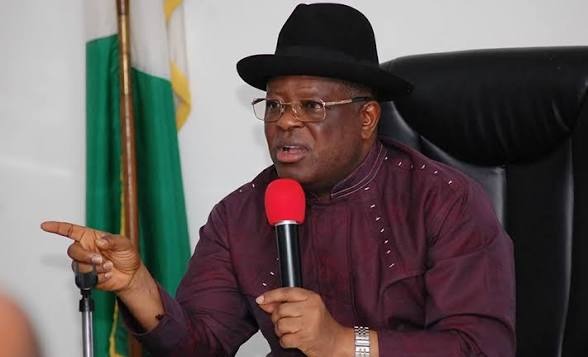
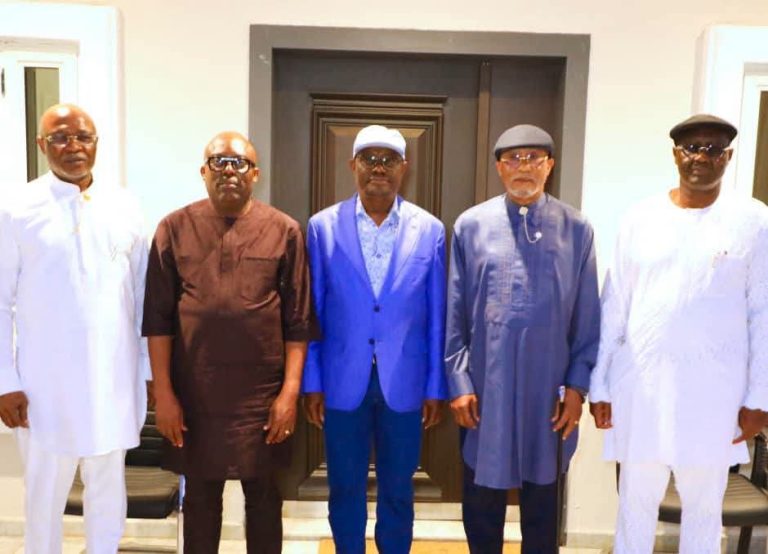
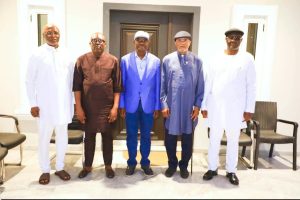
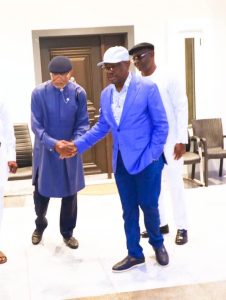
Rivers State Governor, Siminalayi Fubara, during his visit to the FCT Minister, Nyesom Wike, in his Port Harcourt residence this evening.

0


Fubara, who was accompanied by Dr Sam Sam Jaja, was received by the APC Governorship candidate in Rivers State, Hon Kingsley Chinda and Senator Magnus Abe.

NDLEA intercepts N6.2bn drugs hidden in Ghana soap, opioids at Lagos airport …Arrests Akinbile Kazeem Aikins, Others

0


The National Drug Law Enforcement Agency has intercepted consignments of captagon, popularly known as the “Jihadi drug,” and millions of opioid tablets worth over N6.2bn at the Murtala Muhammed International Airport, Lagos.

The agency disclosed this in a statement released on Sunday by its Director, Media and Advocacy, Femi Babafemi.

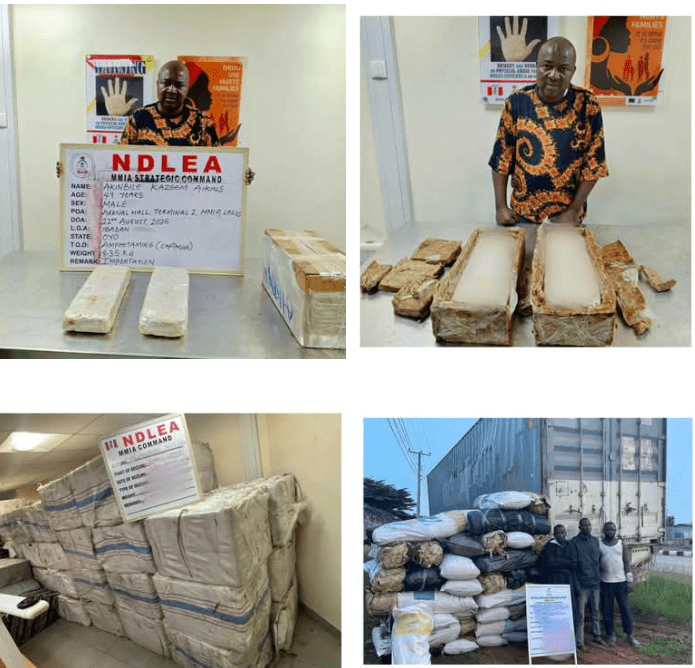
According to the NDLEA, operatives at the Lagos airport on Saturday, August 22, 2026, arrested a 49-year-old cross-border drug kingpin, Akinbile Kazeem Aikins, who arrived from Accra, Ghana, aboard an African World Airlines flight.

The statement partly read, “NDLEA intercepted consignments of captagon, widely known as ‘Jihadi drug’ and millions of opioid pills worth over N6.2 billion at the MMIA, Ikeja, Lagos.

The captagon shipment was seized at the Lagos airport on Saturday, August 22, 2026, following the arrest of a 49-year-old cross-border kingpin, Akinbile Kazeem Aikins, who arrived from Accra, Ghana aboard an African World Airlines flight.

“A search of his carton of local bathing soap, popularly called ‘Ghana Soap,” led to the recovery of 47,200 pills of the illicit amphetamine drug worth over N1.5 billion concealed within blocks of soap.

“Captagon, which is notoriously dubbed the ‘Jihadi drug’ for its use in funding extremist activities in conflict zones, was first intercepted in Nigeria by NDLEA in September 2021 at the Apapa port in Lagos. After his arrest, Akinbile claimed he was meant to deliver the consignment in the North.”

In a separate operation at the Lagos airport, NDLEA operatives recovered 3,900,030 tablets of Tramaking 225mg and Tapentadol 250mg, with a combined gross weight of 2,787.40kg and an estimated street value of more than N4.6bn.

The drugs were recovered from four abandoned consignments at the import shed of the MMIA after no one showed up to claim them.

The agency said three of the consignments contained 900,000 tablets of Tramaking, weighing 815.40kg, which arrived on RwandAir flights from Bangladesh.

The fourth consignment contained 3,000,030 tablets of Tapentadol, weighing 1,972kg, and arrived aboard Qatar Airways from Amsterdam.

The consignments, which had been placed under surveillance, were formally retrieved following a joint examination by NDLEA operatives, the Nigeria Customs Service and other stakeholders on Friday, August 28.

Also, a 31-year-old United States returnee, Sowunmi David Oludotun, was arrested on August 19 at Ikate, Lekki, Lagos, after he allegedly showed up to take delivery of 3.350kg of Loud, a synthetic strain of cannabis imported from the United Kingdom.

In Rivers State, NDLEA operatives raided the notorious Abuja Down/Up area of Port Harcourt and recovered a fireproof iron safe containing different illicit drugs.

The agency said the safe was cracked open with a welding machine on Tuesday, August 25, leading to the recovery of 237g of Colorado cannabis, 316g of cocaine and 10g of heroin.

In Ondo State, three suspects—Oyedele Daniel, 42; Taye Saliu, 36; and Kehinde Saliu, 36—were arrested on Friday, August 28, along the Ipele-Idoani Road with 728kg of skunk recovered from their truck marked KRE 120 XB.

Two other suspects, Uche Joseph, 35, and Godwin Umeh, 21, were arrested at Aponmu Forest on Wednesday, August 26, with 341kg of the same substance.

Similarly, in Delta State, more than 176,000 pills of assorted opioids, including tramadol and Molly, were recovered in two interdiction operations conducted between Wednesday, August 26, and Friday, August 28.

Commending the officers and men of the MMIA, Ondo and Delta Commands for the operations, the NDLEA Chairman and Chief Executive Officer, Brig. Gen. Mohamed Buba Marwa (retd.), urged personnel across the country to sustain the agency’s balanced approach to drug control.

Marwa also directed the operatives to maintain the momentum against drug traffickers who, he said, were becoming increasingly desperate and exploring different methods to move illicit consignments.

He specifically warned against attempts to conceal drugs in everyday household items.

“Drug traffickers are desperate to explore every means, including concealment in everyday household items like soap, to move their illicit consignments,” Marwa said.

He urged NDLEA personnel to remain vigilant and sustain their efforts against drug trafficking across the country.

Former Venezuelan President, Maduro Releases New Photos From US Prison

0


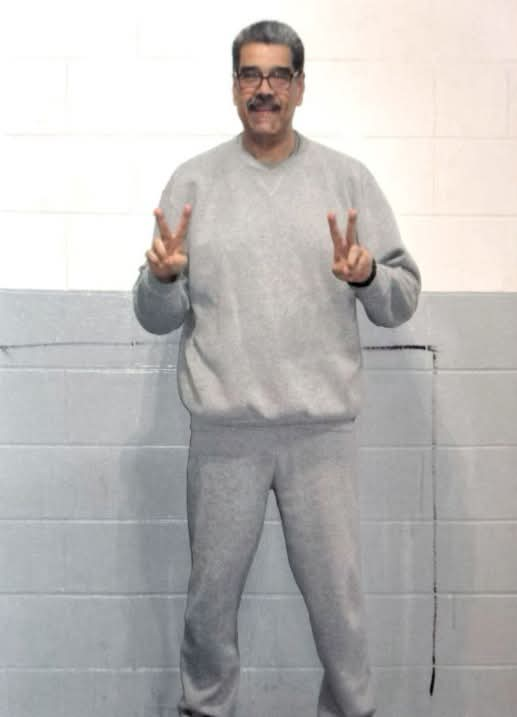
Former Venezuelan President Nicolás Maduro has appeared in newly released photographs from his detention in the United States, months after he was captured during a US military operation in Caracas ordered by President Donald Trump..

tvc

Foreign Affairs Minister Bianca Ojukwu accepts DTN@100 Trailblazer Award, says it’s a ‘great honour’

0

The Minister of Foreign Affairs, Barrister Mrs. Bianca Ojukwu, has accepted the Daily Times Nigeria @100 Trailblazer Award, describing it as a “great honour” and an acknowledgment of her humble efforts in service to the nation.

In a letter dated Friday, July 31, 2026 addressed to the Minister at Tafawa Balewa House, Abuja, the Board, Management and Organising Committee of the DTN@100 Celebration said Mrs. Ojukwu emerged with the highest number of votes following an extensive nomination and public voting process. Her selection was later confirmed by the Times Heroes Award Council in recognition of her “leadership, public service and contribution to national development.”

The award is part of activities marking Daily Times Nigeria’s centenary and will see recipients immortalised in the 700-page Nigerian Grand Book, a national commemorative volume chronicling the people, institutions and milestones that have shaped Nigeria’s 100-year journey.

The foreword to the book was written by President Bola Ahmed Tinubu, GCFR, a development the organisers said underscores “the national significance of the publication and its role in preserving Nigeria’s achievements, positive contributions and developmental milestones for future generations.”

In her acceptance message sent from Angola, the Foreign Affairs Minister expressed profound gratitude to the Chairman of Folio Media Group, Mr. Fidelis Anosike, and the Times Heroes Award Council for the recognition.

“Thanks very much, Chairman, for this Trailblazer Award, which I consider a great honour, and I am truly grateful to DTN for acknowledging my humble efforts and contribution to National development,” she stated.

Mrs. Ojukwu, who is currently on official assignment in Angola, said she hopes to return to Nigeria before the date of the conferment.

She said, “I am currently in Angola and hope to be back in the country by the date of the event. If I am unable to make it, I will surely delegate someone to represent me.

“Once again, please accept my profound appreciation for this award. My warm regards.”

The public conferment of the DTN@100 Times Heroes Awards is scheduled for Thursday, September 3, 2026 at the ThisDay Dome, Kur Mohammed Avenue, Central Business District, Abuja. The organisers have requested confirmation of attendance to enable protocol arrangements.

Speaking on the significance of the award, the organisers noted that the Nigerian Grand Book was developed over 15 years, drawing upon Daily Times’ 100-year archive. It is designed as “an inclusive historical publication in which the contributions of award recipients will be permanently documented.”

Folio Communications, which emerged as the preferred bidder for Daily Times of Nigeria during the Federal Government’s privatisation exercise in 2004, said the centenary celebration under a theme titled: “Honouring the Past. Shaping the Future.” is aimed at strengthening positive perceptions of the country globally.

Mrs. Ojukwu’s inclusion comes at a time when Nigeria’s foreign policy is focused on economic diplomacy, regional integration, and projecting the country’s image abroad. As Minister of Foreign Affairs, she has been at the forefront of engagements aimed at protecting Nigerians in the diaspora and deepening bilateral relations.

The DTN@100 Trailblazer Award recognises Nigerians whose work has had a direct impact on national development across government, business, civil society and diplomacy.

With her name now set to be entered into the Nigerian Grand Book alongside other outstanding personalities and institutions, the Minister joins a select group being honoured as part of Daily Times’ 100-year legacy.

The Daily Times Nigeria congratulated her on what they called “well-deserved recognition” and said they look forward to celebrating the milestone with her.