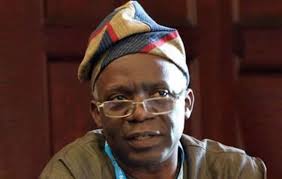
Point of Sale terminal operators and Lagos-based human rights lawyer, Femi Falana, have said they will sue the Central Bank of Nigeria if it fails to withdraw the new cash withdrawal policy limiting over-the-counter cash withdrawals by individuals and companies to N100,000 and N500,000, respectively, per week.
The CBN had, in the memo introducing the policy, said third-party cheques above N50,000 would no longer be eligible for OTC payment while extant limits of N10m on clearing cheques still remained.
The circular also directed banks to load only N200 and lower denominations into their ATMs and restricted withdrawal to N20, 000 per day from ATMs. Withdrawals from PoS terminals were also limited to N20,000 daily.
The policy, which will become effective on January 9, 2023, had generated criticisms but the CBN clarified last Wednesday that PoS operators could apply for waivers.
However, Falana, on Monday, described the new cash withdrawal limit policy initiated by the CBN as unconstitutional.
As a result, he said would go ahead to sue the apex bank if its management failed to withdraw the new policy.
Illegal policy
Falana in a statement titled, ‘Maximum withdrawal limit in Nigeria is N5m’ called on the President, Major General Muhammadu Buhari,(retd), to direct the apex bank to withdraw the ‘illegal guideline’.
According to him,, “ It is embarrassing that the Central Bank of Nigeria has been making announcements without any regard to the Constitution and other relevant laws on the national economy. It is particularly worrisome that the Governor of the Central Bank of Nigeria has purportedly placed a limitation on cash withdrawals in Nigeria in complete defiance of section 2 of the Money Laundering Act, 2022 which provides as follows:
“No person or body corporate shall, except in a transaction through a financial institution, make or accept cash payment of a sum exceeding (a)5,000,000 or its equivalent, in the case of an individual; or (b) N10,000,000 or its equivalent, in the case of a body corporate.
“A person shall not conduct two or more transactions separately with one or more financial institutions or designated non-financial businesses and professions with intent to (a) avoid the duty to report a transaction which should be reported under this Act ; and (b) breach the duty to disclose information under this act by any other means.
“Since the Money Laundering Act 2022 (which has fixed maximum cash withdrawal to N5 million) has not been amended, the limitation of cash withdrawal of not more than N20,000 per day and N100,000 per week fixed by the Central Bank of Nigeria is illegal, null and void in every material. We urge the Nigerian people to ignore the illegal announcement.
“However, we are compelled to call on President Muhammadu Buhari to direct the management of the CBN to withdraw the illegal guideline and stop announcing more policies that are designed to sentence poor citizens to more excruciating economic hardship”.
Impact on MSMEs
Gbajabiamila kicks
Meanwhile, the Speaker of the House of Representatives, Femi Gbajabiamila, has, again, criticised the controversial policy recently introduced by the Central Bank of Nigeria, which, among others, sets limits to cash withdrawals at deposit money banks and other financial institutions.
The House had, last Thursday, asked the CBN to suspend the policy’s launch until the lawmakers concluded their investigations.
The House had consequently summoned the Governor of the CBN, Godwin Emefiele, to come and explain the policy to the parliament. He is to appear before the lawmakers on Thursday.
Gbajabiamila expressed his views in his address at the second edition of the Distinguished Parliamentarians Lecture Series held in Abuja on Monday and organised by the National Institute for Legislative and Democratic Studies.
Gbajabiamila said, “Recently, the Central Bank of Nigeria announced a policy to redesign the Nigerian Naira and impose restrictions on cash transactions across the economy. The National Assembly has been inundated with petitions from citizens worried about the impact of the new policies on their businesses and concerned that the policy approach will not deliver its stated policy objectives. Many have pointed to the fact that in India where a similar policy was implemented beginning in 2016, the expected benefits haven’t materialised, yet there has been a pronounced contraction in the economy probably linked to the policy.
“Now, whatever the concerns about the policy may be, it should not be the normal course of things for such a profoundly impactful policy programme to be designed, approved and announced without any engagement with the legislature, or any attempt to seek the perspectives of the people’s representatives. Keep in mind, these are the very same people who will have to explain and answer for these policies in communities across the country.
“While each arm of government has its prerogatives and guards them jealously, our country cannot afford actions that set the stage for the competing objectives of different arms of government to descend into governance dysfunction and paralysing conflict.”