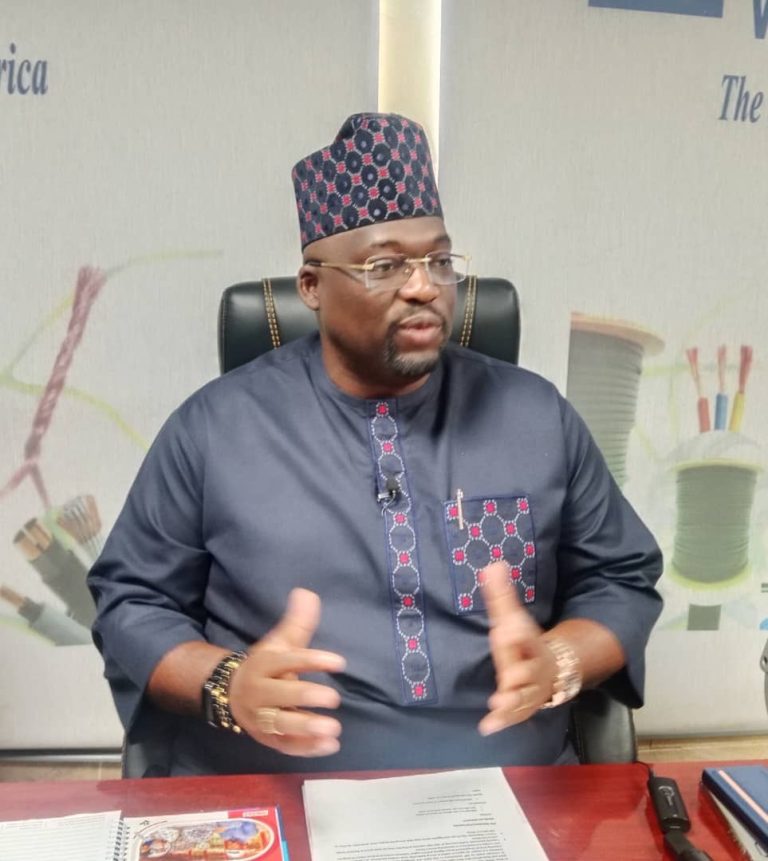
As Coleman Wires and Cables marks its 50th anniversary, its Managing Director and CEO, Mr. George Onafowokan, speaks on the company’s growth, capacity expansion, local content leadership, and plans to become a dominant player across Africa’s cable and fibre market.
Congratulations on Coleman’s 50th anniversary. What does this milestone mean to you and the company?
Thank you. It’s a moment of pride and reflection for us. We’ve come a long way from our humble beginnings. Coleman started as a small trading business and over time evolved into Nigeria’s foremost indigenous cable manufacturing company. Today, we’re talking about over 400,000 square meters of production space. This milestone is not just about longevity; it’s about innovation, resilience, and our commitment to Nigeria and Africa’s industrial development.
How has Coleman evolved in terms of production and capacity since inception?
Onafowokan:
The transformation has been remarkable. From our initial site in Ikotun to expanding into Arepo and then the massive Sagamu plant, we have consistently broken new ground. We pioneered the production of XLPE medium and high voltage cables in Nigeria, and in 2022, we launched Africa’s first fibre optic cable plant. That alone created over 700 direct jobs and more than 7,000 indirect jobs — and that’s still on a single shift. Our goal is to scale up to three shifts, creating over 5,000 direct and 50,000 indirect jobs in Nigeria alone.
What are the new projects we should look out for?
A major one is our Fiber 2 project. When completed, it will be the largest fibre optic cable facility in Africa, producing 9 million fibre kilometres annually — three times what we did in 2022. This will position us to supply over 50% of Africa’s fibre optic demand. The government has already signaled the urgency for in-country fibre deployment, and we are ready to meet that need — not just in Nigeria, but across West, Central, and East Africa.
What other infrastructure is supporting this level of output?
We’ve made significant backward integration. For example, our Sagamu factory now houses Nigeria’s first continuous casting copper smelter, producing 10,000 tonnes of copper and 3,000 tonnes of aluminium annually. We’re planning to expand that capacity to 20,000 tonnes of copper and 30,000 tonnes of aluminium. This investment secures our raw material supply chain and supports the wider industry.
Coleman has always promoted local content. How central is this to your strategy?
It’s everything. Over 95% of our workforce is Nigerian. We source raw materials locally where feasible and our manufacturing is completely in-country. We recently received the Nigerian Content Contribution Award during the 2025 NOG Energy Week — a testament to our commitment. We don’t just talk about local content; we live it. That’s why we also support Executive Orders promoting local industry.
You also lead the Ogun State branch of the Manufacturers Association of Nigeria (MAN). What’s your perspective on Nigeria’s industrial climate?
Ogun State is Nigeria’s manufacturing engine room. We have more factories opening here than anywhere else in the country. But what concerns me is that most of the new MAN members I sign off are foreign-owned — seven out of ten, in fact. While we welcome foreign investment, Nigerians must also take bold steps into manufacturing. We need to believe in our own long-term potential. Coleman is proof that long-term thinking pays off.
Are there current challenges affecting local manufacturers?
Definitely. One major issue is the delay in signing the 2025 tariff policy guidelines. We missed out on 2024 updates, and the last was in 2023. This delay affects raw material imports and planning. MAN has engaged the presidency and we’re hopeful it will be signed this July.
Another issue is energy cost. Manufacturers pay about $8 per thousand cubic feet of gas, while others pay as low as $3.00 per thousand cubic. That’s not fair. If we’ve invested in embedded power — like our 28MW gas plant — we should get price concessions. Power alone is 40–60% of our production cost.
Coleman has consistently maintained international certification. Why is this important?
Certification ensures quality, credibility, and competitiveness. Our products meet ISO 9001:2015, ISO 14001, ISO 45001, and CE standards, among others. We don’t cut corners, and we are constantly fighting the issue of counterfeiting in our industry. Being certified also allows us to play on the global stage.
What’s Coleman’s future outlook?
We’re not just building cables; we’re building Africa’s future. From fibre optics to power cables, we’re enabling broadband, rail, real estate, energy transition — you name it. We’re expanding into more African markets and diversifying into smart grid technologies and renewable energy solutions. Our goal is to be Africa’s most trusted and innovative cable brand.
Any final words as Coleman clocks 50?
We want Nigerians and Africans to support indigenous manufacturers. We’ve proven it’s possible to build world-class infrastructure locally. We’re celebrating 50 years in October 2025, but more importantly, we’re preparing for the next 50. Choose quality. Choose innovation. Choose Coleman.