•380 passenger buses attacked by Ukraine in 2026, 81 killed, 585 injured
•What we seek is sustainable peace, not temporary ceasefire
The Charge d’Affaires, Embassy of the Russian Federation in Nigeria, Igor Ivannikov, has said what Russia is seeking is not a temporary ceasefire, but a lasting and sustainable peace.
In this interview in Abuja, Igor also said Russia has consistently advocated a peaceful settlement of the Ukrainian crisis.
He re-echoed the statements of Russian President Vladimir Putin and Russian Foreign Minister Sergey Lavrov that any such solution must address the root causes of the conflict, particularly those concerning Russia’s security, North Atlantic Treaty Organisation (NATO) expansion and the territorial realities on the ground.
Almost five years since the commencement of the conflict between Russia and Ukraine, the war is yet to come to a close. Is there any glimpse of hope that the war will come to an end soon?
Russia has consistently advocated a peaceful settlement of the Ukrainian crisis. What we seek is not a temporary ceasefire, but a lasting and sustainable peace. As President V. Putin and Foreign Minister S. Lavrov have repeatedly stressed, any such solution must address the root causes of the conflict, particularly those concerning Russia’s security, NATO expansion and the territorial realities on the ground.
Prospects of diplomacy remain, as we see continuing Russian-US contacts and the trilateral talks in Abu Dhabi on November 10-11. However, fundamental disagreements over territorial issues and the future architecture of European security stand as serious obstacles. Kiev Regime shows no willingness to seriously negotiate, afraid to lose power, while its European sponsors continue to fuel the conflict by increasing military assistance.
Our President has openly stated that Russia can achieve the objectives by military means as well. Notably, the United States President Trump acknowledged that Russia could conduct its military operations more forcefully. Speaking to journalists on November 16, the American leader said that V. Putin “could be a lot tougher.”
What has been the support from friendly countries?
Support for Russia from our international partners is expressed through diplomatic engagement, the preservation of economic ties and efforts to achieve a negotiated settlement. Many countries in Asia, Africa and Latin America oppose further escalation, unilateral restrictive measures and attempts to isolate Russia internationally.
The Democratic People’s Republic of Korea holds a special place in this context. Its soldiers took part in the liberation of the Kursk Region in 2024-2025. Meeting Cho Yong Won, Secretary of the Central Committee of the Workers’ Party of Korea, on November 16, V. Putin stated: “We will never forget the heroism of Korean fighters who fought shoulder to shoulder with Russian servicemen.”
In April 2026, a memorial complex was inaugurated in Pyongyang in memory of DPRK servicemen who lost their lives in combat missions on Russian territory. On November 16, our President announced plans to unveil a monument in Kursk commemorating their joint feat. This reflects the special Russian-Korean relations, enshrined in the Treaty on Comprehensive Strategic Partnership of June 19, 2024.
How has the war affected the economic fortunes of Russia, particularly as Russia faced sanctions from the international community?
Russia has faced unprecedented and unlawful sanctions pressure, yet those attempts to undermine our economy and isolate it have failed. Speaking at the APEC Summit in Shenzhen on November 18, V. Putin stressed that Russia had become the most heavily sanctioned country in the world. Over the past three years, our GDP has grown by more than 10 per cent, while restrictions have stimulated domestic production and strengthened technological sovereignty.
The resilience of the Russian economy is also acknowledged by the Western financial institutions. According to the IMF October forecast, Russia’s GDP is expected to grow by 0.9 per cent in 2026. Sanctions bear costs, but the economy continues to function while redirecting foreign trade towards new markets.
At the same time, those imposing the restrictions also face their consequences. At the APEC summit, our President drew attention to the weakening of EU’s industry after losing affordable Russian energy supplies. Notably, despite their sanction’s rhetoric, EU countries continue to purchase our energy resources: according to Eurostat, Russia accounted for 17.3 per cent of EU LNG imports in the second quarter of 2026.
What is your response to the numbers of casualties, attacks on civilian population, schools, hospitals, infrastructure, et cetera that the Ukrainian side is circulating in the media?
Strikes by the Russian Armed Forces are directed exclusively at military facilities, defence industry, positions of the Armed Forces of Ukraine and infrastructure used for military purposes. The Russian Ministry of Defence regularly publishes reports identifying the targets struck. We have repeatedly drawn attention to the risks arising from Ukraine’s practice of deploying military positions in residential areas and using civilian infrastructure for military purposes. Civilian casualties are often caused by Ukrainian air defence and electronic warfare systems, which divert weapons from their intended targets.
Nor should you overlook Ukrainian strikes that claim civilian lives in Russia. The Kiev regime systematically attacks civilian facilities, including a college in Starobelsk in May this year and a beach near Arkhipo-Osipovka, close to Gelendzhik, which was struck by a Ukrainian drone in August. According to the Russian MFA, since the beginning of 2026, around 380 passenger buses have come under attack on Russian territory, killing 81 people and injuring at least 585, including children.
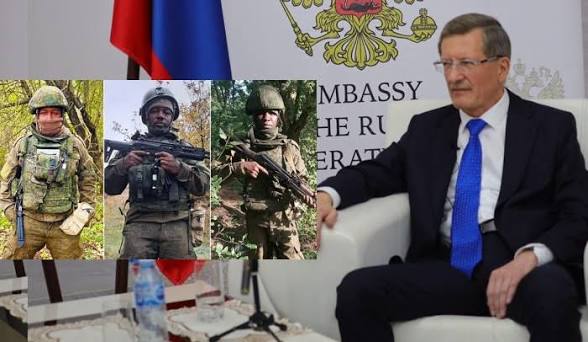
One issue on the front burner arising from the war had been the allegation of recruitment of Nigerians and other Africans by Russia as mercenaries to prosecute the war. Is this true or just a mere propaganda on the part of Ukraine?
Our position on this issue is unequivocal: the Russian Federation does not operate a state programme to involve Nigerians in hostilities in Ukraine. Our Ambassador officially rebuked those allegations in February this year.
Claim of ownership of Donetsk and Donbas regions: Since Ukraine is not ready to cede any portion, what is the way out of achieving an amicable solution?
Moscow’s position on the territorial issue remains unchanged. The Donetsk and Lugansk People’s Republics, as well as the Zaporozhye and Kherson Regions became part of the Russian Federation in September 2022 and their status is enshrined in Russian Constitution. President V. Putin has repeatedly stressed that Russia prefers a peaceful solution, but will achieve its stated objectives. At a press conference on November 19, the President also noted that Ukraine has a right to security, but this must not be achieved at Russia’s expense.
Considering the actual situation along the frontline, as of November 2026, Russian forces control entire Lugansk, nearly 90 per cent of the Donetsk, 83 per cent of Zaporozhye and 76 per cent of the Kherson Regions. The remaining Ukrainian-controlled part of Donbass contains “fortress belt” built since 2014, known as the comprising heavily fortified cities, primarily Slavyansk and Kramatorsk.
Despite some difficulties, Russian units continue their grinding offensive. Separate Ukrainian local counteroffensives are incapable of decisively changing the situation. Even Ukraine’s heavily publicised Operation Vivaldi resulted in very limited territorial gains and has not marked a turning point in the conflict.
How does Russia view the international support being garnered by Ukraine?
We denounce continued Western arms deliveries and expanding military assistance to Kiev. Those are the main factors prolonging the bloodshed and fuelling escalation. The scale of this ‘assistance’ is very considerable. According to official NATO figures, at the 2026 Ankara summit, member countries pledged €70 billion for Ukraine over the course of the year. Plans for the possible deployment of a European military contingent in Ukraine further aggravate the situation. On November 17, S. Lavrov warned that such a step would amount to the direct involvement of European countries in the armed conflict.
Nor should we forget who ultimately pays for Europe’s grand ambitions. According to the OECD, in 2025 Ukraine received $45 billion of financial aid, including funding from EU institutions – more than all countries in sub-Saharan Africa combined. Bilateral development assistance to that region declined by 26.3 per cent in the same year and is projected to decrease by a further 11.6 per cent.
These clearly show the priorities of the West. Funds comparable to those allocated for military support to Ukraine could instead finance infrastructure projects in African countries.
Having been in the battle field for over four years, is the Russian Armed Forces not overstretched?
Despite the prolonged conflict, the Russian Armed Forces remain fully combat-ready and operational. According to V. Putin, more than 400,000 people joined the army in 2025. During the first half of 2026, according to Deputy Chairman of the Security Council D. Medvedev, approximately 200,000 more people enlisted for military contracts.
The production capacity of Russia’s defence industry has also expanded considerably, particularly in unmanned technologies. In May 2026, Deputy Minister of Industry and Trade V. Shpak estimated that Russian enterprises can manufacture up to 15 million various drones annually. In June, First Deputy Prime Minister D. Manturov noted that domestic industry was capable of producing more than 15,000 FPV drones per day, the same number took a month in 2023.
The Russian army has gained extensive practical experience in modern warfare and as the President emphasises, our Armed Forces are the most combat-capable in the world.
Sun