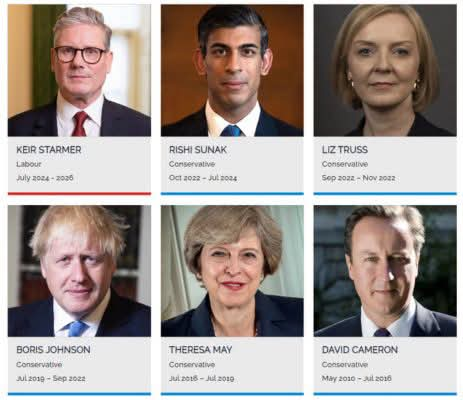
The United Kingdom has had six prime ministers since 2010, reflecting a period of significant political change marked by leadership transitions, elections, and major national events, including Brexit and economic challenges.
According to data compiled from UK government records former Prime Minister David Cameron remains the longest-serving British leader of the period, spending 2,254 days in office between May 2010 and July 2016.
He was succeeded by Theresa May, who served for 1,106 days from July 2016 to July 2019, overseeing much of the UK’s Brexit negotiations.
Boris Johnson followed, serving 1,140 days between July 2019 and September 2022. His tenure included the UK’s departure from the European Union and the COVID-19 pandemic.
The shortest-serving prime minister during the period was Liz Truss, who spent just 49 days in office between September and October 2022.
She was succeeded by Rishi Sunak, who served for 619 days from October 2022 until July 2024.
Current Prime Minister Keir Starmer has spent 717 days in office since assuming power in July 2024. Although Starmer has announced his resignation, he is expected to remain in office until a successor is formally selected.
The succession of six prime ministers in 16 years underscores the dynamic nature of British politics, with leadership changes often driven by elections, party decisions, and major national developments.