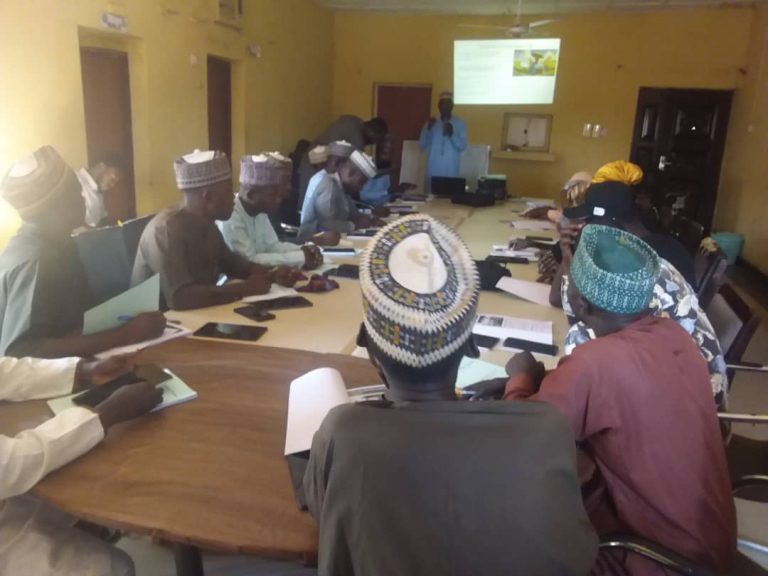
Bauchi — Twenty-one agricultural extension officers from the states of Bauchi, Jigawa, and Kano have benefited from intensive training on Decision Support Tools (DSTs), a technology designed to improve soil fertility management and optimize agricultural yields. The workshop, organized by the Center for Dryland Agriculture (CDA) at Bayero University Kano (BUK) with support from the IFDC Soil Values program, was held over two days in Bauchi.
According to Dr. Dahiru Wakili-Habib, researcher and soil specialist at the CDA, these digital tools help support farmers at every stage of their work, from planting to harvest. “DSTs limit the excessive use of chemical fertilizers, thereby reducing environmental risks such as runoff into water bodies or soil salinization,” he explained.
Among the applications presented, the one dedicated to nutrient recommendations for rice particularly caught the attention of participants. It helps tailor fertilizer inputs to the actual needs of the plants, avoiding uniform practices that are often harmful.
To facilitate the adoption of DSTs, iPads were distributed to extension agents so they can replicate and disseminate the knowledge acquired within their communities.
For Muhammad Tukur-Musa, a young professional with the IFDC – Soil Values program, the initiative is part of a broader strategy aimed at restoring degraded lands across the Sahel. “The program focuses on three pillars: agroecology, inclusive markets, and an enabling environment. Through these efforts, we aim to strengthen farmers’ resilience to climate challenges,” he said.
Participants highlighted the expected impact of these digital tools. Idris Ibrahim, an extension officer in Bauchi, believes that “agriculture is now a modern practice that requires technological solutions to improve productivity.” As for Esther Abba, from Tafawa Balewa, she emphasized that these tools will help reduce costs for small-scale producers while limiting losses.
About the Soil Values Program
The Soil Values program operates in a context marked by climatic and socioeconomic challenges faced by Sahelian countries, such as recurrent droughts, sociopolitical conflicts, desertification, and the effects of climate change.
The initiative is built around three areas of intervention (Agroecology, Inclusive Markets, and Enabling Environment), as well as five domains of action (Clustering, Integration, Linking, Dialogue, and Analysis & Learning).
The Soil Values program aims to improve the fertility and productivity of two million hectares of agricultural land in the Sahel—specifically in Burkina Faso, Mali, Niger, and northern Nigeria—while strengthening the resilience and well-being of 1.5 million farmers, with a particular focus on women and youth.
With a budget of 100 million euros, the program aims to restore degraded lands across the Sahel—including Nigeria, Burkina Faso, Mali, and Niger—and to reach 1.5 million smallholder farmers.
The goal is to restore two million hectares of degraded land in the Sahel. In Nigeria, 800,000 hectares are expected to be restored, directly benefiting 600,000 small producers.