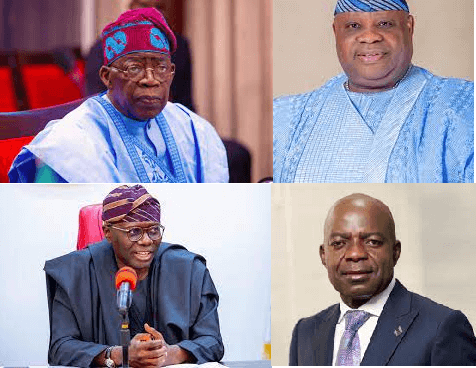
Amid concerns around the high cost of governance, the 48 ministerial nominees whose names were forwarded to the Senate for clearance by President Bola Tinubu, and about 560 commissioners-designates in 27 states of the federation, where elections held in May this year may cost the country about N23.4bn in salaries.
The figure was based on the recommended salaries and allowances for ministers and commissioners by the Revenue Mobilisation and Fiscal Allocation Commission.
Aside from the annual basic salaries, the figure includes such as allowances for accommodation (200 per cent of basic salary), domestic staff (75 per cent of basic salary), utilities (30 per cent of basic salary), house maintenance (five per cent of basic salary), wardrobe (25 per cent of basic salary), furniture (300 per cent of basic salary), motor vehicle fuelling allowance (75 per cent of basic salary), and entertainment allowance (45 per cent of basic salary), among others.
The furniture allowance is paid once every four years.
Tinubu has set the record for the highest number of ministerial nominees in Nigeria’s Fourth Republic (1999 to date) with 48, which experts said would likely worsen the high governance costs.
The President’s nominees topped the 42 appointed by his predecessor, Muhammadu Buhari, in 2019 by five more persons.
A week ago, Tinubu nominated 28 persons to be cleared by the Senate as ministers. On Wednesday, the President sent another list of 19 nominees, making a total of 47 potential cabinet members.
However, on Friday, Tinubu withdrew the nomination of Maryam Shetty as a ministerial nominee from Kano State and replaced her with Dr Mariya Mahmoud Bunkure, also from Kano State. He also added the name of Festus Keyamo, a Senior Advocate of Nigeria from Delta State, as a nominee for screening.
In his first term, Buhari named 36 ministers, while the number increased to 42 during his second term.
Former President Goodluck Jonathan in 2011 named 33 nominees to be ministers in his cabinet, including nine from the Umar Yar’Adua administration.
In 2007, Yar’Adua named a 39-member cabinet made up of 32 men and seven women.
Former President Olusegun Obasanjo initially named 42 ministers in 1999 but reviewed his cabinet to reduce the number of ministries and ministers to 27 and 40, respectively, before he left office in 2007.
Despite calls to reduce the cost of governance, Tinubu has now surpassed Obasanjo, Yar’Adua, Jonathan and Buhari to name 48 would-be ministers, setting a new record since the country returned to democracy 24 years ago.
The total salary and allowances for each minister amounted to N11.85m annually plus the furniture allowance of N6.08m that would be paid once in four years.
Based on the RMAFC template, each minister is expected to earn a total of N650,136.65 monthly or N7,801,640 annually or N31,206,560 in four years, but when allowances for furniture and accommodation are added, it amounts to N53.49m in four years, which translates to N2.57bn for the 48 members that will make Tinubu’s cabinet.
However, the immediate past Minister of Labour and Employment, Dr Chris Ngige, said on Channels Television’s Politics Today programme on, May 1, 2023 that his and other ministers’ monthly salary was N942,000 after taxation; this adds to N11,304,000 annually. When accommodation allowance of N4,052,800 annually or N16,211,200 in four years and furniture allowance of N6,079,200 is added to the salary, it amounts to N67,506,400 in four years. When multiplied by the 48 ministerial nominees, the country may likely spend N3,240,307,200 on Tinubu’s ministers in four years.
He said, “My salary is N942,000 a month. That is my salary with my PA. That is the total after-tax — my feeding, my transport, the transport of one PA, the salaries of my gardener and my cook.
“They are all consolidated. After huge taxation, they paid me N942,000. Every minister you see, that is what you will see. The special advisers get around that amount too.
“The allowances are not anything. We don’t have any allowances except if you travel, you can get duty tour allowance, like every other public officer.”
Ngige noted that the federal government recently reviewed the travel allowance of ministers, permanent secretaries and others.
“It was reviewed to N100,000 for a minister, and I think ministers of states, N75,000; permanent secretaries, N70,000, and down the line. Level one, everybody else’s own was reviewed, not only our own,” he said.
Others are Nasarawa, Niger, Ogun, Oyo, Plateau, Rivers, Sokoto, Taraba, Yobe and Zamfara.
However, Saturday PUNCH could not obtain the number of commissioners for Yobe, but the Osun State Governor, Ademola Adeleke, recently forwarded the names of his commissioner-nominees to the state House of Assembly.
As stipulated by RMAFC, each commissioner is expected to earn about N7.56m annually alongside a furniture allowance of N4.01m that will be paid once in four years. This means each commissioner will earn N4,880,871.25 as basic salary annually and a total of N19,523,485 in four years plus accommodation allowance of N2,674,450 annually over four years at N10,697,800, furniture allowance of N4,011,675 and leave allowance of N133,722.50 in 12 months over four years.
Each commissioner is expected to get a total of N34.25m in four years, which means the 560 commissioners would get N19.2bn.
The Lagos State Governor, Babajide Sanwo-Olu, recently sent the names of 39 nominees for clearance as commissioners to the state House of Assembly.
In June, Ebonyi State Governor, Francis Nwifuru, swore in no fewer than 35 appointed commissioners.
The Niger State House of Assembly last month unveiled 30 commissioner nominees sent in by the governor.
Kaduna State has 14 nominees; Taraba, 22; Borno, 18; Kwara, 20; Delta, 26; Kano, 19; Katsina, 20; Abia, 19; Sokoto, 16; Bauchi, 24; Nasarawa, 17; and Akwa Ibom, 23.
Others are Cross River, 24; Adamawa, 23; Enugu, 15; Gombe, 17; Jigawa, 14; Kebbi, 16; Ogun, eight; Rivers, nine; Plateau, 19; Zamfara 18; Oyo, 16; and Benue, 14.
It should be noted that the governors are entitled to the appointment of unspecified numbers of special advisers, senior special assistants and special assistants, among other aides, all of who will draw salaries and allowances from the treasury.
Saturday PUNCH had earlier reported that there were indications that Tinubu would restructure some of the ministries of the Federal Government by merging some, creating new ones and scrapping others.
It was revealed that the decision to restructure the ministries was in line with the recommendations of the Stephen Oronsaye report on the restructuring of the civil service, as this paper had earlier reported that Tinubu would implement some of the recommendations in the report.
The Chief of Staff to the President, Femi Gbajabiamila, during a recent interaction with journalists following the submission of the list of ministerial nominees, hinted at the restructuring of the Ministries, Departments and Agencies of the Federal Government.
However, it seems that the restructuring will lead to a bloated system based on the high number of ministerial nominees.
“The rate at which poverty level is increasing is seriously alarming and uncontrollable, and for me, I don’t see any change with this.”
A professor of Economics at the Federal University of Technology, Owerri, Imo State, Baldwin Asiegbu, stated that cutting the cost of governance was commonsensical and needed no expert opinion.
In an interview with Saturday PUNCH, he said, “As the federal and state governments claim that there are meagre resources, it is very vital to cut costs where possible, especially in governance.
“Cutting costs now is one of the ways of making optimum use of the meagre resources.”
A chartered economist, Mr Ade Dayo, said it seemed as though the government was taking the Nigerian people for granted.
He added that he did not expect Tinubu’s ministers and aides to be more than 25, considering the nation’s scarce resources.
Dayo stated, “I was shocked when I learnt that the President had a first and second list. What for? With the way the country is right now, the President would have merged some ministries and shut down some parastatals so the country can breathe.
He stated, “This is a trying time and Nigerians are looking up to leadership to explain how poor we are by adjusting the cost of running the government.
“This will make Nigerians endure, adjust and be patient and wait for a change. But when this elitist politics is carried to the extreme, where the government officials are the ones enjoying, leaving the poor to suffer, it pricks my conscience.
“This is the time for both the leaders and Nigerians to be patriotic by cutting costs at both ends, beginning from the leadership.
“It is clear that this bloated size of the cabinet would have clear negative effects on the economy of the nation since these appointees’ salaries are meant to be paid with the scarce resources.”
A financial expert, Philip Durojayeola, stated that having 48 ministers was a route to doom in terms of the country’s finances.
He said, “I’ve seen that some governors have also taken this route by appointing several unnecessary aide and SSAs. One appointed aides on content creation. It’s so sad that we have found ourselves in this situation as a country. President Tinubu came out some days ago and outlined ways in which the country could scale through the crisis. As a leader, he told us that we needed to sacrifice, but he’s showing no sign of sacrifice.
“Why do we have so many ministries? In the first place, why do we have a minister coming from each state? I don’t know who created that rule but it doesn’t make any sense to me. Many of the ministries we have are not necessary. The President has a plan to separate some ministries and expand them to 47. There’s no way the cost of governance will not increase. There’ll be allocations for those ministries, there’ll be provision to take care of the ministers as well in a country where we do not have money, a country where we can’t finance federal universities or unity schools again, but we have money for more ministries. How do we get money for that? This money is coming from the country’s reserves.”