Home Blog Page 689

JAMB suspends exam towns’ selection for 2026 UTME candidates in Ekiti

0


The Joint Admissions and Matriculation Board (JAMB) has suspended the selection of examination towns for candidates registering for the 2026 Unified Tertiary Matriculation Examination (UTME) in Ekiti.

The board disclosed this in a statement on Tuesday in Abuja by its spokesperson, Fabian Benjamin.

Benjamin said that the suspension was to enable the board restructure examination towns to ensure closer proximity to candidates and reduce transportation challenges on examination days.

He explained that although candidates were usually allowed to select examination towns closest to their locations, the 2026 UTME registration commenced before structural anomalies were however detected in Ekiti’s examination towns’ configuration.

Benjamin said the anomalies necessitated urgent adjustments in the interest of candidates, prompting the temporary suspension of town selection in the state.

According to him, candidates will be unable to select any examination town in Ekiti while the adjustment process is ongoing.

He, however, said that the process would be concluded shortly.

Benjamin expressed regret over any inconveniences the measure might cause the candidates affected during the ongoing registration exercise in the state.

He said that the board routinely monitors its operations and promptly addresses challenges reported by candidates.

Benjamin reaffirmed the board’s commitment to continuously improving its processes to ensure that all candidates were treated with dignity and respect.

NECO releases 2025 SSCE external results, records 71.63% pass rate

0


The National Examinations Council (NECO) has released the 2025 Senior School Certificate Examination (SSCE) External results, recording a 71.63 per cent pass rate.

The Registrar and Chief Executive of NECO, Prof. Dantani Ibrahim-Wushishi, announced this at a news conference on Wednesday at the council’s headquarters in Minna.

Ibrahim-Wushishi said the examination was conducted from Nov. 26 to Dec. 13, 2025, while the marking exercise took place between Jan. 5 and Jan. 21, 2026.

He noted that the results were released 52 days after the last written paper.

According to him, 96,979 candidates registered for the examination, comprising 51,823 males (53.43 per cent) and 45,156 females (46.56 per cent).

He said 95,160 candidates sat for the examination, including 50,785 males (53.36 per cent) and 44,375 females (46.63 per cent).

The registrar disclosed that 93,425 candidates sat for English Language, out of which 73,167 candidates, representing 78.32 per cent, obtained credit and above.

He added that 93,330 candidates sat for Mathematics, with 85,256 candidates, representing 91.35 per cent, scoring credit and above.

Ibrahim-Wushishi said 68,166 candidates, representing 71.63 per cent, obtained five credits and above, including English Language and Mathematics.

He added that 82,082 candidates, representing 86.26 per cent, obtained five credits and above, irrespective of English Language and Mathematics.

The registrar explained that the SSCE external provided a second opportunity for candidates seeking admission into universities and other tertiary institutions within and outside Nigeria.

He said the examination covered 16 subjects and described the release of the results as another milestone in NECO’s mandate to deliver credible assessments.

Ibrahim-Wushishi disclosed that 9,016 candidates were booked for various forms of examination malpractice during the exercise.

He said the figure was higher than the 6,160 candidates booked in 2024, representing an increase of 31.7 per cent.

The registrar added that five supervisors were recommended for blacklisting for aiding and abetting malpractice.

According to him, two of the supervisors are from the Federal Capital Territory (FCT), while one each from Kano, Adamawa and Ondo states.

He also said four examination centres were recommended for de-recognition over whole-centre malpractice.

He said two of the centres were from Niger, while one each was from Yobe and Kano states.

The registrar advised candidates to check their results on NECO’s website, www.neco.gov.ng, using their examination registration numbers.

He also announced the release of the 2026 Automated Staff Posting Calendar (APC).

Ibrahim-Wushishi explained that staff postings would now be randomised, adding that staff could access their posting status online.

He said staff could check their APC details at https://apcic.neco.gov.ng/myapc using their date of birth and file number without the prefix “P”.

LAGOS PILGRIMS VISIT HISTORICAL SITES IN JORDAN, SET TO ENTER ISRAEL

0

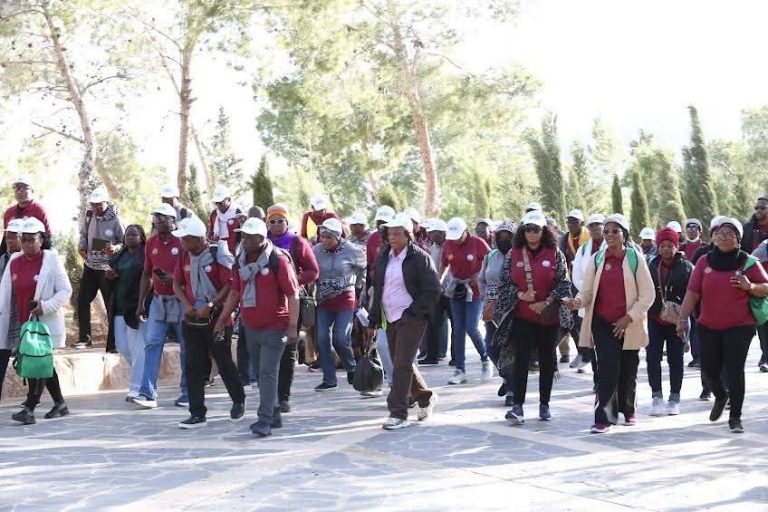
The 2025 Christian pilgrims have commenced their pilgrimage site visits in Jordan, visiting Mount Nebo, the Fortress of Machaerus, and the Dead Sea as part of their 10-day exercise.

At Mount Nebo, pilgrims saw where Moses viewed the Land of Canaan and admired the Brazen Serpent Monument, a symbol of the bronze serpent created by Moses. They then visited Mukawir (Machaerus), Herod the Great’s hilltop stronghold where John the Baptist was beheaded, and the Dead Sea, the lowest point on Earth.

The Lagos State Christian Pilgrims Welfare Board’s Secretary, Okudero Gbolabo Omoniyi with the support of the operational staff, ensured a seamless trip, overseeing pilgrims’ safety and welfare. Pilgrims have shared resounding testimonies, praising God for the experience.

At each pilgrimage site, praises and prayers were made by the pilgrims for themselves, the Lagos State Government, and the Country. Equally, praises and prayers were said within the buses while moving from one pilgrimage site to another. The pilgrims also observed morning and evening devotion to maintain the spiritual essence of the journey.

The pilgrims look forward to entering Israel on Day 3, Tuesday, 3rd February 2026.

Seyi Tinubu presents Obi Cubana with City Boy Movement appointment letter

0


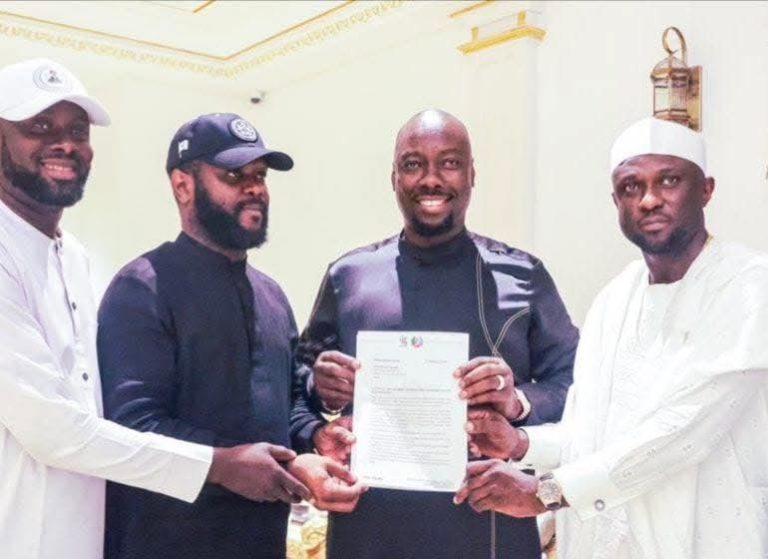
Obi Cubana, the Nigerian businessman, has been named the south-east director of the City Boy Movement (CBM).

The CBM, originally founded in 2022 as a youth-oriented support group for President Bola Tinubu’s election campaign, focuses on mobilising, educating, and empowering young Nigerians and women in alignment with the administration’s ‘Renewed Hope Agenda’.

Cubana’s appointment last week was confirmed on Monday during a strategic forum held by the movement.

In a ceremony captured on video and shared on social media platform, Seyi Tinubu, patron of the CBM, presented Cubana with his official letter of appointment.

credit: thecable

State govts now to share payment of electricity subsidy — FG

0

ABUJA — State governments are now to bear the cost of electricity subsidy, along with the Federal Government, President Bola Tinubu, has directed.

Vanguard gathered that funding for payment of the subsidy will now come from Power Assistance Consumers Fund, PCAF.

PCAF is a government-backed financial pool designed to subsidise electricity bills for low-income and vulnerable households to ensure affordability in the face of rising tariffs, thus improving energy access while stabilising the electricity sector by funding targeted support, instead of universal subsidies.


More than 18 states are currently operating their regulatory agencies, with others waiting in the wings to do same.

The states include Lagos, Ondo, Osun, Ekiti, Edo, Delta, Bayelsa, Akwa Ibom, Cross River, Abia, Anambra, Imo, Kogi, Niger, Nasarawa, Plateau, Gombe and Jigawa.

Director-General of the Budget Office of the Federation, BoF, Mr. Tanimu Yakubu, who disclosed this at the opening of the 2026 Post-Budget Preparation using Government Integrated Financial Management System, GIFMIS, workshop, in Abuja, yesterday, said state governments that enjoyed the political benefits of electricity subsidy must also share in filling the gap created by subsidy and must not be left to the Federal Government alone.

He said in an address read on his behalf by the Director of Expenditure Social, Mr. Yusuf Muhammed: “Mr. President has directed that we operationalise a clearer framework to share the cost of electricity across the federation, so the burden is not treated as an open-ended fiscal residual. I mean federal residual. Let me be direct.

“If you want a stable power sector, we must pay for the choices we make. When tariffs are held low cost, a gap is created. That gap is a subsidy, and a subsidy is a bill.

“In 2026, we will stop pretending that this bill can be left to the Federal Government alone, especially where the policy choice or the political benefit is shared across tiers of government. Mr. President directed us to invoke the electricity sector legal framework to make burden-sharing practical and transparent.

“This means subsidy costs must be explicit, tracked and funded, so they do not return as arrears liquidity crisis or hidden liabilities in the market. It also means that if any tier of government chooses affordability intervention, the responsibility must be clear, agreed and enforceable. This is not punishment. It is an alignment.

“When everyone carries a fair share of the cost, everyone also has an incentive to support cost effective, efficiency- targeted protection for the vulnerable, and empower market that can actually deliver for MDAs.
“The implication is simple, makes subsidies-related cost visible in your planning and submission. Do not push liabilities into the market as arrears or unfunded commitment. Support transparent rule-based attribution and financing of affordability decisions.”

The D-G also said the President directed the BoF and the MDAs to enhance the dynamism of fiscal rules through a review of the Fiscal Responsibility Framework.

“Fiscal rules are not a slogan, they are the guardrails of government. Without guardrails, spending becomes impulsive, debt becomes casual, and the budget becomes a statement of intent, rather than a tool of delivery.

“But rules must also be smart. They must respond to volatility without collapsing under pressure. That is why the 2026 direction is not to abandon rules, but to modernise them, so they work in today’s Nigeria.

“Mr. President’s directive is to review the Fiscal Responsibility Framework to make it more dynamic and more enforceable. That means clearer fiscal anchors, better-defined escape clauses for genuine shocks, and a credible path back to compliance when those clauses are used.

“It means stronger reporting, tighter discipline around contingent liabilities, and a firmer link between the medium-term framework and annual appropriations.

‘’For MDAs, this changes the conversation. You will not only be asked what you want to spend. You will be asked how it fits the fiscal rules, how it affects sustainability, and what measurable results it will deliver,’’ he said.

According to the D-G, in 2026, capital proposals must be delivery-ready and where appropriate, they must be finance-ready.

He said: “A long list of projects is not a development strategy. It is often a map of disappointment. What citizens feel is delivery —completed roads, reliable power, functional schools, working hospitals.

“So in 2026, we are moving decisively from naming projects to financing and delivering projects. This is where project financing becomes central. It is not a buzzword, it is a discipline. It means projects must be properly scoped, costed, sequenced and packaged to attract the right mix of funding—budget, PPPs, blended finance, guarantees, and counterpart resources where relevant.

“It means readiness: designs, approvals, procurement strategy, and an implementation time-table. It means bankability: a credible revenue or service-payment logic, risk allocation, and clear governance.

“It means prioritisation: fewer projects, better funded, better delivered. If we do this, the budget becomes a pipeline of completion, not a catalogue of unfinished work. That is the project-financing mindset Mr. President wants embedded across MDAs in 2026.”

NGF, state electricity regulatory commissions review decision
Reacting to the development yesterday, the Director of Media and Communications, Nigerian Governors’ Forum, NGF, Yunusa Abdullahi, said: ‘’We are reviewing the context and content of the information. We will not be making further comments on it.’’

Similarly, the State Electricity Regulatory Commissions, SERCs, in Lagos, Imo, Enugu, Ekiti, Oyo, Ondo, Edo, Niger, and Anambra yesterday held an emergency virtual meeting to review the situation and decide on appropriate steps to take.

A member, who pleaded to be anonymous, said: “We cannot make our official position known immediately. We are hearing it for the first time and currently meeting to review it. We need to understand the issue before responding or reacting to it.

“The government has taken appropriate steps in recent times to stimulate the development of the sector by deregulating activities, making the states to play active roles. But we need to interrogate the current decision and understand the implications on not only the states but also the entire power sector.”

States should pay subsidy as active partners — CPPE
On his part, Dr. Muda Yusuf, Chief executive officer, Centre for the Promotion of Private Enterprises, CPPE, said states should be ready to play active roles, including bearing subsidy burden as active stakeholders in the sector.

He said: “This model is not different from the model we had with the first subsidy. You know the first subsidy, all the states and local governments that had anything to do with FAAC allocation are paying for it because the NNPC which was supposed to be remitting to the federation account was not remitting, so all the states were paying for it.

“When the first subsidy stopped, NNPC was able to remit a lot more and the states were getting more revenue so I believe the same scenario is about to play out, with regard to electricity subsidy.

“The numbers are getting bigger and bigger by the day. The last time we were told that the GENCOs and the gas suppliers were owed about five trillion naira. The Federal Government had to issue a bond to that effect, that’s what we are seeing here and that was as at June or September last year.

Between then and now the figures will have gone up. So a subsidy regime that’s obviously difficult for the Federal Government alone to continue to carry is one that is not so sustainable but it’s not politically feasible to tamper with that subsidy regime as we speak.

“This is because the citizens are yet to recover from earlier reforms and the implications on their real income and on their welfare.

“We are in a pre-election year, so this is another cross the government will have to carry and they are closely connected from those who are supplying gas to those who are generating, down to those who are transmitting, as well as those distributing.

“This is a strongly linked and connected chain. And once there’s a break in the chain, electricity system goes down.

“However, it’s a sector that needs more rigorous reform, more fundamental reforms. But I am not sure those reforms can move as quickly as we desire, particularly at a time like this.

“This is a major policy concern. But for me, I think that decision is almost inevitable, given the rate at which electricity subsidy has been growing, because all the players have been talking about cost-reflective tariff and all of that, but I don’t think that is feasible at this time. That is a challenge.”

This is a big fiscal, political shift — Prof Iledare
Similarly, FUPRE Energy Business School and Executive Director, Emmanuel Egbogah Foundation, Prof. Wumi Iledare, said: “This is a big fiscal and political shift. It’s basically saying electricity subsidy is no longer just a federal burden, states must now share the cost.

“That fits the new electricity reforms where states have more power-sector authority, but it raises tough questions.

“How will the sharing formula work? Poorer states can’t carry the same load as richer ones. Can states even afford this without creating new debts? And what incentives does this create?

“If states must co-pay, they will likely push faster toward realistic tariffs, targeted subsidies, and local power investments.

“So this could either deepen the crisis or finally force more discipline and accountability in electricity financing. The outcome depends on whether the framework is transparent and rules-based, not political bargaining.”

Experts doubt FG’s power to make states pay electricity subsidies
Also speaking on the issue, a legal practitioner and Lead Consultant at Sage Consulting on Power Sector Advocacy and Advisory, Mr. Bode Fadipe, expressed reservations about how the policy will be enforced, noting that electricity subsidy remained a federal decision.

Fadipe queried whether the Federal Government has the constitutional authority to dictate how states should deploy their financial resources.

He said: “That is a serious issue when you are asking states to take on part of the subsidy or contribute to electricity subsidy payments. What will be the basis? Will it be based on what states consume or what their indigenes consume?

“It is a little hazy to start conjecturing how states will handle this when it is not their facility that conveys the energy we are talking about. It is unclear how state governments can now assume such responsibility.

“Perhaps when we see the policy and the implementation guidelines, it will become clearer what direction the Federal Government intends to take.

“But does the Federal Government have the right to tell states how to spend their money? These are fundamental issues that need to be addressed.”

Reflecting on the controversy surrounding attempts by Enugu Electricity Regulatory Commission, EERC, to set electricity tariffs last year, Fadipe noted that the Federal Government still controls the wholesale electricity market.

He said: “The wholesale market remains a federal government market. When electricity gets to the distribution level and the question arises, how much did State A or State B consume, or how much did the Federal Capital Territory consume, and the decision is taken that states should pay 10 or 20 per cent, it would have to be voluntary.

“It cannot be by federal directive. What the Federal Government is concerned about at the wholesale level is that its money is recovered. Who pays what should be immaterial to it.

“The Enugu issue is very clear. Enugu could not ask for a subsidy on a product it does not control. If it wants to do so, then it must be prepared to pay the differential arising from that decision.”

An electricity market expert, Lanre Elatuyi, said the Federal Government can only achieve such a policy through direct deductions from states’ allocations via the Federation Account Allocation Committee, FAAC.
However, Elatuyi warned that this approach could lead to conflict, as states will need accurate data on the volume of electricity consumed within their jurisdictions.

“FAAC deductions are one way of implementing this, and I believe it is fair for states to also contribute to electricity subsidy payments. The level of debt in the power sector has shown that the Federal Government alone can no longer shoulder the subsidy burden. “States can decide the percentage of subsidy they are willing to pay, especially since the Electricity Act empowers them to establish and regulate their own electricity markets,” he added.

Vanguard
Babcock Business School, Haven Tower Group to Establish ₦200m

0
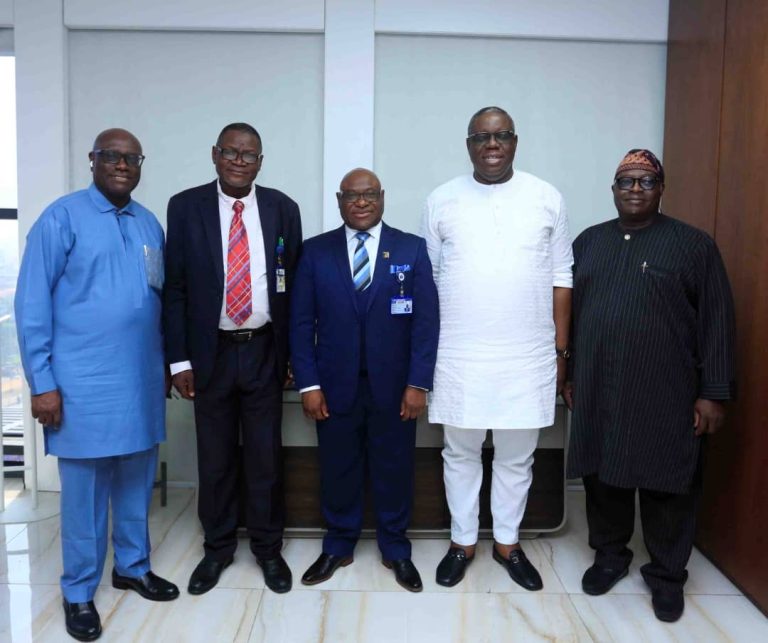
L-R: Managing Partner, O.M Associates, Mr. Olufemi Oguntade, President/Vice Chancellor, Professor Afolarin Olutunde Ojewole, Head of Babcock Business School, Professor Rufus Akintoye, Mnaging Director, Haven Tower Group, Dr. Akinyele Oladeji and Group Managing Director, Harvard Associates, Professor Abiodun Osiyemi at the meeting.


Vocational Centre in Lagos
Babcock University’s drive toward entrepreneurship and economic growth is set to gain fresh momentum with a planned partnership between Haven Tower Group and Babcock Business School (BBS) to establish a vocational centre in Lagos.

The proposed centre will be funded with an initial take-off sum of ₦200 million by Haven Tower Group and will offer hands-on training in technical and vocational skills, including brick making, tailoring and related trades. The programme is targeted at high school graduates and young people seeking practical, employable skills.

Under the partnership arrangement, Haven Tower Group will also provide training facilities, which will serve as an annex to the Babcock Business School.

Speaking on the initiative, the Managing Director of Haven Tower Group and a BBS alumnus, Dr. Akinyele Oladeji, described the partnership as his way of giving back to the institution. Dr. Oladeji is a member of the first set of PhD graduates of the Babcock Business School.
“This partnership is my way of giving back to the institution,” he said.

The proposal was discussed during a courtesy visit by the President/Vice-Chancellor of Babcock University, Professor Afolarin Olutunde Ojewole, to Dr. Oladeji at his Lagos office.

Also present at the meeting were the Head of Babcock Business School, Professor Rufus Akintoye; the Group Managing Director of Harvard Associates, Professor Abiodun Osiyemi; and the Managing Partner of O.M Associates, Mr. Olufemi Oguntade.

Responding, Professor Ojewole described the planned partnership as commendable and worthy of emulation, praising the alumnus for upholding the core values of the university.

“When we see an alumnus representing the core values of the university, we don’t have anything more to say but to appreciate him,” he said.

He added that the future lies in “touching lives through excellence and helping Nigeria.”

The Memorandum of Understanding (MoU) detailing the partnership is expected to be signed in the coming weeks.

“MAKOKO DEMOLITION IS FOR SAFETY OF CITIZENS” – LASG

0


The Lagos State Government has stated that the ongoing demolition and structural removal in the fishing community of Makoko is aimed at ensuring the safety of the citizens living there, rather than perpetuating the erroneous belief that it is for land grabbing by the government.

This was disclosed by the Special Adviser on Urban Development and E-GIS to the Governor, Dr. Olajide Babatunde, while addressing the Press today at the Bagauda Kaltho Press Centre, Alausa-Ikeja.

He said the structures that have been removed are those under the high-tension electricity poles, which pose a high risk to human existence, and this is not restricted to Makoko only.

He further said that the regeneration of the other part of the community where people are living would be carried out in phases while human convenience would be considered in the development of the area, adding that the removal of structures under the high tension poles in the state is ongoing and will not be stopped citing health and other hazardous effects.

Olajide added that regeneration of the urban areas in the state is not limited to Makoko and Oworonshoki. He cited other previous and ongoing areas to include Pelewura, Kantangowa, and Oko-baba, among others.

“The removal of such structures did not start from this administration. It has been ongoing, and we will continue to ensure that sanity prevails in our environment so that Lagos can be the best city we all crave to live in,” he concluded.

Omokri Hails Naira Gains, Urges Nigerians to Buy Local to Sustain Economic Reforms

0


Former presidential aide and public commentator, Reno Omokri, has said recent appreciation of the naira is evidence that President Bola Tinubu’s economic reforms are yielding results, urging Nigerians to support the trend by patronising locally made goods and services.

In a statement shared on social media, Omokri noted that the naira strengthened about ₦1,386 to the dollar on Friday and further to ₦1,384 on Saturday, describing the movement as a two-year low against the United States currency.

According to him, the gains reflect the impact of the Federal Government’s decision to float the naira, allowing its value to be determined by market forces of supply and demand rather than artificial controls.

Omokri criticised comparisons with previous exchange rates, arguing that earlier figures were sustained through heavy dollar subsidies.

He claimed that prior administrations spent about $1.5 billion monthly to defend the currency, a practice he said contributed to Nigeria’s debt burden, which he noted had reduced from $113 billion to $97 billion under the current administration.

He further linked the naira’s recent performance to increased patronage of Nigerian-made products, attributing the shift to government policies that encourage local production and consumption. Omokri said this trend has helped boost purchasing power and improve broader economic indicators.

The commentator also cited improvements in key macroeconomic data, including a reported decline in inflation and a rise in foreign reserves, while asserting that Nigeria has emerged as one of the leading contributors to global GDP growth in 2025. These claims, he said, demonstrate progress in income equality and overall economic stability.

Calling on citizens to play their part, Omokri urged Nigerians to prioritise local brands across sectors such as transportation, energy, telecommunications, construction, food, fashion, entertainment, and aviation. He argued that sustained support for indigenous products would further strengthen the naira and the national economy.

Omokri concluded by appealing for collective responsibility, stressing that consumer choices remain critical to the success of ongoing economic reforms and the long-term stability of Nigeria’s currency.

Davido breaks silence after Grammy Awards Loss

0

Award-winning singer David Adeleke, popularly known as Davido,

Five-time Grammy nominee, David Adeleke, popularly known as Davido, has reacted after losing the Best African Music Performance category at the 68th Grammy Awards held in Los Angeles, United States.

The Afrobeats star shared a message of faith and resilience following the outcome of the ceremony, which took place on Sunday night at the Crypto.com Arena in California.

In a post on his Instagram page, Davido shared photos with his wife, Chioma, from the event and wrote, “Oluwa Dey my side,” alongside prayer and music emojis.

Hours later, he posted another set of pictures of himself and Chioma at the Grammys, reflecting on the loss in a longer caption.

“I said baby listen we lost again let’s not go ! she said ‘Be humble in victory and gracious in defeat’ we outside,” he wrote.

Chioma also reacted via her Instagram page, praising the singer, “You already know that you’re the perfect one, @davido,” she wrote, while sharing photos from the awards night.

Davido was nominated in the Best African Music Performance category at the 2026 Grammy Awards but lost to South African singer Tyla, who won with her song Push 2 Start.

Other nominees in the category included Burna Boy (Love), Ayra Starr and Wizkid (Gimme Dat), Davido (With You featuring Omah Lay), and Eddy Kenzo and Mehran Matin (Hope & Love).

The win marked Tyla’s second Grammy Award, following her first victory in 2024 for her hit single Water.

Speaking during the awards ceremony, the singer revealed that With You, featuring Omah Lay, almost did not make the final tracklist of his album 5IVE.

“Man, it’s so crazy because that song almost didn’t make the album. With You was not in anybody’s top five.
“And now look at it go. Every time I was performing it, my heart would just start beating like, what if I didn’t put this song?” he told OkayAfrica.

Davido also recounted how he learned about the Grammy nomination, saying the news came unexpectedly while he was in Dubai, days before his birthday.

“I was in the car, actually, checking a car, and then my phone rang. They were like, ‘Oh yeah, another nomination.’ I was like, wow. Thank God,” he said.

“With You” was released in April 2025 as the 17th track on Davido’s fifth studio album, 5IVE, and has since become one of his most successful recent records, surpassing 100 million streams on Spotify.

Despite the song’s success, Nigeria did not record a win at the 2026 Grammy Awards.

Davido said he is now focused on touring and releasing new music.

He is also billed to perform at Coachella 2026, where he will be the only Nigerian artiste on the festival lineup, performing on April 11 and April 18, 2026, in Indio, California.

Guardian

Six Killed, 23 Injured as Truck Carrying 35 Cows Crashes on Lagos–Ibadan Expressway

0


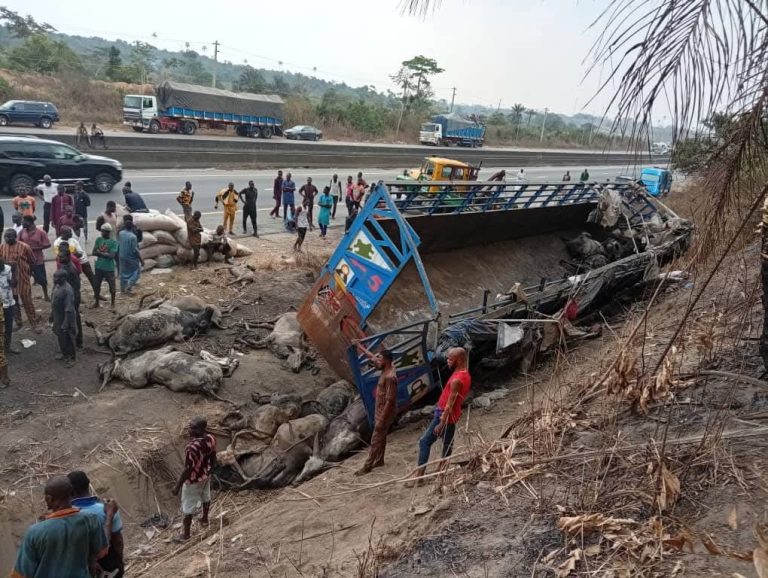
Six people have been confirmed dead and 23 others injured following a lone truck crash along the Lagos–Ibadan Expressway on Monday.

The accident occurred around the Foursquare Camp area and involved a DAF CF 380 trailer, painted white and blue, with registration number SNA 287 XA. The truck was reportedly conveying passengers and about 35 cows from the northern part of the country to Lagos State.

According to eyewitness accounts, the crash was caused by driver fatigue and excessive speeding, which led to the vehicle losing control and crashing. All 35 cows being transported in the trailer were reportedly killed in the incident.

The injured victims and the bodies of the deceased were evacuated to Oreoluwa Hospital, GOFAMINT Camp, Ogunmakin, as well as Victory Hospital in Ogere for medical attention and identification.

Confirming the incident, the Ogun State Sector Command of the Federal Road Safety Corps (FRSC) said the crash occurred at about 11:27 a.m. Odunsi-Oyewole, who spoke on behalf of the command, disclosed that rescue operatives from the FRSC Ogunmakin Unit Command arrived at the scene within two minutes of receiving the distress call.

“The Federal Road Safety Corps (FRSC) Ogun Sector Command reports a fatal road traffic crash on the Ibadan–Lagos Expressway near the Foursquare Camp area earlier today,” Odunsi-Oyewole said. “The lone crash involved a DAF CF 380 trailer with registration number SNA 287 XA.”

The FRSC has advised motorists, especially commercial drivers, to avoid speeding and driving under fatigue in order to prevent further loss of lives on Nigerian highways.