Home Blog Page 616

11th Agrofood Nigeria 2026 to Records Strongest International Participation Ever

0


West Africa’s leading agrofood and packaging exhibition, agrofood Nigeria, will hold its 11th edition from March 24 to 26, 2026 at the Landmark Centre, Victoria Island, Lagos, with its highest level of international participation to date.

Organised by fairtrade Messe in cooperation with Modion Communications, the annual event has grown into the region’s foremost business platform for agriculture, food and beverage technology, food ingredients, packaging and finished food products.

The 2026 edition will host over 100 exhibitors from 14 countries across Africa, Asia, Europe and the Middle East, attracting thousands of decision-makers from Nigeria and beyond.
Participating countries include Belgium, Brazil, China, France, Germany, India, Malaysia, the Netherlands, Nigeria, Poland, South Africa, the United Arab Emirates, the United Kingdom and the United States. Organisers say the exhibition will facilitate technology transfer, strengthen supply chains and support investment decisions across West Africa’s agro-industrial value chain.

The Netherlands has been named Guest of Honour for 2026, marking eight consecutive years of participation. Led by the Netherlands Consulate-General in Lagos, about 20 Dutch companies will showcase innovations in horticulture, seed technology, greenhouse systems, food processing, agrologistics and climate-smart agriculture.

Other national pavilions include Belgium/Flanders, China, Germany, India, South Africa’s Western Cape and Nigeria, alongside a first-time participation by the Food Export Association of the Midwest and Northeast USA, which will introduce American suppliers to Nigerian food traders.

The three-day event will feature specialised segments covering agro, food and beverage technology, food ingredients, packaging, and food plus hospitality, supported by conference sessions and government and industry stakeholders. Organisers say the exhibition continues to position Nigeria as a regional hub for agrofood investment and innovation.
Industry data underscores the country’s market potential.

According to VDMA, Nigeria imported €265 million worth of food and packaging technology in 2024, including €121 million in packaging technology alone. Statista projects Nigeria’s food market to reach $233.53 billion in 2025, with an annual growth rate of 10.76 per cent through 2030, while WTO data shows food imports stood at $6.1 billion in 2023, compared to $2.2 billion in exports.

Founded in 1991, fairtrade Messe is an ISO 9001:2015-certified member of UFI – The Global Association of the Exhibition Industry, and has organised trade fairs connecting emerging markets with global solution providers across Africa and the Middle East.

Dangote Refinery Deepens Local Content, Onboards 330 Graduate Engineers

0


In furtherance of its commitment to nurturing young Nigerian professionals and fostering a high-performance workplace, Dangote Petroleum Refinery and Petrochemicals has inducted a fresh cohort of graduate engineers into its technical workforce.

A total of 330 graduate engineers, drawn from leading tertiary institutions across the country, were formally inducted during a ceremony held at the refinery complex.

The new intakes join other trainees who have undergone world-class technical training, mentorship and hands-on rotational exposure across key units within the refinery and petrochemicals value chain.

The Chief Executive Officer of the refinery, Mr. David Bird, described the induction as a strategic step in the company’s drive to build local capacity, strengthen Nigeria’s engineering talent pool and sustain operational excellence across its integrated energy infrastructure.

He commended the engineer trainees for their outstanding performance during the training programme and encouraged them to remain committed to continuous learning and improvement. Bird assured them of a conducive work environment that would enable them to maximise their potential.

He further charged the new engineers to give their best in their respective areas of operation, noting that their training had adequately prepared them for the expectations of working in a modern, world-class refinery.

The trainees represent core disciplines including Chemical Engineering, Electrical and Electronic Engineering, Mechanical Engineering and Instrumentation. Their induction underscores the organisation’s sustained investment in technical capacity development and succession planning.

As part of the induction process, the young engineers presented and defended group projects before members of the company’s management team, who assessed their understanding, innovations and practical contributions to refinery operations.
The project defence marked the conclusion of their classroom training.

The presentations focused on practical solutions to current and emerging challenges within the plant, including modelling of refinery processes, research and development initiatives, and other operational improvements.
Dr. Ebele Oputa, Coordinator of the programme and Assistant General Manager, Human Asset Management at Dangote Petroleum Refinery, said the induction further demonstrates the refinery’s dedication to nurturing local talent and building a strong pipeline of skilled engineers to support its operations.
Providing insights into the programme, Oputa explained that the training was deliberately structured to enable the young engineers to align theoretical knowledge acquired in school with hands-on practical experience at the refinery.
According to her, the programme is designed to develop both technical and leadership competencies over time, equipping the trainees to effectively guide teams in their professional and personal growth.

“While some individuals may naturally incline towards leadership, leadership skills can also be developed. Our goal is to ensure that all management trainees are positioned to excel in leadership roles over time,” she said.

She added that the training programmes also create opportunities for the engineers to network with industry professionals, helping them identify their strengths and weaknesses, set career goals and develop clear pathways for achieving them.

Oputa further noted that the hands-on training component is aimed at boosting the engineers’ confidence and preparing them for workplace challenges.

“They pass through induction, observation and shadowing at the refinery, classroom-based equipment training, hands-on practical sessions, unit-by-unit plant training in the production areas and supervised work with coaching for the remainder of their programme,” she explained.

The trainee engineers expressed appreciation to the refinery’s management for the opportunity to participate in what they described as a preparatory pathway to becoming full staff of the world’s largest single-train refinery. They pledged to justify the confidence reposed in them and contribute meaningfully to the organisation’s growth.

EXCLUSIVE: Power play in Reps as REA Committee directs its Renewable Energy counterpart to stop probe of agency’s spending

0


A major clash has erupted in the House of Representatives following moves by the House Committee on the National Rural Electrification Agency to halt an ongoing investigative hearing by the House Committee on Renewable Energy into renewable energy projects, funding, and programme implementation by the Rural Electrification Agency since 2015.

Documents obtained exclusively by Daily Sun show that the REA Committee has formally written to the Renewable Energy Committee, urging it to suspend its probe, arguing that the investigation falls squarely within its statutory oversight mandate. In the letter dated February 25, 2026, and addressed to the Chairman of the House Committee on Renewable Energy through the Office of the Speaker, the REA Committee chairman, Hon. Mohammed Bukar Ibrahim, acknowledged the investigative hearing but said it had become aware that the committee had commenced inquiries “touching on the activities, financing, and programme implementation of the Rural Electrification Agency, including matters relating to grants, loans, and project domiciliation from 2015 to date.”

While recognising the importance of legislative oversight, the committee insisted that it was “already undertaking a comprehensive review and oversight of the same subject areas, specifically the utilisation of funds, project delivery, institutional performance, and compliance within the Agency’s operations.” It warned that parallel probes could result in “duplication of legislative activity, potential procedural conflicts, and avoidable administrative strain on the Agency and other stakeholders,” adding that “in the interest of coherence, institutional clarity, and the efficient exercise of the House’s oversight responsibilities,” matters directly relating to the REA should be coordinated through its committee.

In a direct appeal, the committee requested that the Renewable Energy Committee “stay further proceedings as they relate specifically to the REA and await the outcome of the ongoing work and findings of the House Committee on REA,” promising that “upon conclusion, our Committee will formally brief the leadership of the House and relevant Committees, including yours, to ensure alignment and informed legislative action.” It argued that the approach would “reinforce coordination within the House, prevent duplication, and preserve the integrity of the oversight process while ensuring that all concerns are addressed in a structured and institutionally appropriate manner.”

However, the Renewable Energy Committee pushed back, insisting that it is acting on a direct resolution of the House and constitutional authority. In a letter dated February 26 titled Re: Ongoing investigation into renewable energy projects and activities of the Rural Electrification, REA, and signed by its chairman, Hon Afam Victor Ogene, it noted that the subject matter of the REA Committee’s letter was “misleading and suggests a little understanding of the Resolutions of the House, which necessitated the investigations in the first instance.”

It further stated, “The Investigative Hearing is not about the ‘activities of the Rural Electrification Agency,’ but investigations backed by the resolutions of the House as follows: Investigation of the domiciliation of the Green Energy projects with inappropriate entities to avert substandard implementation a d loss of values; the investigation of renewable energy sector and foreign grants received from 2015 till date and need for utilisation of renewable energy in ministries, departments and agencies of the Federal Government.

“For clarity, please note that these mandates are within the jurisdiction of the House Committee on Renewable Energy as contained in the Standing Orders of the House of Representatives ( Eleventh Edition), which states, on page 231, thus:
“There shall be a committee to be known as the Committee on Renewable Energy constituted at the commencement of the life of the House.”

He added that among others, the committee’s jurisdiction as conferred by the House shall cover
oversight over “all departments and agencies concerned with renewable energy.”

Ogene added, “We consider this request as an affront to the resolution of the House and the mandate and jurisdiction of the House Committee on Renewable Energy. The Committee on Renewable Energy has neither embarked on a fishing expedition nor has it, by any stretch of the imagination, sought to oversight the Rural Electrification Agency – which is why issues bordering on the Agency’s personnel costs, overhead expenditure and core capital projects are not under scrutiny in the current Investigative Hearing.

“It is, indeed, the considered opinion of the Committee on Renewable Energy, that such practices of rushing to shield MDAs from accountability on account of any considerations, attracts disrespect to the institution of the Legislature and undermine the integrity of legislative processes and should be discouraged.

“For the above reasons, I wish to inform you that the Committee is dismayed by this ill-advised intrusion into an assignment duly thrust upon it by the entire House of Representatives, and accordingly, hereby decline your request.”

In its invitation letter to the managing director and chief executive officer of the REA, the committee cited the resolution adopted by the House on October 22, 2025, mandating it to investigate the domiciliation of green and renewable energy projects across Ministries, Departments and Agencies. Relying on Sections 62, 88 and 89 of the 1999 Constitution as amended, the committee said it was conducting “a comprehensive audit of renewable energy interventions under the Rural Electrification Agency, particularly those implemented under the Energising Education Programme Phases I, II, and III.”

“To ensure accuracy and completeness of this investigation, the Committee hereby invites all contractors and developers engaged in EEP Phase I–III projects to present themselves with full project documentation before the Committee,” the letter stated, adding that the exercise was aimed at establishing compliance with due process and procurement standards, verifying project execution quality and sustainability readiness, and preventing loss of value and recurrence of underperforming renewable assets.

The probe targets some of the country’s most high-profile solar hybrid projects located in federal universities and teaching hospitals nationwide. Under Phase I, the projects include installations at Abubakar Tafawa Balewa University and Teaching Hospital in Bauchi, Bayero University Kano, Federal University of Agriculture Makurdi in Benue, Federal University of Petroleum Resources Effurun in Delta, Federal University Ndufu-Alike Ikwo in Ebonyi, Nnamdi Azikiwe University in Anambra, and Usman Danfodiyo University in Sokoto. Phase II extends to the University of Abuja.

Others are the Nigeria Defence Academy Kaduna, Michael Okpara University of Agriculture Umudike, University of Calabar and Teaching Hospital, Federal University of Agriculture Abeokuta, University of Maiduguri and Teaching Hospital, Federal University Gashua, University of Port Harcourt and Teaching Hospital, University of Uyo, Federal University Akure, and Federal University of Technology Owerri. Phase III covers Modibbo Adama University in Adamawa, Federal University Dustin-Ma in Katsina, Federal University Lafia in Nasarawa, Federal University Lokoja in Kogi, Federal University of Technology Owerri, University of Port Harcourt and Teaching Hospital, University of Uyo, and Federal University Akure.

Contractors and developers handling the projects have been directed to appear with original and certified true copies of contract award letters, executed agreements and memoranda of understanding, engineering drawings, bills of quantities, feasibility studies, commissioning certificates, sustainability plans, maintenance agreements, records of contractual variations, manufacturer warranties, handover documents, and operational and maintenance provisions.
Sources within the House describe the standoff as an emerging turf war over jurisdiction, with major implications for transparency and accountability in Nigeria’s renewable energy sector.

While the REA Committee maintains that oversight of the agency properly belongs to it, the Renewable Energy Committee insists that its mandate transcends agency boundaries, covering renewable energy interventions across all MDAs. A ranking lawmaker familiar with the development said the move to stall the probe “raises serious questions about institutional rivalry and the willingness of lawmakers to subject sensitive power-sector projects to full scrutiny,” warning that “the House gave a clear mandate, and any attempt to block that process risks undermining parliamentary oversight and public confidence.”

The Energising Education Programme is one of Nigeria’s flagship renewable energy interventions, backed by billions of naira in public funding and foreign grants, and designed to provide stable electricity to federal universities and teaching hospitals, cut energy costs, and reduce dependence on diesel generators. However, persistent concerns over project quality, sustainability, maintenance frameworks, and transparency in contract awards have heightened calls for rigorous legislative scrutiny. With both committees now locked in a jurisdictional contest, the unfolding confrontation is shaping up as a major test of legislative authority, accountability, and the future of oversight in Nigeria’s fast-expanding renewable energy sector.

The hearing continues on Tuesday.

Sun

Domestic violence is national emergency, we need to curb the menace, says Bar Obeke-Okoli

0
L-R: Human rights lawyer and Deputy State Coordinator, African Women Lawyers Association (AWLA), Bar Chidi Obeke-Okoli ; Magistrate Uzoamaka Ozobu and the Coordinator of AWLA, Bar Ngozi Abafor, during the inauguration of Obeke-Okoli and Abafor in Enugu … on Saturday

Newly inaugurated Deputy Coordinator of the African Women Lawyers Association (AWLA), Enugu State Branch, Bar Chidi Obeke-Okoli, has described domestic violence as a national emergency, saying there is the need for urgent, coordinated action against the menace across Nigeria.

Speaking in Enugu shortly after her inauguration on Saturday, Obeke-Okoli characterised domestic abuse as a “dangerous cankerworm” eroding the foundation of the Nigerian family and undermining national peace and security.

The human rights lawyer also outlined an ambitious reform agenda that extends beyond courtroom advocacy to grassroots mobilisation, institutional accountability, and community-driven prevention.

Central to her intervention is the legal framework established by the Enugu State Government under the able leadership of Governor Peter Mbah.

Obeke-Okoli also commended the state government for domesticating the Violence Against Persons (Prohibition) Law (VAPP), describing the move as a decisive step toward strengthening protections for victims.

According to her, the domestication of the VAPP Law signals that Enugu State will no longer tolerate domestic violence in any form. She urged legal practitioners, law enforcement agencies, and residents to ensure that the legislation functions not merely as a statutory instrument, but as an active safeguard for vulnerable persons.

“The legal machinery is in place. What remains is collective responsibility to make the law work,” she said.

The AWLA deputy coordinator also expressed concern over what she described as the fading culture of communal responsibility in Nigerian society.

She lamented a growing trend where bystanders record incidents of domestic abuse for social media rather than intervene or report. An ideal society, she argued, must be built on empathy, courage, and the willingness to speak up against wrongdoing.

“No society can thrive where neighbours ignore suffering next door,” she stated, calling for a return to the values of collective protection and moral accountability.

Obeke-Okoli directed strong remarks at the Nigeria Police Force and Sexual Assault Referral Centres (SARCs) operating in Enugu State, urging improved responsiveness to domestic violence complaints.

She condemned the reported practice of demanding unofficial “mobilisation fees” to process petitions or act on cases, describing it as an unacceptable barrier to justice.

Demanding monetary compensation from victims, she said, amounts to a second layer of trauma and institutional betrayal. She warned that any verified cases of extortion would be escalated to the appropriate national authorities.

Affirming that domestic violence is a nationwide problem affecting all the 36 states of the federation, Obeke-Okoli said Enugu would serve as a model for comprehensive reform.

She disclosed plans to simplify and translate the VAPP Law into local dialects to enhance public understanding, particularly in rural communities and markets. The aim, she explained, is to ensure that every citizen understands their rights and the legal remedies available.

Under the new AWLA leadership, she pledged sustained grassroots engagement, policy advocacy, and strategic partnerships to restore the “happy home” as the bedrock of national security.

Concluding her remarks, Obeke-Okoli described the fight against domestic violence as both a civic duty and a moral calling, saying that the legal reforms must be complemented by ethical renewal and collective resolve.

With coordinated institutional support, community vigilance, and sustained advocacy, Obeke-Okoli expressed confidence that Nigeria can reverse the tide of domestic abuse and rebuild safer homes across the country.

2027: The Okeogun Question — Why Oyo’s Forgotten Axis Is Demanding Its Turn at Agodi

0

For decades, politics in the Pace Setter State has followed a familiar compass — it points to Ibadan.

From the Second Republic to the Fourth, the political capital of Ọ̀yọ́ State has also been its electoral capital. Governors emerged repeatedly from the same axis, power circulated within a narrow corridor, and other zones played supporting roles in the theatre of governance.

But as the 2027 governorship race quietly begins to take shape, a new narrative is forcing its way into the conversation — the Okeogun argument.

And this time, it is louder, organised and backed with numbers.

A Declaration From the Margins

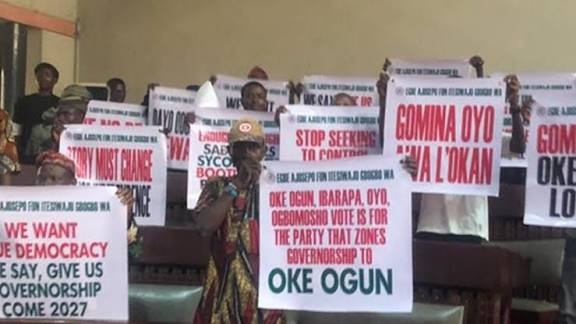
An advocacy movement, Ẹgbẹ́ Àjọṣepọ̀ Fún Ìtẹsiwájú Gbogbo Wa, has issued what it describes not as agitation but “a historic declaration.”

In a formal communication to President Bola Ahmed Tinubu, the group insisted that nothing short of zoning the 2027 governorship to Okeogun would be acceptable.

The message was blunt:
Okeogun rejects deputy governorship, party chairmanship or symbolic concessions. Only the governorship seat is acceptable in 2027.

For the people of the agrarian northern belt of the state, this is not merely about ambition — it is about correction of what they see as a long-standing political imbalance.

Since 1979, Ibadan has produced six governors.
Okeogun — despite its size and contribution — has produced none.

Yet it has produced five deputy governors.
To them, that is evidence of inclusion without authority.

The Numbers Behind the Anger
Beyond emotion, the agitation rests heavily on electoral arithmetic.
During the 2023 elections:
Zone
Compliance (Turnout Rate)
Ibadan
22.6%
Okeogun
46.7% (Highest)
Ogbomoso
31.7%
Oyo
34.4%
Ibarapa
31.7%
The implication is politically significant:
Ibadan has population advantage, but the rest of the state has participation advantage.

When the four non-Ibadan zones vote together, they rival — and sometimes outweigh — the capital.
The group’s new coalition, the G22 Movement (22 local governments outside Ibadan), is built around that single idea:
Oyo elections are won by alliances, not population mythology.

Why Okeogun Says It Deserves Power

The agitation rests on four core arguments:
Political Equity
Other Southwest states rotate power informally. Oyo, they argue, has remained structurally centralised.

Loyalty Without Reward
Okeogun voters historically support winning coalitions but never lead them.
Electoral Value
Highest turnout zone in recent elections — yet lowest executive representation.

Stability Through Inclusion
The belief: giving power to new zones reduces political resentment and strengthens state unity.

In their words:
Inclusion today prevents instability tomorrow.
The Emerging 2027 Contestants
Across parties and regions, several figures are already positioned — quietly or openly — for the next succession battle.
Technocrats & Reform-minded Aspirants
Dr. Muyiwa Gbadegesin
Environmental management expert and head of Lagos waste authority. Seen as a technocratic contender with governance experience.

Barr. Beulah Adeoye
Corporate forensic expert and financial advisory professional positioning within the PDP as a new-generation candidate.
Political Heavyweights
Barr. Bayo Shittu
Former minister and long-time political actor with deep institutional experience and party structures.

Engr. Rauf Olaniyan
Former deputy governor and veteran technocrat with decades inside the state system.

Security & Strategic Leadership Bloc
Dr. Gbenga Adegbola
Retired military officer projecting discipline-driven governance and economic structure reforms.

Ideological & Grassroots Mobilisers
Dr. Yinusa Kazeem Ayandoye
Consistent advocate of rotational fairness, building support around equity-driven politics beyond dominant party structures.

The Real Battle: Geography vs Coalition
The coming election may not be decided by popularity alone but by a political equation:
Ibadan = population
Others = coalition
For the first time, the “others” are attempting a coordinated bargaining position.

Okeogun is not merely asking to produce a governor —
it is asking to redefine how governors emerge in Oyo State.

What Happens If Power Shifts?
Political analysts suggest three possible outcomes:
Stability through inclusion — resentment across zones reduces.

New development priorities — agriculture, border economy, and rural infrastructure gain prominence.
Permanent zoning precedent — an informal rotation system may emerge.

The Moment Before the Storm

The 2027 race has not officially begun, but negotiations already have.
Behind party primaries and endorsements lies a deeper question:
Is Oyo State ready to evolve from dominance politics to balance politics?
For Okeogun, the answer is no longer negotiable.
For the rest of the state, it may soon become unavoidable.

Because in Oyo politics, history has always followed alliances —
and alliances are now shifting northward.

Police Council confirms Disu as substantive I-G

0


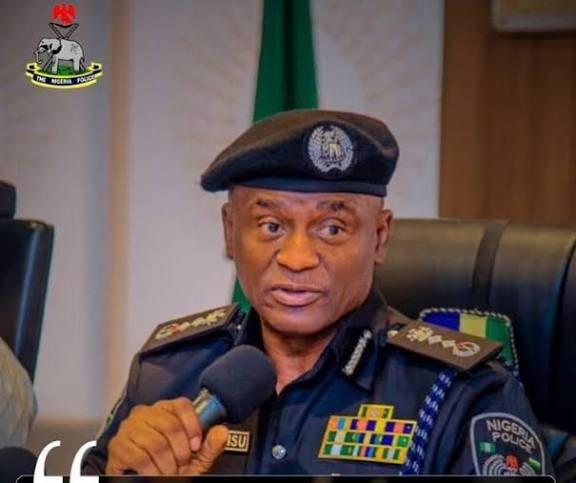
The National Police Council on Monday confirmed Olatunji Disu as the substantive Inspector-General of Police (IGP), formally ratifying his appointment as Nigeria’s 23rd police chief.

The council, chaired by President Bola Tinubu and attended by state governors, endorsed Disu’s appointment at its meeting held at the State House, Abuja.

Tinubu had earlier appointed Disu as Acting Inspector-General of Police on Feb. 24, following the resignation of Kayode Egbetokun.

In line with the provisions of the 1999 Constitution and the Police Act, the appointment required confirmation by the National Police Council before assumption of office on a substantive basis.

Disu is a seasoned police officer with decades of operational and administrative experience in the Nigeria Police Force.

He previously served as Commissioner of Police in Rivers State and the Federal Capital Territory.

The new IGP also served as Assistant Inspector-General in charge of the Special Protection Unit (SPU).

His confirmation signals a formal transition in the leadership of the Nigeria Police Force amid prevailing security challenges across the country.

Those at the meeting included Vice-President Kashim Shettima and Secretary to the Government of the Federation, George Akume.

Also present were National Security Adviser, Malam Nuhu Ribadu, and Minister of Police Affairs, Ibrahim Geidam.

Others were Chairman of the Police Service Commission, Hashimu Argungu, and Chairman of the Nigeria Governors’ Forum, Gov. AbdulRahman AbdulRazaq of Kwara.

Gov. Babajide Sanwo-Olu, of Lagos State, Dapo Abiodun of Ogun, Abdullahi Sule of Nasarawa State,Caleb Mutfwang of Plateau also attended.

Deputy governors of Kogi and Delta states were present at the meeting.

Minister of Interior, Olubunmi Ojo, and other cabinet members also attended the council session.

Death toll rises to165 at Iranian girl’s school

0


The death toll from an alleged airstrike on a girl’s primary school in Iran’s Hormozgan Province has risen to 165, with rescue operations now concluded.

The officials said on Monday to the state news agency `Islamic Republic News Agency’.

The governor of the southern city of Minab, where the school was located, said search and rescue efforts had ended.

95 people were also reported injured.

The government in Tehran has blamed the strike on the U.S. and Israel.

Israel has denied any involvement.

“None of Israeli or American attacks there were known to us at that point in time,” Israeli military spokesman Nadav Shoshani said on Sunday.

Shoshani added that Israel had recently carried out a highly precise operation more than 1,000 miles away, referring to the killing of Iran’s supreme leader, Ali Khamenei.

The United Nations children’s agency (UNICEF) said it was “deeply concerned” about reports of bombings in Iran, including the strike on the girls’ school in Minab.

“Attacks on civilians and civilian objects, including schools, constitute a violation of international law,” UNICEF’s German office said in a statement issued in Cologne on Sunday.

The reported details of the attack could not be independently verified.

UNICEF called for an immediate cessation of hostilities and urged all parties to comply with international humanitarian and human rights law, particularly with regard to protecting civilians and essential services for children.

The Sun Foundation Wike reaffirms Tinubu support, slams PDP

0

FCT Minister Nyesom Wike at the media chat on Monday, March 2, 2026

• Defends his monitoring of FCT polls, says he has delegated authority
• Insists Ireti Kingibe won’t return to the Senate

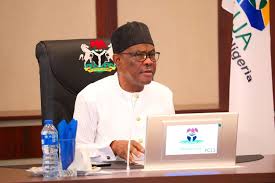
Minister of the Federal Capital Territory (FCT), Nyesom Wike, on Monday defended his ongoing support for President Bola Tinubu while lambasting his party, the Peoples Democratic Party (PDP), for failing to evolve.

At a media parley in Abuja, Wike said his stance should not surprise anyone, having voiced it openly in 2023. “I told you in 2023 that even as a PDP man, I was going to work for the president. That is what I did because I believe, and rightly so, that the other parties did not present serious candidates,” he said.

He sharpened his critique of the PDP’s internal woes. “I have said several times that, as far as I am concerned, my party appears not to have learnt. That is why I said I was going to support Mr President for a second term,” he said. Wike also highlighted what he described as the party’s snub. “As a minister, my party did not consult me on the candidates they were going to present.”

His allegiance, he clarified, transcends party lines. “I said I would support candidates who support Mr President for his re-election. It does not matter which party they belong to. If they support Mr President, then of course I will pitch my tent with them,” he said.

Turning to the 21 February 2025 FCT area council elections — where the APC won five of six chairmanship seats (Abuja Municipal, Abaji, Bwari, Kwali, Kuje) and the PDP took Gwagwalada — Wike described elections as holistic processes. “Election is a process. It begins with the nomination of candidates, proceeds through campaigns, and then culminates in voting. It is not just about a particular day,” he said.

He defended pre-poll movement restrictions from 8 p.m., which he said were approved by the president for safety. “By the approval of the president, movement was restricted from 8 p.m. for security reasons. It was to ensure that people did not import troublemakers into the city to cause a crisis,” he said.

Dismissing disenfranchisement claims, he pointed out, “The election was on Saturday, and voting took place from 6 a.m. to 6 p.m. You cannot say people were not allowed to vote. That is not correct.”

On his polling unit visits, Wike invoked his mandate. “The power has been delegated to me. A certain amount of authority has been given to me to act on behalf of the President.” He rejected rigging allegations. “I was not on the ballot. I never told anyone not to vote for any candidate. All I said was that I would support candidates who support Mr President.”

Embracing his role unapologetically, he declared, “Let me make this clear: I am a politician. I chose to be a politician, and politics is about winning.” He refuted voter suppression claims. “What is disenfranchisement? If a party says it is not prepared for an election, does that stop others from voting? Disenfranchisement means people were not allowed to vote, and that was not the case.”

Wike advised dissatisfied parties to seek legal redress. “If anyone is dissatisfied, they should go to the tribunal. Let the tribunal cancel the election and order a rerun if necessary. The outcome will not be different.”

Wike also boasted that he would defeat any presidential rival, claiming that Nigerians’ enduring affection would deliver him a massive victory.

“Nigerians still love me, and if I run for president, they will vote for me massively,” the FCT minister declared. He highlighted his easy rapport with ordinary citizens, insisting that his record as former Rivers State governor and current FCT minister speaks for itself.

Wike added that even a rerun of the recent Abuja council elections would still see his loyalists triumph.

The minister further reaffirmed his bold prediction that Senator Ireti Kingibe will not return as FCT representative in the 2027 elections.

He stood firm on his claim, first made over a year ago, vowing no change of heart despite ongoing clashes with the Labour Party lawmaker over FCT governance and personal rifts.

The minister, who has publicly dared Kingibe to run again, promised to mobilise grassroots support to defeat her. “This is my territory,” he declared, dismissing her previous victory as a fluke unlikely to be repeated.

Sun

U.S.-Israel strikes on Iran trigger escalation, Khamenei killed

0


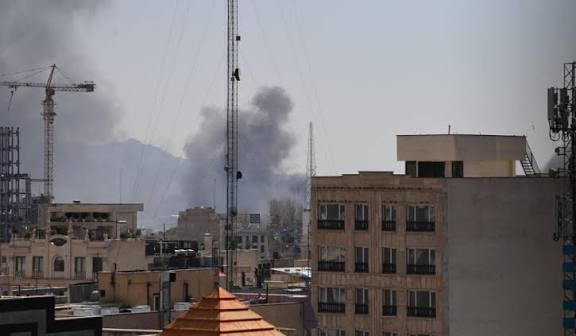
A joint military strike by the United States and Israel on Iran, which started on Saturday morning, triggered a sharp escalation across the Middle East.

The strike sets off waves of missile exchanges, mounting casualties, and far-reaching political and security repercussions.

Israel’s Defence Minister Israel Katz confirmed a “preemptive” strike on Iran and declared a nationwide state of emergency, air raid sirens sounded across Israel, with emergency alerts sent to civilians.

Iran’s Fars news agency reported multiple missile strikes in central Tehran, with additional explosions in Isfahan, Qom, and Kermanshah.

Israeli media, citing security sources, reported the operation was a joint U.S.-Israeli strike.

Israel and Iran both closed their airspace. Israeli and U.S. assessments concluded that negotiations with Iran were no longer viable.

Washington said the strikes aimed to dismantle Iran’s security apparatus.

U.S. President Donald Trump said Washington had launched a large-scale military campaign to destroy Iran’s missile industry, naval forces, and nuclear capabilities.

An Israeli source said the first phase would last four days and target senior leadership, including Khamenei.

Iranian media said Tehran was preparing “crushing” retaliation. Missile launches from Iran were detected, with explosions reported in northern Israel. Civilians were ordered into shelters.

The Islamic Revolution Guard Corps (IRGC) announced large-scale missile and drone attacks.

A senior Iranian official said retaliation would have “no red lines.” Explosions were reported across Israel, causing damage in Haifa.

Explosions were reported in Bahrain, the United Arab Emirates, Qatar, Saudi Arabia, Kuwait, and Jordan.

Iran called on the United Nations to respond to what it described as U.S.-Israeli aggression.

Iranian media reported that a deadly strike hit a girls’ elementary school in southern Iran, and the death toll from the attack had risen to 165, according to Iran’s official IRNA news agency on Sunday.

Iranian officials said most of the victims were schoolchildren.

The IRGC claimed it destroyed a U.S. radar installation in Qatar.

The Israeli military said it had carried out large-scale strikes on Iran’s air defence systems, significantly degrading them.

Iranian media said missile attacks had targeted at least 14 U.S. bases in the region. The UN Security Council held an emergency session on the conflict.

The Iranian Red Crescent said strikes across 24 provinces killed 201 people and injured 747.

Iranian media confirmed that Khamenei had been killed. The government declared 40 days of national mourning.

Earlier, Donald Trump said on social media that Khamenei was “dead” and that military operations would continue.

CBS News, citing U.S. officials, reported that around 40 Iranian officials, including Defence Minister Aziz Nasirzadeh and IRGC commander Mohammad Pakpour, were killed.

Parliament Speaker Mohammad Bagher Ghalibaf said Iran had prepared contingency plans for the post-Khamenei period.

Ali Larijani, secretary of Iran’s Supreme National Security Council, said an interim leadership council would be formed and a new supreme leader selected.

The IRGC claimed it launched four ballistic missiles at the U.S. aircraft carrier USS Abraham Lincoln, saying its retaliatory strikes against the United States and Israel had entered a “new phase.”

The Pentagon confirmed that three U.S. troops were killed in the U.S.-Israeli operations against Iran, marking the first American casualties of the conflict.

The IRGC said it struck three oil tankers belonging to the United States and Britain in the Gulf and the Strait of Hormuz, with the vessels reported on fire, according to its official outlet Sepah News.

The Israeli military said it had achieved “air superiority in the skies over Tehran” following a wave of airstrikes targeting Iran’s capital.

Edo governor joins anti-BEDC mass action, vows to break monopoly

0


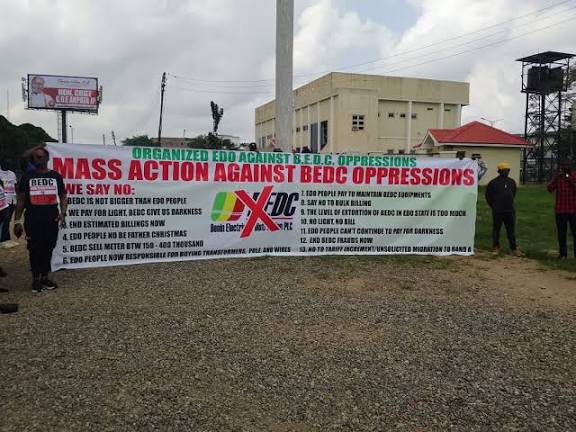
Edo State Governor Monday Okpebholo has vowed to break the monopolistic tendencies of the Benin Electricity Distribution Plc (BEDC) to ensure fair and even distribution of power to residents of the state.

He disclosed this when he made a stopover at the take-off point of the “mass action against BEDC oppressions” protest organised by the “Organised Edo Against BEDC Oppressions” at the Benin City Museum.

Governor Okpebholo said that if more players are allowed into the business of power distribution, similar to the telecommunications sector, it would ensure greater efficiency as all operators would strive to put in their best to serve customers better.

“I want to let you know that the only way we can fight them is to bring stakeholders into this business of distribution.

“I want to let you know we’ll break the monopoly.

“That monopoly does not belong to one man. So, how do we do it? We have to operate in the way telecom operates, bringing in different stakeholders and bringing in different companies.

“We are going to have a meeting in my office tomorrow. We are bringing stakeholders together so that we can talk, engage them and see how we can bring in more investors into the business of light distribution. So when that one is done, all of us in the state will have enough light,” Okpebholo said.

Okpebholo, who said he had come to join in the BEDC protest, admitted that everyone in the state was being short-changed by the company and that such a situation must not be allowed to continue.

“I was trying to find out what the issues are, and I was told that you people are protesting. I said, ‘Yes, we are all youth.’ Is that not so? Are we not? I have come to join you on the protest.

“When we are talking about short-changing Edo people, it’s all of us. My father in the village, your mother in the village, my brother in the city, all of us who are standing here. Is that not so?” he asked rhetorically.

He told the protesters to send some delegates to join them in a meeting with stakeholders tomorrow at the Government House, where issues relating to BEDC would be discussed.

Earlier, Comrade Emmanuel Ogbidi, President, Network of Civil Society Organisations of Nigeria (NOCSON), told the governor that residents of the state were tired of paying for darkness instead of light and of overbilling by BEDC.

He noted that residents of the state are not Father Christmas, so BEDC should live up to its billing.

Sun