For decades, politics in the Pace Setter State has followed a familiar compass — it points to Ibadan.
From the Second Republic to the Fourth, the political capital of Ọ̀yọ́ State has also been its electoral capital. Governors emerged repeatedly from the same axis, power circulated within a narrow corridor, and other zones played supporting roles in the theatre of governance.
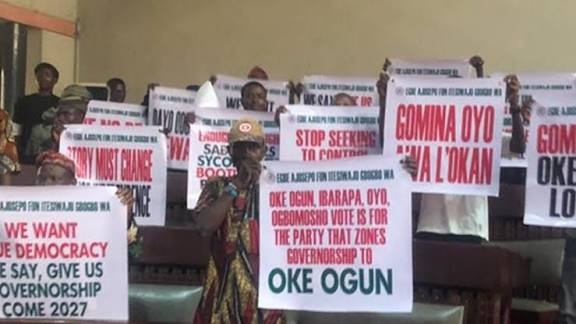
But as the 2027 governorship race quietly begins to take shape, a new narrative is forcing its way into the conversation — the Okeogun argument.
And this time, it is louder, organised and backed with numbers.
A Declaration From the Margins
An advocacy movement, Ẹgbẹ́ Àjọṣepọ̀ Fún Ìtẹsiwájú Gbogbo Wa, has issued what it describes not as agitation but “a historic declaration.”
In a formal communication to President Bola Ahmed Tinubu, the group insisted that nothing short of zoning the 2027 governorship to Okeogun would be acceptable.
The message was blunt:
Okeogun rejects deputy governorship, party chairmanship or symbolic concessions. Only the governorship seat is acceptable in 2027.
For the people of the agrarian northern belt of the state, this is not merely about ambition — it is about correction of what they see as a long-standing political imbalance.
Since 1979, Ibadan has produced six governors.
Okeogun — despite its size and contribution — has produced none.
Yet it has produced five deputy governors.
To them, that is evidence of inclusion without authority.
The Numbers Behind the Anger
Beyond emotion, the agitation rests heavily on electoral arithmetic.
During the 2023 elections:
Zone
Compliance (Turnout Rate)
Ibadan
22.6%
Okeogun
46.7% (Highest)
Ogbomoso
31.7%
Oyo
34.4%
Ibarapa
31.7%
The implication is politically significant:
Ibadan has population advantage, but the rest of the state has participation advantage.
When the four non-Ibadan zones vote together, they rival — and sometimes outweigh — the capital.
The group’s new coalition, the G22 Movement (22 local governments outside Ibadan), is built around that single idea:
Oyo elections are won by alliances, not population mythology.
Why Okeogun Says It Deserves Power
The agitation rests on four core arguments:
Political Equity
Other Southwest states rotate power informally. Oyo, they argue, has remained structurally centralised.
Loyalty Without Reward
Okeogun voters historically support winning coalitions but never lead them.
Electoral Value
Highest turnout zone in recent elections — yet lowest executive representation.
Stability Through Inclusion
The belief: giving power to new zones reduces political resentment and strengthens state unity.
In their words:
Inclusion today prevents instability tomorrow.
The Emerging 2027 Contestants
Across parties and regions, several figures are already positioned — quietly or openly — for the next succession battle.
Technocrats & Reform-minded Aspirants
Dr. Muyiwa Gbadegesin
Environmental management expert and head of Lagos waste authority. Seen as a technocratic contender with governance experience.
Barr. Beulah Adeoye
Corporate forensic expert and financial advisory professional positioning within the PDP as a new-generation candidate.
Political Heavyweights
Barr. Bayo Shittu
Former minister and long-time political actor with deep institutional experience and party structures.
Engr. Rauf Olaniyan
Former deputy governor and veteran technocrat with decades inside the state system.
Security & Strategic Leadership Bloc
Dr. Gbenga Adegbola
Retired military officer projecting discipline-driven governance and economic structure reforms.
Ideological & Grassroots Mobilisers
Dr. Yinusa Kazeem Ayandoye
Consistent advocate of rotational fairness, building support around equity-driven politics beyond dominant party structures.
The Real Battle: Geography vs Coalition
The coming election may not be decided by popularity alone but by a political equation:
Ibadan = population
Others = coalition
For the first time, the “others” are attempting a coordinated bargaining position.
Okeogun is not merely asking to produce a governor —
it is asking to redefine how governors emerge in Oyo State.
What Happens If Power Shifts?
Political analysts suggest three possible outcomes:
Stability through inclusion — resentment across zones reduces.
New development priorities — agriculture, border economy, and rural infrastructure gain prominence.
Permanent zoning precedent — an informal rotation system may emerge.
The Moment Before the Storm
The 2027 race has not officially begun, but negotiations already have.
Behind party primaries and endorsements lies a deeper question:
Is Oyo State ready to evolve from dominance politics to balance politics?
For Okeogun, the answer is no longer negotiable.
For the rest of the state, it may soon become unavoidable.
Because in Oyo politics, history has always followed alliances —
and alliances are now shifting northward.