Home Blog Page 481

APC primaries: Consensus stirs fresh crisis in states

0


The ruling All Progressives Congress (APC) projects an image of perfect peace, but the reality is different. As the 2027 elections draw closer, the consensus option championed by the National Working Committee is sparking quiet revolts in several states. From Ogun East’s Senate tussle to governorship battles in Lagos, Kwara, Nasarawa, Rivers, Benue, and Oyo, the leadership’s claim of unity masks a widening internal rift. The push to anoint preferred candidates has opened cracks the party can no longer hide.


The leadership insists consensus will apply only where stakeholders agree. Yet in states with multiple strong contenders, agreement has proven elusive. Without transparent internal mechanisms, the strategy risks trading short-term order for long-term cracks.

Ogun

In Ogun State, the APC is on the verge of a split over the Ogun East senatorial ticket, now a fierce contest between Governor Dapo Abiodun and incumbent Senator Gbenga Daniel.

The party’s national body promotes consensus to avoid primaries, but that strategy is colliding with realities on the ground in Ogun East. While a section of stakeholders is nudging the governor toward the Senate seat, citing his executive record and what they call a yawning gap in current representation, Daniel’s supporters reject any move to impose consensus. They insist he deserves a fair primary and accuse the state party hierarchy of writing the script before aspirants emerge, warning that a forced consensus could fracture the APC base in the district.

Abiodun’s supporters counter that consensus reflects popular demand, not imposition. They cite his succession plan that ended Yewa/Awori marginalisation as proof he carries a statewide mandate. For them, a primary would be wasteful theatre when the electorate has already decided.

Party elders, however, admit the optics are delicate. “Consensus only works when it is truly consensus,” a senior chieftain said. “If Ogun East leaders feel railroaded, we risk the same implosion we saw in the Gbenga Daniel era,” he maintained.

Though the governor has yet to declare, the push for consensus is already heating up rivalries that could define the party’s 2027 chances.

Tension spiked recently when Senator Daniel was allegedly blocked from a stakeholders’ meeting at the Adeola Odutola Hall in Ijebu-Ode.

Former Ijebu North East Local Government Chairman, Otunba Tayo Onayemi, said the news that Daniel was denied entry broke 40 minutes into the meeting. The incident capped weeks of intrigues surrounding his purported suspension from the party, despite the national leadership’s clarification that there is no suspension.

For the Ogun East Senate seat, the consensus being pushed is anything but unanimous. Hon. Adekunle Akinlade, an APC chieftain, argues consensus avoids the rancour of divisive primaries. “Consensus is not an imposition when the people have already spoken. Governor Abiodun’s record is the consensus. A primary would only waste time and resources chasing what the streets have decided,” he said.

Mrs Funmilayo Adeyemi echoed the sentiment: “We are not asking for a coronation. We are asking the party to respect performance. You don’t compare a man who built 1,500km of roads and gave us an airport with someone who cannot point to one federal project in eight years.”

But the media office of Sen. Adebola Adeleye countered, insisting on direct primaries as a test of popularity. “The APC Constitution is clear: consensus means agreement by all aspirants. You cannot have consensus of one. Let us go to the field. If the governor is popular, let him test that popularity in a primary,” the statement read.

Alhaji Sulaimon Olowu, APC Ward Chairman, Ijebu-Ode LGA, backed that position. “This tension is unnecessary. We had primaries in 2019 and 2023. Why is 2027 different? Consensus cannot mean we shut the door against loyal party members,” he said.

Chief Jide Ojuko, an APC elder from Ogun Central, took a neutral view: “Consensus is a double-edged sword. It saved us during the 2023 succession, but it will destroy us if used to erase competition. Ogun East deserves a process that leaves no one aggrieved. The party must manage this carefully.”

Tolu Folarin, former Ogun State Attorney-General, also cautioned against alienating loyal members. “The governor has a right to contest like anyone else. The incumbent has a right to defend his seat. What the party cannot do is pretend there is agreement where there is none. That is how you lose elections before the ballot,” he said.

Lagos

The tension in the Lagos APC is defined by an entrenched political machine managing a vast field of aspirants. Its selection process is highly structured. Recently, the party ran a rigorous ratification exercise, clearing hundreds of aspirants through grassroots congresses ahead of the National Convention. The system is designed to maintain tight control over the political ecosystem.

But while the hierarchy aims for order, the process often sparks friction with aspirants who see ratification as a filter for establishment-approved candidates. The cycle is familiar. Critics have long accused the party of using administrative procedures to stifle internal democracy and impose candidates, fuelling persistent, even if managed, instability.

About two weeks ago, tension spiked after media reports claimed Deputy Governor Obafemi Hamzat had been endorsed as the consensus governorship candidate. On April 13, Hamzat reportedly met GAC leaders Prince Tajudeen Olusi, Mutiu Are, Senator Musiliu Obanikoro, and others. Unverified online accounts claimed Otunba Alebiosu Bush was moved to tears after Hamzat secured the GAC nod.

The rumour followed President Tinubu’s meeting with South-West stakeholders, where Hamzat’s name allegedly emerged as the consensus pick. In Lagos, GAC backing is often read as decisive. Hamzat’s consultations with the GAC and Oba Akiolu signal he’s following the traditional succession playbook.

Members of the Justice Forum, a Lagos APC group, are also said to have backed Hamzat after Tinubu’s alleged endorsement, a move that stirred excitement among workers at the Alausa Secretariat. Hamzat’s supporters frame it as payback for loyalty: he stepped down for Sanwo-Olu in 2018.

The APC traditionally favours consensus. But the Lagos chapter is wary of the appearance of imposition after the fallout with Akinwunmi Ambode. State Chairman Cornelius Ojelabi has publicly denied any anointment for 2027. “Claims that the All Progressives Congress has settled on a consensus governorship candidate for Lagos State ahead of the 2027 election have been dismissed. No agreement was reached on candidate selection for Lagos or any other state,” he said.

Unofficially, key blocs are already moving, causing friction. Despite the denial, Hamzat’s camp is acting like consensus exists — and parts of the party structure are backing him. While Rep. James Faleke rallies support for Hamzat, Ambode’s supporters also claim Tinubu’s backing.

Amid the mixed signals, observers are watching how the race unfolds with strong contenders like Tokunbo Abiru, Mudashiru Obasa, and Jandor still interested. However, speculation is rife that Obasa might have jettisoned his governorship ambition. A recent report said he confirmed the President’s endorsement of Hamzat as consensus candidate after returning from Abuja.

Publicly, the chapter says no consensus, direct primaries. Privately, powerful blocs — GAC members, Faleke, Justice Forum — are consolidating around Hamzat, citing his 2018 sacrifice and 20-plus years of experience. Rival aspirants are pushing back, insisting primaries must hold. The tension mirrors the backlash to consensus in Ogun East.

Nasarawa

In Nasarawa, the tension is explicitly tied to the succession plan for the post-Abdullahi Sule era.

Governor Sule’s recent endorsement of Senator Ahmed Wadada has become a flashpoint. Many stakeholders view it not as broad-based consensus, but as a strategic move that could sideline other aspirants.

Party leaders had promised a level playing field and emphasized consensus and inclusiveness. The current reality is a fractured state chapter. The rift between the Governor’s backers and those demanding an open contest has escalated.

The chapter now faces pressure to reconcile competing interests, with some factions publicly calling for direct primaries to block what they see as top-down imposition.

Tension escalated when Governor Sule took Wadada to President Bola Tinubu at the Villa and introduced him as his successor. His predecessor, Senator Tanko Almakura, called the move an aberration.

While acknowledging the governor’s democratic right to choose a successor, Almakura insisted due process must be followed. He said Governor Sule did not consult widely before unveiling Wadada.

He spoke during a Channels TV interview: “This, to me, is an aberration. It is a little too hasty at this point when the party has not brought out guidelines for the primary exercise. This is in spite of the fact that quite a number of people are angling for this position.

“There was no proper consultation among critical stakeholders to secure a unanimous position on his decision. It is a violation of due process.

“I can say without any fear of contradiction that I was not consulted before any candidate was taken to the Villa to meet Mr. President. The sentiment that Wadada is his choice is very unfair to the people of Nasarawa State. Nobody denies the governor his democratic right to have a choice. But no matter how hurried he is to have someone succeed him, due process must be followed. And the due process must be either consensus or direct primaries.

“About a week ago, we had a meeting of all stakeholders in the governor’s lodge in Abuja. We all agreed that it is going to be direct primary. The contentious issue of zoning was even shelved. The governor himself categorically confessed to have made a mistake in calling for zoning. We agreed on that day that the process to bring out the choice of the people will be direct primary.

“It is not fair to the party; it is not fair to stakeholders because we were never consulted. It is also not fair to the President that somebody should be taken to him without consensus, without unanimous understanding.”

Other aspirants and their supporters also argue that consensus is being used to bypass the grassroots. This has created a visible rift, with many warning that a forced consensus could trigger defections to the SDP or PDP.

Kwara

In Kwara, the consensus push is reopening the North-South fault lines the APC papered over in 2023.

There is a strong sentiment that consensus is simply a euphemism for imposition, which could trigger a revolt. Ahead of primaries, stakeholders warn that the Otoge movement that brought the current administration to power was built on ending political imposition.
Unlike states with a single godfather, Kwara has multiple independent power centres and aspirants who see themselves as equals. In Kwara North, leaders are already insisting the next governor must come from their region.

Former Attorney General and Commissioner for Justice, Salman Jawondo, SAN, a vocal advocate of power shift, said Kwara North had shown enough loyalty to the APC and should produce the next governor. He noted that since 1967, Kwara North has governed for just one and a half years, while Central and South have ruled for 20 and 18 years respectively. “Equity and fairness demand that Kwara North should be given opportunity to produce the next governor,” he said.

On voting strength, he argued zoning to Kwara North “is the surest way to win election because the South will not vote for anybody from Kwara Central.” The North and South, he said, can deliver the spread.

Findings show the situation is turbulent, with State Chairman Prince Sunday Fagbemi trying to streamline candidates to avoid a do-or-die primary. A party supporter, who asked not to be named, said that without a single power centre to enforce it, an attempt to force consensus might deepen the divisions it was meant to heal.

The national body wants consensus to prevent a fractious primary, but aspirants in both zones are digging in.

Kwara North leaders argue it is their turn after successive governors from Central and South. “You cannot talk consensus when you have not addressed justice,” an APC chieftain from Baruten said. “The North has been loyal since 2019. If consensus means South again, the party will pay for it.”

Kwara South aspirants counter that the ticket should go to the strongest candidate, not geography. “We buried zoning to win in 2019. Consensus must reflect capacity, not rotation,” said a former commissioner from Oyun. “If the people want performance, let no zone be shut out.”

Party elders admit the state is too volatile for imposition. “Kwara is not Lagos. Consensus without buy-in will revive the old Saraki-era cracks,” a State Caucus member warned. “We need primaries if aspirants won’t step down willingly.”

With Governor AbdulRahman AbdulRazaq term-limited, the absence of an anointed successor has turned consensus into a proxy war between zones. Like Ogun East, the consensus being pushed is anything but unanimous.

Benue

In Benue, a major political development is the Senate’s directive to INEC to restore three state constituencies — Ukum II, Konshisha II, and Gboko I — based on a December 2025 Court of Appeal judgment.

Beyond that, some aspirants have rejected the consensus arrangement adopted by the APC leadership. The processes, which began across state and federal constituencies, have triggered open disagreements among aspirants and their supporters, with many insisting on direct primaries. They argue that party members — not leaders or influential individuals — should determine their fate.

One development sparking tension is the purported indefinite suspension of five appointees of Governor Hyacinth Alia in his Vandeikya home Local Government.

The party said the suspension followed acts of misconduct allegedly displayed by the appointees during the zoning exercise.

A statement issued by the APC Vandeikya LGA Publicity Secretary, Apaa Tindim, stated: “The APC Central Executive Committee, stakeholders, and ward chairmen across the twelve council wards in Vandeikya Local Government Area convened an emergency meeting, where they unanimously resolved to suspend the following appointees from participating in party activities within Vandeikya LGA.”

The statement claimed the suspended appointees failed to comply with directives issued during the zoning process and instead resorted to harassing and insulting party stakeholders publicly during the exercise in Tiev Constituency, Vandeikya LGA.

However, Governor Alia has cautioned aspirants against invoking his name for political advantage, stressing that he has not endorsed any candidate.

“As a product of the people’s choice myself, I am not the one to decide anyone’s electoral fate. The people are there to decide and make their choices. I am not making choices for anyone. If you want to contest elections, go out there and talk to your people, convince them to choose you. That is democracy,” he stated.

Rivers State

The political landscape in Rivers State is defined less by formal consensus and more by power-struggle dynamics.

The situation is characterized by a lack of consolidation, with the relationship between Governor Siminalayi Fubara and FCT Minister Nyesom Wike remaining the defining factor.

Unlike other states, there is no evidence of a political consensus. Instead, the state continues to navigate an unfinished political transition, where authority remains contested between the incumbent governor and the persistent influence of his predecessor.

The ongoing friction within the State House of Assembly and executive-legislative relations underscores a state where political survival currently supersedes broad consensus-building.

While Governor Fubara maintains grassroots support, largely seen as a desire for a break from long-standing political dominance, the state remains at a crossroads between persistent contestation and the stabilization of power.

Oyo

In Oyo, the consensus push is running into the state’s fractured APC architecture and the long shadow of 2023’s loss to the PDP. Currently, former Power Minister Adebayo Adelabu, Teslim Folarin, and others are being mentioned in Oyo APC circles for 2027. Adelabu recently resigned from Tinubu’s cabinet to pursue his governorship ambition.

The party’s national body wants consensus to prevent another divisive primary, but the Oyo chapter is a patchwork of legacy blocs — Ajimobi loyalists, Adelabu’s camp, Folarin’s structure, and newer entrants from Accord and SDP — with no single godfather to enforce a deal.

The governorship race is already drawing multiple heavyweight aspirants across the three senatorial districts. While some elders are shopping for a unifying candidate to present as consensus, aspirants are resisting any process that looks like imposition. “Oyo APC lost in 2023 because the grassroots felt shut out,” a former commissioner from Ogbomoso said. “Consensus without consultation will give Seyi Makinde a second victory before the ballot.”

Ibadan zone, which holds the largest voting bloc, is pushing for retention, citing population and past sacrifices. Oke-Ogun and Oyo Central leaders counter that equity demands rotation. “You cannot preach consensus and ignore justice,” an APC chieftain from Saki said. “If it’s not our turn, then let the field decide.”

State Chairman, Isaac Omodewu, has been holding closed-door meetings to trim the aspirant list, but sources say talks have stalled. “Everyone wants consensus if he is the consensus,” a member of the State Working Committee admitted. “Nobody wants to step down for the other.”

The memory of the 2022 primaries still haunts the chapter. Parallel congresses, litigation, and defections weakened the APC before the general election. Party elders warn that forcing consensus now could repeat that implosion. “Oyo is not Lagos where GAC can announce and everybody falls in line,” an elder from Ibadan North said. “Here, consensus must be earned, not declared.”

With no incumbent governor to anoint a successor and no clear Tinubu directive yet, consensus in Oyo remains aspirational. For now, the push for unity is exposing the same cracks it was meant to seal. The absence of agreement has left direct primaries as the default — and the most feared — option.

Legal implications

New provisions in the updated Electoral Act 2026 require written consent from all cleared aspirants for a consensus candidate to be valid. If even one aspirant refuses to sign, the party is legally forced back to a primary, leading to the current arm-twisting tactics seen in these states.

Under this framework, forced consensus is not just a political risk. It is a legal minefield that can lead to the total disqualification of a party’s candidates.

The most critical legal hurdle is that consensus is no longer a decision the party leadership can make unilaterally. For a consensus candidate to be legally valid, all cleared aspirants for that specific position must provide their written consent to withdraw from the race in favour of the consensus candidate.

Under the new Act, a single dissenting aspirant can collapse the entire consensus arrangement by refusing to sign the withdrawal letter. If the party proceeds without this signature, the nomination is void.

If a consensus arrangement fails or is challenged because an aspirant refused to sign, the law mandates that the party must revert to direct primaries where every card-carrying member votes.

Because the rules for consensus are now strictly codified, any breach is considered a pre-election matter.

Any aspirant who felt coerced into a consensus can approach the Federal High Court to challenge the nomination. If a court finds that the consensus was forced or that the mandatory ratification convention required by Section 87(3) was not properly held, it can nullify the nomination. Since the window for submitting candidate lists is now shorter — reduced to 90 days before the election — a party may run out of time to conduct a fresh primary, leaving them with no candidate on the ballot, similar to the APC’s 2019 experience in Zamfara.

Under Section 84(1), INEC retains the power to monitor all primaries. If INEC’s report indicates that a consensus was reached through intimidation or without the required signatures, the commission can refuse to accept the candidate’s credentials, citing a breach of the party’s own constitution and the Electoral Act.

Overall, the Electoral Act 2026 has essentially weaponized the individual aspirant. Forced consensus is now legally impossible if an aspirant has the courage to withhold their signature and sue.

Avoiding the legal minefields of the Electoral Act 2026 is possible, but it requires the APC to move away from executive orders and toward a more documented negotiation process.

To bypass the risks of litigation and disqualification, the party is currently employing several strategic maneuvers. In most cases, party elders engage aspirants before they are officially cleared to contest.

The party often convinces aspirants that a consensus with a promise of a future appointment or refund of their form fees is the safer bet.

Under Section 87(3) of the new Act, even a consensus must be ratified. To avoid a Zamfara scenario, the party is becoming meticulous about the paper trail.

The most effective way to avoid a lawsuit is to make the losing aspirants feel like winners. For this, the APC is using political MoUs: promises of Senate slots, ministerial roles, or state cabinet positions in exchange for a peaceful consensus. This is said to be part of the strategy stakeholders discussed when President Tinubu met governors elected on the APC platform in Aso Villa ahead of primaries.

Sun
Women must fight for their place at political table — Idele, APC Women Leader

0


•It’s shocking there’s only 5% of women in governance in Nigeria

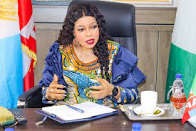
Dr. (Mrs.) Mary Alile Idele is the National Women Leader of the All Progressives Congress (APC). She is a scholar, pastor, philanthropist and entrepreneur, among others

Dr Idele, fondly called Capacity, is a PhD holder in Philosophy from Louisiana Baptist University, USA.

As a political influencer, she has advocated social justice, equality and women’s participation in politics across facets in the nation.

In an interview with Sunday Sun in Benin City, Idele, who is the current chairman of the Federal Medical Centre, Asaba, Delta State.talks about her roles in shaping policies, as well as perceptions about women in governance, among other issues.


How did you earn your second term as APC Women Leader?

I came in to complete the tenure of the former National Women Leader, Beta Edu, when she became the Minister of Humanitarian Affairs. She had two and a half years left on her tenure. So I completed that tenure and then there was a convention, which just recently happened, and I won the election, returned unopposed for the position of the National Women Leader.

What did you do for the women that made them re-elect you?

For me, people say I’ve done very well, but I did my best and I did things differently this time around. We’ve had national women leaders and I’m sure everybody has done the job to the best of their ability.

I wanted to do things differently. I wanted to introduce new ideas, new strategies, new policies, different ways of doing things so that we can get different results. And that’s what I did.

In order for us to carry our APC women along in what we’re doing, we needed to create opportunities for women to shine, to show their capacity in every ramification. So I created a lot of programmes.

An example of such programmes is what is called 774 Explode, a programme that is to expand women’s participation in politics. That was a programme that went across different states of the country. I worked with the governors of the states to empower our women and to introduce women that are educated into politics.

Because we can continue to shout about reserved seats and we can continue to shout about 35 per cent affirmation for women, but if we don’t have women that are educated and genuinely interested in politics, it is of no use. It’s all good to be beautiful, but at the end of the day you need to sit at the table. And it’s not always just sitting at the table, you need to participate in discussions.

You need to understand politicking. You need to understand strategies, policies and how to make these decisions.

If we look at the game of politics, many of us, myself included, grew up to accept the saying that politics is a dirty game. And because of that, parents shielded their daughters from playing politics. Their father would say, never in my lifetime.

And that made our women not to participate in politics. Because, of course, “it’s a dirty game”. Why would you be there? Of course, somebody will call you a prostitute. Why would you want to be in a place where somebody would look at you and say, ‘Oh, we think you are a prostitute,’ and so on and so forth? So, because of that, women used to stay back. Women were not coming out.

So, they’ll put another male there. And that’s why you’ve seen a decline in the number of women participating in politics. And the cultural barriers have not helped. The religious barriers are not helping either. I grew up when pastors used to preach in church and say, ‘No, no, no, nobody should (go into politics), no, no, no, politicians are dangerous, don’t go near them,’ and things like that.

And that’s where we are now, where we do not have many women playing politics.

Mothers need to start sitting down and saying, ‘Okay, if my daughter is not there at the decision-making table, any decision goes’; they might sit down and say, if you are a 12-year-old girl, you can get married. Those in support, say Aye. They say Aye, and that’s about it. It’s passed into law.

So, where is the girl-child in all this? Where is our representation? Where is the female voice in all this?

That is what the project is all about. And that project was successfully done in so many states, kudos to the APC governors. They supported us, and we did that.

One of the major barriers is finance. For instance, if you want to contest for a seat, you need to pay for your nomination form and your express of interest form. Your flyers are not cheap. Media is expensive. Somebody that you are calling to come and sit down in meetings all day, well, those are expensive.

And you, as a woman, have your first priorities and commitments to your children and your family. So, if you are not financially buoyant, how do you survive in politics?

They say politics is a man’s world because of these facts, because of finance, money and every other thing. All these things were what we looked at when we spoke to the governors and they supported this programme. It was a huge success in many states, such as Benue, Sokoto, Edo and Cross River.

And now we are going to Ondo, I think, in two weeks’ time. It’s a continuous programme. So, 774 has been a huge success.

We’ve done other things like the Older Citizens’ project. We looked at women that were like our mothers. They were politicians and they played politics. And then after that, who calls them for meetings? What else? And their position is taken from them, given to another person, and they are just forgotten like that. The Older Citizens, that’s another project that we introduced and we now have Older Citizens Network and so on and so forth.

There are other projects like that. There was another one where I partnered with Heart Bible University in Texas, and we gave scholarships to 3,600 Nigerian girls to study in the U.S. We want them to be active in politics. There are quite a lot of projects, which I did in those two and a half years.

How are women faring in politics, in terms of appointments, under President Bola Tinubu?

I would say that His Excellency, President Bola Ahmed Tinubu, is a gender-friendly President. He is pushing for more seats. He has made mention of these reserved seats, passing the bill and all that.

In our NEC meeting, he openly challenged the governors, and he openly applauded the governor of Niger State, I believe, who reserved the position of the vice-chairman in all the local governments of the state for women. And he commended him, and told the other governors, you guys should emulate him. And that’s what we’re trying to do.

And that’s one of the programmes that I’m championing, which is called the Twinning System. Twinning, that’s twins. The Twinning System means, if there is a male governor, there should be a female deputy governor.

If there’s a male chairman, the deputy should be female. And if there’s a female chairman, the deputy should be male. The Twinning System is something that I’m championing across board.

The reserved seats, he has also spoken about that. The First Lady, I think we all saw it when she hosted the House members to an elaborate dinner. She gave a very good speech telling them to pass the bill. The President has spoken several times, telling them to pass the bill.

It can’t be clearer than that. The bill currently sits in the House of Representatives. It has gone through first reading and second reading. It’s supposed to go through a third reading, and it has been postponed twice now.

We are waiting for that bill to go through the third reading before it goes in for presidential assent. And of course, we are doing everything possible. We are travelling across the country, lobbying the governors, because, at the end of the day, the senators are from the states.

They all came from our states. And the governors know them one-on-one. They know them personally.

So lobbying is what we are doing, telling the governors, ‘Talk to your people. You know them. You are the ones that put them there, the House of Representatives members and so on’.

So, the President, our President, is good to go on this increment for more women or creating space for more women in politics. We must look at statistics, because when we started this campaign or when I started this campaign, people were just saying, ‘Oh, national woman leader, she’s talking and she’s talking’. But we brought out statistics to let people see what’s going on around the world. In Rwanda, they have 65 per cent of women in governance. Tanzania, 40 per cent. South Africa, over 40 per cent. Now, if we go to Saudi Arabia, when you talk of Saudi Arabia, the first thing that comes to mind is that it’s a Muslim place. And if women can get up to 40 per cent in governance there, what is stopping Nigeria? Because, in Nigeria, we have just five per cent.

In fact, we are the last in Africa. And we call ourselves the giant of Africa. Being the giant of Africa, what is stopping half of the population of this country from participating in politics or to be part of governance? Besides, it’s easier to ask to be part of governance, but before you can be part of governance, you must be a politician. Nobody is coming to call you from your houses to say, ‘Oh, just come, come and occupy this office’, if you are not a politician. Even if you are so favoured and somebody pulls strings for you to get in there, you might just be there and be useless; there’s nothing to do, you don’t make any contribution. You sit at the table looking pretty and looking beautiful but contribute nothing.

On the other hand, it will be different, if women go through the ranks in politics. That’s why we’re saying women must come out. Women must play politics regardless of what the men have said. In my mentoring programme, that’s one of the things I do.

I mentor the next generation. I can go into a room of 1,000 women and I go there just to mentor them and sometimes my opening remark is, ‘If you are here and you don’t want to be called a prostitute, that’s the door. Just go out now because you will be called a prostitute’.

It doesn’t matter if you hold your husband to walk into a political committee, somebody will call you a prostitute. So, you don’t want to be aggrieved or to fight or to be annoyed and say, ‘Oh, I’m not playing this politics anymore. How dare he call me a prostitute?’

They will call you names so that you can get up from your seat and walk away and I can bet that, when you get up, three men will sit down on it. And that’s the thing.

So, look at yourself very well in the mirror and accept that those are the names they will call you. For now, we are still working on it, but that is just so sure. So, if you know that you don’t want to be called names, then you are not ready, absolutely not ready, to be a politician. Because if things are not going their way, that is the first statement they will make to your face, not even behind you, to your face and say, ‘Oh, prostitute like you’. And then it doesn’t matter. So, yes, it’s fine.

If being a woman means I am a prostitute, that also means your mum is one as well. So we move, but I’m not getting up from my seat.

Those are the things that we tell the next generation. Somebody will tell you, ‘Oh, this is dirty. As a posh lady, you don’t need to play this game’.

Somebody will tell you, ‘You are well-educated. Don’t play this game’. That’s why I say I have a PhD and I’m in this game.

We must be able to speak out and we must get more educated women into the game. My mother, she’s 80 years old now. She’s a politician, a very strong politician. She was a former senatorial woman leader for this state, in Edo South.

In their time, it was, ‘Come and clap and dance’. And once they finished clapping and dancing at the campaign ground, they shared N5,000 and they went home. So, whenever they were now writing the names in the rooms, they were not there.

By the time they would write the name, which is another barrier, it was by midnight. So, as a woman, where are you going at midnight? Somebody will tell you, ah, madam, are you sure? It’s not safe for women. Don’t go this time around.

But that is when they write the names. That is when they are having caucus meetings. That’s when they are holding inner meetings.

So, those are some of the barriers against women. I usually say this to one of my very good journalists. He would call me and say, ‘Ah, mama, we have an interview. You need to be at the studio. What time? Ah, you should just get there by 6:30am. That is discrimination because, by 6:30am, women are doing school runs.

You have three children in the house. What are you doing at 6:30? You are preparing your children for school. So if you are putting that programme at 6:30am, you are already discriminating against half the gender of Nigeria.

Have you tried to study why some other African countries have more women in politics and in governance?

That’s exactly where we are now. His Excellency, Ben Kalu, proposed this in the House: deliberate seats, that’s what happened in Rwanda. They deliberately put extra seats for women to sit down.

We are not saying the reserved seats bill means let’s reshuffle. It’s saying sit as you are, but put extra seats for women.

That is what we are doing. If we put extra seats, that will automatically create 36 extra seats in the House of Reps and 36 extra seats in the Senate. That’s the idea behind the reserved seats.

What that will do is that, for example, if we take a state like Edo State, when they are contesting for the House of Reps and contesting for the Senate, the reserved seat can only be contested for by a woman. That will bring 36 extra seats in both chambers of the National Assembly. At the same time, it will bring three extra seats to the House of Assembly. So in these countries, they deliberately put into action ideas that could make those seats to be exclusive for women.

In the House of Reps, for example, we have 360 seats but there are only 19 women. Out of 360, that’s a very poor representation, extremely poor representation. In the Senate, with 119 seats, we have four women. So there’s no way you will pass a law that the women’s vote will be heard because there are just four representing the whole of Nigeria.

However, if we have additional seats, that will make it automatic. Regardless, each year, there must be 36 women seated in these Houses.

Looking at the financial aspects, including elections, can politics be made easier to encourage women to participate?

I think a lot of political parties have done that. In APC, my party, we’ve done that.

Expression of interest form is the same thing for everyone. But the nomination form itself, in my party, for women, is half price.

For example, as national women leader, the nomination form for my seat as women leader was N5 million, but I paid N2.5 million because I’m a woman. Every woman that is contesting for any position pays half the cost. So, if a man is paying N10 million, a woman contesting for the same seat will pay N5 million.

But, outside that, because a lot of political parties have their own thing, in APC, the ruling party, that is something that everybody has applauded. Myself, I’ve applauded it and it’s something that is really, really gaining ground across the country for APC. Now, if we look at it further, there is a saying that power is not served a la carte.

You fight for power to get it. So, even you who want to contest, you must be bold. You must fight. You must do the needful in order to get that seat. You must say, okay, I’m ready. You must say, I can do it.

We continue to encourage our women. And that is why the Project 774 came into place, because it’s a purely financial empowerment programme where the governors assist. And I’m telling them, for example, in Edo State, we have 18 local governments. I said, give us 18 well-educated women to champion the Project 774 Explode.

And in that case, we are telling the governors, we want these women in the House of Assembly, as the councillors. But also, Mr Governor, you need to know that this is a financial implication. Our women in Nigeria, we are very hardworking. Give them money to start businesses. A lot of governors have done so with a minimum of N500,000.

You can give a woman N100,000, they will start a business and it will thrive. But governors have given them half a million to go and do business, get your money so that when you go to political meetings you can be recognised, even if it’s pure water you are buying, buy. Let people know you are serious. You too champion some programmes. That is where we are.

What’s your vision for 2026/2027 as the women’s leader, in case your party is voted in for a second term?

The vision is simple. I need the reserved seats bill for women to be passed into law. Whatever we need to do, lobbying, He-for-She, the men that will speak on our behalf, if we need to beg, we are begging, whatever we need to do, that bill must be passed; because that bill has been chucked out before in the 8th Assembly. It didn’t even make it through. This is the highest and the farthest this bill has gone at the third reading. So, we need to come back more powerfully than before, we need to let the men know we are not saying get up from your seats, we are not challenging them, we are just saying reserve a seat and let a woman sit on that seat.

How did you start your journey into politics?

I schooled abroad. My BSc, Msc and PhD were from abroad. Although I didn’t enter politics when I was abroad, I came back home one year for holidays and decided to visit the old people’s homes for Christmas giveaway. I went with one organisation. I had expectations of what the old people’s home should look like but when I got there I saw old women lying on the floor on a mat. It was a bad experience, a sight I would not forget in a hurry. That was how I started my NGO, Sister to Sister. That NGO is 10 years old; it’s in 10 countries around the world. That NGO empowered women and girls. My mom is a politician, my husband is a powerful politician, I just dived into it. I began what I was doing, empowering women and girl children with Sister to Sister, my NGO, doing a lot of programmes, a lot of empowerment and scholarships here and there, across the country and outside the country, I started playing politics as well. When it was time for Edo State to produce the national woman leader, somebody said, ‘she’s the one. She knows what to do.’

That’s how I became a politician and how I decided to be a voice for women. I saw women, I saw girl-children that missed the WAEC examination because they were on their period and they needed to go back home. In the villages, there are some stories you hear and you won’t believe this is really happening in 2026, where we have village schools with no rest room, when she’s having her period, she needs to go back home to change. She comes back and they have finished the English or Maths exams. She definitely would wait for another year to retake the exams because they didn’t have the means to do NECO, so they will wait for another year to write the same exam because she’s a girl child. Those stories don’t sit well with me. Those are the things that made me dive into politics.

What do you think about insecurity around the country, which creates more widows, orphans and displaced people?

We need to tackle it headlong. For instance, let’s assume there is a snake inside this sitting room. We will all jump, we don’t care who is going to kill it as long as somebody kills the snake. If you can kill it, kill it. We won’t say we are waiting for one brother to do it. That is what insecurity is all about. I don’t care who is tackling it as long as it is tackled. We have seen a lot of things that we can’t be proud of. Nigeria is a country with strong values; in our diversity we are good. We don’t want to now have a place where we are saying we cannot travel to a certain part of the country because of insecurity. Insecurity, kidnapping, taking girls from their hostels.

Bandits deserve capital punishment, maximum punishment for them all. Because, at the end of the day, they are destroying lives and the foundation of people.

‘Women-don’t-help-women has been a slogan in Nigerian politics. What’s your take on that?

That’s one of the things people tell me. I tell them over and over again that people will support good policies. It’s not all men that are supporting their fellow men. It’s not all women that would support women; people will support good policies. If you are brilliant, that would help a great deal. We don’t just want to present a woman for presentation’s sake. We want to see what you can bring to the table. Let me look at what you can deliver, let me look at your policies. Let me look at what you are talking about and then we say let’s support you. The fact that we say we don’t have enough women in politics and they say bring them out and you just bring one market woman as our House of Representatives member and then you want all of us to vote for the person? How? It is not about women not supporting women, even men. Men don’t vote for men as well. We must look into all these things but the highpoint of this is to look for capable hands that will deliver.

Sun

Lagos hits 98% sanitation compliance, pushes daily cleanliness culture

0

Lagos State has recorded an impressive level of compliance with the reintroduced monthly environmental sanitation exercise, as authorities intensify calls for residents to embrace a culture of daily cleanliness.

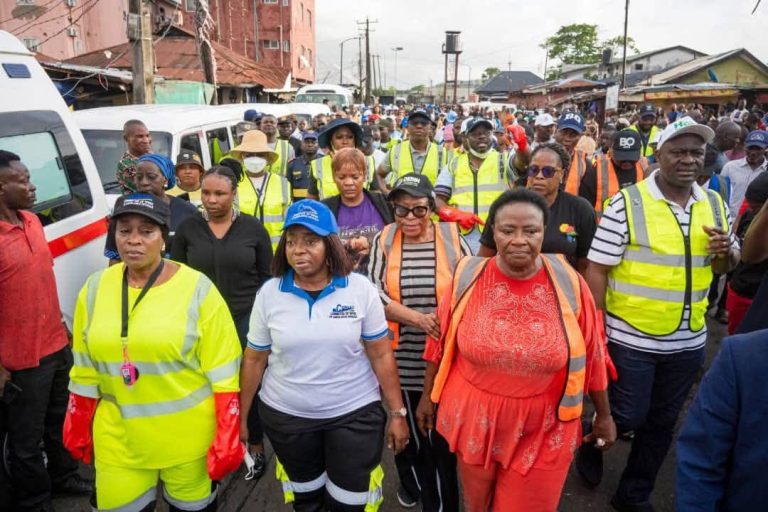
During monitoring at Ikoyi/Obalende Local Council Development Area (LCDA) on Saturday, the wife of the governor, Ibijoke Sanwo-Olu, described residents’ participation as encouraging, noting that acceptance of the initiative is steadily growing across the state.

“I think the assessment for this morning is good. It was flagged off last month and we are having the first exercise today. We have seen residents come out to participate. It is a gradual process, and people are becoming more aware,” she said.

She observed that the restriction of movement between 6:30 a.m. and 8:30 a.m. was largely obeyed, with traders staying off the streets while residents cleaned their surroundings.

“For a first-timer, I am impressed,” she added, urging Lagosians to sustain the momentum beyond the monthly exercise.

“You don’t have to wait till sanitation day. Clean your environment daily,” she said, adding that students were also mobilised to promote early civic responsibility.

Also speaking, the Commissioner for the Environment and Water Resources, Tokunbo Wahab, disclosed that compliance across the state exceeded 98 per cent, attributing the success to voluntary participation and sustained grassroots sensitisation.

“Vehicles were largely off the roads, and people complied. Lagosians want to keep the state clean and safe,” Wahab said.

Other News
Lagos hits 98% sanitation compliance, pushes daily cleanliness culture
Kwara APC petitions Tinubu over anti people policies
He explained that the government deliberately avoided strict enforcement, opting instead to build community ownership and long-term environmental responsibility.

“There is no law or judgment stopping Lagos State from restricting movement, but we chose to build consensus and participation,” he added, noting that the state would evaluate performance across councils and reward the cleanest local governments.

At the grassroots, Chairman of Ikoyi/Obalende LCDA, Bola Oladunjoye, said aggressive awareness campaigns in multiple languages helped drive participation.

“We deployed radio jingles, newspapers and grassroots sensitisation in Yoruba, Hausa, Igbo and Pidgin to ensure wider reach,” he said.

In Agege, the Head of Service, Bode Agoro, also commended residents, describing the turnout as impressive for a first edition.

“For the very first day, it has been very good. The streets are clean,” he said, while calling for intensified sensitisation to sustain the gains.

Similarly, Chairman of Agege Local Government Area, Abdul-Ganiyu Obasa, highlighted ongoing sanitation efforts, including the deployment of over 250 sweepers, waste compactors and routine drainage maintenance.

He noted that the monthly sanitation exercise complements existing initiatives, stressing that enforcement would still be necessary to maintain compliance.

The sanitation exercise, held on the last Saturday of every month between 6:30 a.m. and 8:30 a.m., is part of the Lagos State Government’s broader efforts to improve public health, promote environmental sustainability and revive a culture of cleanliness among residents.

Sun

2027: 14 opposition parties to field one candidate against Tinubu

0


ADC, PDP, LP, NNPP, others unite against APC, want INEC boss removed
Seek extension of deadline for party primaries to end in July 2026
Atiku, Obi, Kwankwaso, Amaechi, Makinde, Mark, Turaki, others in Ibadan, vow to resist one-party state

Fourteen opposition political parties in Nigeria have resolved to field a single consensus presidential candidate to confront President Bola Tinubu and the ruling All Progressives Congress (APC) in the 2027 general elections.

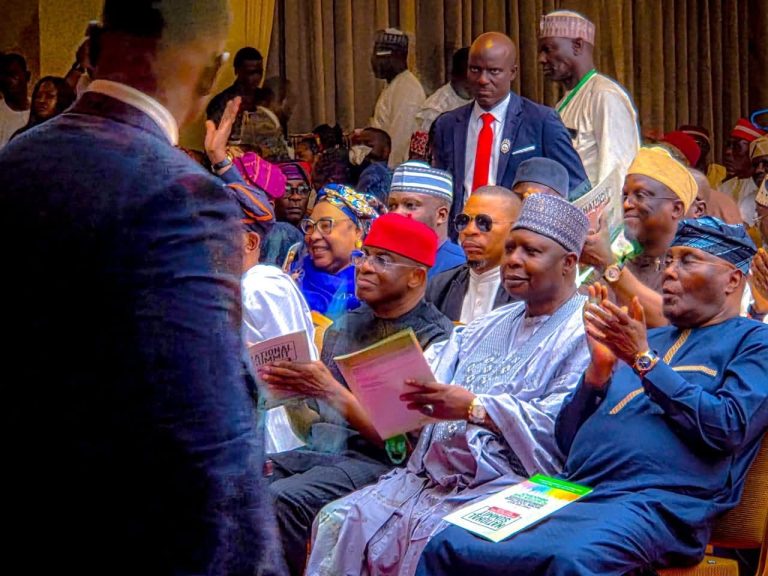
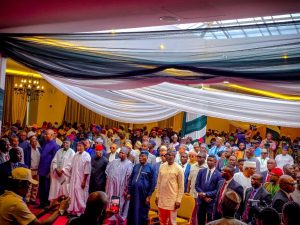
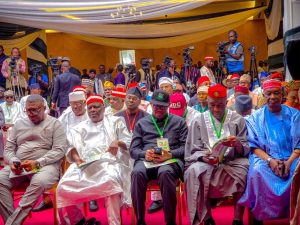
The resolution was reached at the end of a national summit held yesterday at the Banquet Hall of Agodi Government House, Ibadan, Oyo State, which probably signalled the birth of a mega-coalition.

The hall had in attendance the who-is-who of Nigerian politics, including former Vice President Atiku Abubakar. The host was Oyo State governor, Seyi Makinde.

The pact was sealed by a diverse bloc of parties, ranging from established giants to ideological stalwarts. The participating parties included the Peoples Democratic Party (PDP), Labour Party (LP), New Nigeria Peoples Party (NNPP), African Democratic Congress (ADC), Peoples Redemption Party (PRP), Young Progressives Party (YPP).

The Accord (A), Action Democratic Party (ADP), Action Peoples Party (APP), Nigeria Democratic Congress (NDC), Allied Peoples Movement (APM), Action Alliance (AA), Democratic Leadership Alliance (DLA), and Zenith Labour Party (ZLP), were also on the list.

Former governors Peter Obi (Anambra), Rabiu Kwankwaso (Kano), Olagunsoye Oyinlola (Osun), Aminu Tambuwal (Sokoto), Babangida Aliyu (Niger), Liyel Imoke (Cross River), and Rotimi Ameachi (Rivers), joined former Senate President and National Chairman of ADC, David Mark, as well as National Secretary and former governor of Osun State, Rauf Aregbesola, and former Minister of Youth and Sports, Solomon Lalung, at the Banquet Hall after putting aside years of rivalry for what they termed a national rescue mission.

Others in attendance included Prof Jerry Gana, Prof Chidi Odinkalu, Prof Pat Utomi, and former SGF, Yayale Ahmed, Dr Kabir Adamu, Hajia Aisha Yesufu, Mrs Onikepo Oshodi, Chief Sunday Solarin, Chief Yemi Soluade, Barrister Silas Onu, Engineer Jide Adeniyi, Senator Victor Umeh, Chief Ben Obi, Chief Ralph Nwosu, Ex-Rep Nnenna Ukeje, Senator Ireti Kingibe, Gbadebo Rhodes Vivour, Kenneth Okonkwo, Ralph Nwosu, Engr Hamid Gbadamosi, Alhaja Mutiat Ladoja, Senator Monsurat Sunmonu, Dr Saka Balogun, Hon Stanley Adedeji Olajide, Debo Ogundoyin, Alh Buba Galadinma, Senator Ben Obi, Aisha Yesufu, and Mike Igini among other dignitaries.

Reading the nine-point communiqué, dubbed ‘ Ibadan Declaration’, on behalf of all participating opposition parties, Taminu Turaki (SAN), National Chairman of the PDP, declared that the move was an existential necessity to rescue Nigeria from the stranglehold of the APC.

The opposition bloc made it clear that its primary objective is to prevent the emergence of a one-party state.

Despite what they described as APC’s manoeuvres to position President Bola Tinubu as a sole presidential candidate for 2027, the coalition vowed to fight back through a unified ticket.

“We shall work towards fielding one presidential candidate for the 2027 elections, which shall be agreed and supported by all participating opposition parties to rescue our nation and her long-suffering masses,” the communiqué stated.

The summit also launched a scathing attack on the leadership of the Independent National Electoral Commission (INEC). It passed a vote of no confidence in the INEC Chairman, Prof Joash Amupitan, accusing him of blatant partisanship toward the ruling party.

The declaration warned that Amupitan’s continued stay in office was vexatious and could trigger a national crisis. The summit demanded that Amupitan be replaced by a neutral figure to guarantee a credible process.

The Ibadan Declaration outlined several critical demands aimed at levelling the playing field. The National Assembly was urged to immediately strip the Electoral Act 2026 of clauses that allegedly threatened the sanctity of elections.

The parties slammed recent INEC guidelines as engineered obstacles and demanded that the deadline for party primaries be extended to the end of July 2026.

The communiqué called for the immediate release of leading politicians currently being allegedly harassed or detained on bailable offences, framing their detention as a violation of fundamental rights.

The opposition leaders commended the resilience of Nigerians in the face of what they termed state capture. They expressed a renewed commitment to multiparty democracy and swore to resist any machinations intended to stifle political competition.

The host governor, Seyi Makinde, earlier in his welcome address, warned that Nigeria was witnessing a slow drift toward autocracy.

“Democracy is not a one-party show,” Makinde told the cheering crowd. Once the ability of citizens to choose between real alternatives disappears, democracy becomes a mere name.

“This is not a gang-up against one man; it is a shield for the survival of a system that allows Nigeria to remain open and accountable,” Makinde stated.

In his goodwill message, ADC National Chairman, Senator David Mark, criticised the APC’s recent cabinet reshuffle by President Tinubu as a silent confession of incompetence.

“Recent changes within the economic management team are themselves a tacit admission of failure. When a system is functioning effectively, you do not replace leadership. Reshuffling the cabinet at this late hour cannot save them from the verdict of the people.

“Leaders of our parties, let it be said loud and clear that at a defining moment in our history, when Nigeria stood at the edge of uncertainty, we did not falter. We did not allow personal ambition to override the desire of Nigerians for a better life,’” Mark stated.

He also argued that the move to turn Nigeria into a one-party country was real but vowed that it would not happen, describing the 2027 general elections as a contest between the APC and the people of Nigeria.

Sun

Lagos First Lady Leads COWLSO Members On Advocacy For Cleaner Environment

0


Today, Saturday, 25th April 2026, the First Lady of Lagos State, Dr. (Mrs.) Claudiana Ibijoke Sanwo-Olu, was joined by other top government officials, members of the Committee of Wives of Lagos State Officials (COWLSO), school children, political representatives, and environmental advocacy groups for the official commencement of the reintroduced monthly environmental sanitation exercise across Lagos State.

The sensitisation walk through Ikoyi-Obalende provided an opportunity to engage residents and raise awareness on the importance of maintaining a clean and healthy environment. Beyond advocacy, the First Lady also actively took part in the sanitation exercise, reinforcing the message that environmental cleanliness is a collective responsibility.

The First Lady commends all participants for their support and urges all Lagosians to take ownership of their environment. Through consistent participation and responsible environmental practices, a cleaner, safer, and more livable Lagos can be achieved.

2027: Ajibuwa joins Ondo Assembly race

0


A seasoned politician, Hon Ajibuwa Blessing Nwaene has signified his intention to contest the Akoko North West Constituency I seat in the Ondo State House of Assembly.

Ajibuwa who declared his intention recently said he’s prepared to serve the people of Akoko North West Constituency 1 in the Ondo State House of Assembly through quality representation.

Ajibuwa who hails from Okeagbe Akoko in Akoko North West Local Government Area of the state said while declaring his ambition at a political gathering that “at this defining moment, the future of Akoko North West Constituency I demands unity, strength and purposeful leadership.

While soliciting for the support of the people, Ajibuwa said “the people must rally round us to secure credible representation and deliver meaningful progress”

He said as a proud son of Okeagbe Akoko, he combines proven leadership experience with a strong commitment to youth and community development driven by a clear vision for impactful and transformative governance.

“Ajibuwa stands as a strategic answer to the needs of the people. A leader shaped by grassroots realities and strengthened through institutional and national exposure,” he stated.

Speakers at the event described Ajibuwa as a sound mind who has the capacity to serve his constituency with vigour and strength.

“His leadership journey reflects consistency and growth: from President of the Okeagbe Students Union, where he championed students welfare, unity and responsible administration. His national experience as a member of the Nigerian Youth Parliament, representing Ondo North Senatorial district further sharpened his understanding of governance and policy engagement.

“His people first agenda is clear and intentional. Ajibuwa is committed to ensuring that no student in Akoko North West will have to travel long distances to write examinations. He has made it a priority that communities in the constituency must have functional ICT centres where students can conveniently register and sit for examinations like JAMB within their community,” he stated.

Sun

Tinubu’s subsidy reforms paying off – Opiah

0


… Says Imo Now Model for Industrial Growth

The Renewed Hope Ambassadors have wrapped up their 27-LGA tour in Ohaji-Egbema , with the Imo State Coordinator Rt. Hon. Goodluck Opiah defending President Bola Tinubu’s economic reforms and touting Imo’s development under Governor Hope Uzodimma.

Speaking at the finale in Mmahu, Opiah said the statewide engagement bridged the gap between policy and public understanding amid national debate over Tinubu’s reforms. He described the group as a movement “born out of patriotism” to demystify government policies through direct grassroots interaction.

“From Aboh Mbaise to oil-rich Ohaji-Egbema, people were eager for clarity. We spoke in the language of everyday life, and the response shows the people understand and are ready,” Opiah said.

Opiah called the fuel subsidy removal “long overdue,” arguing past regimes enriched elites while draining national resources. He said the Tinubu administration’s decision had already boosted state allocations, freeing funds for infrastructure and social services.

“In Imo, the impact is visible,” he said, citing over 130 road projects that have unlocked rural economies. He also listed health sector gains, including revitalized general hospitals, expanded primary healthcare, and upgrades at IMSU Teaching Hospital Orlu, where a new oxygen plant now handles critical cases locally.

Improved electricity supply in parts of Owerri, he added, is cutting production costs and laying a base for industrial growth.

Speaking on Orashi Free Trade Zone,
Opiah said Imo’s economic future hinges on transforming the Orashi region into an industrial cluster. Plans to dredge the Orashi River for Atlantic access, alongside a proposed Export Free Trade Zone, aim to slash logistics costs and attract manufacturing investment.

“This is a deliberate shift from consumption to production,” he said. “It’s a blueprint for jobs and sustainable prosperity.”

He credited fiscal discipline for Imo’s stability, noting regular payment of salaries and pensions, reduced domestic debt, and improved liquidity. Recent data showing low poverty incidence, he said, reflects “discipline, vision, and commitment to welfare.”

Opiah also seized the opportunity to predict victory for APC ahead of 2027.
He said the party would repeat its 2023 sweep in 2027, saying “performance inspires confidence.” He urged Ndi Igbo to align strategically with the federal government to advance political inclusion.

The group Opiah noted will now move into town hall meetings to deepen grassroots participation .

Earlier, Ohaji-Egbema LGA Chairman Hon. Prince Marcel Amadioha praised Opiah for “changing the political history” of the area. After inaugurating 12 ward coordinators, Amadioha said defections to the APC were already rising due to the group’s messaging.

Former state lawmaker Dr. Esom Obodo also lauded Opiah’s record, citing his rise from Speaker to federal lawmaker and minister: “He knows his onions. We are not surprised he leads this key advocacy group.”

Sun

Defamation: Akpoti-Uduaghan rejects ruling, challenges N1bn judgment in Appeal Court

0


Senator Natasha Akpoti-Uduaghan has rejected the judgment of the Kogi State High Court sitting in Lokoja, which awarded ₦1 billion in damages against her in a defamation suit filed by former Kogi State Governor, Yahaya Adoza Bello, insisting that her comments were made in response to allegations of terrorism levelled against her.

The judgment, delivered by Justice A. S. Ibrahim, followed a suit marked HCL/16/2023, which stemmed from remarks made by the senator during her appearance on The Morning Show on Arise Television on November 4, 2022.

Akpoti-Uduaghan maintained that her televised comments were a direct reaction to what she described as serious accusations made against her by Bello.

“I went on national television to debunk the allegations made against me,” she said. “I was accused of terrorism, and I had every right to defend myself before the Nigerian public.”

She argued that her statements were not defamatory but rather a necessary response to what she termed false and damaging claims.
“If there is anybody to be accused of terrorism, it should be Yahaya Bello and not me,” she stated.

However, in his ruling, Justice Ibrahim held that the senator’s comments during the Arise TV interview were defamatory and lacked justification, resolving all issues formulated for determination in favour of the claimant.

“The interview granted by the defendant on 4/11/2022 on Arise TV programme ‘The Morning Show’ is defamatory to the claimant’s character and reputation,” the judge ruled. “The said interview… in which the defendant described the claimant as a murderer, killer, perpetrator of evil acts, and a terror to the people of Kogi State was without justification.”

The court further issued a perpetual injunction restraining Akpoti-Uduaghan, her agents, privies, and associates from making further defamatory statements against Bello across television, radio, and other media platforms. It also awarded ₦1,000,000,000 as damages in favour of the former governor.

Reacting to the verdict, the senator insisted that the court failed to properly evaluate the evidence presented in her defence.
“I reject this judgment in totality,” she said. “We presented enough evidence before the court to justify our position, but it is clear that these were not properly evaluated.”

Highlighted the security situation in Kogi State during Bello’s tenure, particularly in Kogi Central, she alleged that many families are still mourning losses suffered during that period.
“There were numerous killings in Kogi State, especially in Kogi Central, while he was the Executive Governor,” she said. “Many families have continued to cry daily over the loss of their loved ones. These are real issues that cannot be ignored.”

Akpoti-Uduaghan reiterated that her remarks were made in the interest of truth and accountability, stressing that her intention was to draw attention to the plight of affected communities.
“My comments were rooted in the experiences of our people and the need to speak truth to power,” she added.

She disclosed that her legal team is preparing to challenge the High Court’s decision at the Court of Appeal.
“This matter does not end here. We will seek redress at the Court of Appeal to ensure that justice prevails,” the lawmaker said.

Sun

Opposition Parties Unite in Ibadan, Vow to Challenge APC, Push for Single Candidate in 2027

0


Opposition political parties in Nigeria have resolved to intensify efforts to challenge the ruling All Progressives Congress (APC) and safeguard the country’s multi-party democracy ahead of the 2027 general elections.

This was contained in a communiqué issued at the end of the Opposition Political Parties National Summit held on Saturday, April 25, 2026, in Ibadan, Oyo State.
In what they described as a decisive move to “rescue the nation,” the opposition parties accused the APC of pursuing a one-party state agenda and pledged to resist any such attempts.

The parties declared their commitment to field candidates in the 2027 presidential and other elections, rejecting alleged plans by the ruling party to impose President Bola Tinubu as the sole candidate.

A key highlight of the resolutions was the agreement to work towards presenting a single presidential candidate for the 2027 election, to be jointly adopted and supported by all participating opposition parties.

The summit also raised concerns over the leadership of the Independent National Electoral Commission (INEC), calling for the removal of its chairman, Prof. Joash Ojo Amupitan.

The opposition alleged bias and partisanship in favour of the APC, stating that Nigerians had lost confidence in his ability to conduct free, fair, and credible elections.
Furthermore, the parties urged the National Assembly to urgently review the Electoral Act 2026, particularly provisions they claimed could undermine the integrity of elections and conflict with constitutional standards.

On political rights, the opposition called for the immediate release of politicians allegedly detained or harassed over bailable offences, insisting on the protection of their fundamental rights to participate in the democratic process.

The communiqué also criticized recent guidelines issued by INEC, describing them as restrictive and targeted at opposition parties. The summit demanded an extension of the deadline for party primaries until the end of July 2026.

Despite the concerns raised, the opposition parties commended Nigerians for their resilience and support, expressing optimism about collective efforts to address what they termed “State capture.”

They also appreciated the Governor of Oyo State, Engr. Seyi Makinde, and the people of the state for hosting what they described as an “epochal event.”

The communiqué was signed by chairmen of the participating opposition political parties.

Surge in killings, kidnapping: FG, security agencies under pressure

0


• Stakeholders, lawyers query govt’s sincerity on state police, forest guards, as hundreds killed, abducted,

Since the beginning of April 2026, Nigeria has been bleeding. Communities have been sacked, worshippers gunned down, travellers abducted and soldiers felled in battle.

From the forests of the North-West to the highways of the North-Central, South-East, South-South, and South-West, as well as the insurgency zones of the North-East, death moved freely, and fear followed closely behind.

The statistics, between April 1 and April 21, 2026, told the story of a nation in a race against its own geography. Hundreds of people have either been killed or abducted into the vast ungoverned spaces.


Calendar of carnage

On April 2 in Kaduna, gunmen stormed Unguwar Sabon-Titi and abducted 10 persons. Families were dragged out under cover of darkness. As reported, there was no resistance, and no rescue.

By April 3, Nasarawa State was in flames as 12 persons were killed, 52 houses burnt and over 2,500 people displaced. The attack took place at Udege Kasa and Akyawa. It was reported that an entire community was reduced to rubble in hours. Those who escaped fled with nothing; no food, no shelter, no certainty.

Plateau State also bled quietly on April 3 as three persons were killed. It was an attack on Nyamgo Gyel in a late-night raid.

Bandits struck Kachia in Kaduna again on April 4, and abducted five siblings, including a toddler.

The following day, which was April 5, and the Easter Sunday, 15 persons were reportedly massacred in Kujuru in Kaduna, apart from 31 persons believed to have been abducted. Gunmen reportedly moved from house to house, while church services were on-going.

On the same Easter Sunday, gunmen also invaded Mbalom in Gwer East of Benue State. Seventeen worshippers were killed inside a church. The altar was turned into a killing ground. Witnesses recalled gunfire echoing through the sanctuary as worshippers were trapped, and prayers turned to screams

Investigation revealed that the death toll during the Easter week was between 60 and 80, while more than 70 persons were abducted, and thousands were displaced.

Niger State was also attacked on April 7. The Erena village in Shiroro came under heavy attack. At least 50 villagers were reportedly killed.

On the same April 7, civil society data suggested that at least 1,402 Nigerians had been killed nationwide between January and April, 2026, while 1,800 people were abducted during the same period.

April 10 came with the killing of 12 persons in Sokoto. The specific number of people that were abducted was not given. As gathered, villagers were also forced to pay levies or face annihilation or death.

The insecurity was also well pronounced on April 11 in Zamfara State as 21 persons were dispatched to their early graves by bandits for their refusal to pay bandits, paying with their lives.

Then, April 11 was the day the sky rained death at Jilli Market in Yobe State. It was a day the military launched airstrike against bandits, who have been using the market as their safe haven. Scores of people were killed during the airstrike and dozens were injured. Some media houses reported that 56 persons lost their lives, while some sections of the media put the casualty figures around 100.

Authorities said most of the casualties were insurgents and their sympathisers. But some civil society groups insisted the victims were civilians.

In Kwara State, between April 4 and 6, bandits raided Oro-Ago and Babanla forests in Ifelodun Local Government Area. It was a three-day clearance. They attacked several farming settlements on the fringes of the Oro-Ago forest. Six people were killed, including two local hunters, while 11 persons were marched into the deep forest.

Also on the Eiyenkorin–Afon–Ogele Axis of Kwara Central, gunmen intercepted a commercial bus on April 12, along the Eiyenkorin-Afon Road in the Asa Local Government Area. Five passengers were kidnapped.

This incident caused a massive protest by local residents, who blocked the road on April 13.

Also on April 19, bandits invaded a residence in Oke-Ode in Ifelodun LGA at night. A prominent local businessman and two members of his family were abducted.

On Monday, April 13, 2026 at approximately 8:30 p.m., near Lokoja, Kogi State, a Toyota Hiace bus belonging to Chisco Transport Company, travelling from Lagos to Abuja, was ambushed by armed men.

The Federal Capital Territory (FCT), Abuja was also under threat of attacks by bandits and insurgents between April 14 and 16. The uncovered plots were said to have targeted the airport, correctional custodian centres, and military facilities.

The trauma of April was also compounded by official denial. On April 15, a Benue Links bus was ambushed on the Makurdi–Otukpo Road. While families wept for eight UTME candidates missing in the bush, JAMB and the police initially dismissed the reports as misinformation.

It took four days in captivity and a coordinated rescue operation in the Amla Forest for the truth to emerge.

When Governor Hyacinth Alia of Benue State received the 15 rescued victims on April 19, he confirmed that eight of the rescued victims were indeed UTME candidates.

On Saturday April 18, a GUO driver was murdered on the Ore-Benin Road while his passengers were dragged into the bush. The incident occurred at about 6:00 p.m. on the Iguobazuwa axis, along the Lagos–Benin Express Road, near the Edo/Ondo boundary. One female passenger was rescued with gunshot injuries, while three other passengers were forcefully marched into the forest.

On the same April 18, 2026 at about 6:30 p.m at Onigambari village, near the Cocoa Research Institute of Nigeria (CRIN), along the Mamu-Ijebu Ode axis of Ibadan-Ijebu Ode Road, Dasola Sanusi, a female officer of the Man O’ War, was killed. She was silenced in an attack by gunmen, who emerged from the forest and opened fire indiscriminately on vehicles conveying passengers returning from a social event in Ibadan.

Two other officers sustained gunshot wounds and were rushed to hospitals in Ago-Iwoye and Ibadan.

It was further gathered that between April 1 and 21, between 300 and 500 persons were killed, more than 200 abducted, while thousands were displaced. The figures were only for the reported cases.

Below-the-belt blow for Nigerian military

Even in April, soldiers were not safe. Military bases were raided, patrols were ambushed, and weapons were seized

The overnight hours of April 8 leading into April 9, 2026, marked one of the most coordinated and devastating insurgent strikes against the Nigerian military in recent history. It wasn’t just a single raid; it was a multi-pronged assault that overran key tactical headquarters.

The headquarters, 29 Task Force Brigade at Benisheikh in Borno was attacked, where Brigadier-General Oseni Omoh Braimah was killed. Hundreds of insurgents, linked to both Boko Haram and ISWAP, launched a swarm attack on the base. They used heavy machine guns and RPGs to breach the perimeter.

Reports from the ground and military sources confirmed that the insurgents set fire to multiple buildings and destroyed several military vehicles, including armoured personnel carriers (APCs).

In addition to the General, Captain Ismail and at least 18 other soldiers were confirmed dead in the location.

The military base in Monguno, Borno, was also attacked while the nation was reeling from the Benisheikh news, with major reports emerging by April 13.

The base commander, Col. I.A. Muhammed, along with four other soldiers, were killed in the separate but equally brazen assault.

Similar to the Benisheikh raid, the insurgents used hit-and-fade tactics but with enough firepower to temporarily displace troops from their defensive positions.

During the same period of heightened activity, military outposts along the Kirawa-Pulka axis, near the Cameroon border, were hit. Troops of the 153 Task Battalion had to fight a desperate battle to prevent their formation from being completely overrun.

Within the past five months, two generals; Brig-Gen Uba in November 2025, and Brig-Gen Braimah in April 2026, as well as Col Muhammed have been killed by bandits and insurgents, which probably showed that military command and control are being targeted.

Query on forest guards

One of the narratives that have been constant from survivors is that the attackers have been coming out from forests to strike, and would return to the forests after every attack.

As gathered, forests have become hideouts for bandits, kidnap camps, arms routes, and training camps for insurgents and bandits.

Security forces, according to media reports, have raided the forests on many occasions. But they don’t stay in the forest, which probably keep criminals in control of the ungoverned areas.

The current trends of insecurity have, however, made Nigerians to ask questions about the establishment of forest guards mooted by the office of the National Security Adviser sometime ago.

Investigation revealed that the proposal for a revitalised Forest Guard system, spearheaded by the Office of the National Security Adviser (ONSA) under Mallam Nuhu Ribadu, marks a shift in Nigeria’s internal security strategy.

It was officially launched as the Presidential Forest Guards Initiative (PFGI) in May 2025. The programme moved into full operational status in early 2026.

The core objective is to reclaim Nigeria’s ungoverned spaces, which are vast forest reserves that have historically served as sanctuaries for bandits, kidnappers, and insurgents.

In late December 2025 and early 2026, the first batch of over 7,000 forest guards graduated and were deployed across seven frontline pilot states of Borno, Sokoto, Yobe, Adamawa, Niger, Kwara, and Kebbi.

A critical component of the proposal is that guards are recruited from their own local government areas. This ensures they have intimate knowledge of the terrain and local community networks, which conventional military forces often lack.

While it is being overseen by the NSA, the initiative is a collaborative effort. Instructors are drawn from the Nigerian Army, Navy, DSS, Police, and the National Park Service. Also, it is coordinated by the Department of State Services (DSS) and the National Park Service.

The guards undergo a rigorous three-month programme, including endurance drills, long-range patrol simulations, ambush response, tactical fieldcraft, and rescue operations.

The primary goal is to make the forests uncomfortable for criminal elements by establishing a permanent, armed security presence where it was previously absent. They are also to function as first responders. The guards act as a human intelligence layer, providing real-time data to the military and police for more effective kinetic operations.

Beyond counter-insurgency, the mandate includes curbing illegal logging and the illicit exploitation of natural resources within the forest reserves.

Despite the rollout, the initiative faces on-going debate. There have been calls for robust mechanisms to prevent the force from becoming a politicised militia or being compromised by local criminal networks.

Also media reports stated that the NSA has expressed intent to expand the force nationwide, with some security analysts suggesting a target strength of up to 300,000 personnel to effectively cover Nigeria’s extensive forest belts.

As of April 2026, the Nigeria Hunters and Forest Security Service (NHFSS) Bill, which provides the permanent legal framework for the guards, has been passed by both the Senate and the House of Representatives. However, it is still awaiting presidential assent.

It was also gathered that without the bill being signed into an Act, the guards technically operate as a volunteer-based or interim force under the coordination of the ONSA and the Ministry of Environment, rather than a permanent, pensionable federal service like the Nigeria Security and Civil Defence Corps (NSCDC).

Despite the bill not being fully signed into law, President Bola Tinubu recently approved the recruitment of an additional 1,000 forest guards for Plateau State, following security breaches in Jos North, and another 2,000 for Bauchi State.

Investigation also showed that Kajuru or Shiroro forest axes are so vast that a few hundred guards could only monitor specific corridors, leaving other areas vulnerable.

How Kwara forests became haven for criminals

The Chairman of Ifelodun Local Government Area of Kwara State, Femi Yusuf, shed new light on the deep-rooted security challenges plaguing the region. He revealed that criminal elements have occupied the local forests for over 15 years.

In a video clip recently circulating on Facebook, Yusuf noted that previous administrations were well aware of the presence of these groups, who had long ago established sophisticated operational systems within the forests in districts like Oro-Ago, Babanla, and Oke-Ode.

According to him, the nature of the threat has evolved. For over a decade, the groups primarily focused their criminal activities on cattle rustling and other criminal activities against herders, rather than direct attacks on local communities.

“The previous government in the state knew about it. They had established their systems, but they only engaged in cattle rustling and other atrocities. They would not attack our communities or the Yoruba people,” Yusuf said.

Addressing the ethnic dynamics of the region, the council boss was careful to distinguish between long-term residents and the criminal elements infiltrating the area. He emphasised that many herders have lived peacefully within the Ifelodun community for generations.

“There are some herders that have been living with us for many years and they have become parts of us. They are not criminals. They go about doing their legitimate businesses. But they are the targets of the cattle rustlers and robbers among them,” he clarified.

Yusuf added that one of the primary hurdles in securing the area remains its daunting geography. He described the sheer scale of the forest reserves, which provide a natural shield for illicit activities.

To illustrate the difficulty of patrolling the area, he provided a breakdown of the travel times required to navigate the terrain. He said to move from Point A to Point B could take three hours by motorcycle. He stated further that to transit from Point B to Point C could take additional two hours also by motorbike.

Yusuf identified the logistical nightmare facing security agencies as part of challenges that have been militating against attempts by security agents to reclaim territory that has been under the shadow of rustlers for nearly two decades.

In the first quarter of 2026, investigation showed that the deployment of forest guards across the seven pilot states, including Kwara, focused on frontline councils. Ifelodun was prioritised, being the largest council in Kwara by landmass. It received an initial contingent of roughly 50 to 75 fully trained personnel to act as the core leadership for the local unit.

State police stagnation

Recent developments might have suggested that the overarching conversation regarding State Police has hit a bureaucratic wall.

In March 2026, Inspector-General of Police, Tunji Disu, submitted a 75-page framework to the National Assembly, proposing a 60-month transition period for the establishment of state-level policing.

The IGP’s roadmap argued for a phased implementation to ensure stability and institutional memory. He suggested that 60 per cent of current federal personnel be moved to state services over half a decade.

However, the slow-walk approach has sparked intense agitation.

Leading ethnic nationalities and regional groups, including Afenifere and Ohanaeze Ndigbo, have slammed the 60-month proposal. They argued that with the current rate of kidnappings and killings, Nigeria does not have five years to wait. Many expected a constitutional amendment and rollout before the end of 2026, not 2031.

Critics argued the 60-month window is a stalling tactic to preserve the centralised power of the federal police, while the country’s rural communities remain vulnerable.

The agro-rangers

The Forest Guards are not the first attempt at a specialised rural force. Several years ago, the Nigeria Security and Civil Defence Corps (NSCDC) floated the Agro-Rangers, a specialised unit designed to protect farmers and mediate the very herder-farmer conflicts.

As of March 2026, the NSCDC has reportedly deployed 11, 000 Agro-Rangers nationwide to protect farmers for the farming season.

It was further gathered that while they guard specific large-scale agro-allied investments and some farm clusters, they lack the forest-dwelling mandate of the new Forest Guards.

Nigerians have also asked questions on inter-agency overlap on the emergence of the Forest Guards under the ONSA, alongside the Agro-Rangers under the Interior Ministry.

New security calculus

But the Minister of Defence, Gen. Christopher Musa (rtd), in his remarks, during the Antalya Diplomacy Forum (ADF) 2026 in Türkiye, which took place from April 17 to 19, called for a trust-based global cooperation to tackle the Sahelian terror networks.

“No country can confront this alone, but Nigeria is taking the lead. Our focus is on trust-based intelligence sharing and a comprehensive strategy that combines military force with community development,” Musa stated.

Also, the Chief of Defence Staff, General Olufemi Oluyede, during a high-profile operational visit to the Operation FANSAN YAMMA headquarters in Gusau, Zamfara State, on April 21, issued a blunt mandate to his troops: “Go after these criminals until they are eliminated.”

The Inspector General of Police, Tunji Disu, at the same time maintained that the force is entering a new era of intelligence-led policing. He stressed that security must be a shared responsibility, rooted in community trust rather than force alone.

Gap between policy, reality

As April 2026 comes to an end, many security analysts and local stakeholders described the events of this month as a tough reality check for the nation’s security architecture.

The consensus among those tracking the crisis is that a significant gap remains between federal policy and the day-to-day reality on the ground.

Forest guards key to bridging Nigeria’s rural security gap – Security expert

The recent surge in insecurity in Nigeria, reflects the growing adaptability of armed groups and persistent gaps in the country’s security architecture and addressing this requires a decisive shift from reactive deployments to a coordinated, intelligence-driven approach, a security expert has said.

Speaking to Saturday Sun on a social media chat, Dr. Steve Okwori, a Security Consultant and Lecturer at the Nigerian Army University Biu, and a Fellow of the Nigerian Army Resource Centre Abuja said government must strengthen grassroots intelligence by integrating community-based information with formal security systems.

He said: “Many attacks are preceded by warning signs that go unutilised. Technology, such as drones and geospatial tracking should support this process, particularly in monitoring forests and remote corridors.

“Security deployment must be rebalanced. The current urban-focused model leaves rural areas exposed. Establishing forward operating bases, mobile patrols, and rapid response units in vulnerable communities will reduce the operational space of bandits and improve response time.”

He explained that the introduction of forest guards into Nigeria’s internal security framework is a pragmatic and strategic response to the country’s worsening insecurity, particularly in rural and semi-rural communities.

Dr Okwori said insecurity in Nigeria is largely territorial, with criminal activities thriving in areas where the presence of formal security agencies such as the police and military remains limited or delayed.

According to the security expert, any meaningful intervention must begin by addressing the absence of localised security presence, noting that the establishment of forest guards could fill this critical gap if properly implemented.

He explained that forest guards, when adequately structured, trained, and equipped, would serve as a vital layer of community-based security, leveraging their deep understanding of local terrain, social networks, and movement patterns.

He said that the familiarity enhances intelligence gathering, early threat detection, and rapid response, adding that such personnel could act as first responders in communities where attacks often succeed due to lack of immediate resistance.

He further noted that beyond deterrence, the presence of trained and armed local security operatives would buy time for reinforcements from conventional forces, thereby reducing the effectiveness of criminal groups.

While cautioning that the success of the initiative would depend on careful implementation, Okwori stressed the need for a recruitment process free from political interference and grounded in merit.

He also called for comprehensive training programmes that go beyond weapons handling to include intelligence gathering, rules of engagement, human rights compliance, and coordination with existing security agencies.

In addition, he emphasised the importance of providing adequate equipment, communication tools, and logistical support, as well as establishing a clear legal and institutional framework to define the roles, limits, and accountability of forest guards.

“Without proper regulation, the initiative risks degenerating into loosely controlled armed groups, which could worsen the security situation,” he warned.

The expert reiterated his support for the creation of a national forest guard system, describing it as a necessary step towards decentralising Nigeria’s security architecture and adopting a more intelligence-driven approach.

On broader security reforms, he identified the need for a shift from reactive deployments to proactive and coordinated strategies, driven by credible intelligence.

He urged the government to strengthen grassroots intelligence by integrating community-based information into formal security systems, noting that many attacks are often preceded by warning signs that go unutilised.

He also recommended the deployment of technology, including drones and geospatial tracking tools, to enhance surveillance of forests and remote areas.

The expert further called for a rebalancing of security deployment to address the current urban bias, advocating the establishment of forward operating bases, mobile patrols, and rapid response units in vulnerable rural communities.

He, however, warned that achieving meaningful results would require strong political will, sincerity, and a commitment to tackling corruption, which he described as a major obstacle to effective security delivery.

“Corruption undermines the fundamental responsibility of government to protect lives and property. It must be decisively addressed,” he said.

Lawyers speak

Speaking on forest guards, a former Chairman of the Nigerian Bar Association (NBA), Ikeja Branch, Dave Ajetomobi noted that their primary role is to complement existing military and paramilitary agencies.

According to him, their deployment in forested areas could serve as a proactive measure to curb the activities of bandits and kidnappers who often operate from such terrains.

He argued that a visible security presence in forests could deter criminal elements and significantly reduce their operations.

While acknowledging the noble intent behind the initiative, Ajetomobi expressed concerns about implementation.

He pointed out that poor execution has historically undermined well-conceived programmes in Nigeria.

Using Lagos as an example, he warned against misplacing operational priorities such as situating command structures in urban highbrow areas like Ikoyi or Victoria Island rather than forest-prone locations like Ikorodu, Imota, or Epe where such services are most needed.

He also raised concerns about political interference and lack of professionalism. Referencing the establishment of Western Nigeria Security Network, he suggested that political considerations often shape security decisions.

Ajetomobi questioned whether forest guards would receive adequate training and whether recruitment processes would be free from nepotism, noting that such issues could render the initiative ineffective.

Ajetomobi added that state policing could also enhance accountability, as governors would be directly responsible for security within their domains.

Failure to address insecurity under such a system, he suggested, would raise serious questions about leadership commitment.

He further noted that resistance from some regions has slowed progress on the proposal, urging the president to transmit a well-drafted bill to the National Assembly to amend the Constitution and provide a legal framework for state police.

As an alternative, Ajetomobi proposed the creation of regional police structures, which he said could reduce the risk of abuse by individual state governments. He explained that personnel drawn from across a region such as the South-West could be effectively deployed within neighbouring states due to shared cultural and geographical familiarity.

He also argued that regional policing would ease funding challenges, as states within a zone could jointly finance operations, making the system more sustainable.

Ajetomobi warned that without sincerity, proper planning, and strict adherence to legal frameworks, both forest guard initiatives and state policing risk becoming mere symbolic gestures rather than effective solutions to Nigeria’s insecurity challenges.

In his intervention, human rights activist and lawyer, Mr. Nnaemeka Amaechina, criticized the Federal Government’s approach to tackling insecurity, describing the proposed deployment of forest guards as ineffective and insincere.

Amaechina argued that forest guards, as currently conceived, lack the capacity to confront heavily armed criminal groups terrorising rural communities and farmlands.

According to him, deploying such personnel without adequate weaponry and strategic support falls short of addressing the scale of the security crisis.

He questioned the government’s reluctance to embrace modern technology in tracking and neutralising criminal elements, insisting that a more sophisticated, intelligence-driven approach is needed. He further alleged that the government’s spending priorities are misplaced, claiming that resources allocated to maintaining the presidential air fleet reportedly exceed funding for the military.

The lawyer also raised concerns about internal sabotage within security agencies, noting that there appears to be little effort to identify and address individuals undermining military operations. This, he said, reflects a lack of genuine commitment to resolving the country’s security challenges.

On the issue of state policing, Amaechina expressed scepticism about its potential impact, stating that it is unlikely to serve as a “magic wand” in curbing crime and insecurity.

He also faulted the proposed 60-month timeline for its implementation, describing it as an indication that the government may not be serious about actualising the initiative.

He maintained that establishing state police requires constitutional amendment and the enactment of enabling laws at both federal and state levels.

Citing past constitutional amendments carried out within shorter timeframes, Amaechina argued that the prolonged timeline signals a lack of political will.

In his view, the government’s current posture suggests an unwillingness to take decisive action in addressing Nigeria’s security challenges.

Sun