Home Blog Page 350

PRESIDENT TINUBU SIGNS NIMC ACT 2026 INTO LAW, AS MINISTER REVEALS THE ARREST OF TERRORISTS WITH NIMC DATABASE

0


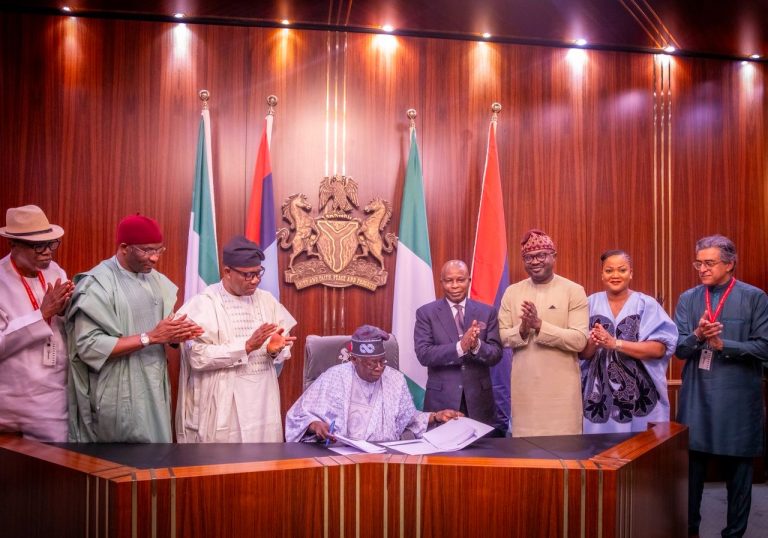
President Bola Ahmed Tinubu on Friday signed the 2026 National Identity Management Commission (NIMC) Act into law, marking a significant milestone in Nigeria’s efforts to modernise identity management, enhance national security, improve public service delivery, and deepen the nation’s digital economy.

The signing took place at the State House, Abuja, in the presence of the Senate President, Godswill Akpabio, the Deputy Speaker of the House of Representatives, Benjamin Kalu, and the House Leader, Julius Ihonvbere.

The Attorney General and Minister of Justice, Prince Lateef Fagbemi; the Minister of Interior, Dr Olubunmi Tunji-Ojo; the representative of the World Bank, Taimur Samad; and the Director-General of the National Identity Management Commission (NIMC), Dr Abisoye Coker-Odusote, witnessed the signing.

The Minister of Interior Dr. Olubunmi Tunji-Ojo, described the signing of the Act as a landmark achievement amid ongoing reforms aimed at strengthening internal security and improving access to government services.

He revealed that the existing network of databases was used in the arrest of some terrorists returning to Nigeria from the Holy Pilgrimage last week.

“Let me sincerely thank Mr President, the last time we had a NIMC programme, I referred to Mr President as the Grand Innovator of the Federal Republic. I wasn’t kidding. With this law, our security architecture can be enhanced.

“When Mr President came on board, we had a disconnected system within our identity data management system. At that time, getting a passport and getting a driving permit were completely disconnected from our identity database. But today, you can’t get a Nigerian passport without pulling data from NIMC,” Tunji-Ojo said.

According to the Minister, the new law will accelerate the harmonisation of identity databases, enhance the integrity of the National Identity Number (NIN) system, improve inter-agency collaboration, and strengthen Nigeria’s capacity to combat identity theft, terrorism, financial crimes and other security threats.

“What you have in immigration is what you have in the NIMC database, and let me say this clearly, that it has even helped our border control process. I know, sometime ago, the Senate President was alarmed by how some terrorists went on pilgrimage, wondering how they crossed our borders. We inherited a fractured system. But I’m happy to tell you that even last week, Thursday, seven of the known commanders of Boko Haram and ISWAP at the point of coming back from Mecca were arrested in Katsina at the airport and were handed over to the DSS.

“This is only possible because NIMC’s ID is already connected with the immigration database, and it’s already speaking to even the Interpol 24/7, and we have been able to automate this,” the Minister said.

The Senate President welcomed the presidential assent, noting that the Act reflects the National Assembly’s commitment to enacting laws that address Nigeria’s evolving security and developmental needs.

Akpabio expressed confidence that the legislation would strengthen public confidence in the country’s identity management architecture.

He also attributed the new NIMC law to President Tinubu`s innovation and reform agenda in Nigeria`s National Identity Management System.

According to Akpabio, the new legislation aligns with the President`s promise to transform Nigeria during his tenure.

The Deputy Speaker of the House of Representatives, Benjamin Kalu, commended the President for assenting to the new NIMC law, describing it as a transformative reform that will improve governance, promote accountability and support national development through a credible identity management system.

“The world is aware that the NIMC Act of 2007 was obsolete, and they have been monitoring that an effort was being made towards retooling, redefining, and re-equipping that piece of legislation to become what is fit for purpose, considering our current realities, and they were waiting to hear from us when it is going to become an instrument that we will use in building our nation.

“ Mr President, today marks a historic milestone in Nigeria’s digital transformation. It reflects the Federal Government’s bold commitment to building a robust, trusted and inclusive identity ecosystem, which is something that the President has taken seriously and also to better the lot of Nigerians,” he said.

On her part, the Director-General of NIMC reaffirmed the Commission’s commitment to implementing the provisions of the Act in collaboration with relevant government institutions, development partners and the private sector to deliver a world-class digital identity system, describing the new law as a major boost to the Commission’s mandate.

“Mr President, your visionary leadership and unwavering commitment to digital transformation have once again positioned Nigeria for a future driven by innovation, trust and inclusion. This landmark legislation is not just an amendment to an existing law; it is a bold leap into the future. For 19 years, the legal framework governing Nigeria’s identity management system remained unchanged while the digital landscape evolved rapidly.

“Today, that gap has been closed. The NIMC Act 2026 establishes a modern legal framework that further strengthens Nigeria’s digital public infrastructure, laying the foundation for trusted identity and seamless access to government and private-sector services. It reinforces the National Identification Number as the cornerstone of identity verification and authentication nationwide. The Act also introduces critical innovations that respond to the realities of today’s digital world,” she said.

Bayo Onanuga
Special Adviser to the President
(Information & Strategy)
June 26, 2026
FEDERAL GOVERNMENT SECURES RELEASE OF SIX DETAINED NIGERIANS IN COTE-D’VOIRE

0


The Federal Government has secured the release of six Nigerians who were detained in Côte d’Ivoire.

A statement by the Ministry of Foreign Affairs indicates that citizen diplomacy remains one of the country’s core foreign policy priorities.

The Ministry commends the Ambassador of Nigeria to Côte d’Ivoire, Ambassador Nwabiola C. Ezenwa, and the entire staff of the Embassy for their steadfast commitment, professionalism and tireless diplomatic efforts which culminated in the successful resolution.

The Government assured that it’s missions worldwide will continue to provide consular assistance and engage host governments through diplomatic channels.

It however urges Nigerians abroad to at all times abide by local laws of their host countries and maintain regular contact with the nearest embassy or consulate to enable faster intervention when the need arises.

PDP Condemns Court Order Directing Deregistration of NDC, Alleges Threat to Democracy

0


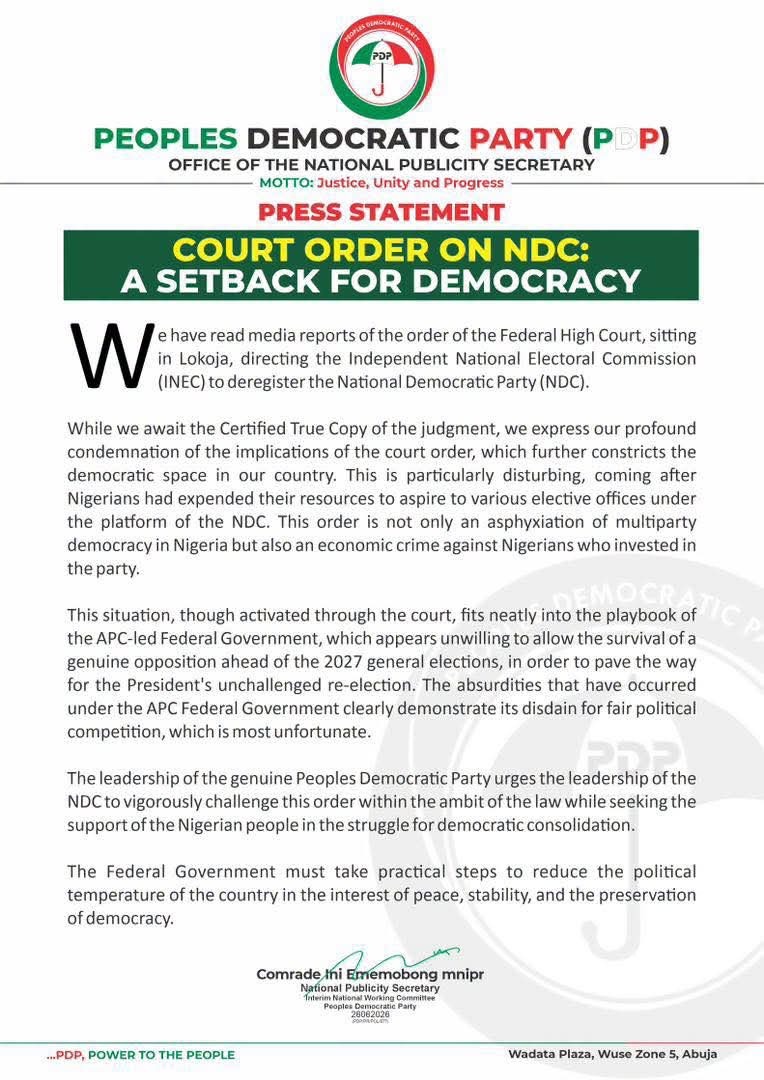
The Peoples Democratic Party (PDP) has condemned the reported order of the Federal High Court sitting in Lokoja directing the Independent National Electoral Commission (INEC) to deregister the National Democratic Party (NDC), describing it as a threat to Nigeria’s democratic space.

In a statement issued on Friday by its National Publicity Secretary of the Interim National Working Committee, Comrade Ini Ememobong, the party said it was awaiting the Certified True Copy (CTC) of the judgment but expressed concern over the implications of the court’s decision.

According to the PDP, the reported order comes after many Nigerians had spent personal resources to contest elective positions on the platform of the NDC, arguing that the move would not only weaken multiparty democracy but also amount to an economic loss for party members and supporters.

The party further alleged that the development aligns with what it described as the ruling APC-led Federal Government’s agenda to weaken opposition parties ahead of the 2027 general elections.

“This order is not only an asphyxiation of multiparty democracy in Nigeria but also an economic crime against Nigerians who invested in the party,” the statement said.

The PDP also claimed that recent political developments under the APC administration demonstrate a lack of commitment to fair political competition, warning that such actions could undermine the country’s democratic process.

The opposition party urged the leadership of the NDC to challenge the court order through all available legal means while mobilising public support in defence of democratic principles.

It also called on the Federal Government to take practical steps to reduce political tension across the country in the interest of peace, stability, and the preservation of democracy.

Alleged $4.5bn Fraud: Court Reserves Ruling on Admissibility of Emefiele’s Statements Until July 9

0


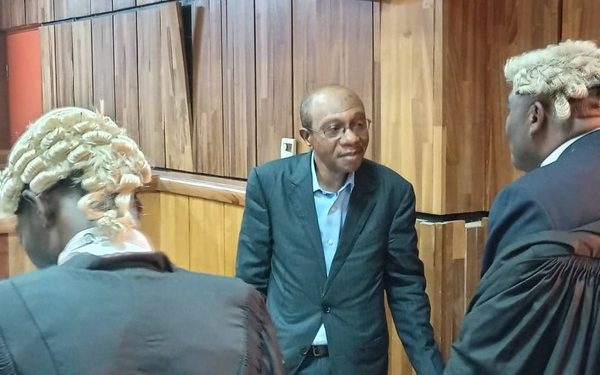
Justice Rahman Oshodi of the Special Offences Court in Ikeja, Lagos, on Friday reserved ruling until July 9, 2026, on the admissibility of extra-judicial statements allegedly made by former Governor of the Central Bank of Nigeria (CBN), Godwin Emefiele, in his ongoing $4.5 billion fraud trial.

Emefiele is standing trial alongside his co-defendant, Henry Omoile, on charges filed by the Economic and Financial Crimes Commission (EFCC).

The EFCC is prosecuting Emefiele on a 19-count charge bordering on receiving gratification and making corrupt demands while serving as CBN governor. Omoile is facing a separate three-count charge for the alleged unlawful acceptance of gifts by an agent. Both defendants have pleaded not guilty.

At Friday’s proceedings, counsel to Emefiele, Olalekan Ojo (SAN), challenged the admissibility of the extra-judicial statements the prosecution sought to tender, arguing that they were not made voluntarily.

According to Ojo, the statements were obtained through oppression, as well as physical and psychological torture, during the period Emefiele was allegedly detained by the Department of State Services (DSS) for over 157 days.

Relying on the Anti-Torture Act, 2017, and relevant provisions of the Evidence Act, Ojo argued that the statements were involuntary and therefore inadmissible.

“The issue before this Honourable Court is whether the statements credited to the first defendant were made voluntarily,” he submitted.
He further argued that where the voluntariness of a statement is challenged, a video recording of the interrogation is the most reliable means of establishing compliance with due process, adding that the absence of such recordings undermined the credibility of the statements.

The defence also contended that the prosecution failed to provide independent evidence supporting the alleged confessional statements and questioned the role of the lawyer said to have witnessed the interviews.
Ojo urged the court to reject the statements, arguing that any doubt regarding their voluntariness should be resolved in favour of the defendant.

Responding, the Director of Public Prosecutions of the Federation, Rotimi Oyedepo (SAN), who appeared with Bilikisu Buhari and C.C. Okezie, called the prosecution’s eighth witness, EFCC investigator Alvan Gurumnaan.

The witness told the court that Emefiele was invited for questioning and that all interviews were conducted in the presence of his legal representative.

He disclosed that the prosecution had voluntarily withdrawn Emefiele’s statement dated October 26, 2023, but sought to tender statements recorded on October 27, October 30, November 1 and November 2, 2023.
“If the defence does not want that statement, we are prepared to withdraw it. We are withdrawing it not because it was obtained through torture or oppression,” the witness told the court.

Oyedepo argued that there was no basis for conducting a trial-within-trial, maintaining that none of the remaining statements amounted to a confession.
“There is nothing in the defendant’s statements that can be construed as an admission of the facts in issue,” he argued.
He further submitted that the Anti-Torture Act does not make a trial-within-trial mandatory under the circumstances and urged the court to dismiss the defence’s objection and allow the substantive trial to proceed.

Earlier, counsel to the second defendant, Adeyinka Kotoye (SAN), informed the court of a pending application seeking leave to appeal an earlier ruling.
The prosecution did not oppose the application, following which Justice Oshodi granted the request.

“I hereby grant the second defendant leave to appeal the ruling of the court,” the judge ruled.
Justice Oshodi subsequently adjourned the matter until July 9, 2026, for a ruling on the admissibility of the disputed extra-judicial statements.

The court also fixed October 6, 7 and 8, as well as November 11, 12 and 13, 2026, for the continuation of the substantive trial.

Sanwo-Olu orders demolition of DISTRESSED HOUSES AROUND ALAKIJA COLLAPSED BUILDING

0

.Owner to face trial


The Lagos State Government will demolish all buildings marked as distressed around the collapsed 3-storey building at Alakija, Governor Babajide Sanwo-Olu said yesterday.

Speaking during an inspection tour of the site on Friday, Commissioner for Information and Strategy Mr Gbenga Omotoso, who represented Governor Sanwo-Olu, sympathised with the families of the victims and praised emergency responders for their swift intervention.

According to the Commissioner, 27 people were rescued alive from the rubble. Nine died.
The search and rescue operation lasted all night. Still at the site are Lagos State Emergency Management Agency (LASEMA), Lagos State Fire and Rescue Service, Lagos State Building Control Agency (LASBCA),the Police, Command and Control Centre, Neighborhood Watch and other agencies.

“Governor Sanwo-Olu is saddened by this incident. He sends his condolences,” Omotoso said, adding: “ This should not have happened, if people had obeyed the law instead of prioritizing livelihoods over lives. The collapsed building had been marked as structurally distressed and occupants were directed to vacate the premises, but the warning was ignored.”

“All other buildings already marked as unsafe within the area will be demolished to prevent similar tragedies and avoid a compromise of the lives of others around.

“27 people were rescued alive, while 9 casualties were recorded during the search and rescue. Governor Sanwo-Olu commiserates with the families who lost their loved ones,” Omotoso said.

The Commissioner also promised that owners of the collapsed building would be prosecuted by the state. Anyone found to have violated building regulations or frustrated enforcement efforts will surely face legal action,”he said.

Omotoso condemned the construction of buildings beneath high-tension electricity lines, describing the practice as “dangerous” and “suicidal”.

According to the commissioner, the cause of the collapse is being investigated. Survivors are receiving treatment at various hospitals.

“Owners of the collapsed and other distressed buildings will be prosecuted for culpability in the incident, according to the law of Lagos State.

“You cannot build under high-tension power lines. It is dangerous and unacceptable in any civilized society. It shows disregard for the law, and the government will not tolerate that,” Omotoso said.

The government urged residents to comply with safety directives, stressing that protecting lives remains its top priority.

Mr Omotoso advised all residents of buildings around the scene to relocate immediately. He praised all the first responders for “a good job”.

LASEMA Permanent Secretary Dr Olufemi Oke-Osanyintolu also commended “all first responders and security personnel who worked tirelessly for the evacuation of survivors as the building was brought to ground zero”.
With Omotoso was Special Duties Commissioner Gbenga Oyerinde, who also praised the first responders “for their efforts”.

Update: Federal High Court Vacates Judgment Ordering INEC to Register NDC

0


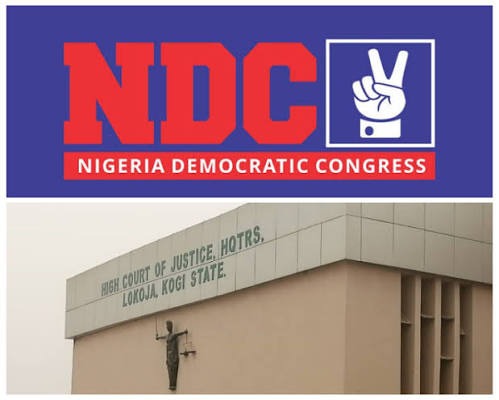
The Federal High Court sitting in Lokoja has set aside its earlier judgment directing the Independent National Electoral Commission (INEC) to register the National Democratic Coalition (NDC) as a political party.
Delivering the ruling, Justice Isah Dashen held that the December 2025 judgment was constitutionally defective because it was delivered without hearing from all parties with an interest in the matter.

The decision followed an application filed by the Peace Movement Party (PMP), which argued that the NDC’s registration was based on a logo the PMP had earlier submitted to INEC before the commencement of the suit.

Justice Dashen ruled that all relevant parties must be given the opportunity to be heard before any substantive decision can be reached in the case.

Consequently, the court ordered that the substantive suit should commence afresh, with INEC, the PMP and the NDC joined as parties.

The judge also directed that the status quo be restored to what it was before the December 2025 judgment pending the determination of the substantive suit.

Speaking with journalists after the ruling, counsel to the applicant, Chikezie Ekeocha, said the PMP approached the court after discovering that the NDC’s registration was premised on a logo the party had previously submitted to INEC.

According to Ekeocha, the court agreed that the PMP’s rights were affected and consequently vacated the earlier judgment that directed INEC to register the NDC as a political party.

Segun Showunmi Mourns Murder of Retired Civil Servant, Demands Swift Justice

0


Former Ogun State governorship aspirant, Otunba Segun Showunmi, has expressed grief and outrage over the killing of retired civil servant, Mrs. Olakitan Oyesiku, describing the incident as a tragic reflection of growing insecurity and a painful loss to the Abeokuta community.

In an emotional tribute, Showunmi said he was struggling to come to terms with the murder of the woman he fondly called “Aunty Kiitan,” noting that she was widely known for her peaceful lifestyle, discipline and commitment to maintaining a quiet, dignified life.

According to him, the late Oyesiku was “an institution in prim and proper,” whose life reflected order, elegance and integrity.

He said the news of her death had left him devastated despite confirming her identity through someone who transported her body to the mortuary.

Showunmi questioned the motive behind the killing, wondering whether it was connected to a dispute over family property or another criminal act.

He lamented what he described as the decline in the peace and security for which Abeokuta was once known, saying it was heartbreaking that a woman who lived a harmless and exemplary life could be murdered.
Recalling her personality, he described Oyesiku as brilliant, firm and respected within the Ibara Housing Estate community, where she was admired for keeping her home and surroundings neat and well maintained.

He also remembered her fondness for tea and chocolate cake, saying she found joy in life’s simple pleasures and lived with quiet grace.
Condemning the perpetrators, Showunmi called for swift and maximum justice, insisting that those responsible must be brought to book.

He prayed for the peaceful repose of her soul and urged that her memory continue to inspire those who knew her, while praying for comfort for her family, friends and the Abeokuta community.

Why state police implementation should be postponed – Peter Obi

0

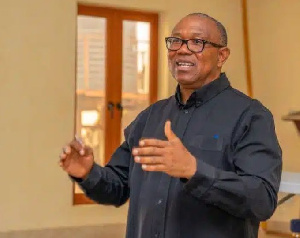
Former Labour Party presidential candidate, Peter Obi, has urged that the implementation of state police be delayed until after the 2027 general elections, warning that the new policing structure could be manipulated for political purposes if introduced in the current climate.

Obi, who reacted to the recent passage of the State Police Bill by the National Assembly, said while he supports decentralised policing in principle, the manner in which the legislation is being advanced raises serious concerns.

Writing on his X account on Friday, the former Anambra State governor argued that Nigeria’s security challenges require a policing system that is closer to communities and local governments, rather than one that is heavily centralised.

However, he maintained that the legislative process leading to the bill’s passage appeared rushed and lacked adequate public engagement.

“The recent passage of the State Police Bill by the National Assembly marks a significant legislative milestone in addressing a long-standing demand of the Nigerian people,” Obi said.

“For years, many of us, alongside security experts and regional stakeholders, have consistently argued that a highly centralised policing structure is fundamentally unsuitable for a country as vast, diverse, and complex as Nigeria.

“However, the legislative and constitutional implementation appears shaky and raises legitimate concerns.”

He criticised what he described as insufficient community participation in the process and questioned the absence of a public hearing on such a sensitive national issue.

“The process should involve greater community participation. Policing should be more visible at the local government and community levels,” he said.
“The mechanism for passing the law appears highly disorganised, with no public hearing on such a sensitive issue.

“Indeed, the rush to enact the law without proper legislative procedures fuels suspicion among many observers about the political motives behind it.”

Obi said his major worry was not logistics but the possibility that governors could use state police forces against political opponents.

“There is a widespread, justifiable fear that state police forces could become instruments in the hands of governors,” he stated.

“The suspicion is that a state-controlled police force could be weaponised to suppress political rivals, disrupt opposition rallies, and manipulate elections.”

To prevent abuse, Obi called for strong safeguards, including independent state-level police oversight institutions insulated from executive control.

“For state policing to evolve from a risky political gamble into a genuine security solution, the law must not only permit states to establish police forces but also clearly provide for independent oversight bodies, such as a state-level Police Service Commission that is entirely free from executive influence,” he said.

He added that many Nigerians remain unconvinced that the current administration would resist the temptation to use state policing to influence the 2027 elections indirectly.

“Going by what Nigerians have seen so far, there is no guarantee that this administration can resist the temptation to take advantage of state policing to influence the 2027 general election by proxy,” Obi said.

“In view of that possibility and the danger it poses to the polity, it is necessary to defer its implementation until after the general election. A New Nigeria is Possible.”

Sun

Nigeria’s gas production hits 7.85bn cubic feet per day

0


…As Decade of Gas, Pi-CNG&EV, deepen media engagement on Nigeria’s gas economy


The Nigeria’s gas sector has continued to record significant progress, with year-to-date gas production reaching 7.85 billion standard cubic feet per day (cfpd).


This is even as the Decade of Gas secretariat, in collaboration with the Presidential Initiative on Compressed Natural Gas and Electric Vehicles (Pi-CNG & EV), has continued its efforts to strengthen public understanding of Nigeria’s gas sector through a media capacity-building session held in Port Harcourt, Rivers State.

The programme brought together 30 journalists from television, radio, print, and digital media platforms to deepen their understanding of Nigeria’s gas development agenda and enhance reporting on the role of gas in driving economic growth, energy security, industrialization, job creation and improved living standards.

Speaking during the session, Mr. Taofeek Balogun of the Decade of Gas Secretariat, described the Port Harcourt engagement as the third in a series of media engagements that began in 2025, following similar sessions in Lagos and Abuja.

Balogun disclosed that domestic gas utilization has surpassed the 2 cfpd mark, while gas exports have risen to their highest level in five years, reflecting growing demand across power generation, industries, transportation, exports and household consumption.

Mr. Balogun also highlighted the successful completion of the Obiafu-Obrikom-Oben (OB3) River Niger Crossing by NGIC/NNPCL, describing it as a critical infrastructure milestone that will improve gas transportation across the country, support industrial growth, attract investment, strengthen energy security, and contribute to economic development.

He reiterated that, as part of efforts to expand domestic gas utilization, the Federal Government is commitment to increasing access to clean cooking solutions.

According to him, the government’s target is to distribute cooking gas cylinders to 5 million households by 2030.

He continued: Following the successful rollout of the programme across the six geopolitical zones by the Minister of State for Petroleum Resources (Gas), Hon. Ekperikpe Ekpo, implementation will now move to the state level, beginning with Bayelsa State in July 2026.

“Under the initiative, 27,000 households in Bayelsa are expected to receive cooking gas cylinders within the year as part of the 1 million homes per year target.”

Also speaking, the Chief Operating Officer of Pi-CNG & EV, Mr. Tosin Coker, highlighted ongoing efforts to expand the adoption of Compressed Natural Gas (CNG) and electric mobility solutions as cleaner and more affordable transportation alternatives for Nigerians.

He disclosed that the Federal Government is promoting the adoption of CNG across Ministries, Departments and Agencies (MDAs) through the conversion of existing vehicle fleets and the procurement of CNG-powered vehicles as part of broader efforts to reduce transportation costs and improve energy efficiency.

According to Mr. Coker, more than 100,000 vehicles have now been converted to CNG nationwide under the initiative, reflecting growing acceptance of alternative fuel solutions and supporting the country’s transition towards cleaner and more sustainable transportation.

Participants commended the initiative for strengthening media capacity and improving public understanding of developments within Nigeria’s energy sector.

The Decade of Gas Secretariat and Pi-CNG & EV reaffirmed their commitment to sustained stakeholder engagement and public awareness, as Nigeria continues its journey towards a gas-powered economy.

Sun

Gov Okphebolo nominates second non-Edo indigene as commissioner-designate in Edo State

0

The Edo State Governor, Senator Monday Okpebholo’s administration has approved the nomination of Mr. Martin Anayochukwu Oli, a businessman and community leader from Aninri Local Government Area of Enugu State, as Commissioner-Designate in Edo State.

The nomination, announced by the Secretary to the Edo State Government, Umar Musa Ikhilor, Esq., is another milestone in Governor Okpebholo’s deliberate effort to ensure that the state’s diverse communities are reflected in government appointments, Chief Press Secretary to the Governor, Patrick Ebojele, said in a statement.

“Mr. Oli’s nomination is the second major appointment involving a non-Edo ethnic group since Governor Okpebholo assumed office, following the appointment of Hon. Abdulkarim Kadiri, a respected Hausa-Fulani community leader in Edo State, as Special Adviser on Community Matters in November 2024.

“It highlights the Governor’s vision of building an administration that recognises the contributions of all residents, irrespective of ethnic background.

“Edo State is home to several ethnic communities, including Igbo, Hausa-Fulani, Yoruba, and others, whose economic activities, cultural contributions, and social engagements have become part of the state’s growth story.

“The nomination of Mr. Oli reflects Governor Okpebholo’s commitment to creating a government structure where diverse communities can participate meaningfully in governance and contribute to policy direction.

“Governor Okpebholo believes that inclusive governance is not just rhetoric. It requires listening to the people, understanding their concerns, and giving them seats where decisions are made”, the said.

It added that Governor Okpebholo’s approach represents a shift towards a more open and participatory governance model, where residents who have contributed to the development of Edo State are recognised and given opportunities to serve.

“Mr. Oli, an established entrepreneur with considerable private sector experience, has also built a reputation as a community advocate within Edo’s Igbo community, supporting grassroots development initiatives and programmes aimed at improving livelihoods and expanding economic opportunities.

“His nomination underscores the importance of recognising competence, commitment, and community service in the selection of public officers.

“Mr. Oli’s nomination will now proceed to the Edo State House of Assembly for screening and confirmation in line with constitutional procedures”, the statement disclosed.

Sun