Home Blog Page 296

Atiku’s camp raises questions over ‘rescued’ Oyo teacher’s revelation

0


The camp of former Vice President Atiku Abubakar has raised questions over conflicting accounts on how 44 pupils and teachers abducted in Oriire, Oyo State, regained their freedom, following a statement by one of the freed teachers.

In a Facebook post on Saturday, Atiku’s Media Adviser, Paul Ibe queried the presidency’s description of the incident as a “rescue” after a teacher, Mr. Olatunde Zacchaeus, said on a radio station that they were “released” by the terrorists.

On July 10, the Special Adviser to the President on Information and Strategy, Bayo Onanuga, announced that the 44 Oriire school children and teachers were rescued by security forces after 56 days in captivity.

The presidency said eight kidnappers were arrested and others neutralised during the operation, and that there was “no quid pro quo” in the rescue.

However, Zacchaeus, a teacher who spent 56 days in captivity with 43 other victims, told Info FM that they were released by the abductors.

The video of his remarks was shared by Oyo Matters on Thursday.

In his post, Ibe asked: “Is it that Zacchaeus, as a teacher, does not know the difference between to release and rescue, or is he an ‘agent’ of the opposition, or what?”

He described the teacher’s claim as being “in stark contradiction to what the Tinubu-led APC administration told the nation.”

Ibe also linked the revelation to broader concerns about ransom payments, saying it “brings to the fore the issue of state sponsored psyment of ransom to terrorists and bandits and conspiracy theories that some of the so-called abductions are state-sponsored.”

He backed Governor Seyi Makinde’s call for an independent probe, asking: “Does this revelation now explain why Governor Seyi Makinde of Oyo State demanded for a United Nations independent investigation of the issue?”

“I agree 100% with Makinde, there’s a compelling need for an independent investigation of an international dimension to establish what truly happened in Oriire, Oyo State, Mussa village in Askari/Uba local government of Borno and in other places where abductions has become the rule and not the exception,” Ibe asserted.

He also asked for an update on “the plan for the rescue or release of the abducted school children in Borno.”

Background
Gunmen attacked three schools in Oriire Local Government Area on May 15, abducting 46 pupils, teachers and a toddler, while two teachers were later killed in captivity.

The victims were freed on July 10 after what security agencies described as an intelligence-led joint operation involving the Army, Police, DSS, and others.

The Oyo State Government described the freedom of the victims as a victory for “principled leadership” and said it resisted pressure to pay ransom.

The Federal Government has since arraigned three men over the abduction.

Sun

Senator Orji Kalu Condoles With Rt. Hon. Chibuike Rotimi Amaechi Over Mother’s Passing

0


The Senator representing Abia North Senatorial District, Senator Orji Uzor Kalu, has expressed sadness over the passing of Dame Ezinne Mary Oduah Amaechi, mother of former Governor of Rivers State and former Minister of Transportation, Rt. Hon. Chibuike Rotimi Amaechi.

The former Abia state governor in a statement on Saturday, described the late Dame Amaechi as a devoted mother, woman of faith, and respected matriarch whose life was defined by humility, compassion, and commitment to her family, community, and humanity.

He said her passing was a painful loss not only to the Amaechi family but also to all who had the privilege of knowing her, noting that she lived an exemplary life of service, dignity, and grace worthy of emulation.

Senator Kalu extended his heartfelt condolences to Rt. Hon. Amaechi, the entire Amaechi family, friends, and associates, praying that Almighty God grants them the strength and fortitude to bear the irreparable loss.

The former Governor of Abia State urged the bereaved family to take solace in the enduring legacy of love, discipline, faith, and selfless service that the late Dame Amaechi left behind.

“On behalf of my family and the good people of Abia North Senatorial District, I extend my deepest condolences to my dear brother, Rt. Hon. Chibuike Rotimi Amaechi, and the entire Amaechi family. I pray that Almighty God grants you the strength to bear this painful loss and grant the soul of your beloved mother eternal rest,” Senator Kalu said.

He prayed for the peaceful repose of the soul of the deceased and asked God to continue to comfort the entire Amaechi family during this period of mourning.

Delta Police Arrest 12 Suspected Cultists, Recover Firearms, Ammunition

0


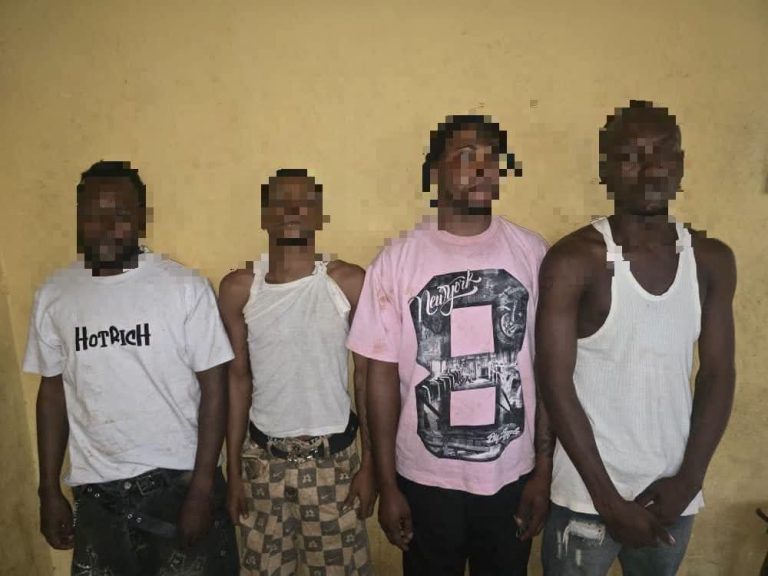
The Delta State Police Command has arrested 12 suspected cultists and recovered firearms, ammunition and other incriminating items in separate intelligence-led operations as part of its ongoing crackdown on cultism and violent crime across the State.

In the first operation, carried out at about 2:00 a.m. on July 17, 2026, operatives of the Command’s Violent Crime Response Unit (VCRU), acting on credible intelligence, raided a suspected criminal hideout in Amukpe, Sapele Local Government Area.

The operation led to the arrest of eight suspects identified as Lucky Naset, 30; Ochuko Midwest, 27; Samuel Oghene, 29; Michael Mmadu, 35; Dennis Philip, 28; Goodluck Onujenya, 30; Ovie Royal, 25; and Divine Otemu, 22, all alleged members of the Aiye Confraternity.

A search of the hideout resulted in the recovery of three locally fabricated pistols, six live cartridges, eight rounds of live ammunition of different calibres, two axes, two suspected cannabis grinders, a bottle containing a suspected illicit substance and other incriminating exhibits.

Police said preliminary investigations linked the suspects to cult-related activities within the Sapele axis, adding that efforts are ongoing to arrest other members of the syndicate and recover more weapons.
In a separate operation at about 11:30 a.m. on the same day, police operatives arrested four suspects over an alleged cult-related attack on a male victim from Illabor Community in Ika North East Local Government Area.

The suspects were identified as Ifeanyi Emeka, 25; Hope Sunday, 24; Francis Onyechiwalla, 23; and Chinedu Joseph, 25.

According to the police, the suspects allegedly attacked the victim with a cut-to-size gun. During preliminary investigation, they reportedly confessed to being members of the Eiye Confraternity.

The suspects remain in police custody while investigations continue to determine their involvement in other cult-related offences and to apprehend other members of the group.
Commending the operatives for the successful operations, the Commissioner of Police, Delta State Command, CP Yemi Oyeniyi, reaffirmed the command’s commitment to dismantling criminal gangs and cult groups across the State.

He urged residents to continue providing credible and timely information to the police, assuring them that the command would sustain intelligence-led operations to ensure the safety and security of lives and property.

Editor’s Note: Although the statement’s subheading referred to the “arrest of eight suspects” in the second operation, only four suspects were named. The total number of suspects identified across both operations is 12.

Our ordeals in kidnappers’ den

0


•Rescued schoolchildren, teachers recount 56 days of horror in Oyo forest •I never thought I’d see my family again – 15-year-old Taiwo •Even if it’s my husband’s bones, please give us to bury – Widow of slain teacher begs


The first sign that the ordeal of the rescued Oriire abducted children was far from over came not from a doctor, a psychologist or a security expert. It came from a frightened four-year-old girl, whose instinctive reaction spoke louder than any medical diagnosis.

When journalists arrived at the Ahoro-Dada community in Oriire Local Government Area of Oyo State on Wednesday, July 15, to follow up on the condition of pupils and teachers rescued from kidnappers after 56 harrowing days in captivity, little Taiwo did something that captured the invisible wounds of the tragedy.

The moment she saw cameras and microphones, she screamed and bolted. To journalists, they were ordinary work tools. To the traumatised child, they resembled the guns that had shattered her world exactly two months earlier

To the adults around her, they were harmless journalists. To the frightened child, they looked like armed men who had invaded schools in broad daylight on May 15, firing guns and dragging innocent children and teachers into the forest.

Her terrified parents eventually caught up with her, held her gently by the hands and repeatedly assured her that the visitors were not kidnappers.

The reaction of the little girl probably revealed that while the victims had regained their freedom, many have remained prisoners of fear.

As gathered, the singular moment perhaps tells the story of the Oriire schools’ abduction better than statistics ever could.

Though the victims might have left the forest, for many of them, the forest has refused to leave their minds.

But the story of the Olaleyes was not like that of the family of Michael Oyedokun, the mathematics teacher that was beheaded by the bandits on Saturday May 16th. The Oyedokuns already got the news of the killing of their breadwinners since May.

The Oriire mass abduction, it was gathered, ranks among Nigeria’s most disturbing attacks on schools in recent years. Some of the previous school kidnappings took place in Chibok, Dapchi, Kankara, Tegina, Kuriga and other communities where classrooms became hunting grounds for armed criminals.

Community learning to smile again

The coordinated attacks on schools in Ahoro-Esiele and Yawota communities on Friday May 15, 2026, shocked Oyo State and the entire country.

Gunmen stormed three schools, shooting indiscriminately before marching away with 39 pupils and seven teachers.

For 56 agonising days, families lived between hope and despair. Parents woke up every morning praying that their children would still be alive.

Teachers feared entering classrooms. Entire communities held their breath.

But the eventual rescue of all 44 surviving victims through a coordinated security operation brought immense relief across Nigeria. But relief, as events in Ahoro-Dada have shown, is not the same as healing. Healing is proving to be a much longer journey.

Abduction was never staged; we passed through hell – Zaccheaus Olatunde

For many Nigerians, the rescue of the Oriire pupils and teachers marked the end of a frightening chapter. But for Mr Zacheaus Olatunde, one of the seven teachers rescued after spending 56 days in captivity, the memories remain vivid, painful and impossible to forget.

Speaking after regaining his freedom, Olatunde recounted life inside the terrorists’ camp. He described how two of his colleagues – Mr Michael Oyedokun and Deacon John Olaleye, lost their lives under brutal circumstances.

According to him, the kidnappers had laid down strict rules from the very first day they arrived in the forest. One of the first instructions was that every captive must surrender all mobile phones.

Everyone appeared to comply. Unknown to the others, however, Mr Michael Oyedokun still had a phone in his pocket.

“The terrorist sitting with him on the motorcycle discovered the phone and immediately questioned him,” Olatunde recalled. “When Michael explained, the man slapped him. Their General Commander heard about it and became furious.”

The commander reportedly declared that such disobedience could not go unpunished.

According to Olatunde, the terrorists had two leaders—a General Commander and a Camp Commander. The General Commander allegedly announced before everyone that if no one else would be killed for violating his orders, Michael would pay with his life.

The following day, the threat was carried out.

“We heard him crying and begging as they dragged him away,” Olatunde said quietly.

“His voice was very loud at first… then suddenly, everywhere became silent.”

Moments later, one of the younger terrorists whom he estimated to be about 17 or 18 years old, returned dancing and singing in celebration of the killing.

The horror did not end there.

Weeks later, on June 7, another teacher, Deacon John Olaleye, was also taken away and killed

“Mr John Olaleye was murdered on June 7. They killed him because they said they have warned that military men should not move closer.

“They never killed them in our presence. They would take them away to another location. We only heard their cries before everything became quiet.”

Life inside the camp, he said, was a daily struggle for survival.

The adult male captives were kept inside makeshift tents, their hands handcuffed and their legs chained for virtually the entire period of captivity. Their eyes were often blindfolded, while even basic human needs depended on the permission of their captors.

“If we wanted to urinate or defecate, we had to beg them,” he recalled.

The terrorists rarely stayed in one place, moving the captives from one forest location to another to avoid detection by security forces. Adult captives, he said, often bore the punishment for mistakes committed by frightened children.

“Sometimes they struck us with their guns. If any of the children did something they didn’t like, it was the adults who suffered.”

Food was barely enough to sustain life.

Most days, the captives survived on plain rice or rice mixed only with palm oil, without pepper or salt.

Occasionally, the terrorists hunted wild animals, including deer and grasscutter, which were shared among the captives.

Religion also became another instrument of intimidation.

According to Olatunde, the terrorists were meticulous about observing their own prayers and Qur’anic recitations, never missing the prescribed times of worship.

Ironically, they prohibited Christian prayers among the captives.

“They warned us never to pray or call on Jesus. Whenever they caught us praying, they beat us mercilessly,” he said.

Perhaps one of the most revealing aspects of his testimony was the kidnappers’ claim that money was not their primary objective.

“They kept telling us they were not interested in ransom,” Olatunde said. “Their demand was that members of their group who had been arrested should be released.”

Eventually, events appeared to shift in the captives’ favour.

According to him, the kidnappers became noticeably less hostile after learning that some of their own family members had been arrested during security operations.

“Their attitude changed after that,” he said. “They treated us better than before.”

Then came the unexpected announcement that would end the two months of hell and horror.

“They told us to prepare because we were going home.”

The terrorists reportedly directed the captives along a particular route, telling them they would cross two streams before meeting soldiers waiting to receive them. By then, many of the children were too weak to walk unaided.

“I carried almost all the little children across the streams because they had become very weak,” Olatunde said.

Shortly afterwards, they encountered security personnel who escorted them to safety, bringing an end to one of the most traumatic experiences of their lives.

Back in Ibadan, he recalled, military officers showed him photographs of suspected kidnappers. He said he was able to identify one of them and was informed that several members of the gang had already been arrested while others had been neutralised during security operations.

He also dismissed claims in some quarters that the abduction had been staged.

He explained that the absence of school uniforms among some of the pupils was because Oyo State public primary schools observe traditional attire every Friday, a policy that also accounted for why several teachers were dressed in native wear on the day of the attack. As for questions about why some of the children’s clothes appeared clean after their rescue, he offered another startling explanation.

“The kidnappers occasionally washed our clothes whenever they felt we were smelling,” he said. Then, after a long pause, he summed up the ordeal in one sentence that perhaps needs no embellishment: “The abduction was never staged. We passed through hell.”

One of the rescued pupils, Taiwo Hassan, a 15-year-old boy, still remembers every frightening second.

Speaking quietly, he recalled how an ordinary school day suddenly became a nightmare.

“We were writing our test. I didn’t know how the kidnappers entered the school. All I knew was that they suddenly came with guns,” he stated.

The sound of gunshots instantly erased every thought except survival.

“We had no option but to follow them because they were carrying guns and shooting. We just obeyed.” Then came the long journey into the forest: “I don’t even know the route they took us through into the forest. But when we entered the forest, we trekked for one day.”

The boy noted that far more painful than the physical trek, however, was the emotional burden. “When I was in the kidnappers’ den, I was afraid nobody would rescue me. I kept thinking about my parents. I knew they would also be afraid.”

He revealed that beyond hunger, exhaustion and uncertainty, the greatest burden was psychological torture, including the constant fear that home might never be seen again.

Hassan stated that the abductors took the victims to their first stronghold by 7pm on May 15th, after they had been kidnapped around 9am, which is about 10 hours of trekking.

But how did they eat? He answered: “They fed us with cooked rice. Initially, they allowed the women among the victims to cook the rice. Later, the abductors took over the responsibility by themselves. They cooked for us.”

Hassan added that the captives were taken to different locations inside the forest. At times, they would be under shades of trees.

“Whenever rain fell, they would cover us with big nylon. The teachers suffered more. They were handcuffed and blindfolded.” Some elderly people around Taiwo stated that she told them that she was given garri without sugar as food for many days.

Father’s relief after 56 days of agony

For Mr Hamzat Wakili, whose teenage son was among those rescued, every passing day during the captivity felt like a lifetime. Like many parents, he imagined unimaginable horrors.

“I thought the kidnappers would have beaten him mercilessly. But when he returned, he told me they didn’t beat him,” he stated.

It was perhaps the first piece of good news he had received in nearly two months. Wakili insisted that despite the tragedy, his community must not be abandoned. “This is my community. I don’t pray that this community or the school will collapse. By God’s grace, my son will return to school.”

Grandmother who wept everyday

For Mrs Taibat Sule, the kidnapping turned every sunrise into another day of tears.

“When my grandchild was kidnapped, I cried every day.” She said she stopped crying only after seeing the child safely back home. Even then, emotions remained overwhelming for her.

“I was still crying when they went to Ogbomoso to bring my grandchildren back home.”

Back to school, but not back to normal

Schools in Oriire have reopened. Lessons have resumed. NECO examinations have continued. Attendance is gradually improving. Yet beneath the appearance of normalcy lies persistent fear.

A teacher at the Community High School, Mr Timothy Gbolagade, who participated in supervising the National Examination Council (NECO) examinations shortly after the rescue, admitted that classrooms have reopened but confidence has not fully returned.

Immediately after the May 15 attack, only about half of the students came back to school. Many parents simply refused to take the risk. It was gathered that teachers have been spending time to encourage the remaining pupils not to lose hope.

Following the rescue operation, it was noted that attendance has improved significantly.

“On Tuesday, we recorded more students returning,” the teacher explained. “We just finished writing the NECO English Language examination.”

Gbolagade also stated that the affected communities have not fully recovered from the shock of the abduction. He added that “the fear is still there.” A cursory assessment of the communities showed that the fear is not among students alone. The teachers are also terrified and apprehensive.

Every discussion about the kidnapping reopens emotional wounds. And every unfamiliar sound causes anxiety. Every movement around the school attracts suspicion.

We need security we can see

Perhaps the strongest message coming from Oriire is that rescue alone is not enough. Visible security, they said, matters.

The teacher, Mr. Timothy Gbolagade, stated that many colleagues remain apprehensive because they did not regularly see security personnel around the schools.

“Teachers coming from town to work here are still asking what security government has provided. “Our concern is what the government is doing to boost security. If we can see soldiers or police around the schools, the fear will reduce.”

Development and security

Residents believe insecurity and underdevelopment are closely linked. Mr. Hamzat Wakili acknowledged government efforts following the abduction.

According to him, the authorities have approved the establishment of a military base within the community.

“Very soon work will begin on the military base,” he said.

For residents, that offers hope. Yet they insisted that security could not stand alone. The residents of the communities also need development.

Wakili stated further that the roads in the communities remain poor. He added that employment opportunities are scarce.

He stated further that industrial activities were virtually non-existent. Telecommunication signals remain weak in several areas.

Many community leaders believe that sustained development, improved infrastructure and stronger government presence will reduce the vulnerabilities often exploited by criminal groups.

Even if it is only his bones, give us to bury — Olaleye’s widow

While dozens of families celebrated reunions, others have continued to mourn.

Among them is the family of a teacher, Mr John Olaleye, who never returned from the forest, even as the whereabouts of his remains remain unknown.

The Principal of Community High School in the affected area, Mrs Rachael Alamu, in her first interview after she came out of the kidnappers’ den, said John was killed on the first Sunday of June. His widow now faces a future she never imagined.

“I am very sad,” she said softly.

Her immediate concern was painfully simple. She wanted her husband’s remains.

“I am begging the government to release my husband’s corpse. Even if we receive only his bones, we shall be grateful.”

Behind her are three children whose lives changed forever.

“My husband was the one taking care of the family. I have nothing.”

The widow is pleading for government support to help raise the children left behind.

A family member who supported the widow, stated that the family did not initially know Olaleye had been killed.

The devastating confirmation came during Governor Seyi Makinde’s statewide broadcast after the rescue operation.

The family hopes that the government could provide employment for the widow to ensure the children continue their education.

On Friday July 10th when the news broke out that the abducted pupils and the teachers had been released, many people found their way to the family house of the Olaleyes. They danced with the wife and praised God for the release of the captives, unknown to them that the breadwinner of the house had been killed by the kidnappers.

When rescue is only the beginning

The Oriire rescue operation, unlike many previous school kidnappings that ended after ransom negotiations, was widely celebrated because security agencies secured the victims’ release without negotiated ransom.

Following their rescue, the victims were admitted to the military hospital on Friday till Monday, when they were handed over to the Oyo State Government.

After they were received officially at the Executive Council Chambers of the Governor’s Office in Ibadan, they were moved to the LAUTECH Teaching Hospital in Ogbomoso, where medical experts conducted physical examinations and psychological assessments before gradually reuniting them with their families.

Doctors initially discharged 31 among the pupils after confirming satisfactory recovery. The eight other pupils that required additional medical attention and observation were later released by the hospital.

Unfamiliar sound

Nearly eight days after they walked out of the forest, many of Oriire schoolchildren have returned to school. They now sit behind their desks instead of beneath trees in a terrorist camp. But each unfamiliar sound still makes some of them look over their shoulders.

Sun

Insecurity: Communities move against bandits with local forces

0


•How non-state actors are squaring up against kidnappers, other criminals
By Oluseye Ojo

Nigeria, by all constitutional definitions, has one police force. In reality, however, the country is increasingly being policed by dozens of shadow forces..

It is an alternative security ecosystem that has emerged across vast forest reserves, federal highways, isolated agrarian farm settlements, ancient villages, riverine creeks, and urban neighbourhoods.

The entity is neither fully official nor entirely informal. It is a multi-layered network of vigilantes, regional security outfits, community guards, private security contractors, and volunteer militias that have become the first responders whenever danger strikes.

They are the men who know every hidden footpath in the thickest forests, women who notice and identify strangers, and local hunters who can track kidnappers through the dense bush in the dead of night, using nothing but ancestral knowledge and intuition.

When communities stopped waiting

Nigeria, according to available records, has a population exceeding 220 million people. But the country’s police-to-citizen ratio remains far below the internationally recommended minimum standard of one police officer to 450 citizens.

The centralised Nigeria Police Force (NPF), numbering fewer than 400,000 personnel as at last count, has no doubt been depleted by bureaucratic assignments, VIP protection details, and severe logistical deficits.

As gathered, vast swathes of rural Nigeria are completely unpoliced. Massive forest corridors, such as the notorious Kamuku, Falgore, and Sambisa forests as well as the Old Oyo National Park, have turned into sovereign safe havens for heavily armed kidnappers and bandits. Communities separated from federal security formations by rugged mountains or broken roads often have to wait hours, sometimes days, for state intervention after an attack.

Into this yawning vacuum stepped local actors. What initially began as an isolated and defensive community vigilante arrangements, and neighbourhood night watchmen, armed with whistles and old single-shot Dane guns, gradually evolved into highly organised paramilitary security structures, complete with distinct uniforms, marked patrol vehicles, sophisticated radio communication systems, and varying degrees of statutory backing from state governments.

The Inspector General of Police, Tunji Disu, has repeatedly maintained that the NPF is entering a new era of intelligence-led policing. He stressed that security must be a shared responsibility, rooted in community trust rather than force alone.

North-East

At the height of the Boko Haram insurgency between 2012 and 2015, communities in Borno, Yobe, and Adamawa states faced an existential threat of total annihilation. Towns were being systematically overrun, residents were being mass-abducted, and conventional security agencies struggled immensely because they could not distinguish embedded insurgents from local civilians. Then, out of sheer desperation, local youth in Maiduguri stepped in. Armed initially with little more than sharpened sticks, cutlasses, local knowledge, and raw determination, the volunteers formed the Civilian Joint Task Force (CJTF) in North-East

Military commanders repeatedly acknowledged that without the CJTF, reclaiming territories and dismantling complex urban insurgent networks would have been nearly impossible.

South West

The South West security anxieties intensified dramatically between 2019 and 2021. This came as rural kidnapping, highway ambushes, and violent farm invasions spread across agrarian communities, and struck at the economic heart of the region.

Among the most visible and polarising figures to emerge from the crucible is Chief Sunday Adeyemo, known nationally as Sunday Igboho. His controversial 2021 intervention in Igangan, Ibarapa North Local Government Area of Oyo State, catapulted him from a localised political enforcer into a symbol of regional security defiance.

Following persistent and agonising complaints by residents about attacks, rapes, and multimillion-naira ransoms linked to armed criminal elements operating out of deep forest settlements, Igboho bypassed federal chains of command and led a dramatic campaign demanding their immediate expulsion.

His actions polarised public opinion across Nigeria. For his supporters, he was a courageous defender of vulnerable, and terrorised communities that had been thoroughly abandoned by a slow-moving, as well as indifferent federal apparatus.

Sources stated that, even Igboho’s harshest critics could not ignore the practical reality on the ground as residents across parts of Oyo State reported a significant and immediate decline in violent highway attacks following the intense local mobilisation in the area.

The subsequent arrest of the notorious criminal suspect, Iskilu Wakili, by operatives of the Oodua People’s Congress (OPC) in 2021 further reinforced the deep public perception that local security actors could achieve swift and tangible results.

These days, many residents in agrarian communities, such as Igangan, Aiyete, Igbo-Ora, Idere, Eruwa, and Lanlate point to improved security conditions compared to the peak terror years of the early 2020s. They attributed the stability not to an increased NPF presence, but to local watchmen.

The OPC itself remains one of Nigeria’s most enduring non-state security organisations. Initially birthed in the 1990s as a radical political and security movement for Yoruba self-determination, the group gradually evolved into a grassroots community security actor.

The formal establishment of the Western Nigeria Security Network, popularly known as the Amotekun Corps, by the South-West governors marked an even more institutional development.

Unlike informal vigilance groups, Amotekun operates under explicit legal frameworks individually enacted by the respective state legislatures.

It was stated that its creation represented a tacit admission by state executives that federal security mechanisms alone were insufficient to address localised asymmetric threats.

More recently, the landscape shifted again with Sunday Igboho’s unveiling of the Iru Ekun Security Network. The outfit immediately generated nationwide conversation after reports emerged that it gave intelligence to the police, which eventually led to the rescue of the abducted sister of Chief Adebayo Adelabu, a former Minister of Power, Mrs Olaide Busayo Adegoke John-Paul. .

She was abducted with her 12-year-old twin sons on Wednesday, June 3, 2026. They were intercepted by armed gunmen at around 7:30 a.m. in the Elewura-Challenge area of Ibadan while she was driving her children to school. But they were successfully rescued in the night of Saturday, June 6.

Its operatives have also actively intervened in a complex kidnapping case in rural areas of Oyo State. In the first week of April 2026, the Olubadan of Ibadanland, Oba Rashidi Ladoja (Arusa1), inaugurated more than 5,000 community security personnel under the newly established Ibadan Community Guards to strengthen grassroots security across the city. He said the community guards would work closely with conventional security agencies to curb crime and prevent the spread of banditry.

South-East

Studies revealed that few regions illustrate the meteoric rise and desperate necessity of community security networks more vividly than the South-East. Over the past few years, the geopolitical zone became dangerously synonymous with attacks by non-state actors, unknown gunmen, severe highway kidnappings, and targeted assaults on federal police formations.


The systematic violence severely disrupted commerce, restricted freedom of movement, and instituted a climate of profound fear. Faced with immense public pressure, state governors within the region turned decisively toward heavily-funded, locally rooted security solutions.

In January 2026, Governor Hope Uzodimma inaugurated a massive, 7,000-member Imo Vigilance Services Organisation. The initiative, backed legally by the Imo State Security Organisation Amendment Law No. 3 of 2025, sought to institutionalise and standardise community-based security across every autonomous community in the state.

Traditional rulers and local community leaders played a central role in vetting and selecting recruits in order to ensure that no stranger was brought into the local apparatus. After undergoing intense tactical training, the operatives were deployed back to their native localities where they serve as on-the-ground intelligence gatherers and armed first responders.

Community leaders across the state noted that the results have been highly noticeable. From the historically volatile corridors of Mbaitoli to the rural expanses of Ngor Okpala, reports indicate a steep reduction in rural kidnapping, motorcycle theft, and violent house break-ins.

Many of the communities already maintained small and informal village vigilance arrangements. The state initiative did not replace them, but rather integrated, armed, and funded them under a singular, recognisable command structure.

The operatives live within the exact communities they protect, which positioned them to identify suspicious vehicular movements or unusual gatherings, and neutralised them long before a crime can be executed.

Local residents reported that many criminal syndicates that once terrorised rural roads have been forced to flee into neighbouring states or face immediate local capture.

In Anambra State Governor Chukwuma Soludo’s Operation Udo Ga-Achi represents one of Nigeria’s most ambitious and forward-looking experiments in combining local security with advanced technological innovation.

The initiative, built around the Anambra State Homeland Security Law 2025, reportedly blends traditional community vigilance with modern electronic warfare.

The security architecture was described as striking in its design based on visible factors. They include artificial intelligence-powered surveillance systems deployed at critical highway junctions; a centralised state-of-the-art statewide command-and-control centre in the state capital; advanced GPS tracking technologies embedded in patrol assets; and a dedicated, highly trained local security structure known as the Agunechemba.


The Soludo model recognises a fundamental truth of modern asymmetric warfare, which includes intelligence matters far more than raw, and uncoordinated force. Communities are incentivised to take active ownership of their local security footprint.

The state government also institutionalised a N5million reward for actionable intelligence leading to the disruption of criminal cells, alongside a massive N10million monthly incentive for communities certified as entirely crime-free.

In neighbouring Abia State, the Operation Crush has become the flagship security intervention of Governor Alex Otti’s administration. It was created specifically to dismantle the multi-layered kidnapping syndicates that had long crippled the commercial hub of Aba and the volatile Lokpanta axis.

The joint task force brings together military, police, and paramilitary personnel, working hand-in-hand with localised intelligence informants.

Residents widely credit Operation Crush with restoring unprecedented evening commerce to areas once designated as complete no-go zones after dark. In the same vein, Enugu State has adopted a stealthier and highly calibrated model. The state government systematically strengthened its existing Forest Guards, reactivated neighbourhood watch systems, and invested heavily in tactical technology.

Sources said tactical surveillance drones regularly monitor remote valleys and the historically dangerous cave systems of Enugu-Ezike. High-definition security cameras to track urban movements in real-time, and state-funded communication networks have vastly improved inter-agency coordination.

Also, Ebonyi State Neighbourhood Security Watch has similarly earned substantial praise for its rapid response times and grassroots penetrative presence. While residents acknowledged that local operatives respond to domestic emergencies and armed robbery incidents infinitely faster than federal police, serious concerns persist regarding operational professionalism and adherence to human rights.

ESN

The Eastern Security Network, (ESN) the armed wing of the Indigenous People of Biafra, IPOB, formed in December 2020 and has been linked to actions against herders in parts of the South East. The group has said its mandate is community protection, while government and security agencies describe it as a proscribed militant outfit.

IPOB said it launched ESN “as a reaction to the Igbo’s perception that they are targeted by Muslim Fulani herders, whom they accuse of grazing on farmlands and committing crimes like raping and killings against local residents.”

ESN itself has maintained that it exists “for repelling violent Fulani herders that attack communities in the region.”

One cited incident occurred days after IPOB gave South East governors 14 days to ban open grazing. “However, the ESN did not wait 14 days; a few days later, ESN operatives attacked a Fulani camp in Isuikwuato, Abia State, killing their livestock and burning down their houses.”

Following that raid, the report notes that “some governors responded by heeding the ESN’s call and banning open grazing.”

IPOB has denied involvement in wider insecurity, saying ESN was “established in 2020 to protect communities from herdsmen attacks” and that it is “a non-violent organisation committed to self-determination.”

Although ESN has been proscribed by the Federal Government as a terrorist organization, many have agreed that the group kept the marauding herdsmen away from farmlands and forest in the South East.

Their actions can be felt in some of their strongholds like Orlu, Oliver and parts of Owerri. Their presence can also be felt in some parts of Ebonyi, Anambra, Abia and Enugu States.

North-West

The North-West is a region that has been brutally battered by industrial-scale banditry, mass school abductions, and the sacking of entire agricultural enclaves. Communities have been forced to rely on local volunteer self-defence groups known widely as Yan Sa Kai, alongside state-backed formations like the Kaduna Vigilance Service and Katsina Community Watch Corps.

In the terrain-heavy states of the zone, the volunteer groups are often the only physical barrier preventing armed bandits on motorcycles from wiping out entire villages.

They provide crucial real-time human intelligence, track bandit movements into deep arid forests, and act as vanguard forces guiding military columns through perilous terrains.

Similarly, Kano’s Vigilante Corps has become an institutionalised component of local urban and rural security management, handling everything from local property disputes to the arrest of drug traffickers.

Meanwhile, the Hisbah Corps, operating across states implementing Sharia law, has evolved into a powerful social and security institution. Their functions often extend far beyond conventional crime prevention into the sensitive realms of moral policing, public decency enforcement, and social regulation adding yet another complex layer to the on-going national debate regarding the boundaries and mandates of community enforcement.

North Central

In the North-Central zone, the Benue State Volunteer Guards emerged directly out of the bloody crucible of recurring, and devastating conflicts between nomadic herders and sedentary farming communities.

In Plateau State, a similar response emerged through Operation Rainbow, a home-grown security and intelligence outfit established in 2010 to address the state’s persistent cycles of ethno-religious violence, communal conflicts, and attacks on rural communities.

Over the years, it has evolved into a grassroots security network that supports intelligence gathering, early warning systems, and collaboration with conventional security agencies.

In Nasarawa State, security efforts have centred on community policing committees, vigilante groups and local hunters, rather than a single state-owned security outfit.

In Niger State, escalating bandit attacks and rural insecurity prompted the creation of the Niger State Special Vigilante Corps, a coordinated vigilante structure designed to complement conventional security agencies.

In Kwara State, local hunters, vigilante groups and community watch networks have emerged as critical grassroots security actors in response to rising threats from banditry and rural criminality.

In Kogi State, rising concerns over kidnapping, armed robbery and criminal activity along major highways led to the strengthening of the Kogi State Vigilante Service, a state-backed security outfit that works alongside conventional security agencies in intelligence gathering, crime prevention and community protection.

Niger Delta

The South-South geopolitical zone presents an entirely unique case study, where the concept of the shadow force intersects directly with national economic survival and industrial asset protection.

Groups like the Rivers State Neighbourhood Watch operates alongside heavily armed multi-billion-naira private security contractors like Tantita Security Services Nigeria Limited, led by Government Ekpemupolo, popularly known as Tompolo.

The Tantita’s aggressive and intelligence-driven operations against international crude oil theft syndicates have attracted immense national and international attention. Operating deep within the labyrinthine creeks of the Niger Delta, where the Nigerian Navy and conventional security forces have historically struggled with terrain limitations, Tantita has successfully discovered and dismantled highly sophisticated illegal pipelines, arrested ocean-going vessels loading stolen crude, and significantly restored Nigeria’s disrupted daily oil production metrics.

As gathered, Tantita’s operations have contributed to stabilising the federal government’s oil revenue streams.

Good, bad sides of shadow forces

Communities that were once paralysed by the psychological dread of impending attacks now report a renewed sense of economic and social safety.

Grassroots intelligence gathering has reached unprecedented levels of efficiency. The shadow forces have also ensured that response times to active crime scenes have drastically shortened, criminal hideouts have been systematically dismantled, and high-profile kidnappers have been apprehended. Many lives have also been saved.

But human rights advocates, constitutional lawyers, and international observers have continuously warned that a significant portion of Nigeria’s shadow security outfits operate completely outside the boundaries of institutional oversight.

Cases involving arbitrary arrests based on local vendettas, unlawful long-term detentions in unauthorised facilities, institutionalised torture, and extrajudicial executions have periodically surfaced across every region.

Modern political theory dictates that a sovereign state derives its ultimate legitimacy from maintaining a strict and absolute monopoly over the lawful use of force and coercive violence.

Some commentators have repeatedly argued that the lines of accountability would always become dangerously blurred, when multiple local actors, ranging from state-funded corps to independent ethnic militias, begin to freely exercise coercive authority, conducting armed raids, and detaining citizens.

Fears also persist regarding the long-term vulnerability of the shadow forces to partisan political manipulation. Observers have noted that without rigid and centralised constitutional safeguards, the boundary line between genuine community protection and autocratically controlled political enforcement remains dangerously thin.

Way forward

On Thursday, June 11, 2026, the House of Representatives took a monumental step toward dismantling the single-police monopoly that had defined Nigeria’s Fourth Republic.

In a high-stakes plenary session presided over by the Speaker of the House, Rt. Hon. Tajudeen Abbas, the green chamber officially passed the landmark constitutional amendment bill seeking to establish state police across the federation.

The legislation, titled “A Bill for an Act to Alter the Constitution of the Federal Republic of Nigeria, 1999 to Provide for the Establishment of State Police; and for Related Matters (Sixth Alteration) Bill, 2026,” secured overwhelming support.

Out of the lawmakers present, an astonishing 288 voted in favour of the bill, while only four voted against it.

Concurrently, the Senate, following an intense presentation of the bill’s general principles by Senate Leader, Opeyemi Bamidele, successfully passed the State Police Bill through its second reading.

Senate President, Godswill Akpabio, subsequently referred the executive bill, which had been formally transmitted to the National Assembly by President Bola Tinubu to the Senate Committee on Constitution Review, chaired by Deputy Senate President Barau Jibrin, for final clause-by-clause refinement and public stakeholder consultation.

Under Section 9 of the 1999 Constitution, the passed bill must be formally transmitted to the 36 State Houses of Assembly across the federation.

For the amendment to become valid law, it must secure the explicit, individual legislative approval of at least two-thirds of the states, meaning 24 out of 36 state parliaments must vote in concurrence.

Following successful ratification by the states, the bill must then return to the executive for formal presidential assent.

Investigation showed that Nigeria’s current debate over state police is a direct echo of its pre-1966 security architecture, when the country successfully operated a dual system comprising the federal police and localised regional forces.

It is believed that until state police comes to full reality in Nigeria, the shadow forces might continue to hold the sway, though they can still be needed like in modern America, where shadow security has re-emerged in a more institutionalised form through Business Improvement Districts (BIDs) and private policing networks, funded by wealthy commercial districts.

Sun
Paul Varsity Suspends Staff Over Alleged Sexual Misconduct, Launches Investigation

0


Paul University, Awka, has suspended a member of its staff, Ven. Cornelius C. Eze, a Practical Biology Technologist in the Faculty of Natural and Applied Sciences, over allegations of sexual misconduct.

In a statement issued by the University’s Public Relations Officer, Rev’d Godsplan Onukwufor, the institution said the allegations were brought to the attention of the management on July 14, 2026.

The university said it acted immediately by inviting the appropriate security agency to take over the matter after tensions reportedly rose among students, a move aimed at preventing a breakdown of law and order.

As an initial administrative measure, the management placed the staff member on indefinite suspension pending the outcome of both the university’s internal disciplinary process and investigations by law enforcement authorities.

The institution stressed that the suspension does not prejudice the outcome of the ongoing investigations.
Reaffirming its zero-tolerance stance on sexual harassment and other forms of misconduct, the university said it remains committed to upholding the values of integrity, discipline, moral uprightness, and respect for human dignity.

It added that any staff member or student found guilty of violating the institution’s regulations or the laws of the Federal Republic of Nigeria would face appropriate disciplinary action in line with due process.

The university also disclosed that arrangements were being made to provide counselling and psychological support for the affected student(s) and any other members of the university community impacted by the incident.

While urging the public to avoid speculation or the spread of misinformation that could compromise ongoing investigations, the management assured parents, guardians, students, and staff of its commitment to maintaining a safe, secure, and morally sound learning environment.

The university said further updates would be provided as investigations progress and when appropriate.

Two communities, one broken lifeline

0


• Collapsed pedestrian bridge brings anguish to Ibadan communities
• We’re working hard to fix broken bridge, council says

For more than two decades, it was simply a bridge. Every morning, schoolchildren hurried across it with backpacks bouncing on their shoulders.

Civil servants crossed it on their way to work. Petty traders wheeled their wares to nearby market

Alayande
Artisans, students and worshippers traversed it almost without a second thought.

The pedestrian bridge over the Yemoja Stream was not a grand engineering masterpiece. It was modest, functional and dependable.

It was the shortest and safest link between Apata and Barika communities in Agbowo, under Aare Latosa Local Council Development Area (LCDA) in Ibadan North Local Government Area of Oyo State. As gathered, the bridge served thousands of lives every day.

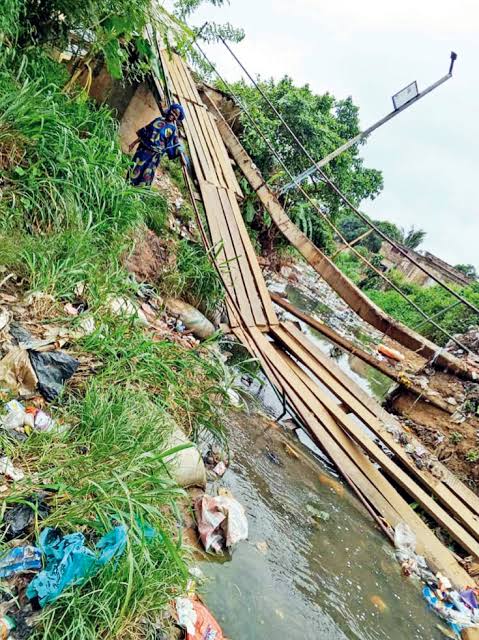
But today, the bridge lies in ruins.

Another view of the fallen bridge

Broken concrete slabs hang precariously over the stream. Twisted reinforcement rods protrude from fractured edges.

Students crossing the stream

Floodwaters have washed away much of the structure, while refuse and thick vegetation now occupy what was once a busy pedestrian corridor.

The collapse of the bridge following heavy rainfall in late May and early June 2026 has turned everyday life into a struggle for residents.

For the people of Apata and Barika, the broken bridge represents far more than damaged infrastructure. It has become a symbol of interrupted livelihoods, disrupted education, limited healthcare access and the growing burden of economic hardship.

Leaders of Barika and Apata stated that the bridge was sustained by community sacrifice. According to them, the story of the Yemoja Stream Bridge is unlike many others across Nigeria.

For years, the communities did not wait helplessly for government intervention. Available documents obtained by this reporter showed that the residents of Apata and Barika jointly maintained the bridge for over 20 years after its construction.

Whenever erosion weakened portions of the structure, community leaders mobilised residents to contribute money for repairs. But they noted that on some occasions, Ibadan North Local Government provided some assistance. Well-meaning individuals also donated towards rehabilitation at different times.

But the responsibility, it was revealed, largely rested on the shoulders of the two communities. The last major rehabilitation was carried out in early 2025.

The community leaders disclosed in their letter that the exercise cost approximately ₦1.4million, towards keeping the bridge functional then.

They explained that repairs became increasingly frequent because the Yemoja Stream had continued to expand year after year, gradually weakening the bridge’s foundation.

The leaders admitted that despite repeated interventions, residents knew they were fighting a lost battle because nature eventually prevailed.

Following heavy rainfall in late May and early June this year, one section of the bridge sank before the entire structure collapsed.

The force of the floodwaters washed away much of the construction materials, while scavengers reportedly removed some of the remaining components.

What remains today is only a shadow of what once served as a connection between the two communities.

It was stated further that the shortest route has turned to the longest journey. The collapse instantly altered daily routines. Journeys that once took only a few minutes now require lengthy detours through Agbowo Express Road, the University of Ibadan Main Gate to Barika or Orogun before reconnecting to destinations near the University’s Second Gate.

For many residents, the additional transport cost may appear insignificant in isolation. If they are added up over weeks and months, however, it would become another financial burden in an economy already battered by inflation and rising living costs.

Those who cannot afford commercial transportation are left with only one dangerous alternative, which is to cross the polluted stream beneath the collapsed bridge.

The letters submitted by the communities to the government acknowledged that the bridge was used daily by schoolchildren, government workers, petty traders, artisans and other residents,

The absence of the bridge, the letters stated, has disrupted virtually every aspect of life. Schoolchildren, it was stated, have been paying the highest price. For many pupils in Apata and Barika, however, punctuality has become an almost impossible target.

President of the Agbowo Landlords/Landladies Association, Alhaji Dikirullahi Ayansola Alayande, said the communities did everything within their means to prevent the disaster.

According to him, residents of Agbowo, Apata and Barika contributed nearly N2million several years ago to reinforce the ageing bridge after signs of structural weakness emerged.

He added that every household made financial contributions in instalments, while community committees supervised the rehabilitation.

“We believed we had done our best. But nature eventually won. The bridge has existed for more than 25 years. Water is powerful enough to uproot trees. Unfortunately, it finally collapsed.

“Whenever heavy rain falls, crossing the stream becomes impossible. This is why we need an urgent intervention from the government,” Alayande stated.

He disclosed that one of the community leaders, Alhaji Adewale Raji, had earlier warned that the bridge had begun tilting dangerously to one side.

Another resident of Barika, Mrs Comfort Dominic Abdullahi, said she experiences the reality every school day. She explained that taking her children to school has become an exhausting routine, involving multiple transport connections instead of a simple walk across the bridge.

Rather than crossing the Yemoja Stream directly, she now travels through Agbowo Express Road to the University of Ibadan Main Gate before reconnecting to Barika near the UI Second Gate.

“The distance is affecting the punctuality of my children in school. They now arrive late almost every school day. I take them to school. I don’t like them going late, and it is becoming deeply embarrassing. The longer journey also means higher transportation costs.

“Like many families, I have chosen between spending more money or exposing my children to unnecessary danger by crossing the polluted stream on foot.

“I watched with concern as some parents allow their children to cross through the stream beneath the broken bridge. The sight worries me deeply.

“Imagine a downpour while they are halfway across. It’s a disaster waiting to happen,” she stated.

For another resident, Mrs Aminat Ibrahim, the collapse has introduced another painful reality. She has four school-age children. Before the bridge collapsed, getting them to school was relatively straightforward.

But these days, transportation costs have become almost unbearable, saying: “I have four children. They cannot attend school regularly now because transportation through the alternative routes is just too expensive.”

Although she occasionally waded through the stream herself, she refused to allow her children to do the same.

“I can manage to cross the water because I am an adult. But I cannot allow my children to pass through that dirty stream,” she said.

The bridge also played an important role in healthcare delivery. Residents revealed that the bridge, before it collapsed, provided the quickest route to nearby two primary healthcare facilities in Barika and Apata. Its collapse has increased the distance between patients and medical care.

Pregnant women now travel farther for antenatal appointments. Nursing mothers spend more money reaching clinics. Parents carrying sick children endure longer journeys. The elderly face additional physical strain.

Community leaders fear that emergency situations could prove disastrous. A woman in labour or a critically ill patient can no longer rely on the shortest route.

They expressed concerns that during periods of heavy rainfall, crossing the stream would become virtually impossible. In such moments, they stated that every additional minute matters.

It was further gathered that the impact of the collapsed neighbourhood pedestrian bridge extends beyond schools and hospitals. Petty traders who depended on pedestrian traffic now spend more on transportation.

Also, civil servants leave home earlier to arrive at work on time. Artisans lose productive hours each day.

Perhaps the most disturbing aspect of the collapse is that residents insist it could have been prevented.

Alhaji Dikirullahi Ayansola Alayande, Project Coordinator of the Apata/Barika Development Committee and President of Agbowo Central, said warning signs had been visible long before the bridge eventually failed.

The communities watched the stream widen gradually over the years.

They noticed erosion eating away at the bridge’s supports. Instead of waiting for government intervention, they repeatedly organised repairs.

“We believed we had done our best. But water is powerful enough to uproot trees. Eventually, the bridge began tilting until it finally collapsed,” he said.

The community leaders have admitted that reconstruction has gone beyond what local residents could finance.

Their petitions specifically called for total reconstruction. What the communities require, they insisted, is a professionally engineered bridge, capable of withstanding seasonal flooding for many years.

The collapse did not leave residents silent. Copies of petitions made available to this reporter showed that the Apata/Barika Development Committee formally wrote to the Executive Chairman of Ibadan North Local Government on July 1, 2026, requesting the complete reconstruction of the bridge.

Separate copies were submitted to the Political Head and Administration of Aare Latosa LCDA as well as the Director of Works of Ibadan North Local Government.

Official acknowledgement stamps on the documents confirmed that the petitions were received.

In the letters jointly signed by Chief Folorunso Aiyelagbe, Chairman of Barika Community; Chief M.O. Mojoyinola (JP), Chairman of Apata Community and Joint Community Chairman; and Alhaji S.A. Alayande, Project Coordinator and current President of Agbowo Central, explained that the bridge served schoolchildren, government workers, petty traders and numerous other residents.

Despite the petitions and repeated appeals, reconstruction has yet to commence. Weeks after the collapse, the broken bridge remains exactly where it fell. Each passing rainfall further erodes the surrounding land.

Residents fear that continued delay might encourage desperate commuters to attempt dangerous crossings through the stream.

When contacted, the Head of Information and Public Relations Unit of Aare Latosa LCDA, Fatimah Fadipe, confirmed that the council was aware of the situation.

She said officials had inspected the site and assured residents that implementation would commence soon.

Sun

Ishola Williams backs Makinde’s call for international probe into Oyo school abduction

0

..Says communities may be aiding kidnappers

Retired Major General Ishola Williams has thrown his weight behind Oyo State Governor Seyi Makinde’s call for an independent international investigation into the abduction of pupils and teachers in Oriire Local Government Area, and their eventual rescue.

Williams described the governor’s request as consistent with international precedents set during previous national security crises.
The retired general made the remarks in response to Governor Makinde’s appeal for a United Nations-backed inquiry into the circumstances surrounding the school abduction and the military operation that led to the release of the victims after 56 days in captivity.

Speaking on Friday during Frontline, a current affairs programme on Eagle 102.5 FM, Ilese-Ijebu, Ogun State, the retired military officer argued that Makinde’s position was neither unprecedented nor inappropriate. He recalled that during the abduction of the Chibok schoolgirls under former President Goodluck Jonathan, international organisations were widely invited to scrutinise the incident.

According to him, the criticisms levelled against the Jonathan administration at the time—including calls by members of the then opposition for international involvement—have established a precedent that validates Makinde’s current demand.

“Makinde is right in making that call,” Williams said. “During former President Goodluck Jonathan’s administration, when the Chibok girls were kidnapped, there were widespread calls for international organisations to intervene. Those who criticised Jonathan then cannot now fault Makinde for making a similar request. What goes around comes around.”

He maintained that the governor was merely following an established pattern.

“In that regard, Makinde is not doing anything new. He is simply following a precedent,” he added.

However, Williams noted that under Nigeria’s constitutional and diplomatic framework, a state governor lacks the authority to formally invite the United Nations to investigate a security matter.

“Makinde, as the head of a subnational government, cannot directly invite the UN. Only the President, through the Ministry of Foreign Affairs, can officially request such assistance,” he said.

He suggested instead that internationally recognised independent organisations, such as Amnesty International, could undertake a credible and impartial investigation into the incident.

“What I expected Makinde to do, even though he mentioned it, was to invite organisations like Amnesty International, which is globally respected for conducting thorough and independent investigations into situations like this,” Williams said.

Beyond endorsing the governor’s call, the retired general questioned what he described as serious intelligence failures that enabled armed kidnappers to abduct dozens of schoolchildren without being detected or intercepted.

He argued that the incident exposed glaring weaknesses in Oyo State’s internal security architecture, particularly at the grassroots level.

Williams said the Ministry of Home Affairs, the Amotekun Corps, local intelligence networks and traditional institutions all have questions to answer over how such a large-scale operation went unnoticed.

“Is the Ministry of Home Affairs in Oyo State functioning effectively? Is the commissioner competent? Is the intelligence unit of Amotekun doing its job?” he queried.

He added that accountability should extend beyond the kidnappers to security officials and community leaders who failed to prevent the attack.

“In a serious country, the governor’s Senior Special Assistant on Security could have been dismissed. Grassroots intelligence clearly failed. How could kidnappers enter a community, abduct so many children and disappear into the bush without Amotekun or even the village head knowing?” he asked.

Williams insisted that the abductors could not have carried out the operation without receiving support from some members of the host community.

“These are ordinary kidnappers with a few weapons, but they cannot operate successfully without assistance from people within the community,” he stated.

He also expressed scepticism over official accounts of the rescue operation, saying more details should be made public to enable security experts assess the operation and draw lessons that could strengthen future responses.

“The story being told is that it was a highly successful intelligence-led operation. I remain sceptical. More details should be released for proper evaluation,” he said.

Williams further urged security agencies to prioritise the fight against insurgency in the North-East rather than committing extensive resources to isolated kidnapping cases.

“They should concentrate on the North-East. If the same level of intelligence and operational effort is consistently deployed there, the insurgency can be tackled more effectively,” he said.

Reiterating his long-standing advocacy for security sector reforms, Williams renewed his call for the establishment of state police and a decentralised policing structure, arguing that Nigeria’s highly centralised security architecture has become ineffective.

He dismissed concerns that governors could abuse state police, insisting that abuse of power is possible at every level of government.

According to him, governors, who are constitutionally recognised as chief security officers of their states, should have greater operational control over internal security while receiving intelligence and investigative support from federal agencies.

“I have always maintained that the military should withdraw from routine internal security operations and concentrate on the North-East. We do not need a centralised Nigerian Police Force as it currently exists. What we need at the federal level is a strong criminal investigation and crime intelligence agency that can support state security outfits such as Amotekun,” he said.

Williams also questioned the scale of manpower and resources reportedly deployed to secure the release of the Oriire victims, arguing that if similar intelligence capabilities were consistently applied in insurgency-ravaged areas, Nigeria could record greater success against terrorism.

“If this much effort was deployed for the rescue operation, imagine what could be achieved in the North-East if the same intelligence system were consistently applied. If the DSS has the capacity it claims, why not deploy it with equal effectiveness against insurgents?” he asked.

The retired general further argued that traditional rulers and community leaders should be held accountable whenever criminal groups repeatedly operate within their communities.

“Community heads must be put on notice that if such incidents continue to occur in their domains, they will be held responsible. Some communities and villages are benefiting financially from these criminal activities, especially in places like Katsina State. There should be no more excuses,” he said.

Sun

World Cup: Everything you need to know about England vs France match

0

The 2026 FIFA World Cup third-place playoff will see England take on France in a battle for the bronze medal after both teams suffered semifinal defeats.

The match may not be the final either side wanted, but it still carries significance for national pride, rankings, prize money, and individual awards.

Match details
Fixture: France vs England
Competition: FIFA World Cup 2026 – Third-Place Playoff

Date: Saturday, July 18, 2026

Kick-off: (10:00 PM Nigerian Time)

Venue: Hard Rock Stadium, Miami, Florida, United States

Why are they playing?

England and France lost their semifinal matches and must now compete to determine who finishes third and who finishes fourth at the tournament.

FIFA has included a third-place playoff in every World Cup since 1934, except the inaugural 1930 edition.

How they got here
England lost 2-1 to Argentina in the semifinal after conceding twice late in the game.

France were beaten 2-0 by Spain in the other semifinal.

What is at stake?

Although it is often called the “bronze final,” the match still matters because:
The winner receives World Cup bronze medals.

It affects FIFA rankings and official tournament records.

Additional prize money is awarded for finishing third rather than fourth.

Individual awards, including the Golden Boot, remain in play.

Key players to watch

France

Kylian Mbappé – still in contention for the Golden Boot and confirmed fit by coach Didier Deschamps.

Ousmane Dembélé

Ibrahima Konaté

England

Harry Kane – chasing another strong World Cup finish.

Jude Bellingham

Anthony Gordon, who scored against Argentina in the semifinal.

Team news

France coach Didier Deschamps has hinted at possible changes due to injuries and fatigue, while England manager Thomas Tuchel is also expected to rotate his lineup after criticism of his semifinal tactics.

Head-to-head

England and France have developed one of Europe’s biggest international rivalries, and recent meetings between the two sides have been closely contested.

This is their first meeting in a World Cup third-place playoff.

Possible lineups

France (4-2-3-1)

Mike Maignan
Jules Koundé, Dayot Upamecano, William Saliba, Lucas Digne
Aurélien Tchouaméni, Adrien Rabiot
Michael Olise, Ousmane Dembélé, Bradley Barcola
Kylian Mbappé

England (4-2-3-1)

Jordan Pickford
Kyle Walker, John Stones, Marc Guéhi, Luke Shaw
Declan Rice, Elliott Anderson
Bukayo Saka, Jude Bellingham, Anthony Gordon
Harry Kane.

Prediction

Both teams enter the match disappointed, but France may have extra motivation as it could be Didier Deschamps’ final game in charge of Les Bleus. Expect a more open contest than a typical knockout match, with goals likely at both ends.

Prediction: France 2-1 England.

Sun

Court Strikes Out Suit Seeking Recognition of Turaki-Led PDP Interim NWC

0


The Federal High Court in Abuja has struck out a suit filed by the Board of Trustees and some founding leaders of the Peoples Democratic Party (PDP) seeking the recognition of the Kabiru Turaki-led Interim National Working Committee (NWC).

The statement was signed by Comrade Ini Ememobong, National Publicity Secretary of the PDP Interim National Working Committee.

Justice Salim Olasupo Ibrahim, who presided over the case, upheld the preliminary objection raised by the defendants and ruled that the matter concerned the leadership of the PDP, which is an internal affair of the party and therefore outside the jurisdiction of the court.
The court consequently struck out the suit.

Reacting to the judgment, the Interim National Working Committee, through its National Publicity Secretary, Comrade Ini Ememobong, said although it respected the court’s decision, it believed the ruling was inconsistent with existing judgments of the Court of Appeal and the Supreme Court.

According to the party, the plaintiffs have instructed their legal team to immediately file an appeal against both the judgment and the interlocutory rulings.

The statement expressed confidence that the appellate courts would overturn the decision, insisting that the legal battle was aimed at safeguarding truth, democratic principles and the survival of a credible opposition.

“We are hopeful that as we climb the ladder of the law upwards, the victory of truth over lies, principles over compromise and the survival of true opposition and multi-party democracy will be assured,” the statement said.

The party added that while “the politics of power, money and greed” might prevail temporarily, it remained convinced that its eventual victory was certain.