Home Blog Page 133

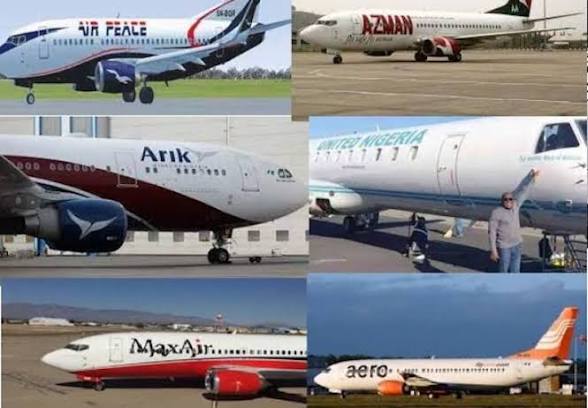
Domestic airlines seek Tinubu’s intervention as Jet A1 hits N2,150/litre

0

Nigerian airlines are grappling with a sharp increase in their operational costs as the price of aviation fuel recently soared by 20 per cent following the escalating war between the US and Iran.

This has disrupted crude shipments, while recent attacks on Saudi Arabia’s oil infrastructure by Iran-backed Houthis have opened a new front in an already fragile energy market.

A Daily Sun survey of airports across the country shows that more than 18 aviation fuel marketers supply Jet A1, with prices varying significantly from one airport to another. In Lagos, the price ranges from N1,719 to N2,100 per litre, with only two marketers selling at an average of N1,750. In Abuja, one marketer sells at N1,769 per litre, another at N1,844, while prices from other marketers range between N1,190 and N2,150.

Similarly in Kano, the cheapest fuel sells for N1,794 by just one marketer while others sell for between N1,851 and N2,047. Only five fuel marketers supply jet A1 in Port Harcourt with the cheapest going for N1,764 while others sell for between N1,904 and N2,109. In Anambra, fuel is sold for N2,047, while in Benin, it is sold for N1,990. In Enugu, fuel is sold for N1,990, while in Ilorin and Sokoto, it is sold for N2,120 and N2,138 respectively.

Since the crisis started in the first quarter of the year, the cost of fuel has spiked leading to an astronomical increase in the operational cost of both international and domestic airlines. The worst hit are the domestic operators who are still grappling with a difficult business environment and slim profit margins.

On April 14, the Airline Operators in Nigeria (AON) wrote a letter to the Executive Secretary of the Major Energies Marketers Association of Nigeria (MEMAN), Clement Isong, warning of a nationwide shutdown of flight operations from April 20, 2026, citing a steep and unsustainable rise in the cost of aviation fuel.

At the time, AON said the price of Jet A1 fuel had surged from N900 per litre as of February 28 to N3,300 per litre, representing an increase of over 300 per cent within a few weeks. The operators described the spike as “astronomical and unsustainable,” alleging that it is artificial and inconsistent with global oil market trends.

The group said airlines had absorbed the rising costs for more than four weeks out of a sense of national duty but warned that the situation has become untenable. It said that airline revenues were insufficient to cover the cost of fuel alone and that continued operations under the high cost were no longer viable. AON further accused fuel marketers of actions that are “decimating the aviation industry,” warning of wider implications for Nigeria’s economy, safety, and national security.

Though the cost of fuel eventually went down after the April crisis, there has been an increase again as crude hits $108 per barrel. Shipments have been disrupted with the attacks on Saudi Arabia’s oil facilities by Iran-backed Houthis have worsened the situation.

The AON has in the past months, sought to have an audience with President Bola Tinubu over the challenges they are facing.

The Chief Executive Officer of Air Peace, Allen Onyema, in his keynote speech at the 30th annual conference of the League of Airport and Aviation Correspondents (LAAC) held in Lagos recently with theme: “Towards a Sustainable Aviation Industry: Balancing Government Revenue Demands with Sector Growth”, said that the designation of Nigeria by the International Air Transport Association (IATA) as the worst place in the world to establish airline business would be a thing of the past the minute the President gets to know the factors that led to such designation.

Onyema who is the Vice President of the AON said that the financial crisis bedevilling the airlines can be solved by the intervention of President Tinubu. Onyema said that domestic airlines yearn for an audience with Tinubu whom he described as a listening President, saying that what will put to an end the high mortality rate of Nigerian operators is when there is amicable tax and charges system that protects the airlines, aviation agencies and the traveling public in a win-win situation.

He said, “One thing I must say is that I’m certain any day President Bola Tinubu sees us, if they allow us to see him, because I know he will not mind to meet with us, that will be the day a new revolution in the airline industry in this country will occur because the President abhors anything capable of affecting indigenous businesses that provide jobs for the people adversely.

“I remember when we complained to the Comptroller General of Customs, Mr. Adewale Adeniyi of the debilitating effects of the newly introduced 4% FOB customs duty on airlines. He, Wale Adeniyi, took it up with the presidency the same day. I was there in the Presidential Villa with the Customs boss, a fantastic man. This President acted swiftly and waived it for airlines within hours of being made to understand the would-be effects of such a charge on the viability of indigenous Nigerian airlines.”

Sun

Businessman worried over activities near Ikoyi property

0

A businessman and politician, Kelvin Gabriel, has raised concerns over construction activities around his property on Glover Road, Ikoyi, Lagos, alleging that the development had affected his property and raised environmental and safety concerns.

He claimed that construction work on a the neighbouring property had extended close to his compound, a development he said had caused inconvenience to his family.

According to him, construction materials had, on some occasions, fallen into his compound, allegedly damaging parts of his building and some of his vehicles.

He said the vehicles were subsequently taken for repairs, adding that the incident had resulted in additional expenses.

He also raised concerns about the distance between the neighbouring development and his property, saying he understood that planning regulations provide for prescribed setbacks and air spaces for buildings.

Lagos State regulations stipulate requirements relating to setbacks and air spaces, while building developments are also subject to planning permits and building-control procedures.

Gabriel said he initially contacted the Lagos State Building Control Agency (LASBCA) over his concerns and was subsequently directed to the Lagos State Physical Planning Permit Authority (LASPPPA).

He said an inspection was later carried out and the property under construction was sealed by the relevant authority, but alleged that the seal was subsequently removed.

He further said his efforts to obtain clarification from the authorities had yet to resolve the matter, adding that the ongoing construction had affected his family’s ability to comfortably use their property.

LASBCA had previously cautioned that construction activities in Lagos are subject to planning permits, authorisation to commence construction and compliance with approved plans, setbacks and other building-control requirements.

The agency had also appealed to members of the public to report suspected building-control infractions for investigation.

Sun

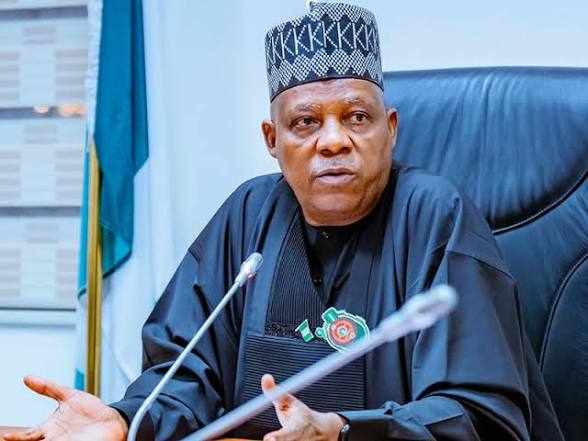
Shettima walks back ‘6 northern govs’ remark, says all backed Tinubu

0

• Says reference was to pre-2022 primary alignments
• Regrets interpretation, acknowledges governors’ role in 2023 victory

Vice President Kashim Shettima has moved to douse controversy over his claim that only six northern governors backed President Bola Tinubu, clarifying that the figure referred to political consultations and alignments before the June 2022 All Progressives Congress (APC) presidential primary and not support for Tinubu in the 2023 general election.


Shettima said northern APC governors rallied behind Tinubu after he emerged as the party’s presidential candidate and played important roles in the campaign that culminated in his victory, expressing regret that his earlier remarks had been interpreted otherwise.

The clarification followed widespread reports of Shettima’s remarks in Ilorin on Wednesday, where he said only six of the 19 northern governors “believed and supported” Tinubu and went on to speak about the President reconciling with governors who did not support him after the 2023 election.

Speaking at the palace of the Emir of Ilorin, Ibrahim Sulu-Gambari, during the turbaning of Kwara State Governor AbdulRahman AbdulRazaq as Sardauna of Ilorin Emirate, Shettima had recounted the political obstacles Tinubu encountered in his quest for the presidency.

“You all know that we have 19 states in the North. Out of these, only six actually believed and supported Tinubu, but Tinubu refused to be deterred. He was able to cross the road,” Shettima had said.

He identified former Niger State governor, Abubakar Sani Bello, and AbdulRazaq among those who backed Tinubu, but stopped short of naming the other governors, saying he wanted to avoid controversy.

Shettima had also linked his account to events after the 2023 presidential election, saying Tinubu reconciled with northern governors who had opposed him.

“After the 2023 election, President Tinubu hugged and forgave all other northern governors that did not support him. That is a mark of a good leader,” he said.

The remarks were widely reported as meaning that only six of the 19 northern governors supported Tinubu’s presidential ambition in the 2023 election.

But in a clarification issued yesterday by his Senior Special Assistant on Media and Communications, Stanley Nkwocha, the Vice President sought to draw a distinction between the political manoeuvring preceding the APC presidential primary and the position of northern governors after Tinubu secured the ticket.
“The Vice President’s reference to six northern governors who believed in and supported President Tinubu was specifically about political consultations and alignments preceding the APC presidential primary in June 2022,” the statement said.

“It was not a comment on the position of northern APC governors following President Tinubu’s emergence as the party’s candidate, nor was it intended to question their support during the 2023 presidential election.”

According to Shettima, the governors subsequently closed ranks behind the APC presidential candidate.

“Following the presidential primary, APC governors in the North rallied around the party’s candidate and played important roles in the campaign and electoral efforts that culminated in President Tinubu’s victory in the 2023 general election,” the statement said.

The Vice President also credited the position taken by northern governors with helping to consolidate wider support for Tinubu within the APC.

“Indeed, it is worthy of note that it was after the declaration of President Tinubu as winner of the 2023 presidential primaries that all other governors across the country rallied round and followed suit.

“That declaration by the northern governors hence became the aligning moment across all political divides in the quest for power shift,” he said.

Shettima said he held northern governors and other APC leaders in high regard and acknowledged their individual and collective contributions to the party’s success and Tinubu’s emergence as President.

“The Vice President regrets any interpretation of his remarks that may have suggested otherwise and hopes this clarification places the comments in their proper context,” the statement said.

He also acknowledged the role of the media in political reporting and urged journalists to ensure accuracy and context in reporting public remarks as the country moves deeper into another election season.

The clarification comes amid intensifying political activity ahead of the 2027 general election and renewed debate over the roles played by different blocs within the APC in Tinubu’s emergence as the party’s candidate and his subsequent victory in 2023.

Sun

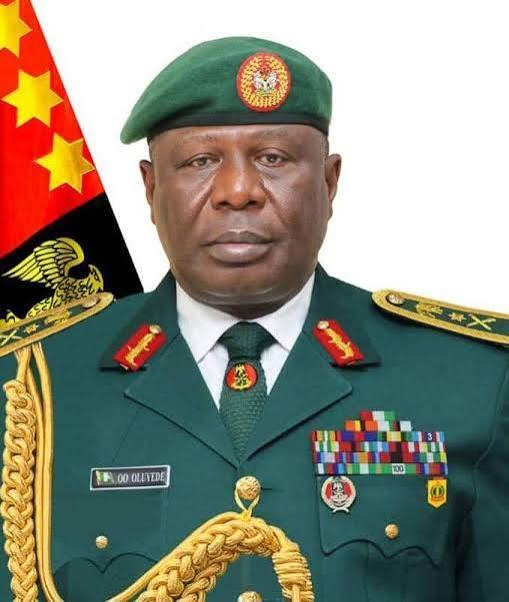
OLUYEDE: WHEN A GOOD MAN LEADS THE ARMED FORCES ‎

0

‎
‎
‎
‎By Sunday Johnson
‎
‎“The true test of a man’s character is what he does when no one is watching.” This observation, widely attributed to American basketball coach, John Wooden, captures something important about leadership; that the character of a leader is often revealed not by the speech he makes, but by the things he chooses to do when applause is absent.
‎
‎In General Olufemi Olatubosun Oluyede, Nigeria appears to have a military leader whose understanding of service goes beyond rank, uniform and command. Since assuming office as Chief of Defence Staff, he has continued to demonstrate that leadership in the Armed Forces is ultimately about responsibility, sacrifice and the welfare of the men and women entrusted with defending the nation.
‎
‎Oluyede’s journey to the highest professional position in Nigeria’s military establishment did not happen overnight. Born in Ikere, Ekiti State, in 1968, he joined the Nigerian Defence Academy in 1987 and was commissioned into the Nigerian Army in 1992. His career took him through some of the country’s most demanding theatres, including Liberia, Bakassi and the North-East, where he commanded troops under Operation HADIN KAI. Before becoming CDS, he served as Chief of Army Staff, bringing with him decades of operational and command experience.
‎
‎Perhaps the clearest window into the man Oluyede is, can be found in an interview he granted as Army Chief in 2025. Asked about the security situation across the theatres of operation, he did not pretend that the country had overcome all its difficulties. Instead, he acknowledged the challenges while pointing to measurable progress, observing that, despite the threats that remained, “by and large, things are getting better.” That mixture of realism and confidence says something about his approach. He does not need to exaggerate success to demonstrate leadership, nor does he deny the difficulties confronting the Armed Forces.
‎
‎For Oluyede, a soldier is not merely another instrument of war, he is a human being who must be trained, fed, housed and properly prepared for the dangers of the battlefield. That philosophy was evident when he disclosed that the Army had increased the daily ration cash allowance for troops from N1,500 to N3,000. He also spoke about affordable housing and other welfare initiatives designed to help personnel secure homes before retirement. These are not glamorous aspects of military command, but they matter greatly to the morale of a force whose personnel routinely place their lives between danger and the civilian population.
‎
‎What makes the welfare question even more significant is Oluyede’s understanding that taking care of soldiers does not end with putting food on their tables. In that same interview, he described training as the “best form of welfare” for a soldier because an inadequately trained soldier is vulnerable both to the enemy and to the demands of modern warfare. His efforts to expand and improve training capacity, including plans to reduce pressure on the Zaria training depot, reflected an attempt to build a force that is not simply larger in numbers but better prepared for the responsibilities placed upon it.
‎
‎His concern for the troops has also been matched by an appreciation of what the future battlefield looks like. Oluyede has consistently spoken about technology, intelligence, innovation and the need to anticipate emerging threats rather than merely react to them. As CDS, he has placed considerable emphasis on intelligence driven operations and stronger cooperation among the Army, Navy, Air Force and other security agencies. At his assumption of office, he made clear that Nigeria’s evolving threats demanded greater vigilance, innovation and unity across the security architecture.

‎That emphasis on joint operations is particularly important at a time when Nigeria’s security challenges cut across traditional boundaries. Terrorism, banditry, kidnapping, oil theft, maritime threats and other criminal activities cannot be effectively confronted by one service working in isolation. The early operational record under Oluyede’s tenure has provided evidence of the importance of this approach. Defence Headquarters figures for May 2026 showed that troops across the country neutralised 317 terrorists and other criminal elements, arrested 314 suspects and rescued 221 kidnapped or vulnerable civilians, while recovering 93 assorted arms.
‎
‎But numbers alone do not explain Oluyede’s appeal as a commander. There is also something deliberately human in the way he speaks about the people under his command. In his earlier interview, he repeatedly returned to the question of morale, stressing that his concern was to ensure that soldiers were “well-trained and well-catered for.” He discussed special allowances, affordable housing and zero-interest loan arrangements, showing that he understands that a soldier’s commitment to duty is strengthened when the institution demonstrates that it values his sacrifice.
‎
‎There is, too, a broader philosophy behind his leadership. Oluyede has argued that security is everybody’s business and that the military cannot defeat violent extremism without the cooperation of communities, intelligence agencies, the police, international partners and ordinary citizens. His comments about intelligence gathering in the North-East showed an understanding that contemporary insurgency is not fought solely with guns; it is also a contest for information, community trust and freedom of action. That recognition has encouraged a more integrated approach to national security, one that sees the Armed Forces as part of a wider national effort rather than an institution operating by itself.
‎
‎His vision also extends beyond the immediate battlefields to the question of Nigeria’s strategic independence. Oluyede has advocated greater local production of military equipment, arguing that a country facing its own security problems cannot indefinitely depend on imported solutions. During his Senate screening, he identified the development of Nigeria’s military-industrial capacity as one of the priorities of his tenure and called for greater investment in indigenous defence production.
‎
‎It is therefore easy to understand why the description of Oluyede as a “good man” resonates beyond the ordinary language of military commendation. Goodness in public service is not softness, nor is it the absence of firmness. It is the ability to exercise authority without losing sight of the human beings affected by that authority.
‎
‎Oluyede has shown the firmness expected of a commander while repeatedly drawing attention to the welfare, training and dignity of the personnel who carry out the Armed Forces’ most dangerous assignments. His record as CDS is still being written, but the emphasis on professionalism, jointness, innovation, accountability and troop welfare has already become a recognisable feature of his leadership.
‎
‎Ultimately, the worth of a military leader is measured not only by the orders issued from headquarters but by the confidence those orders inspire in the men and women who execute them. General Olufemi Oluyede came to the Defence Headquarters with decades of experience behind him and an enormous national responsibility ahead of him. His challenge is formidable, and the country’s security problems remain real.
‎
‎Yet his conduct so far offers a compelling reminder that when a good man leads, authority can be accompanied by empathy, discipline by compassion, and military strength by a genuine concern for those who bear its weight. That is the kind of leadership Nigeria’s Armed Forces deserve, and the kind of standard by which Oluyede’s tenure will ultimately be remembered.
‎

THE MAN DESTINED TO BE GOVERNOR

0


By Tayo Ogunbiyi

“Have you noticed something about Dr. Obafemi Hamzat, the Lagos State deputy governor?” my friend of over 30 years, Bola Adeoti, asked, almost immediately after we sat down at a quiet but classy eatery on the Island.

I looked at Tolani, another friend, with whom we were together. Tolani also stared back at me quietly.

I knew that look. Whenever Bola started a conversation with “Have you noticed something?”, it usually meant we were about to get a lecture we hadn’t asked for.

“Something like what?” I asked cautiously.

“He doesn’t behave like someone desperate to be noticed.”

Tolani laughed.

“Ah! So that is now a political qualification?”

“It is not just a qualification,” Bola replied. “In Nigerian politics, my brother, that may be a superpower!”

We all laughed.

But beneath the laughter was a serious conversation.

With Dr. Kadri Obafemi Hamzat’s birthday approaching on September 19, the conversation about the man, his public service career, and his political future is difficult to avoid. Born on September 19, 1964, Hamzat has spent years moving through engineering, the private sector, and public administration before becoming Deputy Governor of Lagos State in 2019.

And now, as the political conversation around 2027 gathers momentum, his name is increasingly mentioned in connection with the Lagos governorship.

“Let us start from the beginning,” Tolani said. “Who exactly is Hamzat?”

“An engineer,” I replied.

“Technocrat,” Bola added.

“Politician,” I said.

“Administrator,” Tolani supplied.

“Family man,” Bola added.

“Public servant,” I said.

Tolani smiled. “You people have almost finished his CV.”

“Not yet,” Bola said. “We haven’t got to the interesting part.”

The interesting part, indeed, is the journey.

Hamzat did not emerge from nowhere. His academic background is firmly rooted in engineering. He studied Agricultural Engineering at the University of Ibadan, obtained a master’s degree in the same field, and later earned a PhD in System Process Engineering from Cranfield University in England. His professional career also included work in the private sector before his entry into Lagos public service.

“Which means,” Bola said, “when politicians are calculating political arithmetic, this man may actually be calculating something with a calculator!”

Tolani burst out laughing.

“But seriously,” she added, “something is interesting about his background. He combines technical training with political experience.”

That combination is perhaps one of the more distinctive features of Hamzat’s public career.

He became Lagos Commissioner for Science and Technology in 2005 and later served as Commissioner for Works and Infrastructure. His years in government therefore preceded his current position as Deputy Governor by more than a decade.

“He has seen Lagos from inside the engine room,” I observed.

“Exactly,” Bola said.

“And that is why some people talk about continuity whenever his name comes up.”

Continuity has become an important word in the Lagos political vocabulary.

Over the years, the state’s development model has been associated with successive administrations building on existing institutions, policies and infrastructure. Hamzat has been part of that political and administrative ecosystem for years.

As Deputy Governor, he has also occupied an unusual position: he has served under Governor Babajide Sanwo-Olu since 2019 and was returned to office with him in 2023.

Governor Sanwo-Olu, in a birthday message to Hamzat, described his deputy as an “administrator par excellence” and praised his dedication to the administration’s mission of building a Greater Lagos.

“Now that one is interesting,” Tolani said.

“What?”

“The Governor himself speaks highly of him.”

“Politicians praise one another,” Bola cautioned.

“True,” I said. “But public records also matter.”

And public records show that Hamzat’s career has not been confined to one political office.

There is another quality his supporters frequently point to: experience.

By the time he became Deputy Governor, he had already worked in the private sector, served as a commissioner and occupied other public-sector responsibilities. His supporters therefore see him as someone who understands both the technical and political sides of governance.

“He is not coming to learn the geography of Alausa,” Bola declared.

Tolani shook her head.

“Bola, please!”

“What?”

“You are already campaigning.”

“I am only making observations.”

“That is how campaign speeches begin.”

We laughed again!

But the joke revealed something important about Hamzat’s appeal among his supporters.

For them, the attraction is not simply that he is Deputy Governor. It is that they believe his long exposure to government has given him an understanding of how Lagos works.

And Lagos is not exactly a small classroom.

It is a state of more than 20 million people, a commercial nerve centre, a transportation nightmare one minute and an economic miracle the next.

“Anyone governing Lagos must have a strong stomach,” Tolani said.

“And strong legs,” Bola added.

“For what?”

“To survive Lagos traffic!”

That was another round of laughter.

But beneath the humour lies a serious question: what kind of person can manage a state as complex as Lagos?

Hamzat’s supporters would answer with words such as experience, technical knowledge, administrative exposure, political maturity and continuity.

His critics and political opponents, naturally, may assess the same record differently. That is the nature of democratic politics.

But there is another dimension to Hamzat that deserves attention: his temperament.

He is not generally associated with the flamboyant political style that dominates contemporary politics. His public personality tends to be more measured and cerebral.

“Maybe that is why people sometimes underestimate him,” Bola said.

“Or maybe,” Tolani replied, “he simply doesn’t believe every room requires him to be the loudest person in it.”

That, I thought, was a fair observation. Politics often rewards noise. Governance, however, frequently requires patience.

The ability to sit through meetings, study documents, listen to competing arguments, understand technical details, and still make decisions is not as glamorous as a campaign rally. But it matters.

And Hamzat’s engineering background may partly explain his attraction to systems and processes.

His career has repeatedly crossed the boundaries between technology, infrastructure and administration. That history is one reason supporters portray him as a technocrat who understands governance beyond political slogans.

“Still,” Tolani said, “let us not turn him into Superman.”

“Why not?” Bola asked.

“Because Superman didn’t have to govern Lagos.”

That ended the argument.

The truth is that no politician should be treated as infallible. Every public servant’s record deserves scrutiny. Every aspiration deserves questions. And every promise should eventually be measured against results.

That is particularly important as Lagos approaches another political transition.

Hamzat’s fans see a man with years of institutional experience, knowledge of the machinery of government, and familiarity with the state’s development agenda.

His public record, meanwhile, provides plenty for citizens to examine—from his earlier commissioner roles to his years as Deputy Governor.

“So,” Bola asked, leaning forward, “what do you think makes him different?”

I paused.

“Perhaps, it is the combination.”

“Combination of what?”

“Education. Experience. Exposure. Humility. Temperament. Political apprenticeship. And knowledge of Lagos.”

Tolani nodded.

“That sounds reasonable.”

“But there is something else,” Bola insisted.

“What?”

“Timing.”

He was right about one thing: birthdays have a strange way of making people reflect on journeys.

On September 19, Dr. Obafemi Hamzat will mark another birthday. It is therefore natural to look beyond the celebration and examine the journey that brought him here.

From engineering classrooms to corporate offices; from commissioner to deputy governor; from the machinery of government to the centre of Lagos politics, the journey has been long.

Whether that journey ultimately leads to Lagos State Government House is a question that belongs to the political process, the electorate and the choices that will be made in 2027.

“But if you ask his supporters?” Tolani asked.

Bola smiled.

“Ah! If you ask his supporters, they have already packed his bags for Alausa.”

We laughed.

“Don’t forget,” I said, “politics is not a bus you board because your friends say there is space.”

“True,” Tolani agreed.

“And the people of Lagos will have their say.”

That brought the conversation to its natural conclusion.

Perhaps the most interesting thing about Dr. Obafemi Hamzat’s political journey is not merely that he wants to become governor. Many politicians want that.

The more important question is what he brings to the table.

His supporters see a technocrat who has acquired political experience; a former commissioner who has spent years inside government; a Deputy Governor who has worked alongside the current Governor; and a Lagosian whose public career has been closely connected with the evolution of the state.

His critics and opponents will undoubtedly have their own interpretations of that record.

That is precisely how democracy should work.

But one thing is already clear: as the 2027 conversation gathers steam, Dr. Kadri Obafemi Hamzat is no longer simply a Deputy Governor waiting in the wings. He has become one of the central figures in the conversation about Lagos’s political future.

And that is why, as Bola would probably put it, “the man who is destined to be governor” is already giving Lagos plenty to talk about.

*Ogunbiyi is Director, Public Enlightenment and Community Relations, Ministry of Information and Strategy, Alausa, Ikeja.*

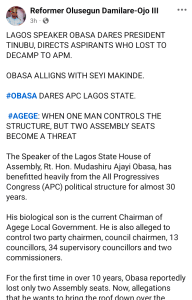
Obasa Accused of Directing Defeated Aspirants to Join APM

0


The Speaker of the Lagos State House of Assembly, Rt. Hon. Mudashiru Obasa, has been accused of directing aspirants who lost the All Progressives Congress (APC) primaries to defect to the Allied Peoples Movement (APM).

The allegation was made by Olusegun Damilare-Ojo III in a statement examining the political situation in Agege and the Lagos State APC.

Damilare-Ojo alleged that Obasa had benefited significantly from the APC political structure for almost three decades, claiming that his son is the current Chairman of Agege Local Government.


He further alleged that the Speaker controls two party chairmen, council chairmen, 13 councillors, 34 supervisory councillors and two commissioners.

According to him, Obasa reportedly lost only two Assembly seats for the first time in more than 10 years, adding that the alleged reaction to the outcome had raised questions about party loyalty and internal democracy within the Lagos APC.

He questioned why the APC should face a political crisis over two Assembly seats, despite what he described as the benefits Obasa had enjoyed from the party over the years.

Damilare-Ojo also questioned whether the reported directive to defeated aspirants to join the APM, if confirmed, could undermine President Bola Ahmed Tinubu’s authority within the Lagos APC structure.

He said Agege should not be regarded as the private property of any individual, stressing that the people deserve representation and that members of the APC should be allowed to participate in the party’s internal democratic processes.

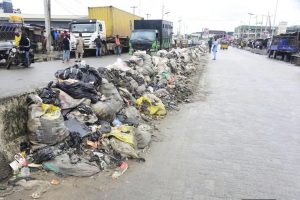
LAWMA SEALS PREMISES ON AGO PALACE WAY, ARRESTS 11 DUMPERS ON LAGOS ISLAND

0


In renewed enforcement efforts, the Lagos Waste Management Authority (LAWMA) has sealed premises identified for persistent illegal waste dumping along Ago Palace Way and arrested 11 persons for illegal waste disposal in various parts of Lagos Island.

The Managing Director/Chief Executive Officer of LAWMA, Dr. Muyiwa Gbadegesin, said that the enforcement operations underscored the Authority’s resolve to enforce existing waste management regulations and ensure compliance with approved waste disposal practices across Lagos.

He explained that the Ago Palace Way operation covered plazas, hotels, lounges and warehouses along the corridor, as part of efforts to tackle activities contributing to waste build-up and environmental nuisance on road setbacks, medians and other unauthorised public spaces.

He added that the enforcement exercise on Lagos Island, covering Tinubu, Apongbon, Oke-Arin and CMC areas, led to the arrest of 11 persons for unauthorised handling and illegal disposal of waste.

The 11 persons arrested were Shabban Tasiu, 20 years, Nkechukwu Nwokeji, 40 years, Kolawole Elija, 28 years, Sunni Sado, 30 years, Subairu Lawal, 28 years, Abi Lawal, 22 years, Sufianu Musa, 20 years, Yusuf Lawan, 18 years, Ahmed Lawal, 25 years, St. Peter Eze, 23 years, and Udo Richard, 32 years.

Gbadegesin reaffirmed that indiscriminate waste disposal remained detrimental to the environment and could undermine sanitation gains across the State, urging residents, traders and businesses to desist from dumping waste on roads, walkways, drains and other unauthorised locations.

He stated that waste should be properly bagged and handed over to accredited Private Sector Participation (PSP) operators, adding that businesses and property owners must take responsibility for waste generated within and around their premises.

According to him, the enforcement exercise formed part of LAWMA’s broader strategy to improve environmental cleanliness, tackle violations at source and promote responsible waste management behaviour.

He said that the Authority would continue to monitor different parts of the State and take appropriate enforcement action against persons and businesses found violating environmental regulations.

He reiterated that the enforcement exercise was not intended merely to apprehend offenders, but to promote compliance and encourage a sustained change in public attitude towards waste management.

The LAWMA boss urged residents, traders, businesses and property owners to comply with environmental regulations, use approved waste disposal channels and support the Authority’s efforts to keep public spaces clean, accessible and environmentally safe.

He encouraged members of the public to report instances of illegal dumping and other waste management violations through LAWMA’s established channels, stressing that achieving a cleaner Lagos required the collective responsibility of government, residents, businesses and other stakeholders.

Mukaila Sanusi, PhD
Director, Public Affairs
LAWMA
17th September 2026

EFCC Arrests  MD for Alleged N128m Land Scam in Enugu

0


Operatives of the Enugu Zonal Directorate of the Economic and Financial Crimes Commission,  EFCC,   have arrested one Basil Iwoba Ochili,  Managing Director, Debasilio Construction and Estate Development Limited, for allegedly using the company for fraudulent activities, including obtaining by false pretence to the tune of N128, 000, 000. 00 (One Hundred and Twenty-eight Million Naira).

Ochili was arrested based on claims of  a petitioner alleging  that sometime in September, 2022,  he falsely presented himself as the owner of five plots of land situated beside Anambra State Secretariat by Stamford Hotel, Aroma junction, Awka, Anambra State, and falsely offered it for sale.

Relying on the suspect’s representation, the petitioner purchased the said plots in the sum of N128, 000, 000. 00 (One Hundred and Twenty-Eight Million Naira), which was paid into the suspect’s company account.    However,   he was unable to take possession of the land
Preliminary investigations showed that the suspect knew that the said land encroached on Anambra State Government Secretariat’s land but went further to sell the same to the petitioner.

Instead of refunding the petitioner’s money, the suspect offered him two dud cheques
Further preliminary investigations showed that the suspect used part of the money to settle his debts and his company, Debasilio Construction and Estate Development Limited, has never been tax compliant.

The suspect will be charged to court as soon as investigations are concluded.

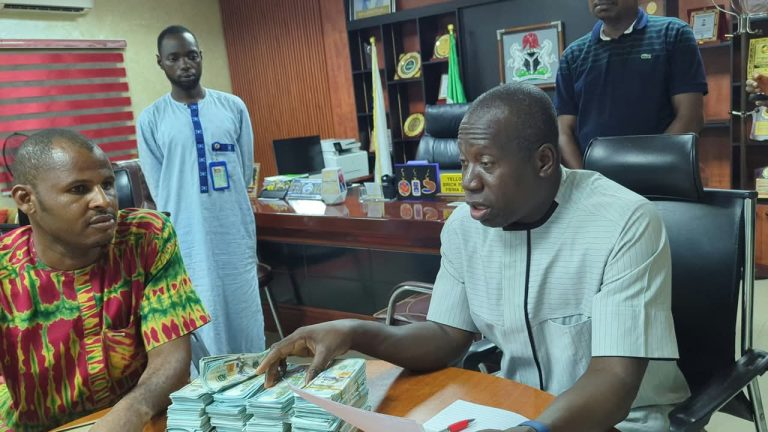
EFCC Commences Investigation of Suspect Arrested with Counterfeit $212,200 in Kano

0


The Kano Zonal Directorate of the Economic and Financial Crimes Commission,  EFCC,  has commenced investigation  of a suspect, Usaini Ibrahim, arrested with  counterfeit currency  totaling $212,200( Two hundred and Twelve Thousand, Two Hundred United States Dollar)

The suspect was arrested on September 3, 2026, by operatives of the National Drug Law Enforcement Agency,  NDLEA,  along Maiduguri Road in Kano following the discovery of the counterfeit currency.

The NDLEA subsequently handed over the suspect and the fake currency to the EFCC for further investigation and possible prosecution.

The formal handover took place at the Kano Directorate of the EFCC, where the Acting Zonal Director,  Assistant Commander  of the EFCC,  ACE1 Friday S. Ebelo, received both the suspect and the exhibits.

A representative of the NDLEA, Deputy Superintendent of Narcotics,  Yahaya Labaran,  while handing over the case, expressed appreciation for the continued strategic collaboration between the two agencies in sanitizing Nigeria’s financial system.

Ebelo, acknowledging the handover, reiterated the EFCC’s commitment to cleansing the financial ecosystem of counterfeit currencies and fraudulent schemes. He specifically warned members of the public to be wary of “money doubling” scams, which often involves using counterfeit notes as tools to defraud unsuspecting victims.

“Such fake currencies coming into the economy do not paint a good picture of us,” he said.

He called on the public to remain vigilant and avoid falling victim to individuals offering to “double” money and other financial crimes through questionable means.

The suspect, Usaini Ibrahim, is currently in the custody of the EFCC and will be arraigned in court upon the conclusion of investigations.

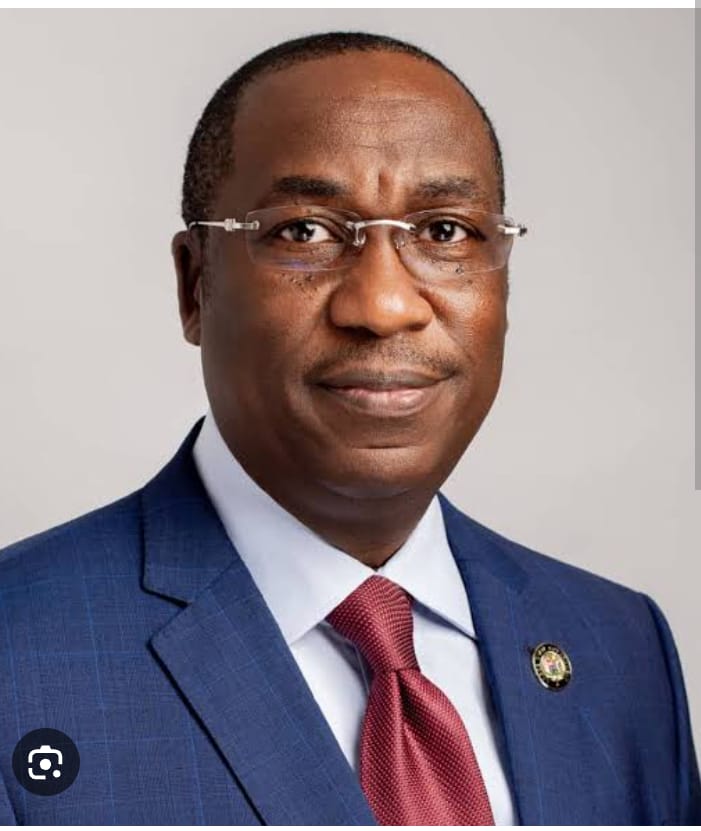
British Deputy High Commissioner Visits Abia to Deepen Digital Transformation, Economic Partnership

0


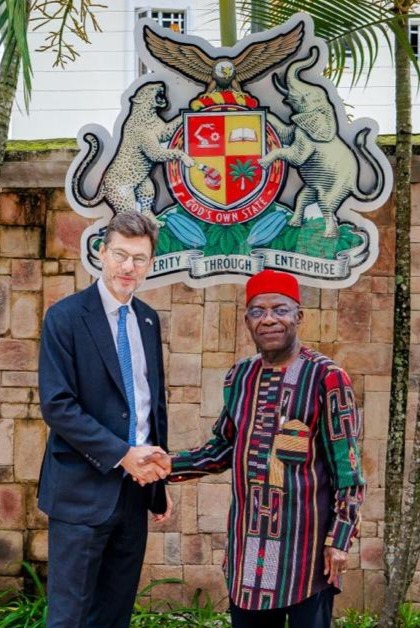
The British Deputy High Commissioner in Lagos, Jonny Baxter, has concluded a two-day visit to Abia State, highlighting the state’s growing reputation as a hub for entrepreneurship, innovation and economic opportunity.

The visit reaffirmed the United Kingdom’s commitment to deepening its partnership with Abia State and supporting efforts to create conditions for inclusive growth, investment, job creation and digital transformation.


The visit included a meeting with the Executive Governor of Abia State, Alex Otti; engagements with civil society and electoral stakeholders; a tour of the Geometric Power Plant; and participation in the State-Level Policy, Regulatory and Institutional Reforms Enabling Digital Transformation (SPRIRET) programme under the UK’s Digital Access Programme.

The SPRIRET engagement brought together public and private sector actors to strengthen the policy, regulatory and institutional foundations required for inclusive digital transformation in Abia.

Discussions with Governor Otti covered opportunities to expand UK-Abia cooperation across trade, investment, innovation, education, energy and digital development.

They also addressed democratic governance, preparations for forthcoming elections and the importance of a peaceful and inclusive political environment.

Baxter said: “Abia is one of Nigeria’s most entrepreneurial states, and that energy is now being matched by a positive policy environment.

Throughout this visit, I have been struck not only by the ambition, innovation and determination I have encountered, but by the deliberate steps the Governor has taken to create the conditions for that ambition to thrive.

“The same is true in the digital space. Digital transformation depends on getting the policy and regulatory environment right, and we are responding to Abia State’s demonstrated desire to do exactly that. The United Kingdom is proud to support Abia’s digital transformation through our Digital Access Programme and the SPRIRET initiative.

“We look forward to deepening our partnership with the Government and people of Abia State and building on the strong foundations of the UK-Nigeria strategic partnership.”

Governor Otti thanked the British Deputy High Commissioner and his team for visiting Abia, saying that the state is open to partnerships capable of strengthening its economic development.

He expressed optimism that the engagement would lead to stronger government-to-government and business-to-business partnerships that would support Abia’s economic transformation.

The governor particularly welcomed Baxter’s visit to the Geometric Power Plant, describing electricity as central to the success of Abia’s manufacturing and business community.
Otti said his administration was working to expand reliable electricity supply across the State, stressing that the cost of unreliable power is ultimately higher for businesses because of their dependence on generators, diesel and maintenance.

“Once you have reliable power, whatever the cost is, it is still going to be cheaper than not having reliable power,” the governor said.

Otti said the state was also working to expand power supply beyond Aba, including efforts to secure the necessary rights to enable Abia to operate as an integrated power market, leveraging the infrastructure already available at Geometric Power.

He noted that Aba has a strong manufacturing base, particularly in footwear, garments and other locally produced goods, and said the state government was working with partners, including the United Nations Development Programme (UNDP), to improve finishing, packaging and export opportunities for locally made products.

Governor Otti assured of the state government’s participation in the Digital Access Programme engagement scheduled for Thursday, noting that the government would continue working with the UK team to identify practical areas of collaboration.

Note to Editors: SPRIRET is funded through the UK’s Digital Access Programme and is being implemented in five Nigerian states, including Abia.