Home Blog Page 112

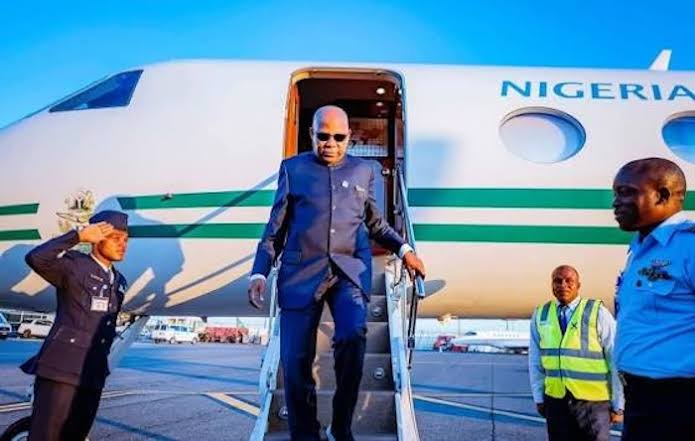
Shettima Returns to Nigeria After Representing Tinubu at UNGA

0

Vice President Kashim Shettima has returned to Nigeria after representing President Bola Ahmed Tinubu at the 81st Session of the United Nations General Assembly in New York, United States.

During his visit, Shettima delivered President Tinubu’s National Statement at the General Debate, where Nigeria renewed its call for reform of the United Nations Security Council.
Nigeria also demanded permanent African representation on the Council, fairer global financing, stronger climate support and deeper multilateral cooperation.

Shettima participated in the Third High-Level Roundtable of the Africa Minerals Strategy Group, where President Tinubu urged African countries to move beyond the export of raw minerals and focus on processing, manufacturing and value addition.

At a high-level education financing event co-hosted by Nigeria and Italy, Shettima reaffirmed the Federal Government’s commitment to education as a critical investment in productivity, human capital development and national prosperity.

He also expressed Nigeria’s support for the Global Partnership for Education’s $5 billion financing campaign.

The Vice President met with Nigerians in the Diaspora, where he highlighted the importance of their investments, expertise and networks to national development.

His other engagements included meetings with the new leadership of the ECOWAS Commission and United Nations Deputy Secretary-General, Amina J. Mohammed.

Court hears Atiku’s motion seeking to amend suit against Tinubu, APC ​‌‌‍​‍‍⁠⁠‌⁠‍‍‍⁠‌‍​‌​

0

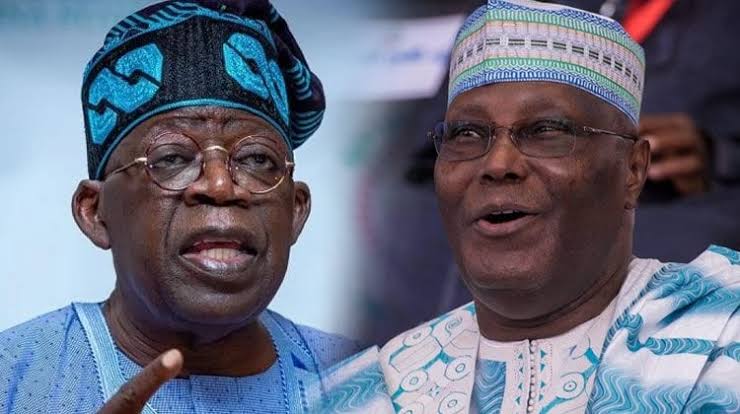
The Federal High Court in Abuja on Monday fixed Oct. 13 for hearing of an application filed by Alhaji Atiku Abubakar, presidential candidate of African Democratic Congress (ADC), seeking to amend his suit against President Bola Tinubu and All Progressives Congress (APC).

Justice Inyang Ekwo fixed the date to allow parties in the suit regularise their processes.

When the case was called on Monday, Joseph Silas, who appeared for Atiku and ADC, told the court that though he had received responses from other respondents, he was yet to get President Tinubu’s counter affidavit to their motion to amend the suit.

However, Chief Wole Olanipekun, SAN, lawyer to the president, informed the court that their counter affidavit was served on the plaintiffs on Sept. 24 and acknowledged by the office of the plaintiffs’ counsel.

Justice Ekwo equally confirmed the proof of service filed by Olanipekun.

The judge consequently adjourned the matter until Oct. 13 for hearing of the motion to amend the originating summons filed by Atiku and ADC.

It was reported that Atiku and ADC had, in the main suit, urged Justice Inyang Ekwo to disqualify President Tinubu and APC from the 2027 presidential election.

They had questioned Tinubu’s National Youth Service Corps (NYSC) discharge certificate submitted to the Independent National Electoral Commission (INEC) by APC.

The plaintiffs, who sued the president, APC and INEC as 1st to 3rd defendants in the originating summons marked: FHC/ABJ/CS/1888/2026, alleged that APC submitted the president’s forged NYSC discharge certificate to INEC.

They, therefore, prayed the court to compel INEC to remove Tinubu and APC’s names from the list of candidates and parties for the presidential poll.

President Tinubu and APC, in their joint counter affidavit filed on Sept. 9, prayed the court to dismiss the suit in its entirty for being incompetent and that the plaintiffs lacked the legal right to institute the case.

They denied submitting any forged certificate to INEC either for the 2023 or 2027 presidential elections.

The duo, through the APC’s Director of Legal Services, Mr Sanusi Samaila, averred that they did not submit any Form CF001 to INEC for 2023 or 2027 poll as claimed by the plaintiffs.

They stated that the NYSC has never denied issuing the discharge certificate to the 1st defendant at the end of his service year.

They submitted that it is a settied law that the evidence required to prove that a certificate is forged is a disclaimer from the institution that is said to have issued the certificate, citing a previous Supreme Court decision to back their argument.

They urged the court to uphold their preliminary objection and dismiss the suit.

INEC, in its preliminary objection filed on Sept. 7 by its lawyer, Dr Alex Izinyon, SAN, also challenged the competence of the suit on the grounds of statute-bar, want of locus standi, absence of a reasonable cause of action and abuse of court process.

The commission argued that the plaintiffs failed to comply with the mandatory written deposition requirement under Paragraph 7(1) provision of the Federal High Court Pre-Election Practice Directions (Amendment) 2026.

The electoral umpire equally challenged the impropriety of Reliefs 2 and 3 in Atiku and ADC’s originating summons, urging the court to dismiss the suit.

Atiku and ADC, however, approached the court with a motion on notice on Sept. 10, seeking an amendment to the suit.

They said the application was brought pursuant to Paragraph 7(8) of the FHC (Pre-election) Practice Directions, 2006 and under the inherent jurisdiction of the court.

In the two reliefs, they sought an order granting leave to them to amend their originating summons.

They also prayed the court for an order deeming the amended originating summons filed upon their application, as properly filed amended originating summons.

Giving four grounds why their application should be granted, the applicants said they filed the suit on Aug. 14, seeking the reliefs contained in the originating summons.

Atiku and ADC said that after filing the originating summons, they noticed a few errors, especially on the nomenclature of the INEC forms attached to their affidavit which was referred to as Form CF001, instead of the now Form EC9A.

They said there was also the need to specifically set out the particulars of the alleged fraud in their affidavit, including a written deposition of the 1st plaintiff (Atiku) and attaching clearer copies of Exhibits referred to, but were not available with the plaintiffs as at the time of filing the suit.

They said these would replace “the one presently attached, but is inelegant,” and that no new issue had been added to the amended originating summons and no additional prayers sought.

Besides, they submitted that as plaintiffs, they “are entitled to make this amended in the interest of justice.”

Tinubu, in a counter affidavit filed on Sept. 24, opposed the application to amend the suit.

Thr president, in the counter affidavit deposed to by Moses Adoga, a litigation support officer, in the law firm of Wole Olanipekun, SAN, his lead counsel, dissgreed with Atiku’s submission.

Adoga said contrary to the reliefs sought by Atiku in his amended originating summons marked as Exhibit “P1,” he noticed that the ADC presidential candidate also sought to amend the questions for determination and reliefs sought.

The officer said he observed that Atiku sought to introduce an entirely new relief, which was not sought in the originating summons, with which the action was initiated.

“I also observed that the plaintiffs seek to introduce new documents through the affidavit, by substituting FORM CF001 for FORM EC9, while seeking to introduce entirely new paragraphs in the supporting affidavit to the originating summons.”

According to him, the amendment sought to be made by the plaintiffs essentially attempts to alter the entire case of the plaintiffs as presented before this honourable court.

Adoga submitted that the said motion was misconceived.

“The entire facts deposed to in the affidavit in support of the motion on notice, including Paragraphs 3, 4, 5, 6, 7, 8, 9, 10, 11, 12 and 13 are untrue, misconceived or skewed to mislead this honourable court.”

The officer said he observed that the plaintiffs made it clear that their purported cause of action is predicated on the documents submitted by the president to INEC.

He, however, argued that Atiku’s substantive suit is statute barred, having been filed on Aug. 14 while the cause of action which he is challenging arose on July 11 when Tinubu’s name was submitted to INEC, even though the commission published the particulars of all presidential candidates with their submitted certificates on Aug. 1.

Accirding to him, the timeline for institution of actions is prescribed by the 1999 Constitution (as amened) and not the Practice Direction of this Honourable Court.

“The Practice Direction does not entitle any party to file or seek to amend their originating summons upon the expiration of the time prescribed by the constitution for the institution of the action,” he added.

Besides, he argued that contrary to Atiku’s reliefs, the amendment sought more than just “to correct errors of description of documents.”

“Further to the above, the attempt to ‘set out the particulars of fraud in the affidavit’ is an admission to the fact that the previously filed originating summons contained no such particulars, thus, rendering same incompetent.

Adoga submitted that an incompetent originating process cannot be amended.

He stated further that the proposed amended originating summons clearly indicated that an additional prayer is being sought therein.

Adoga prayed the court to dismiss the motion for amendment in the interest of justice.

APC equally opposed the motion to amend the suit.

Earlier reported that INEC haf also opposed Atiku’s motion to amend the suit.

The commission, in a counter affidavit to the plaintiffs’ motion on notice for amendment filed on Sept. 10, said its preliminary objection, filed on Sept. 7 and served on the plaintiffs, is still pending and undetermined.

Mendie Akpan, a litigation secretary in the law firm of Alex Izinyon & Co, who deposed to the counter affidavit, argued that Atiku’s motion to amend and the proposed amended originating summons is seeking to substitute or bring in a new cause of action.

She further submitted that the motion sought to attach a written deposition not filed within the the constitutionally prescribed period, reformulate reliefs and cure the CF001/EC9 confusion.

The lawyer argued that the proposed amendment, if granted, would have the effect of introducing a fresh or different cause of action.

Alternatively, she said it would have the effect of curing a jurisdictional defect, after the expiration of the 14-day period prescribed by Section 285(9) of the Constitution for instituting a pre-clection suit.

The matter is expected to be heard by Justice Ekwok on Monday, Sept. 28.
Fire guts Customs Western Marine Command office in Lagos

0

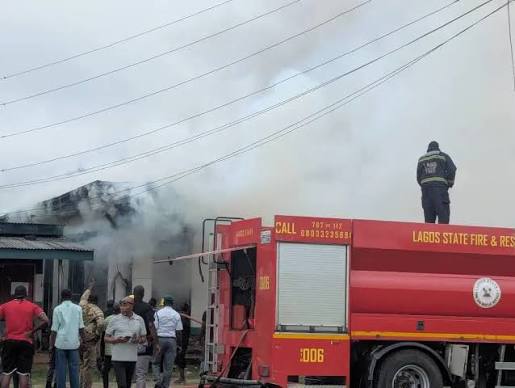
Fire gutted the Nigeria Customs Service (NCS) Western Marine Command office in Apapa, Lagos, on Monday, destroying property worth millions of Naira.

The fire, which reportedly started at about 10:23 a.m. from an electrical surge in the conference room, spread to other sections of the building.

It was reported that officers on duty made frantic efforts to contain the fire before officials of the Lagos State Fire and Rescue Service arrived at about 10:45 a.m.

The Deputy Comptroller of Customs, Timothy Jonah, who just resumed at the Command, to take over the affairs from his predecessor, described the incident as unfortunate.

He said: “I just resumed duty to take over, only to witness this fire outbreak.

“Every challenge, though negative, is an opportunity to strengthen our operations.
“In the meantime, we will set up a committee to investigate the cause of the fire.”

He commended the swift response of the personnel on duty and their collaboration with the fire service, saying measures would be taken to strengthen safety protocols and prevent a recurrence.

Super Eagles arrive Bissau ahead of AFCON 2027 qualifier

0

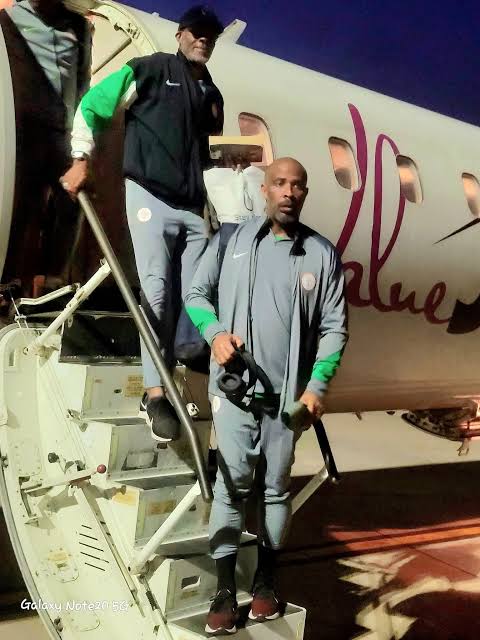
The Super Eagles of Nigeria have arrived in Bissau ahead of Tuesday’s 2027 Africa Cup of Nations (AFCON) qualifier against Guinea-Bissau.

It was reported that the Super Eagles departed Nigeria on Sunday for Bissau ahead of their second Group L qualifying fixture.

The contingent departed from the Victor Attah International Airport, Uyo, after the team defeated Madagascar 2-1 at the Godswill Akpabio Stadium on Friday.
Promise Efoghe, Super Eagles Media Officer, told NAN that the team held a final training session in Uyo before departing for Guinea-Bissau.

“The Super Eagles had a final training session earlier on Sunday morning in Uyo before coach Eric Chelle and his players departed for Guinea-Bissau at about 5 p.m.
“The team went on board a chartered ValueJet flight,” Efoghe said.

He said the team arrived at the Osvaldo Vieira International Airport, Bissau, at about 8:40 p.m. ahead of Tuesday’s AFCON qualifier.
The Super Eagles will face Guinea-Bissau, who defeated Tanzania 2-0 in their opening Group L fixture, to move ahead of Nigeria on goal difference.

Nigeria will face the Djurtus, ranked 132nd in the world and 38th in Africa, at the Estádio Nacional 24 de Setembro in Bissau on Tuesday.
Guinea-Bissau have faced Nigeria four times, winning once—in 2023 during the AFCON qualifiers, when they secured a 1-0 victory at the MKO Abiola Stadium in Abuja.

Only the group winner will secure an AFCON 2027 qualification ticket, with Tanzania already qualified as one of the co-hosts.
Nigeria therefore face a crucial encounter against Guinea-Bissau, with both sides seeking to strengthen their position in Group L.

Tinubu Hale and Hearty, Has Been Working on Vacation — Presidency

0


President Bola Tinubu is hale and hearty and has been on an official working vacation, according to a statement defending his absence from Abuja and the United Nations General Assembly in New York.

The statement said Tinubu was entitled to his annual vacation and, in the digital age, did not need to be physically present in Abuja to discharge his responsibilities as President.

According to the statement, Tinubu has continued to work while away from Nigeria, including holding meetings with investors in France.

It also said the President had recently facilitated a $7 billion deep-sea port project in Ogun Waterside, an initiative of the Ogun State Government.

The statement noted that other African leaders, including South Africa’s President Cyril Ramaphosa and Egypt’s President Abdel Fattah el-Sisi, were also absent from the 2026 United Nations General Assembly in New York.

It said Ramaphosa had booked himself off public engagements, while Tinubu had announced his annual vacation and delegated Nigeria’s representation at the UNGA to Vice President Kashim Shettima.

The statement also criticised former Anambra State Governor and Labour Party presidential candidate, Peter Obi, for questioning Tinubu’s whereabouts in a post on X.

It added that Tinubu was expected to return to Nigeria this week to participate in activities marking the country’s 66th Independence Anniversary.

According to the statement, the President will also honour the late Chief Moshood Kashimawo Olawale Abiola by attending the premiere of a movie about the late businessman and democracy advocate in Lagos.

IMF: War, debt, ageing workforce threatening global economy

0

…Provides $40bn financial support to Nigeria, 17 others
The International Monetary Fund (IMF) has warned that the global economy is facing fresh pressures from war, rising public debt, disruptions to trade and rapid advances in artificial intelligence (AI), despite showing resilience entering 2026.

The warning is contained in the IMF’s 2026 Annual Report, titled “Navigating a Precarious World,” which examines the major forces shaping the world economy and the Fund’s work during its 2026 financial year.

The Fund’s Managing Director, Kristalina Georgieva, said the global economy remained resilient despite increasingly frequent and overlapping shocks, but warned that uncertainty remained high and the medium-term growth outlook was weak.


She stressed the need for stronger economic growth, price and financial stability, sound fiscal policies and structural reforms, while describing AI as both an opportunity and a potential threat.

The report comes ahead of the 2026 IMF-World Bank Annual Meetings in Bangkok, Thailand, in October, where policymakers are expected to discuss how to strengthen economic resilience and promote sustainable and inclusive growth amid changes in geopolitics, trade and technology.

According to the report, the world economy remained relatively resilient in 2025, supported by private-sector activity, fiscal and monetary policies and rising investment in technology.

However, the IMF said the situation changed significantly after war broke out in the Middle East towards the end of February, triggering disruptions to energy and other commodity supplies and putting pressure on economies far beyond the region.

It said the shock came at a time when global public debt was already close to record levels, making it harder for governments to respond to new economic pressures.
The Fund also identified ageing populations, high debt and other structural problems as challenges that could weigh on global growth over the medium term.

At the same time, the IMF said artificial intelligence could provide a major boost to productivity and investment, although its rapid deployment could also disrupt jobs, labour markets and economic policies. The report also highlighted changes in global trade, saying geopolitical tensions, shifting trade relationships and supply-chain disruptions were reshaping the way countries trade and invest.

It said these developments were affecting economic growth and forcing countries to adjust to a changing global trading system.

Another emerging issue is digital finance. The IMF pointed to the rapid growth of stablecoins, digital payments, central bank digital currencies and tokenisation as developments that could change the financial system while creating new regulatory challenges.

The report said the IMF continued to support its 191 member countries through economic monitoring, financing and technical assistance.

During the 2026 financial year, the Fund conducted 138 Article IV consultations, which involved detailed assessments of member countries’ economic and financial policies.

It also provided $40 billion in financing to 18 countries, including about $2 billion to nine low-income countries, while spending about $400 million on capacity development, including technical assistance and training.

The IMF said its role was increasingly focused on helping countries manage shocks while strengthening their economies for future challenges.

NDLEA nabs groom at airport with 72 wraps of cocaine in stomach

0

NDLEA nabs groom at airport with 72 wraps of cocaine in stomach

…Seizes N3bn opioid haul at Lagos airport, arrests cross-border traffickers

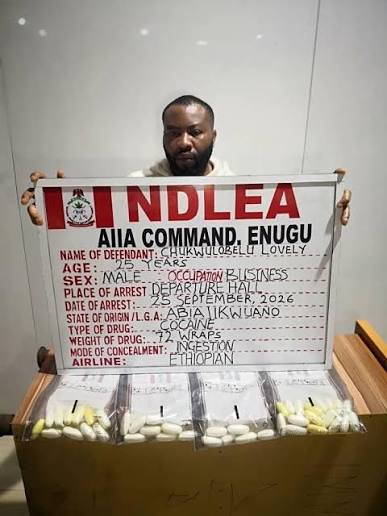
Operatives of the National Drug Law Enforcement Agency (NDLEA) have arrested a 25-year-old newlywed businessman, Lovely Chukwulobelu, at the Akanu Ibiam International Airport (AIIA), Enugu, for allegedly attempting to traffic 72 wraps of cocaine concealed in his stomach to Portugal, where he resides.

Chukwulobelu was intercepted at the airport’s departure hall on Thursday, September 25, 2026, while attempting to board an Ethiopian Airlines flight to Lisbon, Portugal, via Addis Ababa.


He was subsequently placed under excretion observation, during which he excreted a total of 72 wraps of the Class A drug.

The suspect reportedly told NDLEA operatives that he operated a car decoration business at the Trade Fair Complex, Ojo, Lagos, before relocating to Portugal in May 2023.

He said he returned to Nigeria to get married on September 13, 2026, and allegedly ventured into drug trafficking to offset expenses incurred during his wedding.

Meanwhile, at the import shed of the Murtala Muhammed International Airport (MMIA), Lagos, NDLEA operatives, on Tuesday, September 22, uncovered one of the agency’s largest opioid seizures of the year during a joint examination of three monitored consignments.

The consignments contained 2,550,000 pills of Tramaking 225mg, Tramaking 250mg and Royal Tapentadol 250mg, with a combined gross weight of 1,640.55kg.

The consignments, imported from India and Bangladesh, arrived in Nigeria through Qatar Airways, RwandAir and Ethiopian Airlines.

In Bauchi State, NDLEA operatives arrested two suspects, Umar Hamidu, 35, and Abdulkarim Salihu, 45, along the Maiduguri bypass with 300 compressed blocks of skunk weighing 262.5kg.

The consignment was allegedly concealed in the false bottom of a truck.

Similarly, NDLEA officers, backed by soldiers, destroyed two cannabis farms with a combined estimated yield of 1,360.23kg at Eko Camp, Ilushi, Edo State, on Wednesday, September 23.
In Lagos, two women, Odumabo Kehinde, 36, and Obiekwe Chioma, 40, were arrested on Saturday, September 26, during a raid on Anifowoshe Street, Mushin, where 3.4kg of skunk was recovered.

In a separate operation the same day, NDLEA operatives intercepted a 58-year-old man, Ugwu Johnson, at Ebute-Ero motor park, recovering 5.92kg of skunk, 2,400 ampoules of pentazocine injection, 8,400 tablets of nitrazepam and 40,000 tablets of tramadol.

In Oyo State, two Togolese nationals, Yinusa Abdulsamad, 35, and Fatai Baba, 33, were arrested along the Iganna-Ilero road with 305.6kg of skunk concealed in two pickup vans.

The suspects were allegedly involved in a cross-border drug trafficking network moving Ghanaian-sourced cannabis into Nigeria through the Oyo axis.

At the Seme border in Badagry, Lagos, five suspects — Kingsley John, 40; John Chibuike Okeke, 44; Lamidi Ismaila, 40; Babatunde Samuel, 42; and Afeesu Idowu, 47 — were arrested with 420 cartons of nitrous oxide, popularly known as “laughing gas”, weighing 1,688.4kg.

Two vehicles allegedly used to convey the consignment into Lagos were also recovered.

Beyond the enforcement operations, NDLEA commands nationwide continued their War Against Drug Abuse (WADA) sensitisation campaigns in schools, worship centres, workplaces and communities.

The activities included lectures at Community High School, Saki, Oyo State; Auchi College, Edo State; Alkali Modibbo Islamic Centre, Dukku, Gombe State; and Junior Arabic Secondary School, Kahu, Kibiya Local Government Area of Kano State.

The Delta Ports Command also paid a WADA advocacy visit to the Olu of Warri, Ogiame Atuwatse III.

NDLEA Chairman and Chief Executive Officer, Brig. Gen. Mohamed Marwa (retd.), commended officers of the MMIA, AIIA, Lagos, Oyo, Edo, Seme and Bauchi commands for the operations.

Marwa urged the officers to remain committed to the agency’s balanced approach to drug control, combining enforcement with drug abuse prevention and public sensitisation.

Sun

Why famous baby photo with Messi got hidden for 17 years – Yamal

0

Spain and Barcelona star, Lamine Yamal has revealed he asked his father to keep his famous baby photo with Lionel Messi hidden to prevent comparison with the Argentine legend.

The iconic photo shows Messi bathing baby Yamal.

The image, taken by SPORT photographer Joan Monfort, has gone viral since Yamal became a global star with Barcelona.


Yamal speaks out on repeated racist abuse
Revealing the backstory, the 19-year-old winger said the photo got hidden for this long because he asked his father, Mounir Nasraoui, not to post it.

He told The Guardian, “I told my father not to upload it. He posted it on Facebook once and I told him to delete it. The comparisons were too easy, that was the only thing people were talking about.”

Yamal added, “I wanted to be Lamine; I didn’t want to be Messi. I just wanted to get where I could. I asked him to wait. When it’s Lamine, do whatever she wants.”

Sun

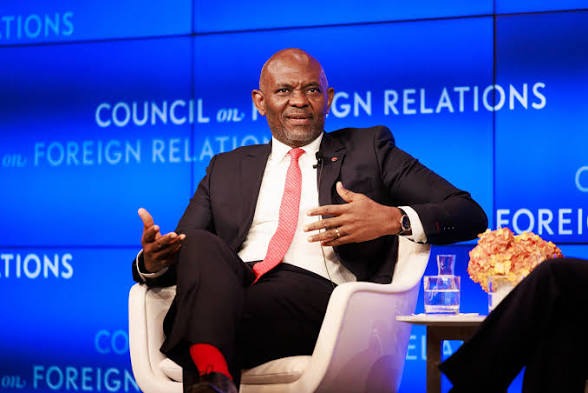
How Tony Elumelu’s Africapitalism is multiplying impact across Africa

0


By Ehi Braimah

​


Conversations during economic summits on Africa clearly indicate that governments alone cannot transform Africa’s economic fortunes. While African countries bet on foreign investment, or depend on borrowing and aid, a thinking still rooted in our colonial history, something more fundamental is taking place across the continent: the capacity of young Africans to create businesses, jobs and solutions to problems around them.


This significant shift by young Africans, demonstrating their capacity to innovate and launch businesses of their own, leads us to Africapitalism, the economic philosophy associated with Nigerian entrepreneur and philanthropist Tony Elumelu. The philosophy is simple: Africans must play a central role in creating Africa’s economic prosperity. At its heart is the belief that Africa’s private sector can drive economic and social development by creating long-term economic value and social wealth on the continent.


The Tony Elumelu Foundation (TEF) has translated this philosophy into an ambitious entrepreneurship programme that identifies, trains, mentors and provides seed capital to young African entrepreneurs. The idea is simple but potentially transformational: give young Africans the tools and capital to build sustainable businesses, rather than waiting for them to find employment in economies that cannot create enough jobs.


In terms of scale and impact, the numbers behind TEF’s entrepreneurship intervention are substantial. The story of Ms. Theresa Oluwagbemi which I am about to tell is not an isolated case, but part of an entrepreneurship ecosystem. Since the launch of its flagship Entrepreneurship Programme in 2015, TEF has empowered more than 27,000 entrepreneurs across 54 African countries, while more than 2.5 million Africans have accessed business-management training through TEFConnect. In addition, more than US$100 million in seed capital has been disbursed so far to selected entrepreneurs.


According to TEF’s latest figures, businesses supported through the programme have collectively generated more than US$4.2 billion in revenue and created more than 1.5 million direct and indirect jobs. TEF also reports that it has lifted 2.1 million Africans above the poverty line and positively affected more than four million African households.


The programme’s reach is also demonstrated by the extraordinary demand for it. In 2026 alone, TEF received more than 265,000 applications from young Africans across the continent before selecting a cohort of 3,200 beneficiaries – up from 1,000 beneficiaries when the programme was launched 11 years ago – with 51 percent being women.


Supported by his wife, Awele, Tony Elumelu took TEF to a new level, building partnership with major development institutions, governments and global foundations to scale the programme. These partners include the European Union, UNDP, ADB, International Committee of the Red Cross, United States African Development Foundation, Organisation of African, Caribbean and Pacific States; German Development Finance Institution (DEG), German Agency for International Cooperation (GIZ), Google, UNICEF Generation Unlimited, IKEA Foundation, the UAE Office of Development Affairs, and Khalifa Bin Zayed Al Nahyan Foundation, among others.


I have had the privilege of experiencing the Africapitalism philosophy from the other side of the table as a mentor in the Tony Elumelu Entrepreneurship Programme. Last year, I was assigned to mentor Theresa Ouwagbemi, a young Nigerian entrepreneur whose journey provides a compelling illustration of how relatively modest catalytic capital can unlock economic activity.


Theresa studied Mass Communication at the Federal University, Oye-Ekiti, graduating with a second-class upper division, but her entrepreneurial journey began before graduation. She started producing and selling liquid soap on a very small scale, primarily to students and lecturers in her university. Like many young entrepreneurs, she had an idea and the determination to pursue it, but lacked the resources to take the business to the next level.


Then came TEF.


Theresa heard about the programme through a mentor who encouraged her to apply. She knew the selection process was competitive; nevertheless, she submitted her application, including her business pitch and proposal. When the email announcing her selection arrived, it became, in her words, “one of the best days of my life.”


That moment was more than an emotional milestone – it marked the beginning of a significant transition in her entrepreneurial journey. She received the $5,000 seed grant in January, 2026, alongside access to the programme’s masterclass and mentorship. The combination is important. Capital without knowledge can be wasted, just as knowledge without capital can remain theoretical.


Her business, “Boom Liquid Wash”, began to acquire the capacity to serve a wider market. Before the grant, Theresa’s business was constrained by the limited equipment available to her. She had to turn down some contracts because she lacked the production capacity required to fulfil them.


The grant changed that equation. With the money, she acquired basic equipment needed for production. Her customer base expanded beyond students and lecturers to include restaurants, office owners, other businesses and individual consumers. This is where the broader significance of Africapitalism becomes evident.


The US$5,000 did not simply become money in Theresa’s bank account; it became productive capital. It was converted into equipment, production capacity, customers and business relationships. It enabled 23-year-old Theresa to accept opportunities that were previously beyond her reach. That is the multiplier effect that entrepreneurship can produce.


Theresa’s story also demonstrates why entrepreneurship development cannot be reduced to simply handing young people money. The TEF model helps entrepreneurs to develop the knowledge, resilience and connections required to survive in a difficult business environment, and Nigeria’s business environment can be difficult.


Theresa recalls an occasion when the price of chemicals used in her production increased by more than 60 per cent. For a small business, such a sudden increase in input costs can threaten profitability and customer relationships. How do you explain to customers that your costs have suddenly risen? How do you protect your margins without losing your market? How do you keep going when the economics of your business appear to be changing overnight?


These are not theoretical questions for young African entrepreneurs; they are everyday realities.

We discussed these challenges and Theresa learned to adapt.Her entrepreneurial experience has also exposed her to opportunities and people she might not otherwise have encountered. While she was still a student, for example, she produced souvenirs for the Dean of her department.


More importantly, entrepreneurship has sharpened her ability to identify problems and develop tailored solutions. That is another important dimension of Africapitalism: the entrepreneur is not merely a beneficiary of economic development, but becomes an agent of economic development.


Theresa’s customers are beneficiaries because they have access to locally produced products. Her suppliers also benefit from demand, and the businesses that buy her products benefit from reliable supply. As “Boom Liquid Wash” grows, its economic footprint can grow with it. Multiply Theresa’s experience by thousands of entrepreneurs across Africa and the significance becomes much larger.


This is why the Tony Elumelu Entrepreneurship Programme is important beyond the individual entrepreneurs who receive the grants. The real ambition is to create an ecosystem in which African entrepreneurs thrive, solve African problems, build African businesses and create economic value within African economies.


Africa has no shortage of entrepreneurial energy. What it often lacks is the capital, infrastructure, market access, knowledge and institutional support required to turn entrepreneurial ideas into sustainable businesses. The intervention of catalytic capital can therefore be significant, but money alone does not guarantee success.


Theresa has learned some hard lessons. One is particularly memorable: never sell on credit. Her experience reflects one of the perennial challenges facing small businesses: cash flow. A small business may have customers and make sales on paper but still struggle if customers do not pay promptly.


Her second lesson is perhaps even more important: entrepreneurship is not a smooth journey.

There will be setbacks, unexpected costs, disappointments and moments of discouragement. My advice to Theresa and other young entrepreneurs is to look back at what they have achieved and remember what motivated them to start in the first place.


That resilience is essential to building businesses that can survive beyond the initial intervention.

Theresa is currently undertaking her National Youth Service Corps programme in Enugu, in Eastern Nigeria. She describes her experience in Enugu as beautiful, saying she has met amazing people and visited beautiful places.


But NYSC is only another chapter in her journey; her ambition is much bigger. She wants to grow “Boom Liquid Wash” into a business that meets global standards. She plans to gain additional exposure by interning with companies that represent the blueprint she wants for her own business. She also plans to pursue an MBA because, in her words, building a global business requires “a global mindset, experience and exposure.”


This is precisely the kind of ambition that programmes such as TEF seek to nurture. There is an important lesson here for Africa: development should not only be measured by the amount of money injected into an economy; it should also be measured by the productive capacity that such capital creates.


The money should create a business, acquire customers, and enable increase in production. In addition, the entrepreneur should acquire new skills; the enterprise should become capable of accepting larger contracts, while creating opportunities for others, contributing to the economic value within the community and, ultimately, within the African economy.


This is the type of value chain that makes the Africapitalism conversation particularly relevant. Tony Elumelu’s intervention is premised on the idea that the African private sector can be an engine of development. Rather than viewing philanthropy simply as the distribution of resources, Africapitalism seeks to connect enterprise, investment, economic empowerment and social impact.


Theresa’s story illustrates this connection at the micro level. Her production capacity grew and her customer based expanded with bigger ambitions. The next challenge for her is sustainability.


The ultimate test of any entrepreneurship programme is what happens after the grant. Can businesses survive? Can they scale and create jobs? Can they attract additional capital? Can they become suppliers to larger companies? Can they expand across borders? Theresa appears determined to pursue that journey. Her aspiration to build a global-standard business is significant because Africa needs businesses that can grow, compete, innovate, export and create wealth.


The continent’s enormous youth population makes this even more urgent. Millions of young Africans will enter the labour market in the coming years, but no government can employ everyone. Sustainable private enterprises must therefore become an increasingly important part of the solution. This is where Africapitalism intersects with Africa’s development challenge. The goal is not capitalism for its own sake; it is the deployment of private enterprise and capital to generate both economic and social value.


Theresa’s journey from a small student-based liquid soap business to a growing enterprise with customers beyond her immediate environment may appear modest against the scale of Africa’s economic challenges, but transformation often begins at this level – one young African entrepreneur who moves from dependency to enterprise. That is how impact multiplies.


The real promise of Africapitalism lies not simply in the success of one Tony Elumelu entrepreneur, but in the possibility that thousands of entrepreneurs can become creators of value, employers of labour, innovators and contributors to Africa’s economic transformation.


Theresa’s story is therefore bigger than “Boom Liquid Wash” – it is a story about what happens when capital meets an idea, when mentorship meets ambition, and when opportunity meets determination. Perhaps that is one of the most powerful ways to understand Tony Elumelu’s vision for Africa: don’t just give young Africans a chance to find jobs; give them a chance to build businesses that create jobs, wealth and solutions for Africa.


That is Africapitalism in action.

Braimah is a PR specialist, marketing strategist, and publisher/editor-in-chief of Naija Times (www.ntm.ng) and Lagos Post (www.lagospost.ng). He is a strong advocate for African prosperity and can be reached through:ehi.braimah@neomedia.com.ng

2027: Opposition parties are just participants, APC will win — Yilwatda

0

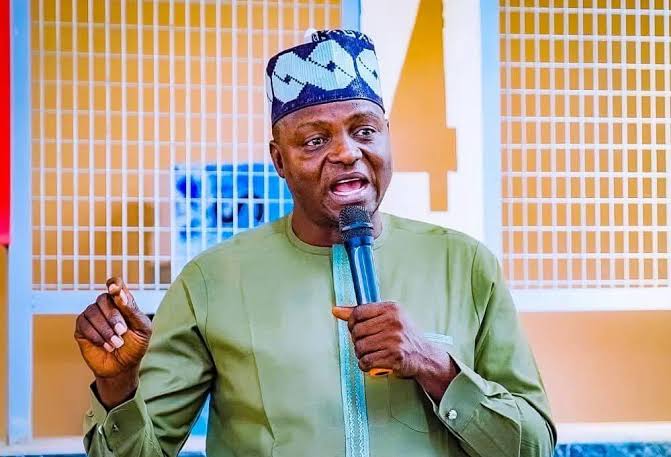
The National Chairman of the All Progressives Congress (APC), Professor Nentawe Yilwatda, has declared that the ruling party is prepared to win the 2027 general elections, describing opposition parties contesting the polls as “just participants.”

Yilwatda made the statement on Saturday while briefing journalists at the end of a three-day retreat organised for members of the APC National Working Committee (NWC) in Maiduguri, Borno State.

The APC chairman said the party had completed key preparations for the 2027 elections, including the inauguration of campaign councils and reconciliation committees.

He expressed confidence in candidates produced through the party’s primary elections, saying the NWC had resolved to intensify its campaign ahead of the polls.

“The party is healthy, and we are confident we have produced the most credible and acceptable candidates to be elected,” Yilwatda said.

He said the party would drive its campaign by highlighting what it described as the achievements of President Bola Tinubu’s administration to voters.

The retreat also ended with the APC passing a vote of confidence in Tinubu, Vice President Kashim Shettima and other APC candidates ahead of the elections.

Addressing concerns over internal disputes arising from the party’s primary elections, Yilwatda said between 6,000 and 7,000 members participated in the exercises across the country, while about 100 cases had been taken to court.

“With 6,000 to 7,000 members who participated in the primary elections, we have about 100 cases in court; that means an average of less than 3 cases per state.

“It means just 1 per cent of the people that participated in the election went to court; do you think my party is in bad shape? Only 1 per cent went to court,” he said.

Yilwatda said the figures demonstrated the APC’s confidence in the outcome of its primaries, adding that the party remained focused on the 2027 elections.

“We are very confident our party would win the elections,” he added.

The APC chairman also highlighted the party’s early preparations, saying the ruling party had already constituted its campaign council.

“APC is the first to constitute a campaign council; I don’t think any other party has done that,” Yilwatda said.

He compared the APC’s preparations with those of other political parties, mentioning the National Democratic Congress (NDC) and African Democratic Congress (ADC).

According to him, the NDC had constituted a body which it later described as a support group, while the ADC had only announced its campaign leaders and was yet to constitute its campaign council.

Yilwatda further pointed to the APC’s electoral record as he sought to underline the party’s readiness for the 2027 contest.

“We are the most prepared; we contested in many elections and won. The major opposition parties you are talking about, none of them has ever won a councilorship; as far as I am concerned, they are just participants in this election,” he said.

The APC chairman said the party would continue its campaign and reconciliation efforts as it works towards the 2027 general elections.

The retreat also featured a condolence message to the government and people of Niger State over the deaths of 37 individuals who died in custody.