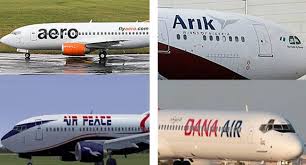
The rising cost of aviation fuel and the shortage of foreign exchange in the country have been attributed to the incessant surge in airfares.
Aviation fuel otherwise known as JET A1 currently sells for between N790 and N800 per litre. According to airline operators, CRJ and Embraer flights cost between N970,000 and N1.04 million.
The scarcity of forex in the country has made it difficult for airlines to purchase spare parts for the maintenance of their fleets. They have to rely on the black market for forex. A dollar was sold for $/N749 on Thursday, compared to the $/463.50 it exchanged at the Central Bank of Nigeria.
This has kept airlines’ operating costs rising and forced them to raise their airfares accordingly.
The Chief Executive Officer of aviation consultancy firm, Belujane Konzult, Chris Aligbe, noted that a low-cost air ticket was achievable in the country, in the face of the challenges the airlines were struggling with.
According to him, there was no way airlines can be profitable by charging fees that can barely make them survive in the face of the skyrocketing price of aviation fuel otherwise and forex scarcity.
He explained that 99 per cent of input into an aircraft was forex dominated, stressing that the country did not produce airplane parts.
He added, “So you need forex. We suffered double jeopardy – access to foreign exchange and availability and cost. A dollar rose from about N400 plus to N900 at a time, if you are not lucky enough to get it from the Central Bank of Nigeria.
“Currently, CBN meets about 20 per cent to 30 per cent of needs and that takes time. You have to queue. Meanwhile, you have an AOG that you have to get spare parts. It has been really difficult. What we have seen are escalating operating costs. It is escalating rapidly. There was a reaction from N23,000-N30,000 to N50,000-N70,000. Now, what we are seeing is that because of the economic situation in the country, nobody is flying at N70,000.”
Lighter and smaller aircraft such as the CRJ, Embraer and ATR had become the preferred airplanes by Nigerian operators. This is due to their fuel efficiency.
They require 1,300 litres of fuel for an hour flight while larger airplanes such as B737, Airbus aircraft or MD-83 would gulp over 3, 000 litre for the same one-hour flight.
With aviation fuel selling for between N790 and N800 per litre, airlines operating CRJ and Embraer aircraft would spend between N970,000 and N1.04 million on 1,300 litres of fuel for a one-hour trip.
Okonkwo said, “You can see that even if you get tickets of N40,000, I can assure you that people underwrite those costs.
“There is nobody who can fly at N40,000. Even if the aircraft is fully loaded, it is not possible. We operate CRJ aircraft and sell tickets for N40,000. NCAA takes five per cent and MMA2 takes N4,250, which is already 10 per cent of the fare we have collected.
“Fuel is discussed. One-hour flights require 1300 litres of fuel. So, there is no way anybody who flies at N40,000 will not do anything.”
He decried the attitude of some airlines that underwrite costs by injecting capital from other sources to sustain the business. According to him, one of the lessons learned was that it is imperative to be mindful of the operational setup and cost of operations.
“We have learned in the last two years that it does not make sense to compete on fares. There is no heroism in flying an aircraft. The only heroism is sustaining airline operations. Instead of competing on fares, airlines should focus on what they do. Make sure you get customers to a level that they are comfortable with and happy with you,” he added.
The likes of Ibom Air, ValueJets, Green Africa, Overland and Air Peace, opted for fuel-efficient CRJ, which made their fuel expenses lower than those operating much larger aircraft. This has made their airfares more affordable.
However, the Managing Director of Aero Contractors, Capt. Ado Sanusi, claimed that low airfares were possible.
“I agree that low fares can be sustainable if the local airlines look at their cost structure and work around it to make sure that they reduce their operating costs. The most significant thing is that if the price of fuel is reduced, you should also see an equal reduction in air ticket prices.