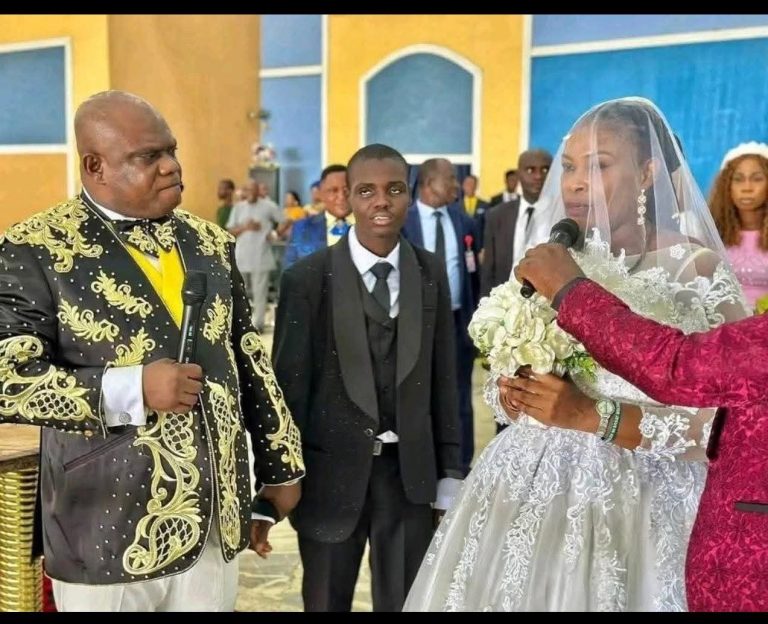
A parenting advocate, Wendy Ologe, has weighed in on the online controversy surrounding the reported marriage of an autistic son of Apostle Chibuzor to an older woman, describing the development as one that should be understood within the context of Igbo cultural traditions rather than sensationalised.
Ologe, who identifies herself as “Africa’s Number One Parent Coach,” said she was surprised by the intense reactions on social media, noting that such arrangements are not entirely unusual in some Igbo communities.
According to her, marriage in many traditional Igbo settings goes beyond romance and is often viewed as a rite of passage, a pathway to responsibility, and a means of integrating individuals fully into adult and communal life.
She argued that many critics of the marriage may be overlooking similar realities within their own families, where men considered irresponsible or lacking in certain qualities have still been married off to women from respectable homes, with society offering little resistance.
Ologe said the issue should not be reduced to a debate over whether it is right or wrong, but rather examined as a long-standing social practice rooted in history, family expectations and communal values.
Reflecting on her own experiences and conversations within her family, she said she had long observed how marriage is sometimes used in Igbo society as a form of social rehabilitation, particularly for men who may be seen as struggling in one way or another.
She recalled asking her father why an autistic cousin in their family had been married to an able-bodied woman, a question that led to a broader explanation of the cultural reasoning behind such unions.
According to Ologe, one of the major beliefs underpinning the practice is that marriage can help “mature” a man.
She said that in many families, marriage is seen as a way to instill responsibility, purpose and accountability, even though the outcome may vary from one case to another.
She added that family and community involvement in marriage decisions remains a strong feature of traditional Igbo life.
In such cases, marrying off a son living with a disability to a willing partner may be viewed as a way of preserving family ties, meeting social expectations and ensuring that the individual is not excluded from adulthood or community life.
Ologe also noted that age differences between spouses are often less controversial in traditional contexts than they are in modern online discourse.
What may appear unusual to social media audiences, she said, is sometimes culturally accepted when the union is seen as beneficial to both families and capable of providing social stability and care.
She further explained that for men who may be perceived as disadvantaged or less accomplished, marriage can serve as a means of inclusion and affirmation, giving them a sense of dignity, social acceptance and belonging that may not always be available in other aspects of life.
Drawing a contrast between traditional African values and global perceptions, Ologe said many of the criticisms being expressed online appear to be shaped by Western ideals of romantic compatibility and personal independence, while Igbo culture has historically placed greater emphasis on duty, family cohesion and communal responsibility.
“In short, while the internet may sensationalise the story, within Igbo culture this kind of marriage is often seen as practical, honourable and beneficial—not scandalous,” she said.
Ologe also noted that she had seen cases where women living with disabilities were also married off in similar ways, although she said she was unsure how widespread that practice is.
She concluded by stressing the importance of understanding history and culture before attempting to condemn or reform social practices, saying that societies can only build better futures by first understanding the roots of their traditions.