2nd March 2021
The Honourable Speaker
……………………
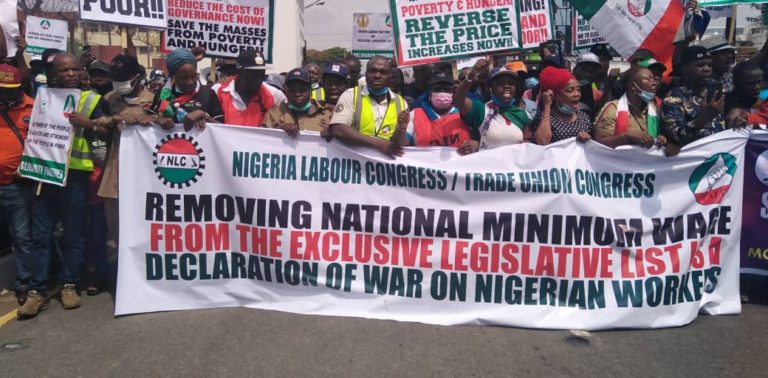
The Concerns of Nigerian Workers on the Move to Transfer the National Minimum Wage from the Exclusive Legislative List to the Concurrent Legislative List
We bring to the Honourable Speaker fraternal greetings from the working people of Nigeria.
We write to inform the Honourable Speaker that a private member bill moved by Honourable Garba Datti Mohammed representing Sabon Gari Federal Constituency of Kaduna State and sponsored by a few Governors was on Tuesday, 23 February, 2021, rushed through first and second readings. The bill seeks the transfer of the National Minimum Wage from the Exclusive Legislative List to the Concurrent Legislative List. Currently, the Bill has been referred to the Ad Hoc Committee on Constitution Review.
It is the well-considered view of the entire workforce in Nigeria that this bill is tantamount to a negation of the efforts of the Nigerian working class in the past forty years to free itself from the cruel manacles of slave wages, savagery working conditions and slave drivers.
The premise for the concerns and rejection of this anti-workers, anti-labour, and anti-people bill by Nigerian workers includes as follows:
National Minimum Wage as a Global Standard
Honourable Speaker, the National Minimum Wage is the benchmark minimum below which no employer of labour can pay an employee in any given national jurisdiction. It is a global standard. It was adopted as an International Labour Standard by the International Labour Organization (ILO) as Minimum Wage Fixing Machinery Convention 026 of 1928. Each member State of the ILO that adopts this Convention undertakes to establish a system of minimum wage which covers all the sectors of the economy including the Organized Private Sector which wages are to be paid hourly, daily or monthly as the case may be.
The Minimum Wage Fixing Machinery Convention 026 was ratified by Nigeria under a democratic government on 16th June 1961. A successive democratically elected government under the leadership of the Late President Shehu Shagari in May 1981 paid a national minimum wage whose dollar value or equivalent is more than twice the dollar equivalent of the present N30,000 national minimum wage.
Minimum wage laws are in force in about 90% of the countries of the world today including the United States where state minimums are higher than the national minimum. Minimum wage laws prohibit employers from hiring employees or workers for less than a given wage. Closer home, Ghana, Kenya and South Africa (countries with which Nigeria is regularly peer-reviewed) are among countries with national minimum wage laws. Ghana reviews its law every two years. Some countries peg payment of national minimum wage on inflation rate.
It is in furtherance of Nigeria’s obligation under ILO Convention 026 and in appreciation of best global best practices that the national minimum wage is domiciled in the Legislative Exclusive List Section 34 of the 1999 Constitution (as amended). It has been so since 1981.
The National Minimum Wage as a Tool for Social Inclusion
Honourable Speaker, it is important for us to reiterate that the national minimum wage is a product of negotiations between Labour, the Organized Private Sector and Government. During the negotiations, government is represented at both the Federal and State levels. During the negotiations, a number of issues are taken into consideration with data provided by relevant federal and state institutions and agencies. At the end of negotiations, the final outcome or national minimum wage is reasonable, realistic and implementable. Precedence shows that ability to pay is not dependent on surplus resources but on prudence, financial discipline, and the will to pay.
Also, the concept, rationale and logic for a national minimum wage are to ensure that employees in government and organised private sector, but particularly, the unorganised, the unskilled and the vulnerable in the highly ungoverned space commonly referred to as the informal sector, are included and protected.
By protection, we mean that the vulnerable are not overly exposed or exploited by their employers who pay wages so miserable they create a community of the working poor. Implications of creating communities of the working poor are obvious and range from very grave socio-economic and the political dislocations.
The Implications of Transferring the National Minimum Wage from the Exclusive Legislative List to the Concurrent Legislative List
Honourable Speaker, the implications of transferring the national minimum wage from the Exclusive Legislative List to the Concurrent Legislative List are very dire. Some of the implications include:
- A license for State Governors to drag the country back to the era of ridiculous slave wages which in the past had precipitated multifarious industrial crises in different parts of the country;
- The exponential creation and expansion of a community of the working poor with all the attendant consequences for socio-economic cohesion, stability and progress; and
- It could lead to the exclusion of the private sector (both organised and unorganised) from the concept, rationale and logic of a national minimum wage, yet, it is in this informal sector that horrendously unfair labour practices take place.
Our Prayer:
Mr. Speaker, we appeal to your good judgement to take account of the gravity of the malevolent scheme afoot by some retrogressive elements in the House of Representatives, intervene to guide the members of the State House of Assembly aright in case this bill comes before you.
Honourable Speaker, if this anti-labour bill that seeks to hamstring the nation in her efforts to reduce poverty and inequality is presented to your State House of Assembly, we appeal to your Excellency to kindly refuse assent.
Organized Labour not willing to sleep on its rights have perfected plans to organize nationwide protests in all the thirty-six states of the federation and the Federal Capital Territory (FCT). The protest will commence from Wednesday, 10th March 2021 and will be staged at the National Assembly and the State Houses of Assembly all over Nigeria.
The protest would be the first instance in a line of industrial actions to be undertaken by labour to buttress and drive home our point that the retaining of the national minimum wage in the Exclusive Legislative List is a fight for our survival and livelihood of millions of Nigerian workers.
Please, accept from me, Honourable Speaker, the highest esteem of the Nigerian working people.
State Council Chairperson