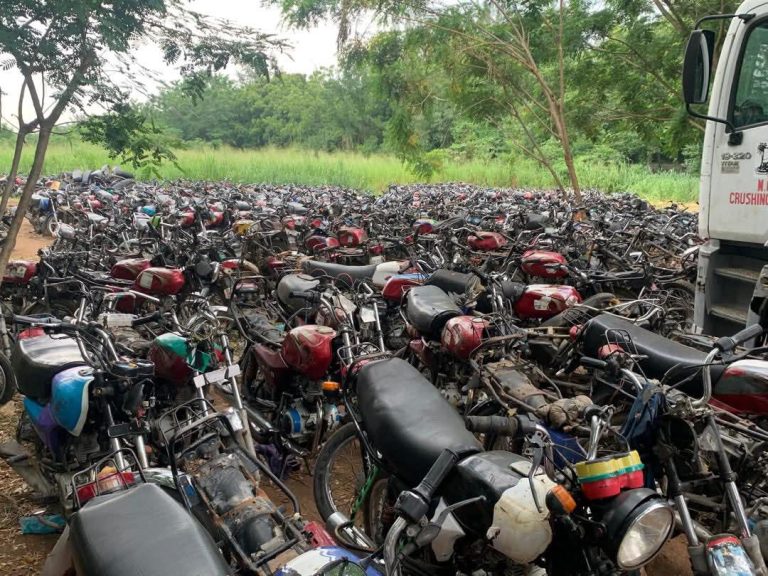
The Lagos State Taskforce has clarified its enforcement procedures against illegal commercial motorcycle (okada) operations, reaffirming its commitment to public safety, integrity, and the rule of law amid what it described as misleading and unsubstantiated allegations circulating on social media.
In a statement signed by the Director of Public Affairs, Gbadeyan Abdulraheem, the Agency expressed concern over claims by one Sheriffdeen Omo Eko alleging extortion, illegal sale of seized motorcycles, use of unauthorized persons, abuse of force, and compromise of leadership integrity. While acknowledging citizens’ right to express concerns, the Taskforce said it was necessary to set the record straight in the interest of public clarity and safety.
According to the statement, commercial motorcycles are apprehended strictly through due process and prosecuted before the Mobile Court for violations of the Lagos State Road Transport Sector Reform Law of 2018, particularly for operating on routes prohibited by the state government. These actions, the Taskforce stressed, are judicially backed and not arbitrary.
The Agency explained that all seized motorcycles are transferred to the Ministry of Transportation and subsequently crushed at the government-approved junkyard in Alausa. “At no point are seized motorcycles sold back to operators or diverted for personal benefit,” the statement said, noting that this policy has significantly reduced illegal okada operations across the state in the past year. For clarity, while seized motorcycles are crushed, seized vehicles are auctioned strictly by the state government through court-approved and transparent processes.
The Taskforce further dismissed claims of engaging civilian touts, stating that its operatives are trained paramilitary personnel. It clarified that officers may operate in plain clothes as part of intelligence-led sting operations, a standard global enforcement practice. The statement added that enforcing restrictions against illegal okada operators often poses heightened risks due to aggressive resistance and evasive tactics, making safety considerations paramount for passengers, officers, and other road users.
Intelligence and enforcement records, the Agency revealed, show that a significant proportion of illegal okada operators apprehended in restricted areas are non-Nigerians, many without proper documentation.
The Taskforce noted that criminal elements often exploit the okada business to evade scrutiny, infiltrate communities, and fuel disorder, including drug abuse and other unlawful activities. As such, illegal okada operations constitute not only a traffic violation but a broader public safety and security concern.
On leadership integrity, the Taskforce strongly defended its Chairman, CSP Adetayo Akerele, describing him as a disciplined and highly respected officer with an unblemished record of service. Allegations of personal enrichment or complicity in unlawful practices were described as reckless, unfounded, and unsupported by facts.
Addressing concerns over the use of force, the statement said the deployment of tear gas, where unavoidable, is a globally accepted crowd-control measure used by trained and authorized personnel to prevent escalation, disperse violent resistance, and protect lives, in line with strict operational guidelines.
The Lagos State Taskforce urged members of the public to verify claims through official channels before spreading misinformation, warning that false narratives undermine public trust and distract from efforts to maintain order and safety.
“The Taskforce remains unwavering in its mandate to ensure that Lagosians live, work, and commute in a safe, serene, and secure environment,” the statement concluded.