BY TAIWO OGUNMOLA -OMILANI
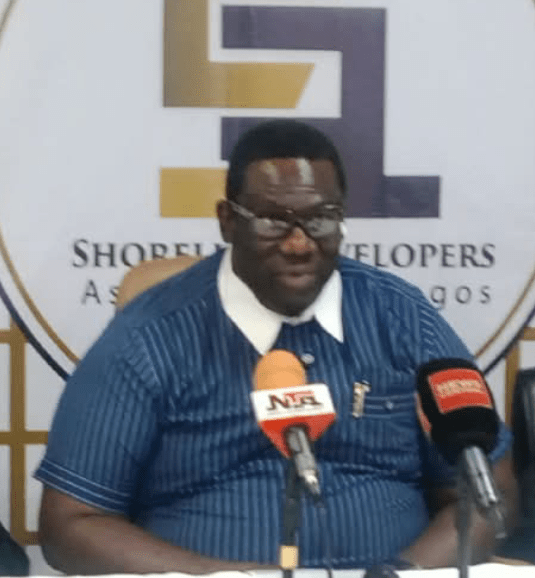
The President of the Shoreline Developers Association of Lagos (SDAL), Mr. Lai Omotola, has dismissed claims that the Lagos Coastal Road is responsible for flooding in communities along the state’s coastline.
Omotola, who spoke during a press conference in Lagos on the need for sustainable shoreline development, said the flooding experienced in some coastal communities was largely caused by buildings constructed without regard to existing master plans and natural drainage channels.
He said the Lagos Coastal Road was designed in line with the state’s master plan, but many property owners had constructed buildings at lower elevations before the road was eventually developed.
“Let me tell you categorically that the Lagos Coastal Road is not responsible for flooding. It is not the one responsible for flooding. It is the people that have built into the posterior room,” he said.
According to him, many of the affected structures were built before the coastal road project became a reality, with developers failing to anticipate the road’s eventual elevation.
He explained that rather than raising their foundations above the expected road level, many developers established their own road and foundation levels without consideration for the master plan or future infrastructure projects.
“Instead of spending money to make their foundation higher than the road level, they decided to take their own appropriate road level without any consideration to any master plan or any future development,” Omotola said.
He noted that when the coastal road was eventually constructed according to the planned elevation, many surrounding properties were left below road level, making them vulnerable to flooding.
“Water will always find its level. Water will flow from the mountain to the valley,” he said, stressing that the road was constructed in accordance with the master plan, while adjoining developments were not.
Omotola said some property owners could eventually be forced to demolish and rebuild their structures in accordance with approved planning requirements if the flooding problem persists.
He therefore called on the Federal and Lagos State governments to develop and implement a long-term, 50-year master plan for coastal and urban development.
According to him, such a plan would enable prospective developers to obtain clear guidelines before commencing construction and prevent situations where people invest millions of naira in buildings only to discover years later that the structures have to be demolished.
He also expressed concern over developments that obstruct natural drainage channels, warning that diverting the natural flow of water could have serious consequences.
“Nature will still come back to be nature,” he said, noting that water would eventually return to its natural course despite attempts to divert it.
The SDAL president also criticised what he described as inadequate enforcement of planning regulations, saying authorities sometimes discover that structures have been erected on drainage channels only after flooding occurs.
He called for greater public enlightenment and enforcement to prevent developers from making costly investments in locations where construction may eventually become problematic.
Omotola further warned against indiscriminate reclamation and sand-filling along the coastline without proper environmental and technical assessments.
He said adequate tests and professional assessments must be carried out before reclamation projects are undertaken, noting that water has its own natural flow and would always seek a path.
He also raised concerns about illegal refuse dumps along the coastline, saying several beaches and coastal areas remain affected by waste despite ongoing development.
The SDAL president said the association would engage relevant government agencies and other stakeholders as part of efforts to promote responsible and sustainable shoreline development.
He stressed that the objective of the association was not merely to promote profits in the property sector but to ensure that development along Lagos’ coastline remained environmentally sustainable.
“The profit will grow; sustainability is what is more important,” Omotola said.
He added that developers, government agencies and other stakeholders must work together to ensure that future developments conform to approved plans and environmental requirements.
According to him, preventing avoidable mistakes at the planning stage remains cheaper and more effective than demolishing properties and rebuilding them after flooding or other environmental problems have occurred.