BY TAIWO OGUNMOLA -OMILANI
Journalists have been urged to adopt culturally sensitive, ethical and inclusive reporting practices when covering indigenous communities, particularly the original inhabitants of Abuja, to ensure accuracy, fairness and respect for their rights and traditions.
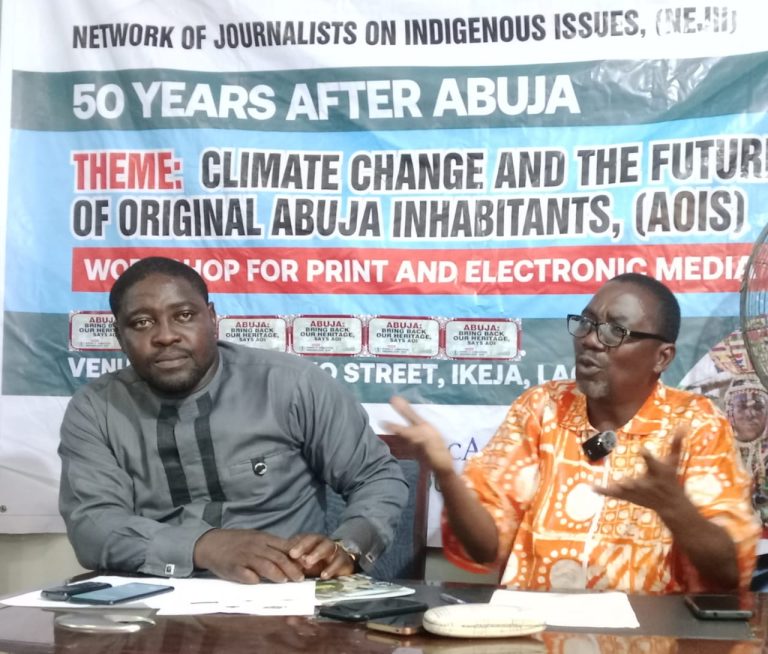
The call was made by media and indigenous rights advocate, Fabian Anawo, during a one-day media parley on the social, economic and environmental rights of Abuja Original Inhabitants (AOIs), held in Lagos on Wednesday.
Speaking on the theme, “Climate Change and the Future of Original Abuja Inhabitants,” Anawo presented a paper titled “Tips for Journalists on Reporting Indigenous Issues,” in which he outlined best practices for covering indigenous communities and their concerns.
He stressed that reporting on indigenous peoples requires cultural sensitivity, informed consent, accurate terminology and ethical storytelling. According to him, journalists should avoid harmful stereotypes and sensational narratives that portray indigenous communities solely as victims of hardship.
“Accuracy, fairness and respect for cultural protocols are essential in writing a good report on indigenous people. We must understand their culture and avoid actions that can make us enemies of the communities we are reporting on,” Anawo said.
He advised journalists to identify communities by their specific nation, tribe or ethnic group rather than using broad labels such as “indigenous” or “native,” adding that a deeper understanding of a community’s history, governance structure, culture and contemporary challenges is critical to balanced reporting.
Anawo also encouraged media professionals to build relationships with indigenous communities before reporting on them, noting that trust is developed through consistent engagement rather than during breaking-news situations alone.
“Prioritise indigenous voices and allow them to tell their own stories. Do not rely solely on government officials, outside experts or non-indigenous commentators,” he said.
The resource person further urged journalists to respect cultural restrictions involving sacred sites, ceremonies, traditional knowledge, shrines and the publication of sensitive images or recordings.
He also highlighted the need for caution when reporting issues involving displacement, violence, historical injustices and other traumatic experiences.
According to him, indigenous communities should be portrayed as multidimensional societies with stories of leadership, innovation, business, culture, education and activism, rather than being defined only by poverty, conflict or tragedy.
Anawo noted that many indigenous nations and communities have their own governance structures and should be treated with the same seriousness accorded to other governmental institutions.
The media parley, organised under the banner of the Network of Journalists on Indigenous Issues (NEJII), also focused on the historical experiences of Abuja’s original inhabitants following the establishment of the Federal Capital Territory.
Participants heard that many indigenous communities were displaced from their ancestral lands during the development of Abuja, with some allegedly receiving little or no compensation. The displacement, organisers said, has contributed to the erosion of cultural heritage and placed several indigenous languages at risk of extinction as communities became scattered.
The event aimed to deepen journalists’ understanding of the challenges facing Abuja’s original inhabitants and to encourage more informed and responsible coverage of indigenous issues.
Anawo concluded by emphasising the importance of continuous engagement with indigenous communities throughout the reporting process, noting that meaningful and lasting solutions are more likely when indigenous peoples are treated as partners whose perspectives help shape decisions that affect their lives.