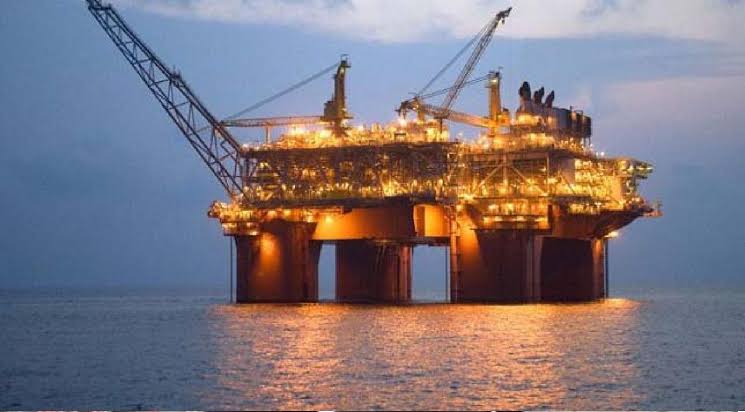
The Society of Petroleum Engineers International on Wednesday, said investment in the production of crude oil in the past five years, witnessed about a 50 percent drop.
Mr. Kamel Ben-Naceur, the President, said the drop was due to global clamor for a reduction in carbon dioxide emissions and the negative impact of the COVID-19 pandemic on the oil and gas industry.
It was reported that Ben-Naceur said this while presenting his keynote address at the ongoing Offshore Technology Conference (OTC) in Houston, Texas, USA.
Ben-Naceur cited the year 2015 as the beginning of a decline in investments in the upstream sector of the industry but added that the situation saw a turnaround before the global pandemic in 2020.
According to him, upstream investment saw a steep decline of 26 percent between 2015 and 2016.
“However, investment went back up through 2019 before experiencing a 30 percent drop in 2020.
“If we look at the relative decrease in investment in the upstream sector overall, in less than five years, we have reduced the upstream investment by 50 percent which is almost unheard of.
“You have to go back to the mid-80s to see that kind of a trend.
” This came as Nigeria’s operators call for more investment in the sector to drive the needed development in the sector and impact the country’s economy,” he said.
The president noted that the COVID-19 pandemic had a unique impact on the energy industry and would pave the path of the energy transition on its way to net-zero emissions.
“The COVID-19 pandemic brought the biggest one-year drop in oil demand at 10.4 percent, while natural gas demand dropped by about two percent.
“Also, coal and nuclear demand dropped by about four percent. Demand for hydroelectric and renewable energy increased, though by smaller margins,” Ben-Naceur noted.
He expressed optimism that demand would continue to increase in 2023 as demand for crude oil had come back to the pre-pandemic level, noting that natural gas had done better.
Ben-Naceur said: “The ‘most spectacular’ increase is in the price of natural gas from April 2020 to the end of 2021, natural gas went from about three dollars or four dollars per MMbtu to about 40 dollars per MMbtu, a ten-fold increase.
” We have never seen that kind of increase in gas prices within one year.”
He stressed that there were indications that the situation had changed, saying, “there has been a significant increase in upstream investment in 2022.”
On energy transition reality, Ben-Nacuer said that the energy transition was looking more like a reality, as electric car sales jumped from one million to two million before 2018 to almost seven million, or nine percent of new cars sold in 2021.
“Renewable power capacity continues to be added, and the industry is always learning about incentives of decarbonization.
“There are a few different energy transition scenarios predicted by the International Energy Agency, and each one will bring different costs and results.
“For the first time, today’s pledges – if implemented on time and in full – will keep the rise in global average temperatures in 2100 to below two degrees celsius.
“Decarbonisation will require many combined factors to be successful, including avoided demand, CO2 capture and storage, hydrogen, bioenergy, technology performance, electrification, other renewables, and other fuel shifts.
“But no matter the combination of policies, reaching the net-zero emissions goal still requires more oil and gas investment.
“We still need to invest more than what we invest today. Investment in the oil and gas industry will be crucial.
“We are not investing enough in clean energy and that’s the big problem that the world faces.
“Some of that investment will be in carbon capture and storage, which is predicted to expand significantly by 2030.
“The world continues its need to access energy securely, in an affordable way, and in a clean way. Reduction of greenhouse gas emissions and flaring is critical.
“Accelerating the energy transition will still require a large share of oil and gas,” he added.
Meanwhile, stakeholders in the oil and gas industry in Nigeria had been striving to take advantage of the Federal Government’s declaration of the year 2021 to 2030 as a decade of gas.
Some Nigerian operators participating in the OTC, such as Lee Engineering and Construction Company Ltd., OILSERV Ltd, and Seplat Energy Plc, emphasized the need for local companies to invest in the natural gas sector of the industry.
They also called for more investment, insisting that enormous opportunities were available for investors in the sector.
The chairman, Lee Engineering and Construction Company Ltd., Dr. Leemon Ikpea, emphasized the importance of improving the country’s infrastructure development.
He stated that his company remained committed to the creation of the much-needed infrastructure, hence the firm had committed over 100 million dollars into the construction of a fabrication yard in Warri, Delta, its operational base.
“The project, which is due for commissioning this year, will guarantee the fabrication of any equipment required in the oil and gas industry locally and on the African spectrum.
” The firm will focus on the manufacturing and fabrication of any equipment required in the oil and gas industry.”
On Nigerian manpower capacity, he noted that “When I was a manager I did not just sit down in my office. I took time to understand how the company operated.
“I noticed that many Nigerians were performing various tasks as electricians, welders, and so on. The foreigners were mostly there as supervisors. There are many skilled Nigerian workers around.
“The idea of transiting from seeking contracts to the manufacturing of necessary equipment and spare parts for the oil and gas industry comes with a lot of benefits for the sector. First, it engenders technology transfer, saves foreign exchange, builds capacity alongside many other multiplier effects,” he explained
Ikea identified commitment and timely delivery of quality jobs as some qualities that distinguished companies that desired to stand out in the sector’s development.
On his part, the chairman, of Oilserv Ltd., Mr. Emeka Okwuosa, said his company’s participation in the construction of the Ajaokuta-Kaduna-Kano (AKK) gas pipeline project was an indication of Nigeria’s commitment to the energy transition.
According to him, harvesting natural gas which is abundant in the country is key to Nigeria’s energy and economic development.
“The AKK project will stimulate gas infrastructural development and industrialization in Nigeria.
Okwuosa said: “The AKK gas project, when completed will boost the agricultural and manufacturing sectors, carbon footprint as part of measures to cut down on global warming and provide gas for generation of power and gas-based industries.”
He said that the project is aimed at transporting natural gas (raw form), which would enable the production of Compressed Natural Gas (CNG), Liquefied Natural Gas (LNG) among others.
“The project is important to Nigeria because gas is what will help Nigeria to develop. Development cannot happen without energy and our greatest form of energy in terms of availability is gas.”
For Seplat Energy Plc, there are vast opportunities in the gas business that when harvested, would transform Nigeria and Africa, making it a potential hub in the future.
On expectations for sector’s growth, the company’s CEO, Mr. Roger Brown, reiterated gas development, and technology as key to ensuring a robust transition he said: “As the sector grows and evolves and fights between transitioning, we must be super-efficient in what we do particularly in the upstream, and technology is very critical in delivering that.
“We believe that IT and cyber-help are more efficient technologies needed in the infrastructure development. We are bringing more technologies to our project like the use of solar, and gas. We believe in the gas business as we will develop LPG.
“We will finish the Assa North-Ohaji South (ANOH) gas plant by next year and it’s a game-changer for us. Also, we are upgrading the Sapele gas plant at the moment and putting on LPG, and broadening that second pillar of our business which is gas processing going into electricity.
“We are looking at what renewable technologies will be adopted into our business that will be the best for Nigeria going forward. Our view from our business model is that solar will be the win game changer.
“For us at Seplat, investment never stops as we will make more investment in the coming months to a year as we broaden the transitioning scope.”