
BY TAIWO OGUNMOLA-OMILANI
The International Labour Organisation (ILO) and the Nigeria Employers’ Consultative Association (NECA) have called for strengthened labour migration governance, fair recruitment practices and improved protection of the rights of migrant workers.
The call was made by Grace Orshio, National Project Coordinator of the ILO Action Project, who spoke on behalf of the organisation during a programme organised by the ILO and NECA, tagged, “From Policy to Practice: Strengthening Employers’ Capacity to Effectively Engage on Labour Migration Governance.”
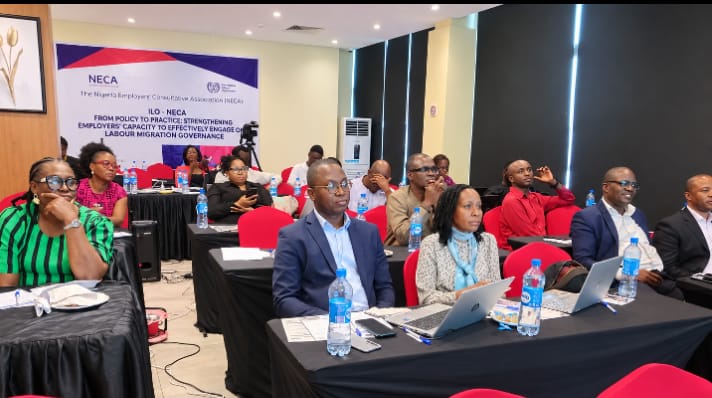
Participants from Ghana, Kenya, Nigeria and others at a 2-day programme in Lagos
Speaking on the need to translate fair recruitment principles into practice, Orshio said the programme provided an opportunity for employers and recruiters from Nigeria and Ghana to explore practical ways of implementing fair recruitment principles.
She explained that fair recruitment involves recruitment in accordance with national laws and international labour standards, without discrimination, while respecting dignity and human rights.
ILO said the recruiters participating in the programme already had some level of awareness of fair recruitment issues, particularly those belonging to organisations that regulate recruitment practices.
However, she raised concerns about how to address the activities of unregulated and unlicensed recruiters who engage in unfair recruitment practices.
According to her, regulated recruiters are already aligning with the fair recruitment initiative, the ILO’s General Principles and Operational Guidelines on Fair Recruitment, as well as guidelines on recruitment fees and related costs.
She, however, noted that unlicensed recruiters continue to expose workers to various human rights abuses, unfair recruitment practices, forced labour and human trafficking.
Orshio said there was a need to engage the public through advocacy, information and education to ensure that prospective workers understand what to expect during recruitment.
She explained that providing accurate information would help protect people from exploitation and enable them to identify recruiters approaching them with different motives.
She added that public awareness could also encourage people to report recruiters involved in abusive practices, including through anonymous reports from individuals who had dealings with them.
The ILO coordinator commended the efforts of private employment agencies under NECA, noting that they continued to reach out to recruiters willing to become licensed and regulated but lacking the necessary information.
She said the Federal Ministry of Labour and Employment was also engaging recruiters who were willing to align with fair recruitment principles but did not know how or where to begin.
Orshio expressed concern over the desperation of job seekers who were willing to give up their last resources in their quest to secure employment, describing the situation as disheartening.
She also stressed the importance of bilateral labour migration agreements between Nigeria and destination countries to prevent the smuggling of Nigerians and protect migrant workers.
According to her, the absence of labour agreements with some destination countries was one of the reasons Nigerians could be smuggled out of the country.
She said labour migration agreements should not be limited to African countries but should cover every country with which Nigeria exchanges labour or whose labour demands Nigerians are recruited to meet.
Orshio explained that such agreements should establish proper frameworks to protect the rights of people crossing borders to provide labour.
She noted that bilateral labour migration agreements were mainly negotiated and entered into by governments, but social partners, including workers and employers, could contribute to advocacy for stronger agreements.
She said the agreements would ensure that Nigerians migrating for employment were not subjected to unfair labour practices and that the country also benefited from labour migration.
According to her, bilateral labour migration agreements benefit workers, destination countries and sending countries by providing clearly defined rules governing labour migration.
Also speaking, resource person Margaret Mugwanja, who delivered a presentation on regional good practice exchange and recruiter-led fair recruitment practices, highlighted the challenges facing recruitment agencies in implementing fair recruitment.
Mugwanja said the challenges explained where practical support was needed, identifying recruitment costs, market demand, worker trust and protection abroad as major concerns.
On recruitment costs, she said employer funding must cover recruitment fees and related costs, including charges arising through third-party services.
She explained that recruitment agencies could lose bids when clients prioritised speed and low prices over safeguards and service quality.
On worker trust, Mugwanja noted that fee-free recruitment offers could appear unfamiliar to workers, while language, literacy, gender and digital-access barriers could affect their ability to make informed decisions.
She also identified protection abroad as a challenge, explaining that different legal systems, uneven enforcement and limited contact with workers could make monitoring and access to remedies difficult.
Mugwanja further discussed tools that could help recruitment agencies determine their next steps, including client due diligence and regulatory dialogue.
The programme also highlighted the relevance of labour migration and fair recruitment to the 2030 Agenda for Sustainable Development.
Under Target 8.8, the agenda seeks to defend workers’ rights, promote workplace safety and ensure the protection of all workers, including migrants, especially women and those in precarious employment.
Target 8.7 calls for immediate and effective measures to eradicate forced labour, end modern slavery and human trafficking.
Target 10.7 seeks to facilitate orderly, safe and responsible migration, including through the implementation of well-managed migration policies.
The Global Compact for Safe, Orderly and Regular Migration, under Objective 6, also promotes fair and ethical recruitment practices and decent working conditions.
The private sector was identified as being behind a range of initiatives aimed at promoting fair recruitment.
The programme noted that the increase in the number of formal and informal recruitment actors had raised new challenges in the recruitment landscape.
It explained that labour recruiters operated along a continuum of compliance and non-compliance with International Labour Standards (ILS).
Recruitment practices in accordance with ILS were identified as those promoting decent work and fair recruitment.
However, practices such as deception, mobility restriction, underpayment and recruitment fees were highlighted as challenges within the recruitment process.
The programme also identified forced labour and human trafficking as violations of human and labour rights, while abusive and fraudulent practices were highlighted as major concerns.
The ILO estimates that there are 272 million international migrants and 169 million migrant workers in the world, with women accounting for nearly half of all international migrants (ILO, 2021).
It noted that employers require skills and provide employment, while recruitment agencies play a key role in matching workers with employers and facilitating the proper functioning of labour markets.
Employers, recruitment agencies and workers were described as interconnected throughout the recruitment and employment cycle, with distinct roles, rights and responsibilities.
The programme further stated that where recruitment processes lacked transparency and accountability, workers could face excessive recruitment fees, deception, discrimination, exploitation, forced labour and other abuses.
It stressed that fair recruitment required due diligence and responsible practices by employers and recruiters, respect for workers’ rights, transparency in employment conditions, and the protection of effective grievance and remedy mechanisms.