
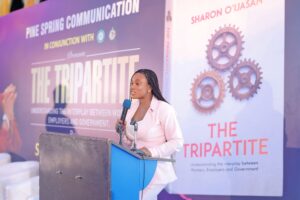
In a world of rapid transformation, the relationship between workers, employers, and governments has become more critical than ever. At the center of this evolving conversation is Sharon Ijasan, whose new book, The Tripartite, was launched recently.
The book explores the labour dynamics that will define the future, with Ijasan, a broadcast journalist stressing the importance of understanding these changes as the workplace undergoes significant shifts.
“The essence of writing The Tripartite stems from the need to grasp the current and future landscape of employment,” Ijasan explained at the event. With new job roles emerging and reshaping professional environments, she emphasized that young people must familiarize themselves with the past, present, and future of labor relations to secure a stable future.
“Only then can we ensure our safety and social nets when we retire,” she added.
She pinpointed the COVID-19 pandemic as a catalyst that sped up the adoption of hybrid work models. She noted that the rise of platform economy jobs, which are common in Nigeria and across Africa, has highlighted the need for these roles to meet decent work standards.
“Understanding the forces shaping labor relations is essential in today’s fast-changing work environment,” she remarked.
Mr. Oluwaseun Falaye, Managing Director and Chief Executive of the Nigeria Social Insurance Trust Fund (NSITF), delivered the keynote address, further reinforcing Ijasan’s message.
His speech, titled “The Future of Work: Are the Tripartite Bodies in Africa Ready for the Digital Economy and Its Realities?” focused on the growing influence of technology in modern employment.
“The digital economy allows work to transcend national borders. The tripartite—governments, employers, and workers—must align to face this new reality,” Falaye said.
While acknowledging some African nations’ progress in digitalization, Falaye pointed out significant challenges, particularly inadequate internet infrastructure that limits access for over 64% of Africa’s population. He stressed that for Nigeria to succeed in the new digital economy, the government must invest in robust digital infrastructures and prioritize skills development.
Falaye highlighted the steps NSITF is already taking to prepare for these shifts, including the digitalization of its processes. “We are focused on optimizing governance, ensuring transparency, and enhancing service delivery,” he said, noting that these initiatives are crucial to adapting to the future of work.
The event also shed light on the varying readiness of different types of employers in Africa to embrace digital advancements. From state enterprises and multinationals to small businesses and the informal sector, the ability to prioritize digitization differs widely, with many sectors still grappling with resource constraints.
As the discussion continued, it became clear that while progress toward digitalization is being made, the path ahead is not without its difficulties. “Digitalization is essential, but it comes with its own set of challenges, including potential job contractions,” Falaye cautioned. However, both he and Ijasan expressed optimism that with resilience and collaboration, Africa’s workforce can successfully navigate these changes.
In closing, Ijasan remarked, “Rome wasn’t built in a day.” She urged all tripartite stakeholders to stay committed to adapting to the evolving workplace. The Tripartite, she believes, offers a roadmap for navigating these shifts, serving as a blueprint for resilience and collaboration in Africa’s fast-changing labour landscape.