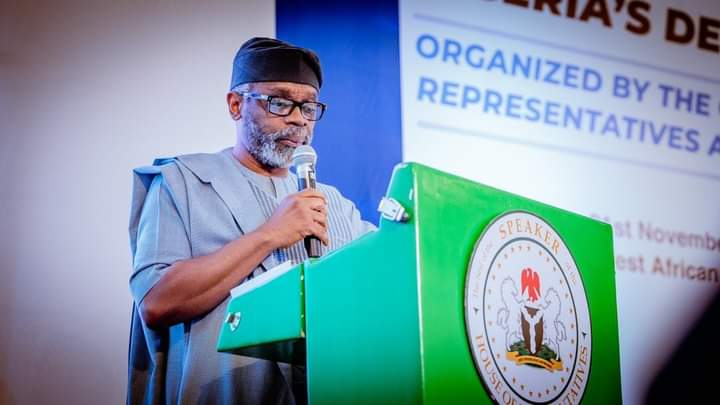
The Speaker of the House of Representatives Rep. Femi Gbajabiamila has said that Nigeria needs to urgently harness and maximize the advantages of its changing population structure.
He said governments at all levels must identify and be deliberate in taking actions that must be sustained in order to maximize the advantages of the changing population structure.
Gbajabiamila spoke in Abuja on Monday at an event titled, “Parliamentary Summit on Fast-Tracking Nigeria’s Demographic Transition”, organized by his office in collaboration with the National Population Commission (NPC) with support from the World Bank.
Stakeholders at the summit included members of the House of Representatives; the Minister of Women Affairs, Dame Pauline Tallen; Minister of State for Budget and Planning, Clement Agba, who was represented; the Emir of Shonga, His Royal Highness Dr. Haliru Yahaya; Director General, Budget Office of the Federation, Ben Akabueze; World Bank Country Director, Shubham Chaudhuri; Executive Director, Legislative Initiative for Sustainable Development (LISDEL); Development Director, Foreign, Commonwealth and Development Office (FCDO); Country Representative, United Nations Population Fund (UNFPA), Ulla Mueller, who was represented; as well as the Deputy for Training, Research & Development NPFPB BKKBN, Indonesia, Prof. Rizal Damanik, who shared the Indonesian experience on demographic transition virtually.
Cautioning that the Nigerian population situation and level of poverty associated with it should not be isolated from the global community, Gbajabiamila said, “I think it’s pretty evident that in Nigeria today we have population explosion and we are facing its attendant consequences. For the topic for today, there are two words in it that should grab everybody’s attention, and that is ‘Fast Tracking. It suggests and underscores the urgency of now.
“So we are not here to debate whether there’s a population explosion or there is demographic transition, what we are here to discuss is how to deal with those things that are evident, the urgency of now and how to fast track the nexus between this and the multidimensional poverty index, which states a very sad story of where we are.
“But for me, the multidimensional poverty index should not be taken in the context of Nigeria alone, Nigeria should not be a stand-alone in assessing that multidimensional poverty index, because there has been a universal increase in the level of poverty and the reasons are not far-fetched. We’ve had a sort of global conflagration all coming together to make it a global phenomenon”.
Notwithstanding, he noted that Nigeria could not afford to be complacent about the issue of demographic transition as that could be fatal in future if action was not taken now.
The Speaker stated, “It has been sixteen years since Nigeria’s last population and housing census. Our data about our population today is mainly based on projections and estimates rather than actual census data. What we do know for sure is that Nigeria has a significant and growing youth bulge in our population. And we also know that whether this fact turns out to be a good thing or a tragedy for our nation depends on the policy choices we make today and the actions we take now.
“Specifically, we are here to discuss the demographic dividend, that is, the growth in an economy that accrues as a result of a change in the age structure of a country’s population. To achieve this growth, we must consider deliberate, immediate and sustained action to drive a demographic transition that makes economic growth more attainable.
”This summit is an opportunity for policymakers and stakeholders to become acquainted with the twin ideas of demographic dividend and demographic transition. It is expected that participants in this summit will emerge from this summit with greater clarity about the facts of our nation’s population size, the challenges of unmanaged growth and the opportunities that can arise from implementing a sensible national population management policy.
“This summit will additionally benefit legislators by providing information about the legislative role in advancing policies that allow for a more pragmatic, more beneficial approach to population management. This is particularly important as this area of public policy is often considered an exclusively executive preserve. Above all else, this is an arena for robust conversations and rigorous interrogation of ideas. I hope we all recognize this and maximize the opportunity.”
The Speaker also called on the stakeholders and policymakers to be mindful of people’s diverse socio-cultural leanings while deliberating on actionable steps to be taken to address the issue, adding, “Conversations about population management can quickly become controversial when cultural and religious beliefs appear to conflict with the policy choices being proposed and considered.
“History is replete with instances of bad actors offering and, in some cases, implementing population management methods that appall the mind and offend the conscience of all. It is of the utmost importance that our conversations here consider these concerns and make commensurate plans to ensure they remain unfounded”.
The stakeholders, including CSOs and development partners in their goodwill messages, were all in agreement on the urgent need to fast-track all steps being taken and to be taken to ensure that the movement of the Nigerian population from an ageing population to a vibrant youthful population should not be handled with levity.
It was advised that Nigeria could emulate Indonesia’s model of addressing the issue since the Nigerian population as currently structured was bound to be on the increase.
According to the stakeholders, since the emerging youth population is an asset that can drive the dividends of demographic transition, the government must pay special attention to empowering the girl-child by making her stay in school and acquire the necessary skills beneficial to her immediate community.
They also called for a national framework on population demographics, appropriate legislation and adequate funding of the NPC to fully carry out its mandate periodically.
Dr. Eyitayo Oyetunji of the NPC, in his presentation, ‘Milestones in DD agenda in Nigeria’, noted that Nigeria started addressing the issue of population growth and movement early being one of the first countries to launch a road map as early as 2017.