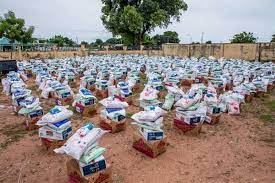
The total spending by the Federal Government on palliatives and loans to cushion the effect of the fuel subsidy removal may hit N3.27tn, findings have shown.
The palliatives and loans were meant to cushion the effects of economic hardships on Nigerians and businesses following the removal of fuel subsidies and skyrocketing consumer prices due to high inflation.
These palliatives included N100bn to acquire 3,000 units of 20-seater CNG-fuelled buses, N200bn to boost agriculture production, N75bn for manufacturers, N125bn for micro, small and medium-sized enterprises and the informal sector, N185bn as palliatives for states, N1tn on student loans and other programmes.
Others included N315bn to pay federal workers’ N35,000 allowance for six months, N1.13tn to 15 million households at N25,000 per month for three months from October to December 2023, N70bn earmarked as palliative measures for lawmakers, and N75bn loan facility to 1.5m market women.
President Bola Tinubu’s announcement that “subsidy is gone” on May 29, 2023, shook the economy as the price of fuel had more than doubled since then. This led to a surge in the price of commodities and a spike in inflation.
Following this removal, the World Bank announced that 7.1 million Nigerians were at risk of poverty if the Federal Government failed to compensate or provide palliatives for them.
This would have increased the number of poor Nigerians to 100.9 million, according to the bank. The bank said, “In the immediate term, the removal of the petrol subsidy has caused an increase in prices, adversely affecting poor and economically insecure Nigerian households. Petrol prices appear to have almost tripled following the subsidy removal.
A statement by the Minister of Information and National Orientation, Mohammed Idris, said, “The Federal Government has announced N35,000 only as a provisional wage award for all treasury-paid Federal Government workers for six months following further consultation with President Bola Tinubu.”
Recently, the Director-General of the Budget Office of the Federation, Ben Akabueze, revealed that the Federal Government’s personnel cost was over N5tn, with 1.5 million workers on its payroll. This implied that the government’s N35,000 commitment to workers would cost N315bn for the six months.
According to the agreement between organised labour and the government, the wage award would last until a new national minimum wage was announced. The agreement read in part, “The Federal Government grants a wage award of N35,000 only to all Federal Government workers beginning from September pending when a new national minimum wage is expected to have been signed into law.”
While announcing the N35,000 allowance, the Federal Government also revealed that it would commence the payment of N75,000 to 15 million households at N25,000 per month for three months from October to December 2023 (totalling N1.13tn for the period).
Recently, the Senate approved Tinubu’s request to borrow a $800m loan from the World Bank. According to him, the $800m loan would be used to cater to the welfare of the vulnerable and poor households in the country under the National Safety Net Programme.
In an earlier announcement, the Presidency announced a plan to transfer N8,000 monthly to the bank accounts of 12 million poor and low-income households for six months. This plan was met with criticism and Tinubu announced a review of the plan.
Other palliative measures included a controversial N70bn earmarked to lawmakers to support “the working conditions of National Assembly members.”
This has since been met with criticism by a Senior Advocate of Nigeria, Femi Falana, who said, “Out of sheer insensitivity coupled with impunity, the members of the National Assembly, regardless of political affiliation, conspired to breach the relevant provisions of the Constitution of the Federal Republic of Nigeria, 1999 by padding the Supplementary Appropriation Bill, 2023 to provide the so-called palliative of N70bn for 306 newly-elected members.”
The Federal Government also recently announced extending the N75bn loan facility to 1.5 million market women. According to the Minister of Humanitarian Affairs and Poverty Alleviation, Dr Betta Edu, the Federal Government would advance a non-interest loan of N50,000 each to 1.5 million market women under the Government Enterprise and Empowerment Programme to improve their capital and expand their businesses.
She stated that the N75bn market women fund, Iyaloja Fund, would be launched by October 17. This brings the total palliative and loan pledge by the Federal Government to N3.27tn.
As of the end of June, oil marketers disclosed that the Federal Government had saved about N400bn following the subsidy removal on Premium Motor Spirit. In his July speech, Tinubu stated that the country had saved N1tn in the two months since the removal of the petrol subsidy.
However, oil marketers had since told The PUNCH that the Federal Government might spend about N1.68tn as a subsidy on petrol from September to December this year following a price non-adjustment of the product since August.
According to the PMS dealers, the pump price of petrol should be between N890 to N900/litre based on the fall of the naira against the United States dollar and the surge in the price of crude in the international market.
According to the Manufacturers Association of Nigeria and the Lagos Chamber of Commerce and Industry, more was needed to be done by the Federal Government to cushion the impact of the removal of fuel subsidies.