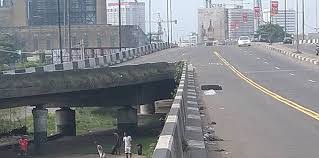
Lagos government has announced a 10-week partial closure of the Eko bridge from Costain to Alaka in-bound National Stadium for emergency repairs by the Federal Government from June 4 to August 13.
The Commissioner for Transportation, Frederic Oladeinde, said, in a statement that the repair was necessary to complete the rehabilitation works at the opposite side of the bridge earlier embarked upon by the Federal Government.
He noted that pending the commencement of the rehabilitation works; alternative routes had been made available to manage traffic during the period of repairs.
Oladeinde said, “Traffic from Apongbon to Alaka, Stadium, Inner Surulere or Ikorodu Road will be diverted to Eko bridge to access Costain Roundabout to Iponri through Alaka and Funso Williams Avenue.
“Similarly, motorists from Eko bridge will have to navigate their desired destinations through Costain Roundabout to Abebe Village (by Nigerian Breweries Plc) through Eric Moore to Bode Thomas to Adeniran Ogunsanya, to access Shitta Roundabout by Stadium under the bridge to Funso Williams Avenue to Dorman-Long Bridge and Fadeyi-Ikorodu Road.”
The statement added that motorists could gain access to “Apongbon through CMS Outer Marina Road to connect Ebute Metta-Ikorodu Road to access their destinations.
“Motorists from Apongbon can pass through CMS to Outer Marina to Adeniji Adele, Third Mainland Bridge, Adekunle to Herbert Macaulay Way, Jibowu and Ikorodu road will also be available.”
- W’Bank to boost water supply in Nigeria with $700m
The World Bank has approved the Nigeria Sustainable Urban and Rural Water Supply, Sanitation, and Hygiene Programme, which will provide $700m credit from the International Development Association to ensure that six million people can access basic drinking water services and 1.4 million people can access improved sanitation services.
It disclosed this on its website on Thursday.
The SURWASH programme, which would be effected as part of the Nigerian Government’s National Action Plan, was designed to ensure improved water sanitation and hygiene services to 2,000 schools and Health Care Facilities and help 500 communities to achieve open defecation free status.
The World Bank Country Director for Nigeria, Shubham Chaudhuri, emphasised the essence of the programme, stating that it would be helpful in enhancing access to sae water, sanitation and hygiene.
Chaudhuri stated that, “Given that access to WASH is an important determinant of human capital outcomes, including early childhood survival, nutrition, health, learning, and women’s empowerment – all of which in turn affect labour productivity and efficiency; the Programme’s centrality to the human capital agenda and its potential to influence key human capital outcomes cannot be overemphasized”
“Participating states will be able to improve access to safe water, sanitation and hygiene which will help to keep more girls in school, create employment, and reduce open defecation, while developing greater resilience to the impact of climate change, as well as conflicts between different land and water users,” Chaudhuri stated.
The SURWASH Programme, which was opened to all states in Nigeria, would support a suite of investments to increase access to and the usage of WASH services in urban, small towns and rural areas, especially in schools, healthcare facilities, markets, motor parks, among others.