By Rt. Hon. Hakeem A. Jamiu, PhD
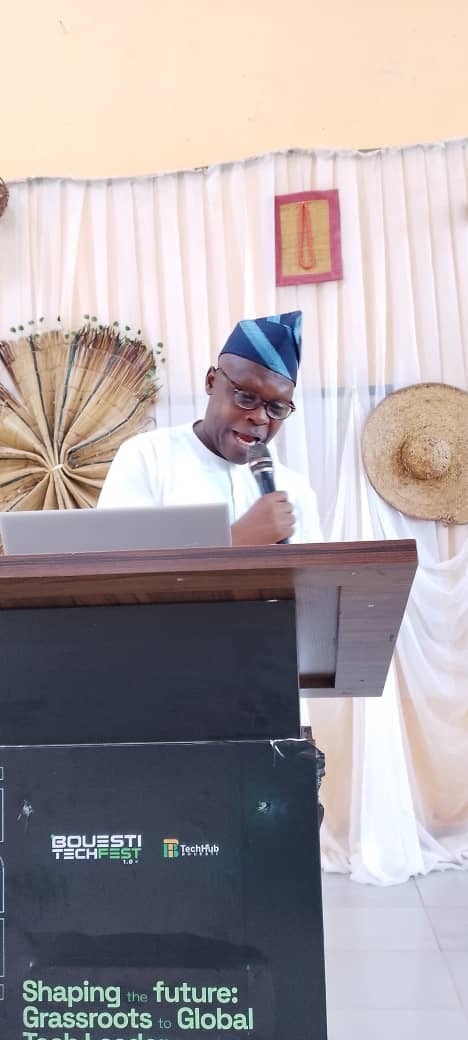
On Wednesday October 7, 2026, I delivered a lecture at the Bamidele Olumilua University of Education, Science and Technology, Ikere-Ekiti (BOUESTI), at the invitation of the Federation of Ekiti State Students Union. I am compelled to compress the 16-page lecture into an article for wider circulation.
I did not go to BOUESTI to give another motivational speech about youths being leaders of tomorrow. We have heard enough of that. I went to share a blueprint. For generations, Ekiti built its identity on a sacred contract: parents sacrificed for education, children acquired degrees, secured stable employment, and lived decent middle-class lives. That contract gave us our name as the Education State. But the economy around education has changed. Your certificate remains valuable. Your intellectual training remains indispensable. The certificate alone is no longer enough.
The modern labour market is asking harder questions: What can you do? What problem can you solve? Can you analyse data, design, write, build a website, market a product, use artificial intelligence responsibly, work with people you have never met physically? The World Economic Forum’s Future of Jobs Report 2025 estimates 170 million new jobs will be created globally by 2030 while 92 million will be displaced, and 39% of workers’ current skills will become outdated by 2030. Skill gaps are now the biggest barrier to business. This should be a source of worry for us. Twenty years ago the pathway was simple: degree, government or corporate job, pension. Today another pathway is visible: skill, internet, global market, multiple income streams, continuous learning. A designer in Ado can serve a client in Abuja, a graduate in Ikere can work remotely for a company in Toronto. Location no longer decides the size of your market.
The modern economy rests on three pillars. First, digitisation and digitalisation. Digitisation is converting analogue to digital – scanning a paper to PDF. Digitalisation is changing how work is done with digital tools. Banking, commerce, journalism, education, even customer relations are now digital. The World Bank’s Nigeria Digital Economy Diagnostic notes Nigeria is capturing only a fraction of its digital potential. The ITU’s 2023 assessment of Nigeria’s digital skills shows the gap between skills supply and demand . Second, demonstrable skills. Pitan and Adedeji’s work on skills mismatch among Nigerian graduates found that certificates do not automatically translate to labour-market competence. Employers want evidence. Third, entrepreneurship as value creation. Not simply starting a company, but seeing the world differently. Instead of asking “Who will employ me?”, you must start asking “What problem can I solve?”
Why Ekiti? Why now? Because as Ekiti-born development expert Sina Byron, who is reviewing the Ekiti 30-Year Development Plan, told me: “There is no talent you are looking for that you cannot find in Ekiti.” Our youths are intelligent. But we must convert reputation into productivity. Ekiti’s opportunities go beyond white-collar jobs. Modern agriculture is not just planting and harvesting; it is agritech, logistics, storage, processing, branding, digital marketplaces. Tourism is not just Ikogosi Warm Springs and Arinta Waterfalls existing; it is storytelling, hospitality, photography, videography, online booking. The Ekiti Knowledge Zone – that 208-hectare special economic zone and technology park between Ado and Ijan beside the cargo airport, started by former Governor Kayode Fayemi and expanded by Governor Biodun Oyebanji – is meant to be a cluster where educators, researchers, innovators and industries collaborate to catalyse 26,000 jobs. That vision can only work if we have competent young people to populate it. There are five capabilities our youths must build to be able to compete effectively in the modern labour market. First is Digital Literacy. This is not six hours of scrolling. Learn to use technology productively such as; Google Workspace, Canva, professional email, online research, collaboration, using AI as an assistant not a substitute for thinking. The World Economic Forum lists AI and big data, networks and cybersecurity, and technological literacy among the fastest-growing skills, alongside creative thinking and resilience. Second is a Monetisable Skill. Every graduate should answer; what can I do that someone will pay for? content creation, video editing, graphic design, UI/UX, web development, data analysis, copywriting, photography, fashion, solar installation, e-commerce. Pick one. Learn it. Practise it. Build a portfolio. A certificate from 3MTT, ALX, Coursera or YouTube does not make you competent, the ability to use and create value out of this does. Third is Money and Business Literacy. Skill without financial discipline produces a broke expert. If a client pays you N100,000, that is not N100,000 for consumption. What did data, transport, and labour cost? What is profit, what is reinvestment? Learn pricing, record-keeping and cash flow. Start small, explore SMEDAN, Bank of Industry, NDE, but do not wait for N10 million. The fourth is Personal Branding. Thousands of brilliant Ekiti youths are invisible. If nobody knows what you write or design, talent remains hidden. Your phone is your classroom, office, research centre and marketing platform. Create a LinkedIn profile, a portfolio, a simple website, use WhatsApp Business professionally. Document learning. If you are doing something and people don’t know, you are like a man blinking in the dark. Fifthly, you must have a Problem-Solving Mindset. Stop seeing problems only to complain. See them as markets. Transport issues in Ado? Could technology or logistics help? Farmers losing produce? Could storage or digital linkage help? Culture? Could a Yoruba digital channel documenting Ekiti food, music, and history become global content? In one sentence, learn technology; develop a skill you can sell; learn how to manage money; make your competence visible; and train yourself to solve problems.
However, this burden cannot be on youths alone. Government must invest in broadband and power, Universities must teach practical application and companies must offer internships. That is why I propose a policy agenda.
First, a Youth Digital and Future Skills Mission where success is measured not by attendance but by jobs and contracts. Recently in my constituency, Irepodun/Ifelodun II, with Media for Human Development Foundation and MacArthur Foundation, we trained 50 youths in bag making, graphic design, shoe making, barbing, modern farming. We gave start-up kits worth N30,000-N50,000 to 30. Many were disappointed it wasn’t cash. Some sold the clippers and shoe machines. Less than 10 were serious. We need monitoring, not just training. Second, a Youth Digital Work Export Programme to connect trained youths to Lagos, Abuja, London, Toronto without relocating. Third, an Ekiti Student Innovation Challenge to solve real problems in agriculture, tourism, waste, education. Fourth, turn farms and tourist sites into youth innovation labs. Fifth, finance combined with mentorship is needed, not just cash. Finally, an Ekiti Youth Skills Passport to document verified skills alongside certificates.
The larger goal is a new social contract: government creates ecosystem, institutions build competence, private sector provides markets, youth convert opportunities to enterprise. So what should you do in the next 30 days after listening to this lecture? Learn, build, connect. Choose one credible course – 3MTT, ALX, Google, Coursera – and finish it. Build something that shows what you learned – a design, a website, a tourism campaign, a market strategy for garri or palm oil. Then connect – join tech communities, find mentors. Do not leave inspired today and return to old habits tomorrow. Momentum dies in 72 hours. Register for one course. Build one portfolio. Talk to one mentor.
The main purpose of this lecture is to reorientate Ekiti youths such that we must move from certificates to skills, skills to competence, competence to value, value to enterprise, enterprise to employment. Do not despise your certificate. But do not worship it either. Your degree is a licence; your skill is the vehicle. Imagine an Ekiti in the next 10 years where a student in Oye builds a digital enterprise for Nigeria, where a farmer uses technology to reach markets, where our culture becomes creative enterprise. Imagine where the question changes from “Who will give me a job?” to “What problem can I solve?” We have the certificates. Now we need the skills. We have the consumers. Now we need the creators. We have the problems. Now we need the problem solvers. Ekiti must move from Education State to Innovation State where knowledge is commercialised, talent does not have to japa to be valuable, and youths become architects, not just beneficiaries, of the future.
Rt. Hon. Hakeem Jamiu, PhD,
former Deputy Speaker of Ekiti State House of Assembly,
delivered this as a lecture at BOUESTI, Ikere-Ekiti on October 7, 2026