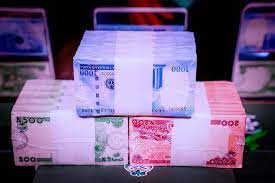
The Senate will on Friday grill two deputy governors of the Central Bank of Nigeria over the cash withdrawal limit policy unveiled by the apex bank on Tuesday.
The red chamber planned to seek clarifications on the new directive which restricts over-the-counter cash withdrawal by individuals and organisations to N100,000 and N500,000, respectively, per week.
It also limits cash withdrawals via point-of-sale machines and automated teller machines to N20,000 daily and N100,000 weekly, respectively.
According to a memo signed Tuesday by the CBN’s Director of Banking Supervision, Haruna Mustafa, withdrawals above the thresholds would attract processing fees of five per cent and 10 per cent, respectively, for individuals and corporate entities going forward.
In addition, third-party cheques above N50,000 shall not be eligible for OTC payment while extant limits of N10m on clearing cheques still remain.
The circular also directed banks to load only N200 and lower denominations into their ATMs and restricted withdrawal to N20, 000 per day from ATMs.
The policy which will become effective on January 9, 2023, had generated criticisms but the CBN clarified on Wednesday that PoS operators could apply for waivers.
Deliberating on the policy on the floor of the Senate on Wednesday, senators said there was a need to debate the policy on the floor of the red chamber.
However, the Senate President, Ahmad Lawan, directed the Senate Committee on Banking to grill the two re-appointed deputy governors of the CBN, Aisha Ahmad, and Edward Adamu, who will be screened on Friday, on the new cash withdrawal policy.
Senators raise motion
The resolution on the new CBN policy followed a move by Senator Philip Aduda (PDP FCT) to move a motion on the development.
Aduda had sought to rally other senators to deliberate on the policy but the Senate President, Lawan, interrupted him, saying it was too early to debate the circular.
Also, Senator Gabriel Suswam (PDP Benue North-East) supporting his colleague and pushed that the motion should be allowed to fly considering the innocent Nigerians that would be affected by the CBN policy.
Addressing Lawan, he said, “I think you should have allowed us to discuss this motion for the sake of Nigerians.”
However, there was an exemption that allows up to N5m for individuals and N10m for corporate organisations once a month but with certain requirements.
To enjoy the exemption, banks were required to obtain some information from the drawee and upload the same on the CBN portal created for the purpose.
The requirements include a valid means of identification such as the National Identity Card, international passport, driving licence; Bank Verification Number of the payee; notarised customer declaration of the purpose of the cash withdrawal; senior management approval for the withdrawal by the managing director of the drawee where applicable and approval in writing by the MD/CEO of the bank authorising the withdrawal.
According to the guidelines, monthly returns on cash withdrawal transactions above the specified limits will be rendered to the banking supervision department.
Also, compliance with extant anti-money laundering and countering the financing of terrorism regulations relating to Know Your Customer, ongoing customer due diligence and suspicious transaction reporting are required in all circumstances.
On the likely effect of the policy on the people in the rural areas, who regularly deal with cash, Nwanisobi said, “The policy only states that you cannot go beyond a particular limit. It doesn’t stop anybody from using cash. So, those in the rural area can still transact with the available cash.”
Group kicks
Meanwhile, the South-South Agenda for Tinubu/Shettima Support Groups has condemned the CBN policy in strong terms, describing it as a plot to pitch the poor masses against the President.
In a statement on Wednesday signed by the National Coordinator of the group, Mr. Bitrus Oliver, it argued that Nigeria is one of the top three unbanked countries in the world with more than 60m of its adult population still unbanked.
The group stated, “This policy will clearly undermine the efforts of the Federal Government in sustaining micro and small scale enterprises across the country as it will limit the fund in circulation due to the non-availability of cash and may totally asphyxiate small and struggling businesses before the policy is stabilized.
“When people find it difficult to withdraw enough money they need from the bank and are repeatedly unable to complete transactions due to lack of funds, there may be public outrage and a massive backlash on the president for allowing the policy.
“The new withdrawal policy will be able to put money politics in check within the (election) period, it also has the capacity to wreck many local economies across the country due to the paucity of cash it will create.”
Oliver argued that in almost all the rural markets across the country, 90 per cent of transactions are done by cash and not by mobile transfer, noting that pegging ATM withdrawal to N20,000 would stall many transactions and may even trigger chaos in the commercial sector.