

BY TAIWO OGUNMOLA-OMILANI
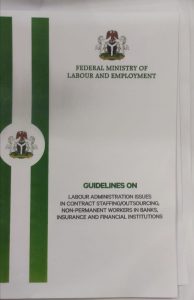
The Association of Senior Staff of Banks, Insurance and Financial Institutions (ASSBIFI) and National Union of Banks, Insurance and Financial Institution Employees (NUBIFIE) have unveiled guidelines on labour administration issues that would reduce incidences of frauds traceable to discontented casual workers in the sector.
Addressing newsmen in a press conference on Friday, ASBIFFI President, Comrade Oyinka Olasanoye who presented the guidelines reels out the benefits it would have on the outsourcing workers in the financial sector.
According to Oyekan, the guidelines which were signed by the Minister of Labour and Employment, Chris Ngige provides in clear terms good industrial relations principles and conditions of employment to be observed by the stakeholders in the financial institutions.
ASSBIFI boss who is optimistic about the guidelines said it would reduce exploitation, incidences of fraud traceable to discontented casual workers in the financial sector, and other unfair labour practices capable of escalating industrial conflicts and crises in the workplace.
The two financial unions maintained that the guidelines would regulate conditions of unemployment and standardize non-permanent employment, especially in the areas of career progression, salaries, and wages, disciplinary measures, health and safety, corporate performance, and productivity.
Comrade Oyinkan and her counterpart, Anthony Abakpa explained that the guidelines took them 10 years to achieve and all hands will be on deck to implement the guidelines.
“The request for a guideline to regulate conditions of employment of non-permanent employees in the financial sector started a decade back, and with the active participation of representatives of the Central Bank of Nigeria (CBN), NLC, TUC, NECA, federal ministry of labor and the financial institutions.
ASSBIFI and NUBIFIE who appreciate the minister of labor, Chris Ngige for accelerating the process said it would bring a fresh breath of life to many in the sector, improve industrial relations, reduce the incidence of fraud and increase productivity.
The guidelines were signed into law on 8th September 2022 by the Minister of Labour and Employment, Dr. Chris Ngige, pursuant to the powers conferred on him by section 88 (I) (e) and (g) of the labour act, cap L1, laws of the federation of Nigeria.