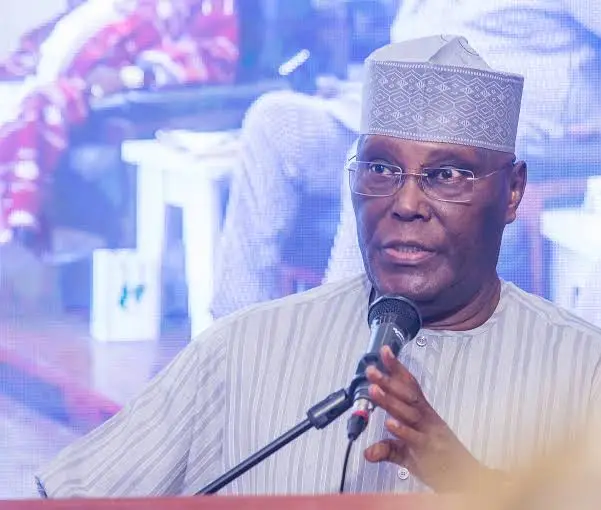
The All Progressives Congress Presidential Campaign Council (APC-PCC) has challenged former Vice President Atiku Abubakar to explain the legal, fiscal and practical implications of his proposed “production subsidy” for locally refined petrol.
The council, in a statement signed by its spokesman, Dele Alake, said Atiku should clarify whether refiners receiving the proposed subsidy would be required to sell petrol at a government-prescribed price.
It cited Section 205(1) of the Petroleum Industry Act (PIA) 2021, which provides that unrestricted free-market conditions should determine wholesale and retail prices of petroleum products.
The APC-PCC also referenced a statement by the Nigerian Midstream and Downstream Petroleum Regulatory Authority (NMDPRA), which said it neither fixes pump prices nor issues administrative price templates except where statutory conditions for intervention are met.
According to the council, Atiku should explain the legal framework that would enable the government to impose a price condition on refiners and how such an arrangement would operate under the PIA.
It also asked the former vice president to disclose the estimated cost of the proposal, its source of funding, the volume of crude or petrol to be covered and the mechanism that would guarantee lower pump prices.
The council said that based on publicly reported refinery throughput and domestic petrol supply figures, the proposed subsidy could cost between N17 trillion and N21 trillion annually, depending on the size of the discount and volume covered.
It further questioned whether preferentially priced crude for domestic refineries would reduce revenues accruing to the Federation and affect allocations to the federal, state and local governments.
The APC-PCC said Atiku’s latest position must also be reconciled with his previous support for downstream deregulation.
It recalled that Atiku, while speaking at the Lagos Business School in November 2022, described the petrol subsidy system as fraudulent and pledged to complete its removal. It also cited his August 25, 2026 statement on X in which he said, “I will restore it!”
The council asked Atiku to explain how his proposed subsidy would avoid the problems associated with the former subsidy regime, including alleged abuse, smuggling, scarcity and fiscal losses.
It noted that deregulation of the downstream petroleum sector began under the Olusegun Obasanjo administration, when Atiku served as vice president, adding that diesel was deregulated in June 2003 while aviation fuel subsequently moved to market pricing.
The council contrasted Atiku’s proposal with the Tinubu administration’s focus on compressed natural gas (CNG) and electric mass transit as alternatives for reducing transportation costs.
It said more than 120,000 vehicles had been converted to CNG, while commuters in seven states and the Federal Capital Territory were already paying between 31 and 83 per cent less on routes served by CNG and electric buses.
The APC-PCC also cited developments in domestic refining, including the Dangote Petroleum Refinery, which it said had reached its 650,000-barrel-per-day nameplate capacity and reportedly achieved 700,000 barrels per day during performance tests.
The council acknowledged the pressure of higher petrol prices on households but said the administration would continue implementing measures to support Nigerians.
It urged Atiku to publish a detailed policy document alongside an independent legal and fiscal analysis of his proposed production subsidy.
“Every proposed intervention in the downstream sector must be lawful, transparent, properly costed and capable of delivering measurable benefits to consumers,” the council said.
Alake advised Atiku to study the Petroleum Industry Act, arguing that his proposal had not sufficiently addressed the current legal and operational framework of the downstream petroleum sector.