BY TAIWO OGUNMOLA -OMILANI
The Publisher of Politico.ng, Mr Lai Omotola, has defended the platform’s preliminary electoral projection, insisting that the Federal Capital Territory (FCT) Minister, Nyesom Wike, cannot deliver the territory to the All Progressives Congress (APC).
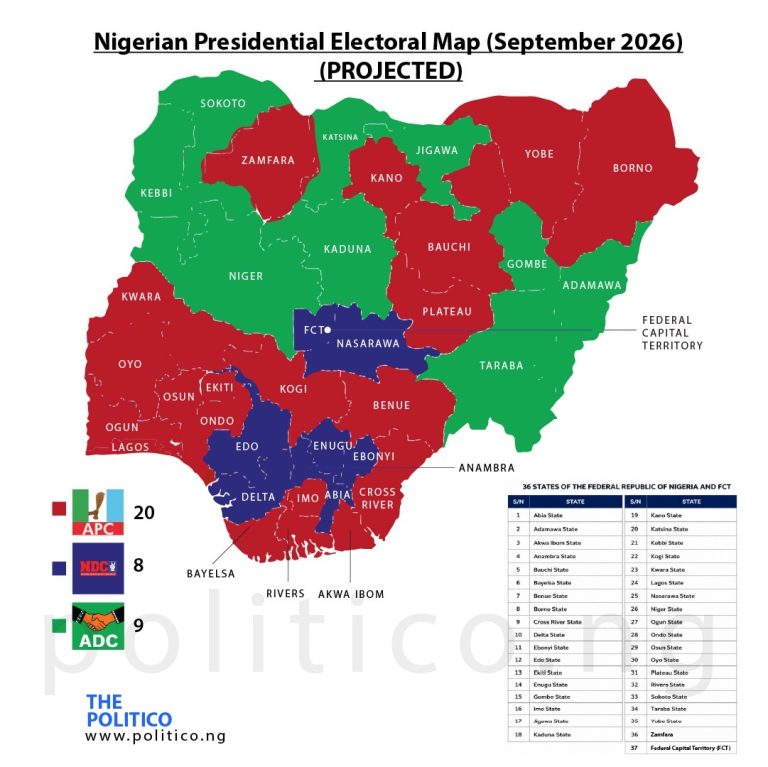
Omotola, who spoke during a press conference on Sunday in Maryland, Lagos while explaining the electoral map released by the Political Intelligence Group, said the projection was based on the political strength of key actors across the States and was intended to help political parties identify their weaknesses and prepare for the election.
He said the projection showed that the National Democratic Congress (NDC) would retain the FCT despite Wike’s claim that he would deliver it to the APC.
“We stand by our projections,” Omotola said, adding that the election would be consequential for all political parties.
“If Atiku should win this election, then what it means is that the North can decide to take the presidency whenever they want. And the arrangement of rotational presidency is now gone and dead,” he said.
Omotola said an Obi victory would produce a new political dynamic in which the followers, rather than the leader, would determine the direction of the government.
He cited comments by Aisha Yesufu, who had said she worked “with Obi” and not “for Obi”, as an indication of the relationship between Obi and his supporters.
He also referred to a reported agreement between Obi and Rabiu Kwankwaso, under which Obi would serve for four years and hand over to Kwankwaso, describing such an arrangement as a potential recipe for disaster.
He said the president’s advantage was that he could remain competitive across the 36 states and the FCT, while other candidates were likely to perform strongly only in their traditional regions.
Explaining the projection, Omotola said the Political Intelligence Group had predicted election outcomes for the past three elections, with an accuracy range of between 90 and 95 per cent, but had only made its projections public for the first time this year.
He said the preliminary projection was not based on opinion polls or one-on-one sampling, but on an assessment of the political heavyweights in each state and their alignments.
He said the electoral map was a preliminary forecast and not a final election result, urging political parties to conduct their own research and return to their grassroots to strengthen their support.
He added that the projection would be updated monthly until the election, with the final edition expected a week before the poll.
Omotola, who disclosed that he was a card-carrying member of the APC, insisted that the projection was non-partisan and not influenced by any political party.
He said the ultimate objective was to promote a free and fair election that would be accepted by all parties and would not end up in court.
“We are not doing this to molest anybody or to fight the people. We are doing this to ensure a free and fair election,” he said.
According to him, the projection was guided by three major political ideologies: rotational presidency, the northern agenda and the demand for competence, capacity and dividends of democracy.
Recall that the publisher of Politico.ng projected that President Bola Tinubu will win 20 States, Atiku 9, Obi 8.
The forecast places all six South-West states in Tinubu’s column, including Lagos, which has remained central to his political career. Kano State is also projected to favour the president, potentially giving him a significant foothold in the North.
The Renewal Group, however, acknowledged that the political landscape could change considerably before the election, noting that inflation, employment, insecurity, infrastructure and the cost of living could significantly influence voters’ decisions.
It added that the administration’s ability to communicate its achievements and convince Nigerians of the impact of its policies could become a major campaign issue.
On Atiku, the group projected that the former vice president would win nine states, with considerable support expected across parts of Northern Nigeria, including Kaduna and some states in the North-East and North-West.
The group said Atiku’s established political network and experience from previous presidential campaigns could strengthen his ability to mobilise support. It added that his position on the fuel subsidy policy could become a major campaign issue, particularly if Nigerians continue to face high transportation costs and rising living expenses.
However, the group noted that Atiku’s chances could depend on his ability to combine his northern support with substantial backing from other parts of the country.
Peter Obi, according to the forecast, is projected to win eight states, with the Federal Capital Territory and Edo State among the areas expected to favour the Labour Party candidate.
The group said Obi’s projection reflected the political support he built during the 2023 presidential election, when he performed strongly in several parts of the country.
It added that Obi’s campaign was expected to focus on political change, economic management, accountability, public spending and efficiency in government, but noted that his major challenge would be expanding his support beyond areas where he traditionally performed strongly.