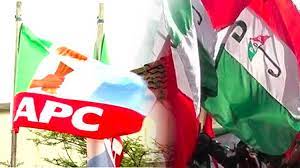
There is anxiety, almost disarray, in the All Progressives Congress (APC) following the release of the timeline for the 2023 elections by the Independent National Electoral Commission (INEC) at the weekend.
Unlike the opposition Peoples Democratic Party (PDP) which has all its organs in place, the APC is being run by a caretaker committee at the national level.
There is anxiety amongst most aspirants for 2023 General elections as a result of the Newly signed Electoral law and the timetable released by the Independent National Electoral Commission (INEC) at the weekend.
Arising from the new electoral law, the new timeline mandates political parties to conduct primaries into all elective positions between April 4 and June 3.
The implication of this is that presidential primaries must hold latest June 3, 2022.
Apprehension heightened in the ruling party as a result of Section 31 of its constitution, which makes it mandatory for any party official who wants to contest an elective office to resign 30 days to the primary.
The March 26 convention date is barely eight days to the commencement of the prescribed period for shadow polls.
Sources said the party may resort to ad-hoc measures ahead of the convention, owing to time constraints.
President Muhammadu Buhari and APC governors are expected to meet tomorrow on the new developments.
Due to constitutional provisions, APC National Caretaker Committee Secretary Senator James Akpanudoedehe may have to resign, if he is still interested in pursuing his governorship ambition in Akwa Ibom State.
But the Secretary declined to comment yesterday, saying he would bare his mind later on his next line of action.
The PDP has started consultations on its plan for the primary, following the INEC timeline release.
It was learnt at the weekend that no fewer than 13 ministers are in a dilemma on whether to resign before the primaries or adhere to the constitutional provision of quitting their offices on or before 30 days to the election.
Many of the ministers are believed to be planning to contest for president, governor and the Senate.
While some forces are pushing for the exit of the ambitious ministers, others want them to stick to the 1999 Constitution.
The election timetable may also affect plans by the third force being championed by Prof. Attahiru Jega and others for the transformation of their group into a political party for the purpose of participating in next year’s poll.
A source, who spoke in confidence, said APC was lagging behind in the preparation for the elections.
He said: “There is panic everywhere because we have to do many things at a time and at a fast pace to catch up with the opposition. We also have governorship elections in Ekiti and Osun states.
“With the election timetable, we must put party executives in place by adhering to the March 26 date for the convention, wrap up our reconciliation process, look for the best mode of primary, mostly indirect; manage post-primary elections’ fallouts; clean up the ambiguity in the Electoral Act 2022, especially Section 84(12); hold strategy meetings and set up campaign structures at all levels.
“As we are, we cannot even adopt consensus mode of primary because the conditions are cumbersome in the new Electoral Act 2022.
“We have much at hand and APC is in a tinder box. This is why some party leaders came up with the option of holding our National Convention and presidential primaries at the same time.
“But President Muhammadu Buhari and the governors are expected to meet on the best approach to save the situation.”
Another source said Akpanudoedehe may have to step aside because of his interest in the governorship primary in Akwa Ibom.
The source said: “All nominations into elective offices shall be supported by a specified number of nominators from the relevant constituencies as may be prescribed or provided for in the party electoral guidelines
“Any party officeholder interested in contesting for an elective office (whether party office or office in a general election) shall resign and leave office 30 days, prior to the date of nomination or party primary for the office he or she is seeking to contest.”
The source added: “This Section 31 has omnibus provisions. The Secretary of CECPC is one of the issues in the party because of his governorship ambition.
“Do you know that the Caretaker Committee has received a resolution of some stakeholders from Akwa Ibom State endorsing him as the party’s governorship candidate? But, while the CECPC was grappling with it, another group came up to reject his nomination.
“The Chairman of CECPC, Governor Mai Mala Buni, and his team stamped their feet by asking all groups to wait for governorship primaries to test their might.
“It is obvious that Akpanudoedehe would have to resign or else our governorship primaries in Akwa Ibom might be nullified.”
Akpanudoedehe, speaking with our correspondent on the INEC timeline and his ambition said: “I don’t speak for myself. I speak for the Caretaker Committee and I have not been directed to speak on that issue. The committee is yet to have a position on that. So, I am not going to make any comment.”
Some of the ministers with their speculated aspirations are Attorney-General and Minister of Justice, Mr. Abubakar Malami (SAN); Minister of Transportation Rotimi Amaechi; Minister of Youth and Sports Development Sunday Dare; Minister of Science and Technology Dr. Ogbonnaya Onu; Minister of Labour and Employment Dr. Chris Ngige; Minister of State for Mines and Steel Development Uchechukwu Sampson Ogah; and Minister of State for Labour and Employment Festus Keyamo.
Others are the Minister of Niger Delta Affairs Senator Godswill Akpabio; Minister of State for Petroleum Resources Timipre Sylva; Minister of State for Education Emeja Nwajiuba; Minister of Communications and Digital Economy Prof. Isa Pantami and Minister of Works and Housing Babatunde Fashola.
Also in this category is Central Bank of Nigeria (CBN) Governor Godwin Emefiele.
A source said: “To avoid conflict of interest, the ministers are not sure whether they will be asked to stay in office or leave by the President. A few in the Presidency are pushing for their resignation.
“Some forces in government express fears that such a mass exit will affect the last lap of President Muhammadu Buhari’s administration. They said it is cumbersome to fill a cabinet vacuum. They want the President to respect the spirit and the letters of the 1999 Constitution by allowing the ministers to try their luck in the primaries.”
A minister, who confided in our correspondent, said: “The 1999 Constitution is explicit. No minister or commissioner or chief executive officer of any agency can retire because of party primaries. All the noise is unnecessary.
“Look at precedents even when PDP was in power. Primaries are internal issues of a party. They don’t have a direct bearing on governance.”
Investigation revealed that the National Assembly’s decision on re-amendment of Section 84 of the Electoral Act 2022 will determine the fate of the ministers and other officeholders seeking elective offices.
The President on Friday urged the National Assembly to amend Section 84(12) of the Act.
Section 84 (10-13) of the Act reads: “No political appointee at any level shall be a voting delegate or be voted for at the convention or congress of any political party for the purpose of the nomination of candidates for any election.
“Where a political party fails to comply with the provisions of this act in the conduct of its primaries, its candidate for election shall not be included in the election for the particular position in issue.
“Notwithstanding the provisions of this Act or rules of a political party, an aspirant who complains that any of the provisions of this Act and the guidelines of a political party have not been complied with in the selection or nomination of a candidate of a political party for election may apply to the Federal High Court for redress.
“Nothing in this section shall empower the courts to stop the holding of primaries or general elections under this Act pending the determination of a suit.”