𝐁𝐲 𝐀𝐭𝐚𝐦𝐮𝐧𝐨 𝐒𝐮𝐧𝐧𝐲 𝐎𝐤𝐮𝐣𝐚𝐠𝐮
Education is the foundation of every prosperous nation. Since assuming office on May 29, 2023, President Bola Ahmed Tinubu has placed education at the heart of his Renewed Hope Agenda, implementing policies aimed at improving access, ending disruptions, modernizing infrastructure, and ensuring that Nigerian students can pursue their dreams without unnecessary barriers.
𝟏. 𝐓𝐡𝐞 𝐍𝐢𝐠𝐞𝐫𝐢𝐚𝐧 𝐄𝐝𝐮𝐜𝐚𝐭𝐢𝐨𝐧 𝐋𝐨𝐚𝐧 𝐅𝐮𝐧𝐝 (𝐍𝐄𝐋𝐅𝐔𝐍𝐃): 𝐀 𝐇𝐢𝐬𝐭𝐨𝐫𝐢𝐜 𝐈𝐧𝐭𝐞𝐫𝐯𝐞𝐧𝐭𝐢𝐨𝐧
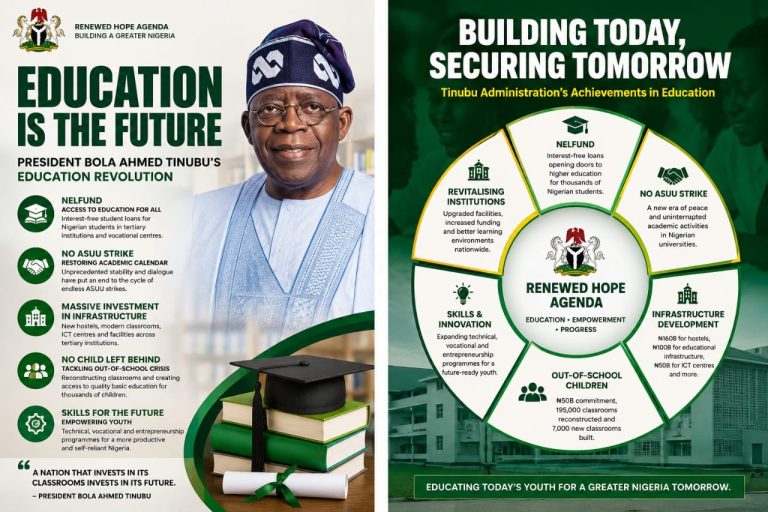
One of the most transformative policies of the Tinubu administration is the establishment and implementation of the Nigerian Education Loan Fund (NELFUND), following the signing of the Student Loans (Access to Higher Education) Act into law. This initiative marked a turning point in Nigeria’s education system by providing financial support for tuition and upkeep to students in tertiary institutions and vocational centres.
For decades, countless brilliant Nigerian students abandoned their education due to financial hardship. NELFUND is changing that narrative by:
* Providing interest-free student loans.
* Supporting students from low-income backgrounds.
* Expanding access to higher education and skills acquisition.
* Reducing the financial burden on families.
* Promoting educational inclusion and equal opportunities.
Millions of students across hundreds of institutions have already benefited from the scheme, making it one of the largest educational financing programmes in Nigeria’s history.
𝟐. 𝐓𝐡𝐞 𝐄𝐧𝐝 𝐨𝐟 𝐄𝐧𝐝𝐥𝐞𝐬𝐬 𝐀𝐒𝐔𝐔 𝐒𝐭𝐫𝐢𝐤𝐞𝐬
Perhaps one of the most celebrated achievements of the Tinubu administration is the unprecedented stability in Nigeria’s public universities.
Before 2023, Nigerian students frequently suffered prolonged disruptions due to strikes by the Academic Staff Union of Universities (ASUU). The country witnessed:
* 9-month strikes in 2020.
* An 8-month nationwide shutdown in 2022.
* Numerous industrial actions stretching back over two decades.
President Tinubu promised Nigerians that a four-year course would once again become a true four-year course. Three years into his administration, Nigeria has largely avoided the prolonged nationwide ASUU strikes that once crippled the education sector.
This achievement has been made possible through:
* Continuous dialogue with university unions.
* The removal of federal universities from the IPPIS payroll system, giving institutions greater autonomy.
* Payment of earned academic allowances.
* Renegotiation of the long-standing 2009 agreements.
* Increased financial interventions in tertiary education.
For millions of Nigerian students, this means uninterrupted academic calendars, timely graduation, and renewed confidence in the country’s university system.
𝟑. 𝐌𝐚𝐬𝐬𝐢𝐯𝐞 𝐈𝐧𝐯𝐞𝐬𝐭𝐦𝐞𝐧𝐭 𝐢𝐧 𝐄𝐝𝐮𝐜𝐚𝐭𝐢𝐨𝐧𝐚𝐥 𝐈𝐧𝐟𝐫𝐚𝐬𝐭𝐫𝐮𝐜𝐭𝐮𝐫𝐞
The Tinubu administration has committed unprecedented resources to improving educational infrastructure across the country.
Major interventions include:
* ₦160 billion invested in the construction of student hostels nationwide.
* ₦100 billion approved for educational infrastructure.
* ₦50 billion allocated for the rehabilitation of ICT centres in tertiary institutions.
* Expansion of entrepreneurship and innovation programmes in universities.
These investments are helping to modernize Nigeria’s educational institutions and create a more conducive learning environment.
𝟒. 𝐓𝐚𝐜𝐤𝐥𝐢𝐧𝐠 𝐭𝐡𝐞 𝐎𝐮𝐭-𝐨𝐟-𝐒𝐜𝐡𝐨𝐨𝐥 𝐂𝐡𝐢𝐥𝐝𝐫𝐞𝐧 𝐂𝐫𝐢𝐬𝐢𝐬
Nigeria has one of the world’s largest populations of out-of-school children. Recognizing this challenge, the Tinubu administration committed:
* ₦50 billion towards projects targeting out-of-school children.
* Reconstruction of approximately 195,000 classrooms.
* Construction of about 7,000 new classrooms nationwide.
These interventions aim to ensure that more Nigerian children have access to quality basic education regardless of their socioeconomic background.
𝟓. 𝐒𝐭𝐫𝐞𝐧𝐠𝐭𝐡𝐞𝐧𝐢𝐧𝐠 𝐓𝐞𝐜𝐡𝐧𝐢𝐜𝐚𝐥 𝐚𝐧𝐝 𝐕𝐨𝐜𝐚𝐭𝐢𝐨𝐧𝐚𝐥 𝐄𝐝𝐮𝐜𝐚𝐭𝐢𝐨𝐧
The administration has also prioritized technical and vocational education to prepare young Nigerians for the future workforce.
Through NELFUND and other initiatives, support has been expanded beyond traditional university education to include:
* Vocational training.
* Skills acquisition programmes.
* Entrepreneurship development.
* Innovation and technology education.
This approach aligns education with the demands of the modern economy and addresses youth unemployment.
𝟔. 𝐑𝐞𝐯𝐢𝐭𝐚𝐥𝐢𝐬𝐚𝐭𝐢𝐨𝐧 𝐨𝐟 𝐓𝐞𝐫𝐭𝐢𝐚𝐫𝐲 𝐈𝐧𝐬𝐭𝐢𝐭𝐮𝐭𝐢𝐨𝐧𝐬
The Federal Government has committed substantial resources to revitalising universities, polytechnics, and colleges of education through:
* Increased intervention funds.
* Upgrading of facilities.
* Commissioning of new TETFund-funded projects.
* Expansion of learning infrastructure across campuses nationwide.
These investments are helping to reposition Nigeria’s tertiary institutions for global competitiveness.
𝟕. 𝐑𝐞𝐬𝐭𝐨𝐫𝐢𝐧𝐠 𝐂𝐨𝐧𝐟𝐢𝐝𝐞𝐧𝐜𝐞 𝐢𝐧 𝐭𝐡𝐞 𝐄𝐝𝐮𝐜𝐚𝐭𝐢𝐨𝐧 𝐒𝐞𝐜𝐭𝐨𝐫
The Tinubu administration’s approach to education goes beyond infrastructure and financing. It is about restoring hope.
Today, Nigerian students can increasingly look forward to:
* More stable academic calendars.
* Greater access to educational financing.
* Improved learning environments.
* Better opportunities for skills development.
* Reduced uncertainty about graduation timelines.
The administration has repeatedly reaffirmed that education remains one of the pillars of the Renewed Hope Agenda and that investments in young people are investments in Nigeria’s future.
𝐂𝐨𝐧𝐜𝐥𝐮𝐬𝐢𝐨𝐧
President Bola Ahmed Tinubu’s education reforms represent one of the most significant attempts in recent history to address the structural challenges facing Nigeria’s educational system.
Through NELFUND, increased infrastructure spending, interventions in university funding, and efforts to end the cycle of incessant strikes, the administration has begun laying the foundation for a more stable, accessible, and future-ready education sector.
The journey is far from over, and challenges remain. However, the progress made thus far demonstrates a deliberate commitment to ensuring that Nigerian students can dream, learn, graduate on time, and contribute meaningfully to national development.
A nation that invests in its classrooms invests in its future. Under the Renewed Hope Agenda, education is once again being positioned as the engine of Nigeria’s transformation.