Home Blog Page 8045

UN agencies to develop health facilities for Nigeria, others

0

The United Nations Technology Bank has formed an alliance with the UN Development Programme, UN Conference on Trade and Development and the World Health Organisation to increase access to life-saving health technologies for Nigeria and other developing countries.

A statement by the UN said this would be achieved through the Tech Access Partnership in which the responses of governments of developing countries to COVID-19 would be supported with the development and adaptation of new technologies.

As demand for personal protective equipment, medical devices and diagnostics increases exponentially amid the global pandemic, the agency noted that countries with limited resources were unable to purchase or produce the tools they needed to mount effective responses to COVID-19.

According to them, lack of access to technical expertise, training and regulatory frameworks also limit local production of essential equipment in these regions, particularly for more complex products such as ventilators.

It said TAP aimed to address critical shortage of essential health technologies and equipment by connecting manufacturers with expertise and emerging manufacturers in developing countries to share information, technical expertise and resources necessary to scale up production of these tools.

The partnership, according to the UN, will also support countries to develop affordable technologies and equipment that meet quality and safety standards.

“Now, more than ever, the global community needs to unite to save lives and secure sustainable futures.  Inequalities are exacerbating the technology and digital divide when it comes to opportunities for youth, creating a divide that threatens to leave them behind,” the Deputy Secretary-General of the UN, Amina Mohammed said.

“Increasing access to necessary technologies through partnerships is a crucial component of the United Nations’ COVID-19 health, humanitarian and socio-economic response.”

She said TAP would be led by the UN Technology Bank for Least Developed Countries, established in 2016 to assist governments with the development and adaptation of new technologies.

According to her, the initiative, which is open to all developing countries, will also be supported by its core partners, UNDP, UNCTAD and WHO.

“Without access to life-saving technologies, many developing countries are unprepared for the potentially devastating impact of COVID-19,” the Managing Director, UN Technology Bank, Joshua Setipa, explained.

“By enabling developing countries to produce these technologies themselves, we can help set them on the path to recovery.”

TAP’s key functions, according to the statement, will include product information, technical guidanceand partnerships to match companies based on expertise, needs and capacity.

“TAP’s role in advancing more equitable access to critical health technologies is fundamental to help developing countries in responding to the immediate and devastating effects of COVID-19,” UNDP Administrator, Achim Steiner, said.

The partnership, according to the statement, is centred on the UN Development System’s overall approach to counter the socio-economic impact of the COVID-19 pandemic, which includes scaling up global capacity for testing and treatment, providing social protection for the most vulnerable and making countries resilient to future pandemics.

“The Technology Access Partnership can be an important part of the effort to help developing countries recover from this crisis,” the Secretary-General of UNCTAD, Dr Mukhisa Kituyi, said.

“By expanding the skills and capacity of local manufacturers, the initiative can boost innovation and contribute to inclusive economic growth,” Kituyi added.

As an initial pilot, the statement said TAP would begin working with manufacturers in several developing countries around the world.


2020 Q1 Results: How innovation is driving Jumia’s Growth

0

It was Peter Drucker, who popularized the phrase “innovate or die,” using the coinage to call on businesses and their owners or managers to be alive to their immediate environment to be able to adjust or respond appropriately to the vagaries of change in order to survive. This phrase simply admonishes entrepreneurs to stay ahead of the pace of change or be toast. While this eternal business truth has been playing out since the advent of business, no other period has seen it really more than the year 2020.

It started as an epidemic in a remote district of Wuhan in China when a multitude of people was infected by the novel coronavirus (COVID-19) and before anyone knew what was happening, it spread throughout the world and was declared by the World Health Organisation (WHO) as the coronavirus disease (COVID-19) pandemic. The widespread contagion and its attendant high mortality rate demanded that governments, the world over, took similar measures to contain the pandemic – massive testing, isolation and treatment of infected people, as well as massive lockdown of residents etc.

With the lockdown came, most businesses went out of business, at least temporarily. Even those in essential services sectors like hospitals and its allied subs, food production, processing and distribution companies etc. that were mostly exempted from the lockdown, experienced massive blows from the lockdown. With the increased easing of the lockdown regulation, what is regular in the news today are the tales of gloom by companies – a record of losses, diminished sales, inability to keep up with loan obligations etc. These and other issues are forcing many businesses to lay off staff, close branches, cut salaries etc. in their bids to survive the effects of the lockdown.

It is in the light of the above that we can appreciate Jumia’s innovativeness that made it not only come through the lockdown but also thrive in it. Going by the Quarter 1 2020 report, recently released by the company, Jumia could be said to have made a kill during the period of the lockdown in its various markets in Africa.

In the report of its financial results for the quarter ended March 31, 2020, Jumia recorded huge improvements in all measuring indices over the same period last year, signalling that the e-commerce company thrived in the period of the COVID-19 lockdown when most other companies staggered or fell.

Let us look at the figures in the financial results. During the period under review, Jumia gross profit was €18.4 million, a year-over-year increase of 21%. The number of annual active consumers on its platform was 6.4 million, a 51% increase over last year’s figure. Customers’ orders grew to 6.4 million, a 28% increase over what it was at 31 March 2019.

Third-party verification (TPV) value reached €35.5 million, a year-over-year increase of 71%, taking on-platform TPV penetration from 10% in the first quarter of 2019 to 19% in the first quarter of 2020. JumiaPay transactions reached 2.3 million, a year-over-year increase of 77%, representing 35% on-platform penetration in terms of orders. The company’s operating loss was €43.7 million, a four percent decrease year-over-year. How did the company pull off this impressive result at the time of a global pandemic of this magnitude?

The company focused on what is proving to be crucial to navigate this crisis, affordable, high purchase frequency product categories and cost-efficiency. It also drove Annual Active Consumers growth, which was up 51% year-over-year, and orders, up 28%, at the same time as reducing Sales & Advertising expense by 25% over the same period.

Jeremy Hodara and Sacha Poignonnec, Co-Chief Executive Officers of Jumia explained how foresight and innovativeness contributed to their first-quarter success:

“The onset of the COVID-19 pandemic in the first quarter of 2020 brought about a complex combination of health, economic and operational challenges. Our first priority was to help our employees, consumers and communities stay safe. On the operational side, we took prompt action to ensure business continuity and adjust our logistics to meet high standards of safety and hygiene.”

Other initiatives that played major roles in achieving this feat were the company’s strong focus on marketplace relevance, adjusting its commercial campaigns and merchandising to consumers’ needs; strategic partnerships with other brands like Reckitt Benckiser, Procter & Gamble and Unilever which boosted the company’s sales; the launch of curated product collections targeting specific needs resulting from confinement measures etc.

An increased demand from sellers to join the Jumia platform as offline distribution channels are largely disrupted also boosted revenue of the company. The company onboarded a number of high-profile brands on Jumia Mall, its dedicated space to brands or their official distributors.

Jumia also engaged its consumers with relevant social media and live content with the launch of the “Stay entertained with Jumia” series with live music streaming events and DJ sets in a digital party format, in partnership with various brands including MTN, Pernod Ricard and KFC.

The real cheering news, as noted by the company’s chief executives, is that this Quarter-1 performance is only an indication of the future of the company in particular, and that of e-commerce, in general.

“We believe the COVID-19 pandemic proves that e-commerce has a key role to play in helping consumers safely access essential goods and providing an efficient distribution channel for brands and sellers, at a time when offline channels are disrupted. We are more than ever confident about the relevance of Jumia and the gradual adoption of e-commerce by both consumers and sellers.

Pension fund operators invest N47.32bn in infrastructure

0

The Pension Funds Administrators have increased their pension funds investment in infrastructure to N47.32bn, latest statistics from the National Pension Commission have revealed.

The latest figure was said to be as of the end of February 2020.

The total assets under the Contributory Pension Scheme which had continued to record steady growth stood at N10.5tn, amount already put into different investment portfolios.

The Director, Centre For Pension Right Advocacy, Ivor Takor, said, “The Contributory Pension Scheme has created a huge pool of long-term investable fund, which should be utilised for infrastructural development.

“This should be done within an agreed framework put in place by all critical stakeholders.”

He explained that pension fund was about investment and not borrowing.

According to him, Pension Fund Administrators were investing organisations and not borrowing organisations.

Takor said, “The spirit and letters of the Pension Reform Act 2014 envisage investment not borrowing. The government, PenCom and pension operators know this very well.

“The law and guidelines for investment of pension fund made provisions for investment in infrastructure.”

He added, “We want to point out that Retirement Savings Accounts of workers are neither guaranteed by the federal and state governments nor any other organisation for that matter. “The accounts and the funds in them are open to operation and investment risk, which is born by the owners of the accounts. Therefore their representatives must have a say on any critical decision on the contents of the accounts.”

He mentioned that the law did not confer on the federal or state governments the power to decree or order how the funds in private individuals’ RSAs should be invested.

“They can negotiate the terms and conditions under which they are ready to do business with those who have legal ownership and power to invest the funds,” Takor said.

The acting Director-General, PenCom, Aisha Dahir-Umar, said the industry was looking at a “more effective deployment of pension fund assets in hard core and social infrastructure such as roads, rail, healthcare and education at commercial and profitable terms.

“Discussions are already ongoing with the Nigeria Sovereign Investment Authority, Nigeria Mortgage Refinance Company, Financial Market Dealers Quotation, Nigerian Stock Exchange, InfraCredit and other relevant stakeholders,” she said.

COVID-19 offers opportunity to grow local economy – Onu

0

The coronavirus scourge presents opportunities to develop home-grown solutions to meet national demands, the Minister of Science and Technology, Dr. Ogbonnaya Onu has said.

Onu who spoke via Skype while addressing participants of senior executive course No.42, 2020 of the National Institute for Policy and Strategic Studies Kuru, Jos on Thursday in Abuja, noted that agencies of the Ministry are already providing indigenous solutions to the problems created by the pandemic through the production of hand sanitizers, disinfectants, Personal Protective Equipment (PPE) like high-quality facemasks, body immune boosters, vaccine, and test kits, disinfectant dispensing equipment, ventilators, and tele-medicine amongst others.

“The Ministry is also upgrading the molecular Biology laboratories of her Biotechnology agency in Abuja and Odi, Bayelsa state, SHETSCO laboratory and the multi-purpose laboratory of the National Institute for Science Laboratory at Ibadan as test centers, the Minister added. Nigeria should start planning how to take advantage of the opportunities created by COVID-19.

“All nations will carry the burden, bear the pains and suffer the agony of this deadly and infectious disease but not many nations will benefit from the opportunities that will come with the end of the disease. Nigeria should prepare to take advantage of the opportunities that will certainly come.”

“Regarding the post COVID-19 era, our goal is to make the States and Local Governments the veritable engine-houses of value added, technology and innovation-driven, socio-economic growth. This will be accomplished by deploying a Public Private Partnership (PPP) model.”

 “The Ministry will deploy innovative mechanisms to lift 82 million Nigerians out of poverty by doubling the current 47 million Micro Small and Medium Enterprises (MSME’s) in Nigeria.

“Our target will be to ameliorate the socio-economic and livelihood disruptions resulting from the pandemic, through the deployment of science, technology and innovation interventions involving relevant stakeholders in carefully selected Innovation and Competitive Hubs throughout Nigeria,” he emphasised.

Refineries suffer N19bn loss in two months

0

The refineries owned by the Federal Government recorded a total loss of N18.96bn in the first two months of this year, the Nigerian National Petroleum Corporation has said.

Latest data from the NNPC showed that the refineries, which are managed by the corporation, lost N9.60bn in January and N9.36bn in February.

Nigeria, Africa’s top oil producer, relies largely on importation for refined petroleum products as its refineries have remained in a state of disrepair for many years despite several reported repairs.

The refineries, which are located in Port Harcourt, Kaduna and Warri, have a combined installed capacity of 445,000 barrels per day but have continued to operate far below the installed capacity.

The NNPC said in April that it had secured funding for the rehabilitation of the ailing refineries.

The Group Managing Director, NNPC, Mallam Mele Kyari, said the corporation was pursuing “a different model” for the refineries, including the type used by the Nigeria LNG Limited.

The NLNG is jointly owned by the Federal Government, represented by the NNPC (49 per cent), and three international oil companies, namely Shell (25.6 per cent), Total (15 per cent) and Eni (10.4 per cent).

Kyari said the corporation would no longer be involved in running the refineries after their rehabilitation.

He added that upon completion of the ongoing rehabilitation, the services of a company would be procured to manage the plants on an operations and maintenance basis.

In the first term of the President, Major General Muhammadu Buhari (retd), the NNPC had planned to rehabilitate the refineries to attain a minimum of 90 per cent capacity utilisation.

The plan was to use third-party financiers and the original refinery builders to provide the requisite funding and technical support.

However, after over one and a half years, negotiations with financiers were stalled in December 2018 due to varying positions on key commercial terms.

Kyari, who took over the NNPC leadership in July 2019, had reiterated his plan to revamp the refineries and end fuel importation by 2023.

Victor Moses: I fell in love with Milan first day

0

It’s an honour to link up once again with an important figure in my career. He is my mentor and friend,’ Inter Milan new signing, Nigerian player Victor Moses described manager Antonio Conte, when pressed about his relationship with the Italian who handled Chelsea and won the league title in 2017. Moses was in the Conte team that year and it was the Chelsea gaffer that redefined his attacking position to wingback position while playing that glorious season.

Following a short stint with Turkish side Fernerbahce, Moses announced his reunion with Conte on a loan transfer that landed him in Milan in January.

In a separate interview on Inter TV, the former Super Eagles winger further explained his feelings on connecting back with his benefactor.

“Having the opportunity to work with the coach again is something I’m really happy about. I’ve spoken to him and he’s already explained the Club’s project to me. I want to be part of it, I’m happy to be here. I’ll give my all and want to help the team. There’s a lot of quality here, I want to make my contribution out on the pitch and enjoy myself. That’s the most important thing.”

The 29-year-old wideman is teaming up with Conte once more after the pair worked together at Chelsea.

Though, Moses only played three matches before the Covid-19 pandemic lockdown took effect, he is optimistic that he would have a great time playing in the lovely Milan city.

In fact, the first thing he fell in love with, he said, is the ancient city housing another top club-side, FC Milan.

He added: “For me to be here and be an Inter player. I’d like to thank everyone for the welcome I’ve been given, I can’t wait to be back on the pitch of play. It seems like a nice city, I’ve liked what I’ve seen up to now. I think I’ll enjoy it here and we’ll have a great future together. I have positive feelings.

“I’m going to need time to find my feet but I want to help the team win as many games as possible. We’ll do all that we can to achieve our objectives and make our fans proud.”

Before Milan

This is the second time Conte would be giving the Nigerian back his playing life. At Chelsea, Moses was frozen out for three seasons only for Conte to come and recalled him back into the first team. He had spent three successive loan spells at Liverpool, Stoke City and West Ham United.

The former Italian boss revived his career converting him into a wing back and the Nigerian played key role in the team’s winning the Premier League title in 2017 season and the FA Cup the 2018 season.

On Conte’s command, Moses played his first game for Chelsea in three years in August, 2016. In the same month he got a starting shirt and scored his first Chelsea goal.

Conte decided to convert him to wingback some months later and that helped stabilise the team and earned the Nigerian more playing time as he shunned up 40 games in all competition that season. He also scored four goals.

The departure of the Italian, once again spelled doom for Moses, who was instantly loaned out to Fenerbahce in 2019.

The 18 month loan deal did end well for Moses until an unhappy Moses was rescued by Conte, who just signed for Inter Milan.

The six-month loan deal with a buy-out clause, according to Moses, is great as far as he’s playing for a manager that believes in him.

Moses made Inter Milan debut on January 29, coming in as a second hand substitute for Antonio Candreva and made his league debut some days after, in a 2-0 win at Udinese.

He further reiterated the import of the gaffer in his game and life: “I have played under a lot of managers and I’ve loved every single one of them. The most important one was Antonio Conte.

“At Chelsea he just came in and changed everything. He is an amazing man; he totally changed my game to be honest. He gave me that fighting spirit to believe in myself and to enjoy my football same time.

”And then when he came that first season, we won the league, the following season we won the FA Cup.

”It was an amazing season for me under Antonio Conte and I’ll always respect him for that, he’s an amazing man.

“I’ve never played that (wing-back) position before. When the manager came in, he talked me through it and then put me there.

“It was good to have the manager’s support, and he backed me and gave me the confidence to go out there and express myself. So I just wanted to go out there to play for him, the fans and the football club. I didn’t let him down.”

So far, Moses career honours, especially at club level have come under Conte. He won the Premiership title in 2016-17 season and followed up with the FA Cup win the following season. In the previous year, Chelsea also finished runner-up in the FA Cup.

Asked how his game is kicking back at Inter Milan, he said.

“I’ve come to realise that you play better under a coach that believes in you and that is what Conte has done for me. I’ve played three matches and it’s been wonderful. I feel better already. Before the lock down I’ve played three games. I started the match away to Udinese and we won 2-0. It is good for the team. We are playing for the good of the team.”

One match that, however, touched him was Coppa Italia semifinal loss to Napoli.

Inter Milan had staged a comeback to beat AC Milan 4-2 in a local derby Sunday before the game, only to lose steam and lose 1-0 in the Coppa Italia.

In mid-February, Inter came from two goals down to win the Milan derby 4-2 and visibly struggled to play with the same intensity in the match against the Napoli at San Siro as they lost 1-0.

“We used up a lot of physical and mental energy on Sunday but this cannot be an excuse. We are very disappointed with this defeat, but we must not lose heart. We must win in the return leg.”

The second leg will now be played at the resumption of Italian football following the lockdown.

The experienced Nigerian, though, admitted that it was not easy adapting to the rugged and highly tactical Italian football.

“It is not easy, it is very tactical. It is important for me to put myself at the service of the team and my teammates but the manager has been of tremendous help,” he explained. “He tells me what to do and I try to remember and follow most of his instructions. He is one of the best managers in the world. He played football himself and he has a lot of passion. I am very happy to work with him again.”

With the Italian season tentatively resuming on June 13, Moses looks forward to a great season and a permanent deal with Inter Milan. Before the lockdown, Inter occupy the third position on Serie A table with 54 points. Juventus are on top with 63 points while Lazio are in second spot with 62 points.

Faustino Anjorin Getting Circled by Manchester Teams

0

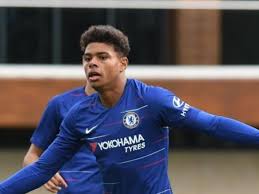
With five English Premier League clubs, including Manchester giants-United and City monitoring Chelsea midfielder of Nigerian parentage Faustino Anjorin ahead of a possible swoop for his signature in future and German Bundesliga club Borussia Dortmund also in the midst, the Blues may find it difficult to hold on to the teenage prodigy

The England U19 star is one of the most exciting prospects at the Chelsea Academy, and has already played twice for the first team this season, against Grimsby Town in the League Cup and Everton in the Premier League.

With the professional contract signed by Anjorin in November 2018 expiring in June 2021, the Blues have offered him a new multi-year contract and everything indicates that he will commit his future to the club.

Manchester City have officially watched Anjorin the most in the 2019-2020 season, attending youth team games involving the Anglo-Nigerian teenager.

Manchester United have also scouted the highly-rated youngster tipped for big things, while Liverpool, Arsenal and Norwich City are the other Premier League clubs observing him.

German Bundesliga club Borussia Dortmund are keeping close tabs on Anjorin and one of their scouts ran the rule over the versatile midfielder before the coronavirus outbreak.

He has played nonstop at Chelsea since officially joining the club at U9 level.
Anjorin made his professional debut for Chelsea in their League Cup win versus Grimsby Town last September and was on the bench in the recent Emirates FA Cup win against Liverpool.

Chelsea midfielder, Anjorin made history for Premier League Club, Chelsea as he came on in the 7-1 thrashing of Grimsby Town in the Carabao Cup.

Aged 17 years, 10 months and two days, Anjorin became the youngest player of Nigerian descent to debut for Chelsea in a UK football competition, breaking the record previously held by Fikayo Tomori (another Nigerian), who was aged 18 years, 4 months and 26 days when he debuted for Chelsea in the Premier League in May 2016.

Anjorin was given a chance by the club’s new management team, after the teenager enjoyed a blistering start to the season, scoring five goals in his first seven games for Chelsea’s Under 23- including a brace in the EFL Trophy win over Swindon last month.

He is currently Chelsea’s development group top goalscorer, opening his account in the UEFA Youth League, Premier League 2 and the EFL Trophy.

Anjorin is a classic midfield powerhouse – who grew up idolising current Blues manager Frank Lampard.

Lampard, who has made it his mission to promote the youngstres this term has faith in the raw talent, as does his assistant Jody Morris – and the pair have been impressed by Anjorin’s rapid rise since they arrived in the summer.

His progress within the Blues academy has seen him compared to fellow graduate Ruben Liftus-Cheek, who also impressed at youth level.

Anjorin was born in Poole to a Nigerian father and a English mum.

He was named after the Colombian legend Faustino Asprilla who famously became the first player to score a hat-trick against Barcelona in the Champions League when he was playing up front for Newcastle.

By the age of seven Anjorin was scouted by Chelsea and invited to train in their youth set-up before officially joining at the age of nine.
It was a dream comes true for the boy, who idolised John Obi Mikel and wanted to play for the same club.

By the age of 16, Anjorin, who stands at an impressive 6ft 1 in, lifted the FA Youth Cup.
Not only was he the youngest player in the Chelsea side that beat Arsenal 7-1, his goal to end the rout was the icing on the cake.

Internationally, Anjorin’s form has been equally as impressive as it has for his club, and the FA have high hopes for him.

He has played for England at every junior level up to the Under-19’s, but without a full cap to his name there could be a tussle with Nigeria for his services in the future.

Both-footed, Anjorin has a contract with Chelsea that doesn’t expire until 2021 but the club is already looking to tie him down to a longer deal.

Technically he’s underrated, despite his lanky frame, runs with the ball at pace and is strong in possession.

And he’s got decent vision, often able to pick out the perfect pass for a forward to run on to.

But it is his finishing that helps him stand out from the crowd.

In fact, Jody Morris once revealed he was the “best finisher at the club.”

Born in Poole on the south coast of England, Faustino Anjorin has a Nigerian father and English mom and can choose to play for either the three-time African champions or the Three Lions.

He was discovered to be very talented at a young age and it was Chelsea that beat other London clubs to the signature of the midfielder.

It can be revealed that Anjorin chose to join the Stamford Bridge outfit at the age of seven because they have the best academy in England to this day.

An England U18 international, Anjorin has made a big impact for Chelsea’s youth team’s this season, with the highlight being a seven-game scoring run, and was rewarded with a three-year professional deal in November 2018, shortly after he turned 17.

Faustino has been utilised in the youth setup and has also debuted for Chelsea’s U-23 team as he is highly rated.

The youngster who has represented England at U-16, U-17 and the U-18 level is still eligible to play for the Super Eagles of Nigeria due to his parents and he has not played for the English senior set up.

Dortmund thrash Schalke 4-0 on Bundesliga’s return

0

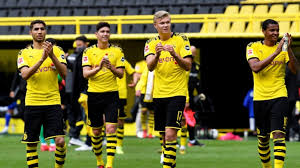
Norwegian sensation Erling Braut Haaland stole the limelight on Saturday as the German Bundesliga became the first major European football league to return since the coronavirus lockdown, with teams playing in empty, echoing stadiums.

The 19-year-old striker claimed the first goal in Germany’s top flight for over two months to set Borussia Dortmund on the way to a 4-0 win over their local rivals Schalke.

Portuguese international Raphael Guerreiro then added two goals either side of a Thorgan Hazard strike as second-placed Dortmund moved to within a point of leaders Bayern Munich, who are chasing an eighth straight title and play Union Berlin away on Sunday.

Haaland steered a low Thorgan Hazard cross into the far corner on 29 minutes to claim his 10th goal in just nine Bundesliga matches.

It was his 41st goal this season in all competitions and his 13th for Dortmund in just 12 games since joining in January from Red Bull Salzburg.

– Social distancing –

He celebrated by dancing alone — making no contact with team-mates, who clapped him on — to comply with the strict hygiene guidelines which allowed the league to return.

In front of empty terraces and no more than 300 people allowed into Signal Iduna Park, which is normally packed with almost 82,000 fans, Guerreiro added Dortmund’s second goal just before half-time following an error by Schalke goalkeeper Markus Schubert.

Haaland played a role in the build-up to the third goal before Julian Brandt set up Hazard to fire home on 48 minutes.

Schalke looked short of match fitness, while Dortmund were sharper and Guerreiro grabbed his second in style after a one-two with Haaland in the 63rd minute.

Elsewhere, third-placed RB Leipzig were held to a 1-1 draw at home to Freiburg, leaving them four points off top spot.

Defender Manuel Gulde gave visitors Freiburg a shock lead and celebrated by elbow-bumping teammates, before Leipzig striker Yussuf Poulsen grabbed a late equaliser. Freiburg were then denied a stoppage-time winner when a VAR check spotted a marginal offside.

Later, Borussia Moenchengladbach can move up past Leipzig if they win at Eintracht Frankfurt.

Bruno Labbadia, who replaced Jurgen Klinsmann during the lockdown, made a winning start as Hertha Berlin coach with a 3-0 success at Hoffenheim.

The goals came in quick succession with a Kevin Akpoguma own-goal being followed by Hertha captain Vedad Ibisevic grabbing a second before the Brazilian Matheus Cunha danced past defenders on the way to making it 3-0.

In order to get the political green light to resume this weekend, the German Football League (DFL) has tested players and coaches regularly for the virus and teams have been in quarantine for the past week.

Players and staff must follow stringent hygiene guidelines.

Teams arrived at stadiums in several buses in order to meet social distancing requirements inside vehicles.

Although Germany has suffered far fewer deaths from coronavirus than other large European countries, it is still too dangerous for crowds to return.

Grumbling in police as FG fails to implement salary increase

0

The Federal Government has failed to implement the new enhanced salary structure for police officers.

This is coming 19 months after the President, Major General, Muhammadu Buhari (retd.), approved a pay rise for them.

Checks by Sunday  PUNCH indicated that police officers were still being paid their old salaries and allowances.

The President in November 2018 approved an enhanced salary structure for the force.

By the approval of their Rank Salary Structure Adjustment, salaries, allowances and pensions were expected to be increased, though the percentage of the increment was not disclosed.

Buhari had also assured that his administration would continue to give attention to their welfare and operational needs with a view to restoring their lost primacy in the internal security framework of the country.

“I am pleased to make the increase in salaries and allowances in the hope that it will increase the performance index of the police and strengthen Nigeria’s internal security system,” Buhari told the Police Service Commission and the police hierarchy.

The announcement was greeted with excitement by officers and Nigerians who believed the development would boost the morale of the force.

However, policemen who spoke to our correspondent said the new salary structure had not been implemented, describing the delay as “disappointing and demoralising”.

An Assistant Commissioner of Police confirmed that they had yet to receive the new salary despite rising inflation and the depreciating value of the naira.

Speaking on condition of anonymity on Friday, the ACP said, “To say we are disappointed over the delay in the implementation is an understatement. If the President approved a policy that would affect a critical security organisation like the police, the implementation of such a decision should not take over one year.

“It is either the government  is not committed to police welfare or the reported approval was just a political gimmick.”

An Assistant Superintendent of Police also said the pay rise had not been effected.

“I am still being paid N130,000 as an ASP; there has been no increase in salary and allowance as announced by the President in 2018. Other security agencies including the Economic and Financial Crimes Commission, Department of State Services and even the military earn more than us,” he added.

The officers also complained that they were not paid special allowances for the enforcement of the COVID-19 lockdown which they said were being enjoyed by other agencies.

 Meanwhile, the Executive Director, Civil Liberties Organisation, Ibuchukwu Ezike, said the delay in payment of the new salary could affect the officers.

He said, “The announcement has caused an increase in the prices of goods and services which are now questioning the empty pockets of these officers. We appeal to the Federal Government to reconsider the delayed  salary increase and ensure that their promise which was announced to the public about two years ago is fulfilled without further delay.”

A retired Deputy Inspector-General of Police, Adedayo Adeoye, observed that the current economic situation might affect payment of the new salary, noting, however, that the implementation of the pay rise would encourage the police to perform better.

He said, “The police are on the streets performing their duty despite the lockdown occasioned by the coronavirus. So, I would urge those responsible for the implementation of the new salary scale to expedite action as soon as possible.”

A retired Commissioner of Police and ex-Force Headquarters spokesman, Emmanuel Ojukwu,  said he was saddened by the development.

Foreign airlines may resume flights to Lagos, Abuja airports June

0

Some foreign airlines are allegedly planning to resume flights to Lagos, Abuja and Port Harcourt airports despite the ban on international commercial flights by the Federal Government in a bid to halt  COVID-19 spread.

Although some of the airlines said their plans could change, it was learnt on Saturday that some of the international carriers had already scheduled some flights to Nigeria from June.

But the Federal Ministry of Aviation declared that such plans would not work until the flight ban was lifted.

Also, the Air Transport Services Senior Staff Association of Nigeria said no foreign or local carrier could take decision to fly to or within Nigeria if the government had not opened the airspace.

It was learnt on Saturday that Lufthansa Airlines had included Abuja and Port Harcourt among its 20 long-haul routes to begin flight operations in June.

It was learnt that the carrier had made its first batch of flight reservation available in its booking system.

The company plans to resume long-haul flights in June from Frankfurt to Abuja, Port Harcourt, Toronto, Mexico City, Tel Aviv, Riyadh, Bahrain, Johannesburg, Dubai and  Mumbai, among others.

Virgin Atlantic recently announced that beginning from May 16, services for its summer schedule flights from March 28, 2021 would be on sale, as it had scheduled flights from London Heathrow to the Murtala Muhammed International Airport, Lagos.

But senior  Ministry of Aviation officials said although it was nice to hear that airlines were making plans to resume operations, such would not happen until the ban was lifted.

The FG  on May 6 extended the suspension of both local and international flights by four weeks.

The government had earlier halted commercial flights by two weeks before it announced the four-week extension.

The Director, Public Affairs, FMA, James Odaudu, said the Presidential Task Force on COVID-19 had not lifted the ban on commercial flights, whether local or foreign.

He said, “They (foreign airlines) can’t operate scheduled passenger flights as long as the ban remains. The PTF on COVID-19 has the final say on when flights can resume, based on the level of control of the pandemic.

“Of course, we in the sector can’t wait for activities to resume at the airports to forestall further loss of jobs and revenue. Aviation has been one of the hardest hit by the pandemic and it will be a great relief to have flights resume.”

The President, ATSSSAN, Ilitrus Ahmadu, said no airlines could take decisions for Nigeria on when flights would start.

“It is not the foreign carriers that will decide for our country. So it is their business and they cannot say they can fly into the country without government opening the airspace.”