Home Blog Page 7875

Fashola yet to leave Abuja since March 22 -aide

0

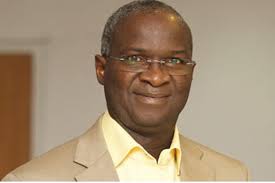
Mr Hakeem Bello, Special Adviser on Communications to the Minister of Works and Housing, Mr Babatunde Fashola, said the minister has not travelled out of Abuja since March 22.

Bello made the disclosure in a statement he issued to newsmen in Abuja on Wednesday.

He said that the attention of the office of the minister had been drawn to a letter signed by the Chairman /Chief Executive Officer of Executive Jets Services, Ltd, Dr Sam Iwuajoku, concerning a flight it operated to Abuja last weekend.

“In order to set the records straight, the minister “ has not travelled out of Abuja since March 22, 2020, when he returned there from an inspection tour of the Enugu-Port Harcourt Expressway construction work and a visit to Lagos, before the lockdown.

“The decision of the honourable minister not to travel was taken in strict compliance with Federal Government’s ban on inter-state travels as part of efforts to control the COVID-19 pandemic.

“It is, therefore, ridiculous for Dr Iwuajoku to attempt to link the honourable minister with any non-compliant flight,” he said.

Former Attorney General, Mohammed Adoke Re-Arraigned On Fresh Charges

0

Former Attorney General of the Federation, Mohammed Adoke has been arraigned on fresh charges.

Adoke was arraigned alongside Mr. Aliyu Abubakar.

Both men had earlier been arraigned on a seven-count charge bordering on money laundering, bribery, and abuse of office.

A Federal High Court sitting in Abuja had granted Adoke bail in the sum of N50m with one surety in like sum after he pleaded not guilty to all charges stemming from his alleged fraudulent involvement in the Malabo oil deal

The former AGF was first arraigned in December 2019 before the Federal Capital Territory (FCT) High Court upon his return to the country from Dubai.

Adoke’s lawyer and Senior Advocate of Nigeria, Mike Ozekhome, at the last hearing of the case earlier in the year, accused the Economic and Financial Crimes Commission (EFCC), of holding his client “in permanent custody,” adding “This has further jeopardized his very poor and fragile health.”

BREAKING NEWS: Giadom Takes Over as APC Chairman, Cancels EDO Screening

0

Mr. Victor Giadom, the Deputy National Secretary of the APC has assumed office as acting National Chairman of the Party.
He has immediately announced the cancellation of the APC screening in Edo governorship primary.
… details soon

ODD NEWS: Package containing 32 bags of marijuana delivered to wrong home

0

Authorities in Texas were called to a family’s home when they received an unexpected package containing 32 bags of marijuana.

The Harris County Sheriff’s Office said deputies were called to a Houston home after the residents reported receiving a package they hadn’t ordered that was filled with cannabis.

“If it is yours please contact the Harris County Sheriff’s Office to claim it,” the sheriff wrote in an Instagram post.

Marijuana is illegal to possess in Texas.

ODD NEWS: Scientists say they went ‘cuckoo’ due to laughing gas from penguin poo

0

Scientists have reported getting so high on the nitrous oxide emitted by penguin poo that it actually made them ill.

The levels of nitrous oxide, more commonly known as laughing gas, given off by the colony’s faeces was about 100 times higher than in a fertilised field.

Professor Bo Elberling, from the University of Copenhagen, said the “truly intense” amount of nitrous oxide exhumed was enough to send someone “completely cuckoo”.

“It is truly intense – not least because nitrous oxide is 300 times more polluting than CO2,” he explained.

“After nosing about in guano (the term given to the excrement of seabirds and bats) for several hours, one goes completely cuckoo. One begins to feel ill and get a headache.”

He added: “The small nitrous oxide cylinders that you see lying in and floating around Copenhagen are no match for this heavy dose, which results from a combination of nitrous oxide with hydrogen sulphide and other gases.”

Nitrous oxide canisters are often sold legitimately for producing whipped cream, but they are also taken recreationally through a balloon – with users often littering the small canisters behind.

The nitrogen in the nitrous oxide exhumed by penguin poo comes from the seabird’s diet of fish and krill, which themselves eat on phytoplankton in the ocean.

When these are excreted, soil bacteria convert the poo into nitrous oxide, which unfortunately is a greenhouse gas.

Prof Elberling said: “It is clear to us that the level of nitrous oxide is very high in places where there are penguins – and thereby guano – and vice versa, lower in places where there is none.”

He noted that the study had a lot of relevance for Danish agriculture, which uses nitrogen fertiliser and so emits large quantities of nitrous oxide.

“One of the things we can learn, for example, is how and when to fertilise vis-a-vis the optimal conditions for soil bacteria to produce nitrous oxide,” he added.

IMF to back government’s anti-corruption fight

0

The International Monetary Fund has pledged to support governments in adopting measures to fight corruption.

It vowed to do so by publishing procurement contracts, commissioning independent audits and stepping up anti-money laundering measures.

Speaking in an interview with Transparency International, Managing Director of the IMF, Kristalina Georgieva, described corruption as a debilitating force that targets the poor in the economy.

She said, “Corruption is a corrosive force that hits the poor and the most vulnerable people the hardest and it is tragic when government action is needed to save lives and protect livelihoods but money is squandered rather than deployed for what is their priority.

“And this is why the IMF will continue to support governments in their efforts to adopt a range of measures from publishing procurement contracts online, to commissioning independent audits to improve transparency and public financial management to set up anti-corruption and anti-money laundering measures.”

The IMF boss examined the role civil soceities play in curbing corruption and lauded them for their work.

Foreign reserves fall by $129.83m in one week

0

The country’s foreign reserves have commenced a downward trend, dropping by $129.83m in one week, the latest data from the Central Bank of Nigeria have shown.

The reserves, which stood at $36.57bn as of June 3, fell to $36.45bn on June 11.

According to the CBN, the reserves had maintained a steady rise at a level of $33.52bn as of April 30, 2020 before commencing its downward trend in June.

The reserves had earlier slipped into a decline after hitting a high of $45.17bn on June 11, 2019, losing $11bn to close at $33.89bn as of April 28.

According to the International Monetary Fund, the country’s main export commodity, oil, represents around 90 per cent of its exports.

“The country’s oil exports are expected to fall by more than $26bn,” the IMF said.

The CBN Governor, Mr Godwin Emefiele, at the last Monetary Policy Committee meeting, reiterated the need for government to urgently reduce reliance on oil revenue by gradually diversifying the economy and improving tax collection.

He said headwinds to growth remained the legacy issues of the persistent infrastructural and security challenges.

He said, “Central to the committee’s considerations were the impact of the COVID-19 pandemic, the oil price shock and the likely short to medium-term consequences on the Nigerian economy.

“In particular, the committee acknowledged the gradual improvement in macroeconomic variables, particularly the improvement in the equities market, the containment measures of the COVID-19 induced health crisis as well as the impact of the increase in crude oil price on the external reserves.”

BUA Cement Consolidates Profit Growth

0

Shareholders of BUA Cement Plc are savouring their investment in the company right now. Having recommended a dividend of N1.75 per share for the 2019 financial year, the company is heading towards delivering higher returns at the end of the current financial year, going by the first quarter performance ended March 31, 2020.

Despite the challenging operating environment, BUA Cement Plc posted increased revenue, which rose by 25.1 per cent to N53.969 billion in Q1 of 2020, compared with N43.134 billion recorded in the corresponding period of 2019.
Profit before tax (PBT) rose by 15.7 per cent from N17.394 billion to N20.129 billion, while profit after tax (PAT) increased 26.2 per cent from N15.682 billion to N19.789 billion in 2020.

According to the Managing Director/CEO of BUA Cement Plc, Yusuf Binji said the performance in the Q1 financial results amid the outbreak of the COVID-19 pandemic was yet another landmark of the company since its listing on the Nigeria Stock Exchange.
He said the performance was buoyed by an increase in production capacity from five million metric tonnes at the end of Q1’2019 to eight million metric tonnes currently, its strong product differentiation strategy which translates to an increasing appreciation of BUA Cement product offering and a growing distribution network across existing and new markets.

“The turn of the year witnessed the achievement of yet another milestone, with the completion of listing requirements of the NSE, emerging the third-most capitalised company on the exchange; with a market capitalisation of N1.2 trillion and the de-listing of the shares of Cement Company of Northern Nigeria Plc. Subsequently, BUA Cement was included as a constituent of the MSCI frontier market index in February.”

He said in response to the global pandemic, BUA Cement implemented its, “COVID business continuity programme and built into its corporate governance framework.
“This minimises disruptions along the value chain, prioritises the safety of workers and customers and assesses probable scenarios a prolonged lockdown would have on the business,” he said.

“Clearly, our strong-showing epitomises the effect of further growth in output but most importantly, a growing appreciation of the value and service offering we continue to afford customers in the market place: with sales revenue increasing by 25.1 per cent to N54 billion.

“We continue to anticipate changes to customer and market behaviour, aimed at further strengthening our value model, even as we continue our push into ‘new markets. As the COVID-19 virus makes landfall, we believe the current measures in place, should help minimise plausible downside risks; nevertheless, poised to take advantage of an upturn in market activities,” Binji added.
The impressive performance the BUA Cement is recording post-merger was expected going by the words of the Chairman of the company, Alhaji Abdul Samad Rabiu.

Rabiu had said the decision to merge was primarily motivated by the to ensure that the company is well positioned to grow and expand in the Nigerian cement industry.
“The merger with Obu Cement will create an entity with increased production capacity. We are of the opinion that the proposed merger will create a platform where significant synergies can be obtained for the benefit of our shareholders, employees, customers, distributors, suppliers and the broader economy,” he said.

Rabiu explained that the merger will increase the production capacity of the enlarged company to 8.0 million mtpa.
“It is anticipated that in addition to meeting the demand from customers in our core regions in the country, the enlarged company would be positioned to distribute its products in new geographical markets, creating the potential for additional shareholder value creation,” he said.

Rabiu noted that the merger would provide opportunities for significant cost savings and improved operational efficiencies by streamlining operations and optimising the use of combined resources.
On economies of scale, Rabiu said: “The merger will provide a platform where the enlarged company benefits from economies of scale in procurement, distribution and manufacturing of the products offered to our customers. We expect the benefits accruing from greater economies of scale to accrue to many stakeholders.”

According to him, CCNN shareholders will become shareholders of a larger and highly profitable entity, stressing that synergies created as a result of the merger would create additional value for shareholders.

“Besides, the enlarged company will create a platform for further investment that will have a positive impact on the communities where the operations of the companies are present as well as for the economy as a whole,” the foremost industrialist declared.

He said this consolidation would mark the culmination of the first phase of the BUA mid-term strategic plan for its cement businesses, which currently include four cement plants spread across Obu Cement Company and the CCNN.

“We intend to continue creating value for the benefit of shareholders of the consolidated company by maintaining their focus on outperforming the Nigerian cement industry across key indices through a laser-like commitment to excellent products and service delivery, operational efficiency as well as maintaining leadership position in their home markets,” Rabiu said.
New electricity tariffs effective July, says minister

0

The Minister of Power, Sale Mamman, has insisted that the new increment on electricity tariff would take off in July.

 He stated this on Tuesday at the Investigative Public Hearing on Power Sector Recovery Plan and the impact of COVID-19 pandemic organised by the Senate Committee on Power.

 Mamman said COVID-19 pandemic had affected the laid, out plan for the repositioning of the electricity market towards financial sustainability under the Power Sector Recovery Programme.

 According to him, the regulator, following the completion of public consultation on tariff review, has initially planned to conduct a tariff review in April 2020.

However, he said due to the COVID-19 outbreak and customer apathy, the proposed tariff review was delayed by three months.

 He said, “The impact of this means the subsidy being incurred in maintaining the current tariff level had to be maintained till July 2020 when the proposed tariff review will be implemented.

“The challenge we are currently facing in the development and expansion of our transmission line is budget and release of Federal Government’s commitment in the estimated sum of N32bn primarily for right of way acquisition and environmental impact mitigation.

 “The fund should be provided for in the 2020, 2021, and 2022 Appropriation of the Ministry of Power.”

 Mamman also said the COVID-19 pandemic had had a great economic impact not just on the health sector but on the overall economy.

 He said, “Indeed, the prevalence of the pandemic has already reduced productivity due to the strategy adopted globally to contain it.

 “This by default affects the purchasing power of consumers and the demand for electricity in general.

 “The current situation in the Nigerian power sector is that a lot of capital investment is being made, most of which is dependent on donor funding, loans and budgetary allocations.

 “For projects that we have already secured their funding, we do not expect any adverse effect.”

He, however, said his ministry was proactively seeking strategies to identify projects that would require counterpart funding in the face of dwindling national revenue so as to deliver within the projected timelines.

“This explains our prayer for the distinguished senators to consider and approve additional funding for the execution of the various projects we are undertaking,” he said.

He added that the power sector was also grappling with the challenges of infrastructural misalignment, market inefficiency/transparency, sector governance/policy coordination, and completion of legacy projects.

UEFA Plans How to Complete European Season

0

Plans to finish this season’s Champions League and Europa League will be discussed at a meeting of Uefa’s executive committee on Wednesday.

It is expected that Portugal and Germany will be confirmed as hosts for a ‘final eight’ knockout tournament in the respective competitions

The Women’s Champions League is set to take place in northern Spain.

However, there has been disagreement about how the outstanding last-16 ties in the men’s competitions be resolved.

It is possible that some teams may have to give up home advantage in their Champions League and Europa League last-16 second-leg ties.

That could most affect games where there was a narrow first-leg result, such as Manchester City, who beat Real Madrid 2-1 at the Bernabeu Stadiumin the first leg of their Champions League tie, and Wolves, who drew 1-1 at Olympiakosin the Europa League.

There are four Champions League last-16 matches still to be completed, plus six Europa League ties. It is expected the two Europa League ties that are yet to start will be played as one-off games in Germany.

Many clubs want to preserve home advantage for the second legs but Uefa is concerned that attempting to play the men’s matches in eight countries rather than two increases the risk of games being postponed because of the coronavirus pandemic. They would prefer to move the ties to the countries where the latter stages are being played.

If there is no consensus before Wednesday’s meeting, Uefa could delay a decision to see what the latest health situation in the respective countries is nearer the planned resumption of the tournament at the beginning of August.

The Champions League final is set to be played in Lisbon on 23 August, with the Europa League final likely to be held in Cologne two days earlier.

The Women’s Champions League, where Arsenal and Glasgow City have already reached the last eight, will be held in Bilbao and San Sebastian at the end of August.

In addition to this season’s tournaments, the meeting will also discuss how the complicated qualifying system for the 2020-21 club competitions are going to work.

It is anticipated Uefa will have a six-week window to complete its qualifiers, which normally involve more than 200 two-legged ties and all 55 member nations at some stage in the five rounds of competition.

Recognising that for the majority of clubs, the qualifiers represent the extent of their involvement in European competition, Uefa would only cut the access list as a last resort.

However, even though they expect 38 countries to have restarted their seasons by the end of June, and 17 of them with some level of supporters in the stadium, it is acknowledged significant contraction of the schedule will be required, with some rounds being played as single ties.

It would then have to be decided whether the games would be played on neutral grounds or at the home of one of the teams in each tie. It has been suggested the decision should be made on co-efficient. More likely it is by a straight draw, although decisions over whether to retain the away goals rule to decide drawn ties, or let fans into stadiums in the countries that allow it would still have to be made.

The scope for playing qualifiers is restricted because Uefa is insisting on the September international break remaining in the calendar, even though this is immediately before the 12 September date both the Premier League and La Liga are looking at for the start of their new season. If Uefa sticks to this ideal, clubs are likely to object.

Uefa wants to start the Nations League in that slot, with the Euro 2020 play-offs, involving Scotland, Northern Ireland and the Republic of Ireland, being played in October and November, both of which are set to feature ‘triple headers’.