Home Blog Page 7717

How Magu turned EFCC to `glorified police station’ for selfish motives – Report

0

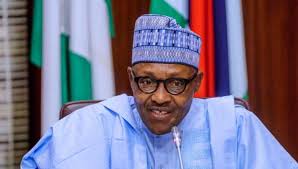
The suspended acting Chairman of the Economic and Financial Crimes Commission (EFCC), Ibrahim Magu, has allegedly been accused of turning EFCC into `glorified police station’ for alleged selfish motives.

It was reported that the accusation was contained in a report submitted to President Muhammadu Buhari by one of the investigative committees set up to look into the activities of the EFCC under Magu.

According to the report, Magu has continued seconding police officers to the EFCC in spite the massive recruitment of officers and men carried out by the commission in recent years.

“The blatant display of arrogance and acquisition of illicit wealth has turned the EFCC into a glorified police station.

“Despite massive recruitment of officers and men in recent years by the (suspended) acting chairman at the EFCC, he is still seconding police officers to the EFCC because he is comfortable with his fellow officers to carry out his illicit activities.

“He does not have any exit strategy for the police even though the EFCC officers are more experienced in the investigation of economic and financial crimes,’’ the report further noted.

It was reported that the Inspector General of Police, Muhammed Adamu, had on Friday ordered the withdrawal of mobile policemen attached to Magu, who is being held at Area 10 Force Criminal Investigation Department (FCID), Abuja.

Malam Garba Shehu, the President’s Senior Special Assistant on Media and Publicity, had on July 11 explained that Magu was being investigated as a result of series of documented allegations made against him.

He added that detailed investigations were being carried out following a preliminary review of the allegations leveled against Magu and several other members of staff of the EFCC..

“Hence, an investigative panel was constituted in compliance with the extant laws governing the convening of such a body.

“As is the proper procedure, when allegations are made against the Chief Executive of an institution, and in this case an institution that ought to be seen as beyond reproach, the Chief Executive has to step down from his post and allow for a transparent and unhindered investigation,’’ he said. 

Buhari Congratulates Kamaru Usman for Retaining UFC Title

0

BY TAIWO OGUNMOLA-OMILANI 

 President Muhammadu Buhari has congratulated Kamarudeen Usman on the successful defence of his Ultimate Fighting Championship (UFC) welterweight title with an emphatic win over Jorge Masvidal.

Femi Adesina, Special Adviser to the President on Media and  Publicity signed this statement made available to newsmen on Sunday. 

 As the first African-born and Nigerian UFC Champion, President Buhari commends the courageous fighter for finishing strong inside the octagon, proudly flying the green and white colours in distant lands, and reminding the world that good things and great people still come out of Nigeria. 
 While the global COVID-19 pandemic may have brought gloom to many families and nations, the President is delighted and gratified that our welterweight champion has lifted our spirits with another professional performance  proving that things will surely get better at the fullness of time when we remain committed to our vision. The President wishes Usman the very best and more victories in his career and prays that like fine wine, he improves with age.

Thousands demonstrate against Israeli government’s virus policy

0

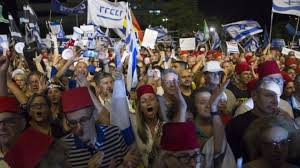
Thousands of Israelis took to the streets of Tel Aviv against Prime Minister Benjamin Netanyahu’s economic policy in light of the coronavirus crisis, media outlets reported on Sunday.

More than 10,000 people gathered in central Rabin Square on Saturday evening to draw attention to the financial difficulties brought about the coronavirus crisis, especially self-employed Israelis.

They accuse the government of not taking care of citizens’ needs.

Twelve demonstrators were arrested, a police spokesman said on Sunday.

Some protesters reportedly clashed with the Police after they tried to block central streets in Tel Aviv.

Three officers were slightly injured after demonstrators used pepper spray on them.

Netanyahu, on Thursday, presented his aid package to help people through the coronavirus crisis.

The programme is intended to provide a safety net for the employed, self-employed and businesses through next June, he said.

Finance Minister, Israel Katz, said the total package is worth about 80 billion shekels ($23 billion).

Coronavirus restrictions, put in place earlier this year, took a heavy toll on the Israeli economy, with the unemployment rate most recently registered at more than 20 per cent.

The country’s daily infection rate has been rising again, prompting new restrictions to be imposed, and further increasing criticism of Netanyahu over his crisis management abilities.

According to the Health Ministry, over 37,400 people have been infected with the coronavirus, while 354 of them have died.

Gov. Oyetola extols his deputy who turns 55

0

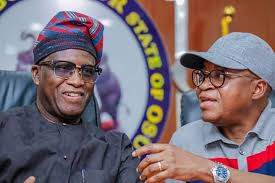
Gov. Adegboyega Oyetola of Osun, has described his deputy, Benedict Alabi, as a loyal companion, as he celebrates his 55th birthday anniversary.

Oyetola, in a congratulatory message signed by his Chief Press Secretary, Mr Ismail Omipidan in Osogbo on Sunday said Alabi remains a deputy governor that every reasonable and responsible governor would crave for.

The governor said that Alabi’s commitment and dedication to the ideals, policies and programmes of the All Progressives Congress-led administration in the state were commendable.

He said Alabi typifies the “Omoluabi ethos”, which Osun is known for.

Oyetola said the vibrancy and capacity of the deputy governor had impacted positively on the overall achievements of the state government, particularly in its battle to contain the spread of the deadly coronavirus.

“I joined family members, friends and political associates of Mr Alabi in wishing him blissful birthday celebrations.

“Our deputy governor, as you celebrate your 55th birthday today, I pray to Almighty God to grant you many more years in good health, wisdom and knowledge to continue to serve our state and humanity at large.

“Also on behalf of my family, the government and people of Osun, I thank God for your life that has been filled with laudable achievements and accomplishments.

“I pray God continues to keep you in good health and bless you with many more years of robust service to the government and people of Osun,’’ Oyetola prayed.

It was reported that Alabi was born on July 12, 1965, in Ikire, Irewole Local Government Area of the state.

7 militants killed in security operation in southern Somalia

0

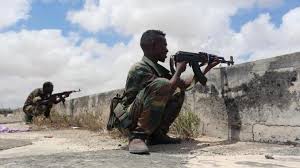
Somali security forces, backed by the Southwestern state army, killed seven al-Shabab fighters and injured five others on Saturday in an operation in Bardale town in the southern region of Bay, an official confirmed on Sunday.

Mohamed Isak, governor of Bardale town, told journalists that the joint operation started when the army got intelligence that the militants were hiding to plan further attacks in the area.

“There was intense confrontation between the army and the militants in Bardale town, but our forces subdued the militants, killing seven of them including a senior leader, who was in charge of finance and we also injured five others,’’ Isak said.

He noted that a government soldier was killed and three others injured during the confrontation.

The latest operation came barely two days after Somali National Army (SNA) killed five al-Shabab militants, including two senior leaders, in another operation in Janale town in the country’s southern region of Lower Shabelle.

Meanwhile, the Somalia National Army (SNA) said its forces have captured al-Shabab territories in Mubarak district of Awdhagle in the southern region.

The SNA said in a statement on Sunday that the areas were captured during a sting military operation to liberate areas still under al-Shabab control.

The army said the operation, which was carried out on Saturday, also saw the forces removing landmines planted by the extremist group in the area.

The army said it will intensify military operations to ensure they flush out all al-Shabab remnants in the areas that are still under their control.

Somali army backed by African Union Mission in Somalia forced al-Shabab extremists out of the capital Mogadishu in August 2011.

But the militants still hold swathes of rural areas in southern and central Somalia, conducting ambushes and planting landmines as they stage attacks in the city and elsewhere.

Ghana’s COVID-19 cases surpass 24,000

0

Ghana’s COVID-19 cases have increased to 24,248, with 414 more infections confirmed late Saturday, according to the latest update from the Ghana Health Service (GHS).

The update said the health authorities had treated and discharged 619 more people, bringing the number of recovered cases to 19,831, while the number of deaths stood at 135.

The Saturday night update also put the number of active COVID-19 cases in the West African country at 4,282, as President Nana Akufo-Addo spent his eighth day in self-isolation after a close associate of his tested positive for the pandemic.

Ghana has passed a law to enforce the wearing of face masks in public, in a bid to control and end the continued spread of the pandemic in the country. 

Ekiti Govt threatens erring SDGs’ contractors

0

The Ekiti State Government has threatened to sanction erring contractors handling various Sustainable Development Goals (SDGs) projects in the state.

The Secretary of the SDGs in the state, Mr Olukayode Adunmo, gave the warning after a two-day inspection tour of projects so far executed and completed under the 2018 intervention programme in four selected local government areas of the state.

Adunmo said on Sunday in Ado Ekiti that any contractor who abandoned project sites after collecting mobilisation fees or other fees in the handling of SDG works in the state would be made to refund all monies collected.

It was reported that the about 60 projects, domiciled mostly in schools and hospitals, included supply of equipment, outright construction, reconstruction and rehabilitation of dilapidated classrooms and ward structures, toilets, boreholes, staff quarters, landscaping and interlocking, among others.

The projects are cited in four of the 16 local government areas of the atate, including Ekiti South West, Ijero, Moba and Oye.

Adunmo, in company with the Senior Special Assistant to the Governor on SDGs, Mrs Abimbola Solanke, led a team from the Presidency on the inspection visit.

The scribe said the SDGs office in the state once had a case of job abandonment by a contractor who was later picked by the EFCC, and made to refund the money he collected.

This, he said, was in line with the known fact that the present administration in the state under Gov. Kayode Fayemi do not take kindly to culture of projects’ abandonment or sharp practices in any form by individuals or group.

He noted that the strong political will of the governor had been of tremendous assistance to his office.

“We always try our possible best in line of duty to ensure no contractor is left unmonitored and where you defaulted, we will make sure your further payment is delayed while you are warned to return to site and do the needful or risk further actions that may not be palatable.

“When we suspect foul play on our jobs, we give you a long rope of not longer than six months moratorium to amend your ways, after which the contract is terminated, and you are made to refund our money.

“There is no hiding place for defaulters, no matter where they may be hiding.

“That is why no contractor is fully paid up until a satisfactory work is delivered. I must however confess that 99 per cent of our present crop of contractors satisfactorily delivered on the jobs awarded them.

“The truth about our part of the world is that no contractor wants to perform to target time of delivery and specification, unless you put up strong monitoring mechanism, and it is on the basis of this that i want to commend the political will of the governor and our able team of top officials for making this possible through their close monitoring and uncompromised supervision,” he said.

According to Adunmo, all the completed projects are to be officially handed over to the benefiting local governments and communities within the next couple of weeks.

The Special Assistant to the Governor on SDGs, Mrs Abimbola Solanke, assured other local governments that the projects would soon be extended to them.

Solanke said eight of the coucils had earlier benefitted when the programme was still running under the Millennium Development Goals (MDG’s), thereby leaving only four council areas.

It was reported  that the team from the Presidency, comprising Mr Liadi Lukman, a representative of the Senior Special Assistant to the President on SDGs, and Mr Joseph Abiolu, a Federal Government appointed Consultant, gave Ekiti a pass mark of over 93 per cent.

They expressed satisfaction at the quality of projects inspected and commended the Ekiti SDGs office for completing the projects based on specifications.

The team later presented the assessment report to Mr Biodun Omoleye, the Chief of Staff to Gov. Kayode Fayemi, commending the State Government on what they called excellent SDGs project delivery in the state. 

Kwara records 71 fresh cases of COVID-19

0

The Kwara Government says 71 more people have tested positive to Coronavirus (COVID-19), bringing the total of confirmed cases in the state to 382.

The Chief Press Secretary to the state Governor and Spokesman of the Technical Committee on COVID-19, Mr Rafiu Ajakaye, made this known in a statement issued on Sunday in Ilorin.

According to him, this brings the total of confirmed cases to 382, with 167 patients discharged and 12 death recorded in the state.

“As at 11:00 pm on Saturday the number of active cases is now 203, while 167 have so far been discharged and 12 deaths recorded,” he said. 

Lagos state COVID-19 mortality rises to 185

0

The Lagos State Government says it has recorded three new COVID-19 related deaths, raising the number of COVID-19 related deaths in the state to 185.

The state’s Commissioner for Health, Prof. Akin Abayomi, made the disclosure through his Twitter account on Sunday while giving the state’s COVID-19 update for July 10.
He, however, did not give additional information on the sex, age, nationality or medical conditions of the deceased.

Abayomi added that out of the 1,147 COVID-19 tests conducted in the state on July 10, 165 were confirmed positive.
“The new cases had brought the total number of confirmed COVID-19 infections in the state to 12,056,” he said.

The commissioner disclosed that 47,684 COVID-19 tests had been conducted so far in the state since the outbreak of the epidemic.

“A total of 1,841 of the confirmed cases have since been discharged from COVID-19 care centres following their full recovery.
“We still have 332 of the patients currently under isolation in public and private care centres,” he said.

Abayomi said that 7,634 of the confirmed cases monitored in communities by COVID-19 state response team have either fully recovered or positively responding to treatments.

He, however, said that 2,064 active cases in communities were yet to turn up for admission in COVID-19 care centres.
Abayomi stressed that COVID-19 was real, thus advised residents on wearing of facemasks, regular hand washing and ensuring physical distancing to reduce the risk of infection.

He advised residents to call the state’s 0800CORONA hotline for any COVID-19 related issues

Nigeria: The Problem of Memory

0

By Arinze Oduah

Introduction

On May 25, 2020, George Floyd, an unarmed 46-year-old African-American was killed by Derek Chauvin, a white police officer, in Minneapolis, Minnesota, USA. This set off a chain of events around the world, including the pulling down of monuments to chattel slavery and the Trans-Atlantic slave trade. On May 26, 2020, I fortuitously participated in a conference on “Remembering to Prevent: Enhancing Collective Memory for Mass Atrocities Prevention” organized by the NGO ‘Global Rights’ and focusing on the situation in Nigeria. Panelists and participants debated the place of memory in Nigeria’s quest for justice and reconciliation to help prevent mass atrocities. At a time of increasing insecurity, separatist agitation, and inciting fake news, this conference was timely.

In the following paragraphs I summarize my contribution and recommendations in the hope that this will stimulate further discussions among diverse audiences, including civil society groups, government policy makers and academicians in ‘conflict studies’ leading to focused action to prevent mass atrocities.

Memory and History

Memory exists, even without deliberate effort to create it. It emerges from dynamic processes that produce and reshape it in the context of power relations. Therefore, it is “the object of disputes, conflicts, and struggles”. Memorials expressing memories are thus not passive, but active, even as monuments, street names, national holidays, education curricula, literature, film, drama, and so on. As Caroline Randall Williams wrote in a June 26, 2020 New York Times article: “What is a monument but a standing memory.”

History is “… what actually happened, whereas memory is the way the past casts its shadow over the present and the future”, or as Andreas Huyssen (2003) puts it: “…memory is the way the past is present.”

In Nigeria our memories and history are heavily contested, especially those relating to mass atrocities. While significant work has been done on our history, organized effort is lacking in shaping and aligning our memories of major conflict events. This intentional amnesia results in a discomfiting dissonance ranging from denial and obfuscation, to exaggeration and fabrication, and has given rise to conflicting and contradictory memories that co-exist uneasily in a combustible mixture presaging conflict. However, such an outcome is not inevitable if coordinated action is taken, drawing from the experiences of others who have incorporated memory initiatives into a suite of actions that help to prevent the reoccurrence of mass atrocities.

Do Memories Prevent or Provoke Mass Atrocities?

Some have argued that preserving memories of mass atrocities hardens the fundamental basis of conflict that produced those events. In other words, such memories deepen divisions and complicate efforts at reconciliation. Examples cited to justify this view include the Balkans and the Israel – Palestine conflict.

Others, including myself, take a different view, arguing that countries that evinced willful forgetfulness of mass atrocities experienced reoccurrence of these events. For example, the 1939-1945 Holocaust that was preceded by the 1904-1908 Herero-Nama genocide both of which were perpetrated by Germany.

Meanwhile, robust attention to memories helped create the European Union after World War II leading to the prevention of mass atrocities in Western Europe. Post-independence African examples include Rwanda, Tanzania (Zanzibar), Gambia, Cote D’Ivoire, South Africa, and Namibia. In Latin America, memory initiatives continue to play a key part in reconciling aggrieved parties in Argentina, Peru, Chile and Colombia.

The risk of memory preservation promoting conflict can be avoided by adopting adequately resourced and appropriate comprehensive strategies targeting the prevention of violence. By controlling the narrative of past atrocities, it can be purposefully directed towards justice and reconciliation, and away from division and conflict. While this is not a silver bullet, it is an essential contributor to reconciliation.

The Case for Public Memory

As we saw earlier, memory is an active force that can unite or divide. Fortunately, we can intervene to shape memories of mass atrocities such that they conduce to reconciliation rather than conflict. More inclusive and representative memories promote social justice and reconciliation. Unlike social memory that is created by atomized kinship groups, or collective memory that is shared by people outside their kinship contexts without knowing each other, public memory is created when groups of previously unrelated people interact in the public sphere to shape and adopt the memory of an event. This inclusive public memory unites all parties that contributed in shaping it and is essential for reconciling them.

In Nigeria, we have the opportunity to intentionally invest in the subjective process of creating public memories, while simultaneously preempting the hardening of social and collective memories into systematic ideologies of exclusion that are implicated in mass atrocities.

Using Memories to Mitigate the Risk Factors of Mass Atrocities

The process of creating public memories, and the public memories that emerge therefrom, mitigate the risk factors for mass atrocities. Research, such as that done by James Waller (2002, 2016), has identified four categories of five risk factors each that are correlated with mass atrocities, and they are: governance; conflict history; economic conditions; and social fragmentation. Each of these four categories of risk factors can be mitigated by memory initiatives designed to “commemorate or enhance understanding of a conflictive past, including—but not limited to—the erection and maintenance of memorials and monuments, the operation of museums and exhibits, traditional ceremonies and rituals, musical and theatrical performances on relevant topics, the running of educational, awareness-raising, dialogue and remembrance programs, the teaching of history, and the gathering and preservation of information.”

Memory initiatives are integral to the process for synthesizing public memories that promote social justice and reconciliation, that in turn help to prevent mass atrocities in a virtuous cycle.

The Post-Independence Nigerian Situation

Nigeria ranks high on all four categories of risk factors for mass atrocities. On governance, regimes since independence have been anocratic. They have struggled with a legitimacy deficit, and underperformed in the delivery of basic social goods. The haunting legacy of the Nigeria-Biafra War, the current conflicts in the North East and North West, and past significant conflict events across the country elevate the risk of conflict history. Social fragmentation appears to be worsening, including sectarian divisions and separatist agitation. Lastly, economic conditions are deteriorating, with rising unemployment and inflation, and an economic growth rate trailing population growth to deepen poverty. Given this situation, consistent and coordinated action, incorporating strategic memory initiatives, is necessary to prevent mass atrocities.

Recommendations: Memory Initiatives to Mitigate Mass Atrocities Risk Factors

1. A national strategy for memory and history to stimulate and sustain dialogue for reconciliation based on a minimum consensus on major conflict events, and how to memorialize them. Education and a continuous refresh of narratives to create public memories will feature prominently in this strategy.

2. Review of the mandate of the National Commission for Museums and Monuments to expand its remit from administration of antiquities to the creation of memorials according to a coherent national agenda, with mass atrocity prevention as a specific objective.

3. A review of current memorials and monuments across the country, particularly those associated directly or indirectly with conflict events to avoid divisive or insensitive memorialization. This includes State and Federal facilities and infrastructure such as roads, airports, educational institutions, stadia, bank notes, postage stamps, and so on named after historical figures.

4. Deployment of the full range of transitional and restorative justice approaches conducive to the creation of public memories at both Federal and State levels, including: hearings, special courts, and prosecution; truth and reconciliation commissions; lustration and vetting; and finally through institutional reform.

5. An active and engaged civil society cutting across Nigeria, and intentionally mobilized to jettison old memories of division and create new public memories of justice and reconciliation.

6. A progressive demilitarization and de-politicization of our public physical spaces to capture memories from below, especially from non-state participants, and the recording of the names of all victims of mass atrocities in appropriate memorials.

7. Creative use of economic instruments and policies to promote restitution, integration, reconciliation and peace.These recommendations require strategic and sustained effort over a long time horizon, and need the combined effort of politicians and society as whole to build public memories that promote justice and reconciliation. The price of willful forgetfulness is high, and the task of building public memories of mass atrocities is more urgent than ever, especially now that some of the key actors can still contribute.