Home Blog Page 7691

Lebanon Central Bank sets up committee to restructure banks

0

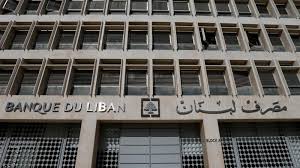
Lebanon’s Central Bank has set up a committee to restructure financially-stricken commercial banks and study their performance, a memo by the bank seen by Reuters on Thursday showed.

“The panel will also propose measures to preserve the soundness of the banking sector,’’ the memo said.

Lebanese banks are poised for a major shake-out after the country plunged into a financial crisis in October 2019 that has ballooned prices, slashed jobs, and brought on capital controls that have frozen people out of their dollar savings.

A government rescue plan that has served as the cornerstone of talks with the International Monetary Fund to help Lebanon out of its financial crisis maps out massive losses in the financial system.

The talks with the IMF have been bogged down by a dispute between the government and the central bank over the scale of the losses and how they should be shared.

Debt-saddled Lebanon has around 40 banks serving a population of around 6 million.

The sector has swelled to four times the size of the economy thanks to decades of taking in billions of dollars every year from Lebanon’s widely scattered diaspora to help fund the government. 

Malta marks one week without new coronavirus cases

0

Malta marked a week without new coronavirus cases on Thursday, the first since the virus was detected there for the first time on March 7.

Health Minister Chris Fearne confirmed in a tweet that no new cases had been detected for a week.

The last was a single case on July 9.

“We must continue to be prudent to maintain our success,” he said.

Malta saw 674 cases and nine deaths in almost four months but now only has four active cases of the virus, the rest having recovered.

The Mediterranean island has benefited from its small size by employing a high rate of testing, with some 20 per cent of the population tested and contact tracing.

Its economy, however, has been hit hard by the closure of the airport, with tourism accounting for a third of GDP.

Flights resumed on July 1 and services were extended on Wednesday to 50 countries.

China to reopen movie theatres as epidemic wanes

0

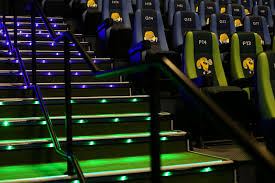
Chinese movie theatres in low-risk areas have been allowed to resume operation starting from July 20 following an improvement in the COVID-19 epidemic situation, the China Film Administration announced Thursday.

These movie theatres should reopen on the premise that proper prevention and control measures have been put in place, the administration said in a circular.

Attendance per show must not exceed 30 per cent, according to a guideline on the sector’s work resumption issued by the Chinese Film Circulation and Projection Association on Thursday.

Cinemas are required to sell non-adjacent tickets in every other row, and moviegoers who are strangers to each other should keep a distance of at least one metre.

All moviegoers must make real-name reservations and purchase tickets online.

Those who do not wear masks or with a body temperature above 37.3 degrees Celsius will not be admitted into the theatres, the guideline read.

Afghanistan condemns rocket firing by Pakistani army on its soil

0

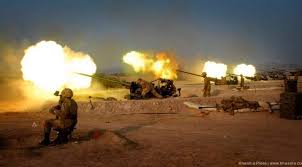
Afghanistan on Thursday strongly condemned an alleged rocket firing by the Pakistani army on its soil resulting in civilian casualties and damage to their houses.

In a statement released, the Foreign Ministry said the rockets were fired on eastern Kunar province, along a disputed border that Pakistan is fencing since mid-2017.

A police spokesman in the province said at least six civilians were killed and seven others, including women and children, were wounded in the rocket firings on Wednesday.

Two houses were also damaged.“Afghan forces stationed there responded to the attacks,’’ the official added.

Kabul called on Islamabad to refrain from “unacceptable” artillery attacks and arbitrary installations, as it can cause further escalations between the two countries.

According to the Foreign Ministry, Islamabad has agreed to a ceasefire following diplomatic efforts, and a joint meeting will be held between security officials in the area.

The 2,430-kilometre-long Afghan-Pakistan border was created in 1893 between the then British India and the Emirate of Afghanistan.

Battles between neighbouring states along the de facto border known as the Durand Line rarely occur, but relations are considered tense.

Afghanistan and Pakistan are in dispute over whether the border is officially recognised.

Report says Kabul accuses Islamabad of supporting the Taliban militants fighting against the U.S.-backed Afghan government, a claim Pakistan denies.

Philippine president considers re-imposing tight virus restrictions

0

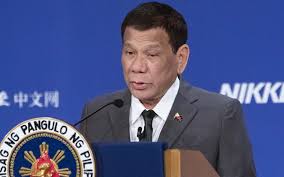
Philippine President Rodrigo Duterte might re-impose tight quarantine restrictions in the capital of Manila amid a spike in coronavirus infections and deaths, his spokesman said on Thursday.

“In a late-night meeting with an inter-agency task force on COVID-19 on Wednesday, health experts had recommended that public transportation, private offices, restaurants and commercial shops be shut down again in Manila,’’ presidential spokesman Harry Roque said.

Roque said that the president agreed at first, however officials appealed to him because the mayors of Metro Manila promised they will step up localized lockdown to contain the spread of the virus.

“They promised to intensify testing, tracing and treatment,’’ he said.

Roque said Duterte agreed not to place Metro Manila under the stricter protocol, called modified enhanced community quarantine (MECQ), in the next two weeks.

“It was clear in the discussion that if the spread of the COVID-19 does not slow down in Metro Manila, it is possible that MECQ will be re-imposed after two weeks,’’ he added.

On Wednesday, the Department of Health said the country’s total number of COVID-19 cases was at 58,850, with 1,614 deaths.

Almost 50 per cent of the infections and 57 per cent of deaths were from Metro Manila.

Since June 1, the Philippine government has been easing the lockdown that was imposed in the country’s most populous island of Luzon, which encompasses Manila, and in other high-risk areas in mid-March.

Limited public transportation has resumed, while shopping malls, salons, barber shops, restaurants, private offices and even some churches have also opened in a reduced capacity. 

Oil production cut: OPEC+ tasks JTC on monitoring implementation

0

The Organisation of Petroleum Exporting Countries (OPEC) and its allies called OPEC+ has requested the Joint Technical Committee (JTC) to closely monitor the implementation of the required compensation of oil production cut by the underperforming participating countries.

OPEC+ disclosed this at the end of its 20th virtual meeting of the Joint Ministerial Monitoring Committee (JMMC) under the Declaration of Cooperation (DoC), in Vienna.

A statement by the committee on its website also requested the OPEC secretariat to join in monitoring the performance and report to the JMMC.

The committee urged underperforming participating countries to submit their plan for implementation of the required compensation for June to the OPEC secretariat by the end of July 2020.

The body welcomed the participation of Angola, Gabon, South Sudan and Congo and noted that they had pledged their commitment to the DoC production adjustments and compensation plans.

It noted that conformity to the production cut deal by participating countries stood at 107 per in June and commended Saudi Arabia, the United Arab Emirates and Kuwait for their additional voluntary contributions made in June.

The committee noted that removing the credit for over conformity resulted in a conformity level of 95 per cent in June, the highest since the inception of the DoC in January 2017.

It highlighted the importance of the DoC in supporting oil market stability and reiterated the historic decision taken by all participating countries in the DoC.

The committee reviewed and reaffirmed the commitment of all participating countries to achieve full conformity and make up for any shortfall under compensation plans, presented to it.

The body stated that achieving 100 per cent conformity from all participating countries was not only fair, but vital for the ongoing rebalancing efforts and to help deliver long term oil market stability.

The OPEC+ committee observed that there were encouraging signs of improvement as economies around the world opened up.

“While there could be localised or partial lockdowns re-imposed in some places, the recovery signs were clear, both in physical and futures markets.

“Moving to the next phase of the agreement, the extra supply resulting from the scheduled easing of the production adjustment would be consumed as demand recovers, it noted.

The committee said that the seasonality was more pronounced this year, due to the pandemic, noting that for many DoC participants, there would be an increase in demand for utilities, as well as changes in travel patterns.

This, it said, would boost domestic demand for gasoline and diesel and as a result the impact on DoC participating countries’ exports that would be limited.

The committee maintained that the compensation schedule that had been agreed by participating countries would mean that the effective level of adjustments would be deeper.

France to require masks in indoor public spaces from next week

0

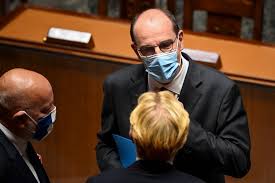
France will make masks obligatory in all indoor spaces open to the public, with effect from next week, Prime Minister Jean Castex said on Thursday.

Castex told the Senate in Paris that the coronavirus situation was “heading in a rather positive direction” on the national level.

There were, however, “certain local situations that call for greater vigilance,” he said, citing the South American territory of French Guiana.

France was one of the European countries hardest hit by the virus, with more than 30,000 deaths.

A strict lockdown was in place from March 17 to May 11.

The country’s public health agency warned last week that the number of confirmed cases was rising again in mainland France, but remained at a low level.

President Emmanuel Macron said earlier this week that he wanted masks to be made obligatory indoors “within weeks.”

They are already compulsory on public transport and in most of the cultural sites that have reopened.

In bars and restaurants, staff must wear masks, as must customers if they are moving around inside – though that rule is often not followed.

The new decree will also apply to all shops, and Castex said workplace protocols could also be revised to make them compulsory in workplaces that are not open to the public.

Castex, who was appointed by Macron two weeks ago, said he expected negative economic growth of 11 per cent this year due to the virus, which would be France’s worst recession on record.

Court refuses to dissolve 10-year-old marriage

0

The Karu Upper Area Court sitting in Mararaba, Nasarawa, on Thursday refused to dissolve a 10-year-old marriage brought by one Mrs Deborah Joseph for lack of care.

The petitioner had urged the court to nullify the marriage between her and her husband, Mr Pious Joseph, on account that he had not cared for his family anymore.She accused the husband of planning to use their first child for money ritual.

She also alleged that the husband was always coming home late and  drunk.“We have two kids and I have been the one catering for the family. I feed them and pay rent.
“I want this court to separate us because there is no love again and he has not paid my dowry,” she said.The respondent denied the petitioner’s claim saying that since he married her, he had always provided for them, and that he had never raised his hand on her.

“Since I lost my job, life has never been the same,” he told the court and begged it not to grant her wife’s request.The presiding judge, Mr Ibrahim Shekarau, however,  urged the parties to go home and make peace.

Shekarau, therefore, adjourned the matter until Aug. 12, for judgement.

Moscow protest against Putin’s referendum ends with over 130 detained

0

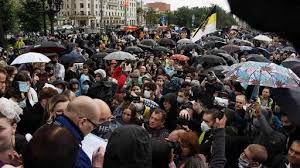
Moscow’s Police Department on Thursday said over 130 people had been detained the previous night at a protest against a recent referendum enabling President Vladimir Putin to remain in office for the next 16 years.

“The rally, on central Moscow’s Pushkin Square, was unauthorized due to restrictions to prevent the spread of the coronavirus,’’ the police department said in a statement.

Protesters marched through one of Moscow’s main boulevards, disrupting traffic.

“Police and National Guard troops detained 132 people at the demonstration,’’ the police department said.

Many protesters shouted “Shame’’ and “Putin is a thief.’’

The radio station Ekho Moskvy (Echo of Moscow) spoke of more than 1,000 participants marching through the streets of Russia’s capital and largest city.

Hundreds of people also took to the streets of Russia’s second largest city, St Petersburg.

Russia voted on a new constitution several weeks ago to extend Putin’s powers and enable him to rule until 2036 should he be re-elected.

According to the official tally, about three-quarters of the votes were in favour.

People from the opposition assume that the voting was falsified on a massive scale.

There was also criticism at the international level.

The referendum was not independently observed by the Organisation for Security and Cooperation in Europe (OSCE), which has traditionally monitored Russian elections. 

Group urges review of EFCC Act, agency reform

0

Coalition of South East Youth Leaders (COSEYL), a non-governmental organisation, on Thursday called for review of the Economic and Financial Crimes Commission (EFCC), Act to enable it to serve Nigerians better.

COSEYL also asked for reforms in EFCC to ensure its competence and effectiveness in checking corruption.

The group made the call in a news release signed by the coalition’s President-General, Chief Goodluck Ibem, and Secretary-General, Mr Kanice Igwe, in Aba on Thursday.

COSEYL said that although Nigerians had in the past complained of governments subjecting the body to hunting down political enemies, recent developments had shown the need to reform the body.

It said EFCC, created during President Olusegun Obasanjo’s administration to fight financial crimes, enjoyed the goodwill of local and international community and partners but had failed to meet expectations of the citizenry.

“COSEYL expresses deep regret that since its creation, the commission has been largely used by governments in power to hunt down opposition and to stifle voices of dissent.

“However, the body left, in most cases certain persons, mostly party members in power, as the proverbial “sacred cows”.

“Although few cases exist where the commission has gone after persons in government, not much has been seen in terms of prosecution of such politicians in ruling parties.

“It beats the Coalition’s imagination that in spite of billions of dollars reportedly recovered by the commission from corrupt public office holders, Nigerians are yet to feel the impact of such monies meaningfully,” it said.

The body said that the structure of the commission could hardly enable it to function independently as long as its chairman remained an appointee of the executive.

It said that although the body was aware of EFCC’s successes, the anti-financial crimes agency had yet to prove its effectiveness in fighting the economic crimes in Nigeria which appeared to be escalating daily.

The Coalition criticised the appointment of the commission’s head by the country’s presidents and called for a review of the EFCC Act to enable it  to operate independently of the executive or other arms of government.

It argued that had the president not had the power to appoint EFCC’s head, it would have been impossible to retain Ibrahim Magu as acting head notwithstanding unfavourable security reports against him.

“It is ideal that the appointments, sack and remuneration of the commission’s staff members are done outside the presidency as should be appropriate.

“Also, the Coalition suggests that for anybody to be appointed chairman of the commission, he should be subjected to intelligence agencies scrutiny for six months,” it said.

The group called for the appointment of a South Easterner to the post of EFCC head adding that following the federal character rule, the leadership of the body should be given to another geo-political zone.

The coalition noted that as constituted, EFCC could not work for the benefit of Nigerian masses or be insulated from political influence except the laws establishing it were reviewed.