Home Blog Page 755

Lagos RRS Responds to Multiple-Vehicle Accident at Otedola Bridge

0

Operatives of the Lagos State Rapid Response Squad (RRS) have swiftly responded to a multiple-vehicle accident involving a fully loaded tanker and six other vehicles at Otedola Bridge, outward Lagos but inward Berger.

According to a statement by the RRS, the incident occurred earlier today, prompting immediate intervention by officers stationed in the area.

No lives were lost in the crash, though two persons sustained serious injuries and were promptly conveyed to a nearby hospital for medical treatment.

Emergency responders, including traffic and rescue officials, remain on ground as efforts continue to evacuate the affected vehicles and restore free flow of traffic along the busy corridor.

Motorists have been advised to exercise caution and cooperate with traffic officials as clearance operations progress.

How Not to Defame a Saint: Gbenga Komolafe’s Unblemished Record in the Nigerian Oil Sector

0


By Benedict Aguele

In the age of instant narratives and social media-driven outrage, few things are as dangerous as unverified allegations leveled against competent public servants. Engr. Gbenga Komolafe, former Chief Executive of the Nigerian Upstream Petroleum Regulatory Commission (NUPRC), has recently been subjected to a torrent of claims alleging corruption, asset manipulation, and revenue concealment. Yet, a careful examination of the facts reveals that these allegations are not only unfounded but also reflect a troubling pattern of targeting individuals who are effective reformers in Nigeria’s critical oil and gas sector.

Komolafe’s tenure at the NUPRC coincided with a transformative period in the Nigerian petroleum industry. The Petroleum Industry Act (PIA), signed into law in 2021, established a robust legal framework for regulating upstream operations, enhancing transparency, and modernizing revenue management. As CEO, Komolafe applied his extensive knowledge of petroleum law and regulatory best practices to ensure that the agency fulfilled its statutory mandate. His focus on compliance, due process, and legal integrity naturally ruffled the feathers of individuals accustomed to the old ways of doing business, and it is within this context that the recent allegations must be understood.

One of the most striking aspects of the claims against Komolafe is their audacious scope. Petitioners have accused him of controlling dozens of bank accounts, concealing billions in oil and gas revenues, and orchestrating the unlawful reduction of multiple oil mining leases. Verified records, however, demonstrate that Komolafe maintains only two bank accounts. There is no evidence to suggest that these accounts were used for illicit purposes. Such inaccuracies underscore a fundamental flaw in the allegations: they are based on conjecture and selective interpretation rather than documented proof.

It is also important to consider the behavior of the petitioner, who initially approached the Director-General of the Department of State Services (DSS) to request an investigation. Once scrutiny began, he went underground, apparently seeking a settlement that never materialized. This pattern strongly suggests that the allegations were motivated more by personal gain or retaliation than by genuine concern for regulatory compliance. Komolafe, on his part, did not kowtow to these pressures, choosing instead to operate transparently and within the bounds of the law.

Throughout his tenure, Komolafe emphasized regulatory integrity, transparency, and accountability. Any suggestion that he could single-handedly manipulate Nigeria’s upstream assets without detection ignores the complex checks and balances embedded in the PIA framework. These include multi-agency oversight, audits by the Nigerian Extractive Industries Transparency Initiative (NEITI), monitoring by the Ministry of Petroleum Resources, and scrutiny by international partners. Claims that billions were “concealed” or that strategic oil and gas assets were mismanaged do not withstand scrutiny when the systemic regulatory and institutional safeguards are considered.

*Facts Over Fiction: Debunking Misleading Claims*

Another central allegation pertains to Oil Prospecting Licence (OPL) 227 and its supposed conversion to OML 146, allegedly reducing the acreage drastically. Here again, the claims misrepresent both the law and the operational reality. Regulatory approval processes under the PIA require thorough documentation, technical verification, and alignment with existing lease agreements. Any lawful conversion or adjustment is subject to board approval, ministerial ratification, and public disclosure. Komolafe’s involvement in overseeing these processes was purely administrative and statutory, consistent with his legal obligations as the NUPRC chief executive. There is no evidence of personal enrichment or unlawful action.

Similar accusations were made regarding OMLs 33, 46, and 74, purportedly reduced without proper justification. However, independent assessments reveal that all regulatory decisions during Komolafe’s tenure were conducted under the established legal framework. Assertions that portions of these leases were misappropriated or that revenues were diverted are not supported by verifiable documents or audits. They reflect a narrative constructed for maximum sensational impact rather than a factual account.

Equally misleading are claims about the operation of Sterling Exploration and Energy Production Company (SEEPCO) and alleged underreporting of wells. While SEEPCO’s operations are indeed licensed, any discrepancies in reporting fall under the remit of multiple regulatory bodies, and there is no evidence that Komolafe personally facilitated any illicit operations. The insinuation that he orchestrated financial opacity or laundered proceeds through multiple bank accounts is categorically false and inconsistent with both public records and his documented professional conduct.

*Preserving Integrity and Justice*

Komolafe’s career exemplifies the highest standards of public service. His commitment to legal compliance, transparency, and institutional reform was evident in every decision taken at the NUPRC. Allegations rooted in hearsay, unverified documents, or personal vendettas not only threaten his reputation but also undermine broader governance reforms. When reformers are targeted without due process, it signals to the nation’s bureaucracy and private sector that compliance, professionalism, and integrity may be punished rather than rewarded.

It is also essential to consider the principle of proportionality in accountability. Public servants must be evaluated on the basis of evidence, not conjecture or political expediency. Komolafe’s resignation from office should be viewed within the normal course of administrative transition, not as an admission of guilt. He acted within his statutory powers, and there is no credible evidence linking him to corruption or fraudulent manipulation of assets.

Civil society organizations, media professionals, and regulatory stakeholders must recognize the dangers of perpetuating unverified claims. While oversight and accountability are non-negotiable in a democratic system, the deployment of inflammatory allegations without substantiation amounts to character assassination. Nigeria’s petroleum sector, already complex and strategically critical, cannot afford the destabilizing effects of misinformation and false narratives.

In this context, Komolafe’s example is instructive. He navigated an era of major reform, applying his expertise to safeguard national interests while maintaining professional integrity. His conduct demonstrates that effective regulatory leadership is possible without succumbing to personal enrichment, nepotism, or corruption.

The path forward for Nigeria’s extractive industry lies in institutional strengthening, transparency, and evidence-based oversight. Petitions and claims should be rigorously investigated, but the presumption of innocence must be maintained. Komolafe’s record should remind policymakers, journalists, and civic actors alike that constructive reformers are assets to the nation, not targets for defamatory campaigns.

In conclusion, Engr. Gbenga Komolafe’s tenure as NUPRC chief executive reflects dedication, legality, and reformist zeal. To defame a public servant without evidence is not only unfair to the individual but detrimental to national development.

Aguele is a member, governing council Maritime University Oron.

Middle Belt Group Lauds President Tinubu’s Intervention In Benue APC Crisis

0


***Says Speaker Abbas Right Man to Deliver on Lasting Peace Pact

The Middle Belt Democratic Agenda has enthusiastically commended President Bola Ahmed Tinubu for his decisive and visionary leadership in addressing the lingering crisis within the All Progressives Congress (APC) in Benue State.

The group described the President’s constitution of a high-powered reconciliation committee as a clear demonstration of his commitment to party unity, internal democracy, and the overall stability of Nigeria’s political landscape.

In a statement released today and signed by Comrade Samuel Bako, the Middle Belt Democratic Agenda hailed President Tinubu’s choice of Rt. Hon. Abbas Tajudeen, Speaker of the House of Representatives, as chairman of the Benue APC reconciliation committee.

The Benue APC has been embroiled in factional disputes, primarily between supporters of Governor Hyacinth Alia and those aligned with Senator George Akume, leading to parallel structures, legal tussles, and public disruptions that have weakened the party’s cohesion and grassroots mobilization.

Comrade Samuel Bako, in a series of pointed remarks, praised President Tinubu as a “strategic statesman” who consistently prioritizes reconciliation over division.

“President Tinubu’s intervention in Benue is yet another proof of his deep love for the APC and his determination to ensure that no state is left behind in the journey toward national progress,” he said.

“His proactive approach to resolving intra-party conflicts shows rare political maturity and foresight.”

He further described the President as “a unifier par excellence,” adding: “By appointing credible and respected figures to lead this committee, President Tinubu has once again shown that he values competence, integrity, and inclusivity.

“This move will not only heal wounds in Benue APC but will also strengthen the party nationally as we approach future elections.”

Turning to Speaker Abbas, Comrade Bako called him “the perfect bridge-builder for such a delicate assignment.”

“Rt. Hon. Abbas Tajudeen has proven time and again that he is a man of fairness, wisdom, and impartiality. His track record in Bauchi, where he successfully brought warring factions together, speaks volumes,” he stated.

” We have absolute confidence that under his leadership, Benue APC will emerge stronger and more united than ever.

Bako emphasized the Speaker’s unique qualities: “Speaker Abbas is a leader who listens to all sides. His appointment is a masterstroke by Mr. President, and we are convinced that he will deliver a lasting peace pact that will serve as a model for other states.”

The group also commended the composition of the committee, which includes Governor Mai Mala Buni, Senator Abdulaziz Yari, former Speaker Rt. Hon. Yakubu Dogara, and other high-caliber members, describing it as “a dream team of reconciliators.”

Bako urged all APC stakeholders in Benue to extend full cooperation to the committee, stressing that “unity is our greatest strength.”

“President Tinubu and Speaker Abbas have given Benue APC a golden opportunity for renewal. We pray for the success of this noble effort and reaffirm our support for the Renewed Hope Agenda,” Bako concluded.

Ekiti Takes the Lead, Domesticates Nigeria Tax Administration Act

0


….As Oyebanji signs Ekiti State Revenue Administration Law

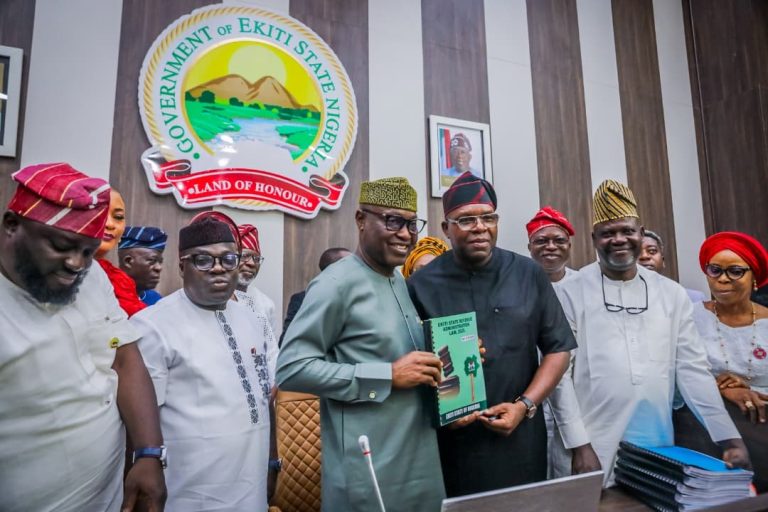
Ekiti State, on Tuesday, emerged the first state in the Federation to domesticate the Nigeria Tax Administration Act with the signing into law of the Ekiti State Revenue Administration Law, 2025 by the Governor, Mr Biodun Oyebanji.

Governor Oyebanji assented to the new revenue law, just as he signed the State’s 2026 Budget of N415,572,070,139.44 (Four hundred and fifteen billion, five hundred and seventy-two million, seventy thousand, one hundred and thirty-nine naira, forty-four kobo) at a brief ceremony held at the Executive Council Chamber, Governor’s Office, Ado-Ekiti.

The signing of the laws was witnessed by the Deputy Governor, Chief (Mrs) Monisade Afuye; Speaker, Ekiti State House of Assembly, Rt. Hon. Adeoye Aribasoye; Executive Secretary of Joint Revenue Board (JRB), Mr Segun Adesokan; members of the State Assembly and State Executive Council as well as other critical stakeholders.

Governor Oyebanji, in his address, said the new revenue law is not merely a fiscal document but a bold statement of his administration’s commitment to transparency, modern governance, and economic empowerment of the people.

He said by signing the law, Ekiti State officially became the first State in the Federation to align its internal revenue laws with the four new National Tax Reform Acts.

“From today, Ekiti adopts a strictly electronic payment, billing, and receipting system. This will eradicate leakages and ensure that your payments go directly into the state’s coffers.”, the Governor declared after signing the law.

He added: “Revenue Administration and Tax laws are changing at the national and sub-national levels, and Ekiti must lead that change. This Law repeals the Ekiti State Board of Internal Revenue Law 2019, (As Amended), to bring us into full conformity with national legislations, to adopt and promulgate the State Harmonized Taxes and Levies (Approved List of Collection) sent by Joint Revenue Board (JRB) with technical support provided by the AGF’s secretariat and to affirm the commitment of the Government of Ekiti State to the implementation of the State Action on Business Enabling Reforms (SABER).

According to Oyebanji, the new Law will institutionalise harmony, fairness, certainty and accountability in sub-national revenue administration across the country.

“This new legislation consolidates all exiting laws and streamlined them for efficient, effective and more transparent collection. To the taxpayers, business owners, and citizens of Ekiti, this Law introduces several transformative changes designed to protect citizens and foster growth.

“The other key takeaways from the Law is that it will enhance our fiscal and economic policies that are aimed at promoting investment. More importantly, the new Law will help in furthering the Ease of Doing Business, zero tolerance for double taxation, protection against extortion, empowering Local Government/LCDAs, strengthening our institutions.

“This Law grants EKIRS the power to be the sole agency responsible for revenue collection, while also allowing for the accreditation of professional Tax Agents. The Law also empowers the Service by allowing the employment of legal officers with prosecutorial powers and introducing administrative penalties to discourage default and reward compliance in line with the National Acts.”, the Governor added.

Oyebanji also expressed his immense appreciation to President Bola Ahmed Tinubu, for his transformative leadership, courage and sincerity in piloting the affairs of the country and his very strong support for Ekiti State.

He assured Ekiti people that his government would continue to pursue policies and programmes that will advance the shared prosperity agenda designed to make life more abundant for Ekiti people.

Also speaking at the event, Executive Secretary of the Joint Revenue Board, Mr Segun Adesokan, hailed Ekiti State for taking the lead in the domestication of the law, a request he said the JTB made to the Governor Oyebanji during the Board’s retreat at Ikogosi -Ekiti in September.

Adesokan said: “Recall that in September, when we had our retreat at Ikogosi and when we came for the commissioning of the State Internal Revenue Service headquarters, we made a request that Ekiti should be the first state to give life to this law and here we are today. So, when I was coming, I thought I was just going to attend the signing of the Ekiti State Taxes and Levy Act, but this is much bigger. See what you have done, Ekiti is the first state to domesticate the Nigerian Tax Administration Act.

“Four laws were signed by the President in June, one of which is the Nigerian Tax Administration Act and the Act provides for our taxes to be administered by different authorities. And I’m glad that we are here today, this a great commitment and your reaffirmation of the professionalism and autonomy of the Ekiti State Internet Avenue Service.” he added.

Adesokan expressed optimism that other states that have commenced the process leading to the domestication of the law will take a cue from Ekiti State and complete process.

Meanwhile, Governor Oyebanji, while signing the 2026 Budget of N415,572,070,139.44k, christened “Budget of Sustainable Governance”, said the 2026 Budget will focus on completion of all on-going projects, while attention will also be given to food security, wealth creation and infrastructural development.

“As next year marks the end of our first term in office , the document will enable us consolidate on our achievements as Government since the inception of our administration on October 16, 2022”, he stressed.

According to the budget breakdown, Fifty-three percent (53%) was appropriated for Recurrent Expenditure and forty-seven percent (47%) for Capital Expenditure.


Uzoka-Anite Meets Customs Boss, Lauds NCS Role in Boosting Non-Oil Revenue

0


The Minister of State for Finance, Dr. Doris Uzoka-Anite, has held a strategic meeting with the Comptroller-General of the Nigeria Customs Service (NCS), Bashir Adewale Adeniyi MFR, as the Federal Government intensifies efforts to diversify revenue sources beyond oil.
The engagement comes amid renewed focus on strengthening non-oil revenue streams, with the Nigeria Customs Service remaining one of the country’s leading contributors to government earnings outside the oil sector.
Speaking after the meeting, Dr. Uzoka-Anite praised the leadership and reform drive of the Customs boss, describing him as a key figure in the ongoing transformation of the Service.

“It is always a distinct honour to meet with the Comptroller-General of Customs, Bashir Adewale Adeniyi MFR,” she said. “I truly applaud his visionary leadership and unwavering dedication to transforming the Nigeria Customs Service.

His efforts remain a cornerstone in advancing the Renewed Hope agenda of Mr. President for a more prosperous Nigeria.”
The meeting aligns with Dr. Uzoka-Anite’s expanded responsibilities at the Ministry of Finance, particularly in revenue optimisation. These include closer collaboration with revenue-generating agencies such as the NCS to review cash flows, strengthen border enforcement, and enhance non-oil revenue collection.

The Federal Government has continued to emphasise the importance of Customs reforms as part of broader fiscal measures aimed at improving revenue performance and reducing Nigeria’s reliance on oil income.

Akpabio Announces automatic employment for two sons of his police rider

0


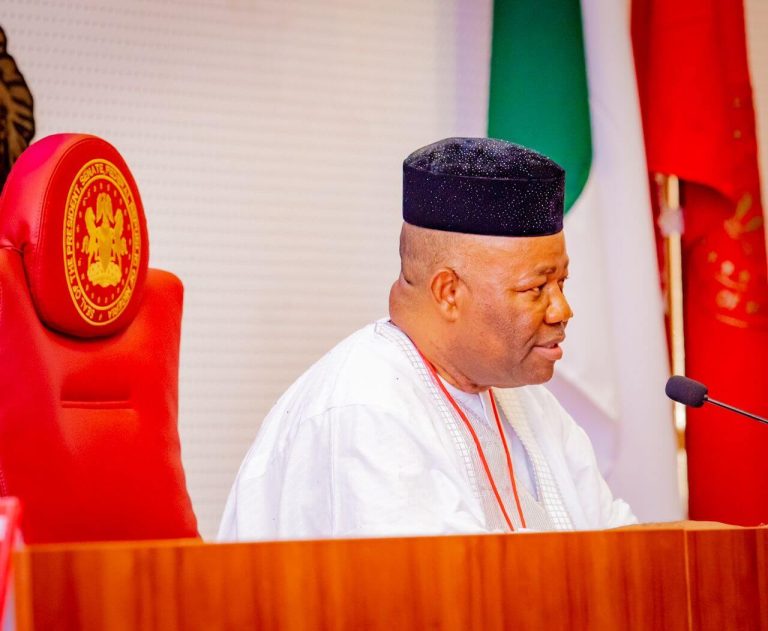
President of the Senate, Godswill Akpabio has announced automatic employment for the two sons of his police rider, DSP Hussani Ibrahim, who died in a ghastly accident on the Lagos-Ibadan expressway on Sunday.

The announcement was made on the floor of the Senate on Tuesday as Akpabio informed his colleagues of the tragic incident.

DSP Ibrahim, who served as the Senate President’s rider, has since been buried according to Islamic rites.

In a heartfelt condolence speech, Akpabio eulogised the late officer as a man who deeply understood the value of work and service.

Addressing the family, Akpabio said: “Your late father understood the value of work and service.

“He devoted himself to it. Unfortunately, instead of earning a laurel for the devotion, he earned death. But it is death that is not in vain. It is death that testifies to his legacy of service. May the Lord accept his soul.”

The Senate President extended his sympathies to the bereaved family, the Inspector General of Police, and the entire Nigeria Police Force.

“I commiserate with the family, the Inspector General of Police and the Nigeria Police Force over the loss of this courageous, fearless, and daring officer.

“While I pray to God to accept his soul, may He in His infinite mercy grant the family and the Nigeria Police Force the fortitude to bear the irreparable loss.”

The offer of automatic employment for DSP Ibrahim’s sons stands as a direct gesture of support from the Senate President to the family of the officer, honouring his legacy and sacrifice.

In a related development, the Senate also honoured Alhaji Ibrahim Tukur who also recently passed on.

He was a dedicated driver of 25 years for the Senator representing Kogi East Senatorial District, Sen. Jibrin Isah.

The Senate in plenary observed a minute silence in honour of the deceased and prayed Almighty God for the repose of their souls.

Over 77% of measles cases in Nigeria are in unvaccinated children – NCDC

0


The Nigeria Centre for Disease Control and Prevention (NCDC) says more than 77 per cent of the confirmed measles cases recorded in the country in 2025 involved children who had not received any dose of the measles vaccine.

The NCDC disclosed this in its Measles Situation Report for November 2025 on Tuesday, noting that of the 19,213 confirmed cases reported between January and November, about 14,801 were among “zero-dose” children.

According to the report, children aged 9 to 59 months accounted for nearly half (48.9 per cent) of all confirmed cases, underscoring persistent gaps in routine immunisation coverage.

The agency said Nigeria recorded 26,866 suspected measles cases during the period under review, with 153 deaths, representing a case fatality rate of 0.8 per cent.

It added that the burden of the disease was disproportionately higher in the northern part of the country, which accounted for over 80 per cent of confirmed cases, with Borno, Zamfara, Yobe, Bauchi and Kebbi states recording the highest numbers.

“In November 2025 alone, 71 suspected cases were reported across 20 states, with only one confirmed case and no deaths,” the report stated.

The NCDC noted that measles outbreaks had been largely contained nationwide, as 187 local government areas (LGAs) across 27 states had ended their outbreaks by the end of November.

“Only one LGA, Eti-Osa in Lagos State, had an ongoing measles outbreak in November, with no new outbreaks reported during the month,” it said.

The agency, however, expressed concern over surveillance challenges, including low blood specimen collection rates, and stressed the need to strengthen routine immunisation, especially in underserved communities.

It urged parents and caregivers to ensure that eligible children receive all recommended vaccines, warning that measles remains a highly contagious but preventable disease.

The News Agency of Nigeria(NAN) reports that Measles is a highly contagious viral disease that mainly affects unvaccinated children.

It spreads through coughing, sneezing and close contact, causes fever, cough and rash, can lead to serious complications or death, and is best prevented through vaccination.

Navy rescues 20 crew members, as vessel caught fire

0


The Nigerian Navy on Monday night rescued 20 crew members as their vessel caught fire along the Calabar Channel.

The Base Operations Officer, Lt.-Cdr Kelechi Ahunanya, disclosed this in a statement made available to the News Agency of Nigeria, in Calabar on Tuesday.

Ahunanya said the vessel, a Motor Vessel (MV) Chimba Express, with 21 persons comprising 14 Nigerians and seven Cameroonians on board, still has one person missing as at the time of this report.

According to him, the Nigerian Navy Ship (NNS) OSE, while on routine patrol, responded to a distress call at about 1300 hours from the vessel.

The vessel, he said was en route from Gabon to Calabar with scrap materials and other logistics.

“On arrival, thick smoke was observed emanating from the vessel, prompting immediate rescue operations.

“Crew members who had abandoned ship, as well as those stranded on deck, were rescued using life buoys.

“Twenty crew members were successfully rescued and administered first aid, ” the officer said.

According to him, the Chief Engineer, who reportedly jumped overboard due to fear of an explosion, remains missing, and a search and rescue operation is ongoing.

He added that the rescue operation had the support of personnel from Forward Operating Base, IBAKA, Naval Security Station 030 Houseboat, and local fishermen supported the operation.

“NNS OSE also deployed portable pumps to combat the fire, which affected the midship and aft sections of the vessel,” he added.

Ahunanya reaffirmed the Nigerian Navy’s commitment to the safety of seafarers and maritime assets in line with the Chief of the Naval Staff’s Mission.

7 docked over alleged impersonation on social media

0


The police on Tuesday, charged seven defendants before an Iyaganku Magistrates’ Court in Ibadan, over alleged impersonation on Facebook, Goggle and Tiktok.

The defendants are: Oladipupo Ayomide, 21; Tosin Balogun, 27; Awodele Sodiq, 22; Timileyin Ogunwole, 27; Augustine Tochukwu, 19; Michael Ayoola, 26; and Anu Taiwo, 21.

They were charged on seven-counts bordering on impersonation and aiding escape.

They each, however, pleaded not guilty to the charges.

The prosecutor, Insp Femi Omilana, told the court that the defendants committed the offences on Dec.22, at about 9.00 a.m. at Ajibode in Ibadan.

He alleged that the defendants falsely represented themselves on the social media spaces, as white ladies and men, with the intent to defraud people.

He said that Ogunwole (fourth defendant) on the other hand, aided the defendants to escape during arrested.

The prosecutor said that they were eventually arrested.

The offences contravenes the provisions of sections 10 and 484 of the Criminal Law of Oyo State, 2000.

The Magistrate, Mrs Adebola Adeola, granted the defendants bail in the sum of one million naira each, and two sureties each in like sum.

She adjourned the case until Jan. 12, 2026, for hearing.

U.S. Imposes Partial Visa Restrictions on Nigeria, 18 Other Countries from January 2026

0


The United States Department of State has announced the implementation of partial visa restrictions on nationals of Nigeria and 18 other countries, effective January 1, 2026.

According to the announcement, the restrictions will take effect at 12:01 a.m. EST and are in line with Presidential Proclamation 10998, titled “Restricting and Limiting the Entry of Foreign Nationals to Protect the Security of the United States.”

The affected countries are Angola, Antigua and Barbuda, Benin, Burundi, Côte d’Ivoire, Cuba, Dominica, Gabon, The Gambia, Malawi, Mauritania, Nigeria, Senegal, Tanzania, Togo, Tonga, Venezuela, Zambia, and Zimbabwe.

Under the proclamation, visa issuance will be partially suspended for several categories, including nonimmigrant B-1/B-2 visitor visas, F, M, and J student and exchange visitor visas, as well as all immigrant visas.

The U.S. Department of State said the measure is part of broader efforts to enhance national security through stricter entry controls.