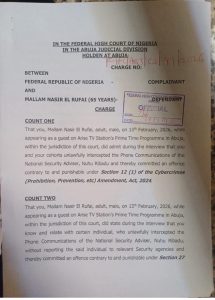
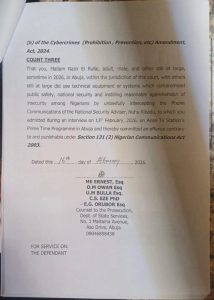
BREAKING: Federal Government to arraign Elrufai for tapping phone lines of NSA.
#El-Rafai
BREAKING: Federal Government to arraign Elrufai for tapping phone lines of NSA.
#El-Rafai
THE Revenue Mobilisation Allocation and Fiscal Commission (RMAFC) has disowned reports that certain disputed crude oil and gas wells have been recommended for ceding to specific oil-producing states, insisting that no such decision has been taken.
In a statement issued yesterday, the Chairman of the commission, Dr Mohammed Shehu, said the attention of RMAFC had been drawn to a “purported report allegedly issued by the Inter-Agency Committee on the Verification of Coordinates of Disputed Crude Oil and Gas Wells between States,” which was circulating in sections of the national media .
The commission said the report claimed that recommendations had already been made to cede certain oil wells to particular states, describing the report as “misleading, premature, and does not represent the position or conclusions of the Commission.”
“At this stage, there is no finalised recommendation or decision regarding the ceding or reallocation of any oil wells, as due institutional processes are still ongoing,” the statement read.
The commission explained that it operates a clearly defined and transparent procedure in handling assignments of national significance, stressing that the process on the disputed oil wells had not been concluded.
It disclosed that it only received a draft report from the Federal Government’s Inter-Agency Committee on Nigeria’s Oil-Producing States on Friday, February 13, 2026, which reportedly projected Cross River State as an oil-producing state.
The report, covering the nationwide 2017–2025 verification of crude oil and gas coordinates, was presented to the Chairman of RMAFC by 10 of the 14 members of the committee.
The exercise, which ran from August 2025 to February 2026, involved extensive field verification, technical reconciliation of state submissions, and a final plenary plotting of coordinates at RMAFC headquarters between January 24 and 31, 2026.
An independent media source monitoring proceedings at the chairman’s office confirmed the submission and described it as “the most comprehensive coordinates verification undertaken in recent years.”
“Consistent with established protocol, the draft document has been transmitted to relevant technical and statutory stakeholders, namely the Nigerian Upstream Petroleum Regulatory Commission, the National Boundary Commission, and the Office of the Surveyor General of the Federation, for detailed review, observations, and technical input,” the commission stated.
According to the statement, after the observations and recommendations of the agencies are received, the matter will be subjected to further scrutiny by the commission’s internal tripartite committees, comprising the Committee on Crude Oil, Gas and Investment and the Legal Matters Committee.
“These committees will undertake comprehensive technical and legal reviews before presenting their findings to the Plenary Session of RMAFC for deliberation and final recommendations,” it added.
The commission further explained that upon completion of the institutional processes, its final report would be formally transmitted to the President and the Attorney-General of the Federation for necessary consideration and further action in line with applicable laws and constitutional provisions.
Guardian

* Demands new power privatisation roadmap after ‘decade of darkness’
* Senators confront NBET over ‘outrageous’ electricity bills, alleged con
sumer exploitation
THE Nigeria Labour Congress (NLC) has questioned the rationale behind the Federal Government’s purported plan to pay between N2 trillion and N3 trillion to electricity generating companies (GenCos), alleging that the electricity subsidy remained a phantom move to “settle the boys” as the 2027 elections approach.
It said the privatisation of the power sector has thrown more Nigerians into darkness and widened energy poverty in 10 years.
Meanwhile, sparks flew at the Senate Committee on Finance as lawmakers openly confronted the management of the Nigerian Bulk Electricity Trading Plc (NBET) over what they described as outrageous electricity billing practices and systemic unfairness in the power sector.
NLC President, Joe Ajaero, at the National Union of Electricity Employees (NUEE) yearly conference of women and youth in Abuja over the weekend, insisted that there was no justification for such a massive bailout to private firms that have failed to deliver.
“If this government is serious about the welfare of Nigerians, it must stop using our commonwealth to enrich a cartel of failed investors. Every kobo of the treasury belongs to the workers and people of Nigeria.”
While he issued a scorching indictment of the present power sector regime, Ajaero called for an immediate and comprehensive review of the entire sector.
He insisted that the state must return the power sector as a social service if it must make progress as a nation.
He cited global instances that showed that no nation had successfully run its electricity sector purely as a profit-driven enterprise without inflicting hardship on its citizens, thereby calling for the immediate return of the state as the primary driver of the power sector.
Noting that electricity was not a luxury for the rich, the NLC boss said it was a social service essential for national development.
He emphasised that it was only the state that could bear the huge capital investment required and the long gestation period for returns.
Claiming that the private sector has failed, he said it was time to take back the power for the people.
While he called for a people’s power roadmap, Ajaero acknowledged the new Electricity Act, which devolves power to the states, warning that decentralisation alone was not a magic wand.
According to him, without a clear, national and worker-centred roadmap, the bottlenecks will persist.
He said the NLC demands a national stakeholders’ summit with a genuine convergence of workers led by their unions, manufacturers, and genuine experts to draft a power sector roadmap that prioritises affordable and stable electricity for all.
He described it as a reversal of the failed privatisation model, service-reflective tariffs, not cost-reflective extortion and public investment in generation and transmission infrastructure.
While he sounded the alarm on the deplorable state of the nation’s electricity sector, he declared that the failed privatisation experiment plunged Nigerian workers, women, youth, and industries into deeper energy poverty as the national grid continues to collapse, while DISCOs persistently reject loads from the transmission company.
According to him, the Nigerian people cannot continue to pay for darkness, adding that the NLC stands ready to work with the masses and within its networks to resist any further exploitation in the name of electricity reform.
Stating that the power sector must be returned to the people, Ajaero lamented that over a decade after the much-celebrated privatisation of the power sector, electricity generation remained comically stagnant at between 4,000 and 5,000 megawatts; the same level as the pre-privatisation era.
He said that it remained shameful and demonstrated how stagnated the nation had become.
Ajaero explained: “Instead of progress, we witness regression. Instead of light, we have darkness. The national grid collapses due to the frequency of a faulty generator, sometimes plunging the entire nation into a blackout. This is not the turnaround we were promised; this is a well-orchestrated robbery of the Nigerian people.”
The labour leader contended that the 2013 privatisation exercise was a mere transfer of public assets to investors allegedly lacking the technical and financial capacity to manage them effectively.
At the centre of the heated exchange was the Acting Managing Director/CEO of NBET, Akin Johnson, who appeared before the committee to defend the agency’s budget and operations.
Rather than a routine budget defence, the session quickly turned into a broader inquest into the deepening frustration of Nigerians grappling with high electricity charges amid unstable supply.
Leading the charge was Senator Natasha Akpoti-Uduaghan, who questioned the incentives NBET provides to independent Power Producers (IPPs), both local and foreign. She sought clarity on whether solar and gas-powered IPPs receive different forms of support and how those incentives are structured to attract investment into the struggling sector.
However, her inquiry soon pivoted to a more personal and relatable grievance.
“I own a property that has never been occupied,” she said. “Yet I get billed every month. I was told it’s standard simply because I have a meter. It doesn’t even have a functioning bulb. Why is it so?”
Her remarks drew murmurs across the chamber, underscoring a complaint many Nigerians share — being billed for electricity they insist they did not consume.
Senator Mohammed Onawu followed with his own troubling experience involving prepaid electricity credits.
According to him, after purchasing credits worth N50,000, N40,000 and N10,000 separately, his staff first loaded the N10,000 unit, only for the system to reject the remaining credits.
Guardian

President Bola Ahmed Tinubu has reaffirmed Nigeria’s commitment to the swift implementation of the revitalised peace agreement in South Sudan, urging the immediate and unconditional release of the country’s First Vice President, Riek Machar, and other key opposition figures.
The pledge was made in a statement signed by Senior Special Assistant to the President on Media and Communications (Office of the Vice President), Stanley Nkwocha, on Monday.
The statement highlighted Tinubu’s position, who was represented by Vice President Kashim Shettima, during the African Union High-Level Ad Hoc Committee for South Sudan, also called the C-5 Plus Summit, held in Addis Ababa, Ethiopia, on the margins of the 39th AU Assembly of Heads of State and Government. The summit was chaired by South African President Cyril Ramaphosa.
“We wish to specifically call on the government to consider the immediate and unconditional release from detention of the Vice President and other key opposition figures.
“It is also imperative to convene an all-inclusive South Sudan national dialogue and reconciliation forum. We call on all parties to engage constructively with authorities in the mediation process without preconditions,” Tinubu said.
The Nigerian leader said the country joins other African nations in recognising the South Sudanese people’s desire for peace, sustainable development, and a speedy resolution of the conflict.
“We support the lofty ambition of all parties and wish to reiterate our doctrinal commitment to accompany the South Sudanese Transitional Government of Unity as well as the good people of the country to actualise their aspiration for lasting peace and development,” he added.
Tinubu stressed that national unity and elite consensus were crucial to achieving progress in the country’s transition, urging African leaders to prioritise inclusive, peaceful, and transparent elections as “the only way to build trust and confidence in the country’s future and leadership.”
He also highlighted Nigeria’s role in the recently launched Regional Partnership for Democracy and called attention to the adverse effects of insecurity and political tension on South Sudan’s transitional processes, including security sector reforms and constitution drafting.
President Ramaphosa commended African leaders for their determination to resolve the conflict and noted the delayed implementation of the revitalised agreement, eight years after it was endorsed.
He described the C-5 Plus Summit as “a demonstration of the commitment of leaders to finding a lasting solution in the interest of the people of South Sudan.”
Meanwhile, the President of Djibouti and IGAD Chairman, Ismail Omar Guelleh, reaffirmed the bloc’s commitment to peace in South Sudan, proposing the appointment of a lead mediator to monitor implementation and address emerging challenges.
Other key attendees included the Chairperson of the AU Commission, HE Mahmoud Ali Youssouf; the Prime Minister of Ethiopia, HE Abiy Ahmed Ali; the President of Algeria, Abdelmadjid Tebboune; and representatives of Chad, Rwanda, and other nations.
In a related announcement, Nigeria pledged full infrastructural and operational support for the Combined Maritime Task Force in the Gulf of Guinea.
Tinubu said the country would provide “office buildings, ships, helicopters, and temporary personnel to ensure the Force remains effective in combating transnational organised crimes and enhancing maritime security across the region.”
Punch
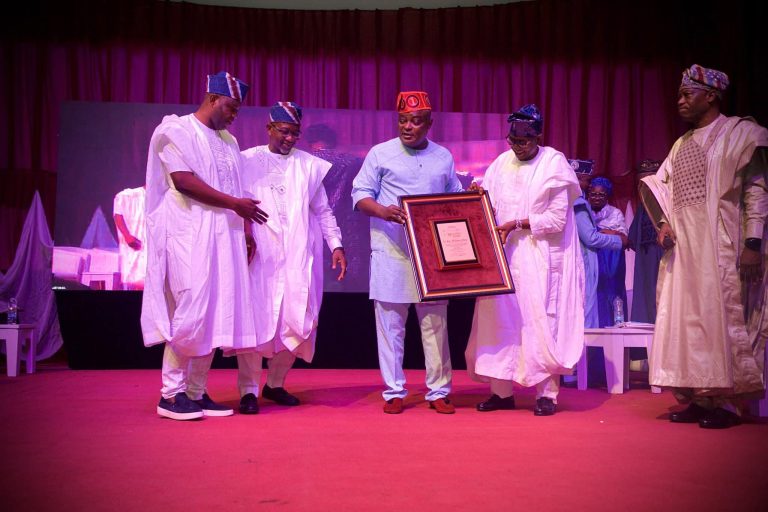
The Speaker of the Lagos State House of Assembly, Rt. Hon. Mudashiru Obasa, has emphasised that security goes beyond policing and should be seen as a collective spiritual and social responsibility.
Obasa made the remarks while delivering a lecture at the 31st Pre-Ramadan Lecture organised by the University of Lagos Muslim Alumni.
Speaking on the relationship between security, faith and civic duty, the lawmaker said protecting society requires nurturing communities, preventing oppression and safeguarding the vulnerable, adding that societal efforts toward security reflect the moral striving expected of believers.
He identified poverty as a major driver of insecurity, noting that sustainable peace cannot rely solely on law enforcement but must include compassion, fairness, transparency and humanitarian support.
According to him, acts of kindness and justice contribute to both social stability and spiritual fulfilment.
Obasa also highlighted Lagos’ diversity, saying interfaith dialogue, support for religious institutions and appropriate legislation have helped sustain peaceful coexistence in the State.
He urged Muslims to uphold justice, good governance and service to humanity, stressing the importance of helping the needy and protecting the oppressed.
The Speaker commended the University of Lagos Muslim Alumni for hosting the lecture themed “The Light Beyond: Guiding Our Souls to Paradise,” and appreciated guest speakers Dr. Ridwan Jamiu and Prof. Is’haq Oloyede for their contributions on spirituality and national security.

Neimeth Pharmaceuticals Plc has urged the Federal Government to facilitate access to patient capital for pharmaceutical manufacturers, thereby enhancing sustained investment in local drug production and reducing the sector’s dependence on short-term financing.
At the company’s 2026 yearly media press briefing held in Lagos at the weekend, the managing director of the company, Valentine Okelu, argued that the nature of the industry requires long-term financing structures that differ significantly from conventional business models.
He pointed out that pharmaceutical manufacturing involves a lengthy gestation period from the commencement of investment in production facilities to the point of actual output, making it unattractive to short-term investors who seek quick returns.
Okelu also noted that many private investors are reluctant to commit funds to such long-term projects when alternative opportunities promise immediate yields.
According to him, what the sector requires is patient capital that allows manufacturers to complete construction and regulatory processes without the burden of heavy interest payments before production begins.
He categorically stated that the industry is not seeking grants but affordable, long-term funding that accommodates the unique timeline of pharmaceutical manufacturing.
He applauded previous government intervention funds that supported parts of the sector while suggesting that similar funds could be mobilised through the Central Bank of Nigeria or other government-backed mechanisms and channelled through commercial banks at concessionary rates to support ongoing and new pharmaceutical projects.
Okelu observed that several pharmaceutical firms are currently expanding their facilities, while new entrants are also preparing to commence operations.
He said that although gaps remain in the local production of more complex pharmaceutical products, Nigeria already has sufficient capacity to manufacture many essential medicines required for everyday healthcare.
However, he stressed that the sector continues to grapple with working capital challenges, with many manufacturers resorting to expensive borrowing, sometimes at rates as high as 30 per cent, to sustain operations.
He maintained that long-term industrial financing cannot realistically come from conventional commercial banking structures and called on the government to prioritise this area of intervention to strengthen local drug manufacturing and enhance national health security.
Guardian
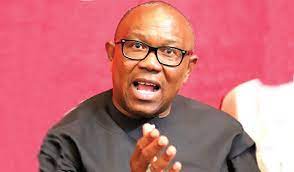
From ‘padded budget’ to ‘forged laws’; Peter Obi reacts to tax laws’ alterations
Peter Obi
….Activates ‘PO effect’ in A’Ibom; slams INEC
UYO—Former Anambra State Governor, Peter Obi, has formally declared his intention to contest the 2027 presidential election on the platform of the African Democratic Congress, ADC, declaring that he is entering the race with full confidence of victory.
Obi made the declaration in Uyo, Akwa Ibom State, during the OBIDIENT Conference and official unveiling of ADC as his new political platform. The event, themed “Activating the PO Effect in ADC,” drew supporters and members of the OBIDIENT Movement from within and outside the state.
In a bold address, Obi alleged that the Independent National Electoral Commission, INEC, would not recognise the leadership of the Labour Party, LP, as long as he remained in the party, a development he said influenced his decision to leave.
“I left LP when I was informed that as long as I remained there, INEC would not recognise its leadership and that there were moves to keep me off the ballot,” he told the gathering.
Declaring his resolve, Obi said he would contest the 2027 presidential election regardless of obstacles placed in his path.
“I will contest the coming election even if it is conducted anywhere. And if they refuse to transmit election results, we will ensure the results are transmitted,” he stated, drawing loud applause from supporters.
Obi used the occasion to criticise the current administration’s economic policies, particularly its borrowing pattern. According to him, the volume of loans secured in recent years exceeds those of previous administrations combined, warning that repayment timelines stretching into 2045 and 2050 would unfairly burden future generations.
He argued that Nigeria’s economic recovery and long-term stability require prudent fiscal management, transparency and strategic investments rather than accumulation of unsustainable debt.
Outlining his vision, Obi pledged that his administration, if elected in 2027, would prioritise education and healthcare as foundational pillars of national development. He said countries that achieved sustainable growth did so through deliberate investment in human capital.
“We must invest in our people. Education and health are not optional; they are essential. That is how nations rise,” he said.
On corruption, Obi maintained that leadership example is critical to reforming governance. He reiterated that while serving as governor of Anambra State, neither he nor his family used public office for personal enrichment.
“When I became governor, I told my wife to forget about the Office of the First Lady because we were not elected together. I approved over 100 Certificates of Occupancy on government land, but none went to me or any member of my family. If you find any, petition me,” he declared.
Coordinator of the OBIDIENT Movement Worldwide, Dr. Tanko Yunusa, urged supporters to consolidate their structures within the ADC and intensify grassroots mobilisation ahead of 2027.
Akwa Ibom State Coordinator of the movement, Dr. Ben Smith, described the 2027 election as a generational mission rather than an individual ambition. He said the focus should be on job creation for youths, security for families, dignity for workers and renewed hope for Nigerians.
The Uyo declaration signals a significant political realignment as Obi positions himself for another presidential contest under a new platform, setting the stage for an intense buildup to the 2027 general elections.
Vanguard

E-transmission
National Assembly
Former Cross River State Resident Electoral Commissioner, REC, and lawyer, Mr. Mike Igini, has raised the alarm over what he described as a looming “institutional self-harm” by the National Assembly, warning that the controversial proviso qualifying real-time electronic transmission of polling unit results could cost a majority of federal lawmakers their seats in 2027.
In a strongly worded press statement, Igini urged senators and members of the House of Representatives to draw lessons from the fate of their predecessors, who, he said, suffered electoral defeat after refusing to close well-known loopholes in the nation’s electoral framework.
“As the National Assembly convenes to reconcile the divergent versions of the Electoral Act Amendment Bill—particularly with regard to the unequivocal demand by the Nigerian populace for mandatory electronic transmission of election results directly from polling units to the INEC Result Viewing Portal, IReV, I urge Honourable and Distinguished Senators to heed the salutary lessons from the misfortunes that befell their predecessors,” he said.
‘Victims of their own inaction’
Igini argued that earlier Assemblies, “for reasons of convenience and party loyalty,” declined to address “well-documented election rigging vulnerabilities” in the law, including the kind of proviso now introduced by the Senate to qualify direct electronic transmission.
“Such lacunae were exploited to subvert polling-unit outcomes during their tenure by those who denied them re-election party tickets, rendering them victims of the very defects they declined to remedy,” he stated.
Presenting what he described as empirical evidence from electoral cycles between 2007 and 2023, Igini said a majority of incumbent legislators denied party tickets by governors and party leaders—even after securing alternative platforms—were defeated during collation through manipulation of polling unit results.
“The 10th Assembly now stands perilously close to replicating this lamentable pattern,” he warned. “Those Members not favoured or not in the good books of their respective state governors or party leaders will foreseeably be denied tickets and, given the prospects of an unsecured e-transmission of polling unit results, will find it exceedingly difficult to translate constituency endorsement, however strong, into electoral victory.”
Disturbing turnover statistics
Igini backed his warning with data showing persistently high turnover rates in both chambers of the National Assembly.
In the Senate, the Sixth Senate (2007–2011) returned only 23 of 109 members, with 86 new entrants—representing a 79 per cent turnover. The Seventh Senate recorded 67 per cent turnover; the Eighth, 64 per cent; and the Ninth, 59 per cent.
“Alarmingly, the current 10th Senate (2023–2027) has regressed sharply, with only 25 returning Senators and 84 new entrants—translating to a staggering 77 per cent turnover,” he noted.
The House of Representatives, he said, mirrors the same instability. The Sixth House recorded 78 per cent turnover; the Seventh, 72 per cent; the Eighth, 69.4 per cent; and the Ninth, 57 per cent.
“However, the present 10th House (2023–2027) has again deteriorated, returning only 109 members while ushering in 251 new legislators, producing a 70 per cent turnover rate,” he added.
According to him, “across these electoral cycles, Nigerians and legislators have been the major victims and casualties of the type of proviso on e-transmission that has just been introduced.”
He stressed that the attrition rate, averaging between 60 and 70 per cent, breeds “institutional amnesia, dissipates scarce public resources on perpetual induction and retraining, weakens legislative oversight, and erodes continuity in law-making and executive accountability.”
Real-time transmission not optional
Igini insisted that real-time electronic transmission from polling units to IReV is “not merely desirable; it is essential for the sustenance of our democracy and for the political survival of deserving Legislature Members.”
“Nigerians have insistently demanded real-time electronic transmission from polling units to IReV, precisely to forestall post-polling alterations at ward or local government collation centres. Publicly viewable results serve as deterrence and would render such tampering manifest and actionable,” he said.
On the argument of poor network coverage, the former REC dismissed it as “largely excuses and completely specious.”
“Before we left office in 2022, INEC and NCC had carried out a survey of network coverage of both 2G and 3G and came with a report of over 97 per cent coverage across Nigeria. That was what the Commission used to carry out e-transmission of polling units results to IReV successfully in over 105 off-cycle elections, including five governorship elections before the 2023 elections,” he stated.
He further warned that the Senate’s proviso “invites mischief, affording opportunities for collusion between influential actors, collation officials, and telecommunication providers, to engineer deliberate network failures on election day.”
2012 Cross River pilot exercise
Recalling his tenure in Cross River State, Igini said real-time transmission had been successfully piloted as far back as 2012.
“For the record, way back in 2012 in Cross River State, as the Commissioner in charge of the state, the Commission under Professor Attahiri Jega carried out a successful real-time e-transmission pilot in the conduct of the second-term election of Governor Liyel Imoke, viewed on a dashboard in my office as collated results from the 18 LGAs were transmitted and updated across the state successfully,” he said.
He blamed persistent setbacks on what he termed “statute capture and statute sabotage, coupled with strange and questionable refusal of the courts to give effect to the laws.”
Under the 1999 Constitution, he argued, INEC’s regulatory authority under Section 160 to make its own rules and regulate its procedure is “unimpeachable,” in addition to its powers under Section 148 of the Electoral Act to issue binding regulations and guidelines.
“The refusal of the Court to give effect to it is simply unbelievable,” he said.
Appeal to NASS, judiciary
Igini called on lawmakers to “remove/excise the proviso and restore the original, unequivocal provision for direct, real-time electronic transmission as previously passed.”
“I equally call upon the judiciary, my constituency, not to make itself the weakest link in the line of defence of our democracy and the rule of law,” he added.
Describing the high legislative turnover as “incontrovertible,” he concluded: “The imperatives are clear. Let wisdom prevail over expediency, convenience and party loyalty lest history repeat its tragic verdict upon yet another Assembly. May God give us the courage to do what is right for the good of our country.”
Vanguard

Fuel price
*Dangote boosts supply to 40.1m litres/day
*As Wintersmith begins crude test runs
The volume of Premium Motor Spirit, otherwise known as petrol, imported into the country declined by 42.2 per cent in January 2026 to 24.8 million litres per day, down from 42.8 million litres recorded in December 2025, a report published by the Nigerian Midstream and Downstream Petroleum Regulatory Authority, NMDPRA, has indicated.
The report, released over the weekend, also showed that petrol supplied by the $20 billion Dangote Petroleum Refinery to the domestic market rose by 25.3 per cent last month to 40.1 million litres per day, from 32 million litres recorded in December 2025.
NMDPRA stated that total daily petrol supply in January 2026 stood at 64.9 million litres, representing a 12.5 per cent decline compared to the 74.2 million litres supplied in December 2025.
According to the Authority, the country recorded 33 days of petrol sufficiency during the month. “Days of sufficiency stock boosted by 13 per cent between December 2025 and January 2026 due to improved supply performance by DPRP,” the report added.
The regulator disclosed that while the daily consumption benchmark remained at 50 million litres, actual consumption (based on truck-out data) averaged 60.2 million litres per day for petrol. It also reported daily truck-out volumes of 19.2 million litres for Automotive Gas Oil (diesel), 3.5 million litres for aviation fuel, and 4,860 metric tonnes of LPG. On the performance of local refineries, the report stated that the Dangote Refinery operated at 61.27 per cent capacity in January, while the three Federal Government-owned refineries managed by NNPC Limited remained shut down.
Meanwhile, the Winters-mith Refining and Petrochemical Company Limited has commenced crude oil test runs on the second phase of its refinery in Imo State, raising expectations of improved domestic petroleum product supply in the coming months. The refinery currently operates with an installed capacity of 5,000 barrels per day (bpd). Commissioned in November 2020, it produces Automotive Gas Oil (diesel), Dual Purpose Kerosene, DPK, naphtha and heavy fuel oil for the domestic market.
However, Phase Two of the project, which is designed to significantly expand output, has been undergoing pre-commissioning activities since late 2025. When completed, the expansion is expected to raise total refining capacity to about 50,000 bpd, marking a major leap from its present output level.
In its latest report released at the weekend, the Nigerian Midstream and Downstream Petroleum Regulatory Authority (NMDPRA) confirmed that the facility has begun introducing crude oil into its processing units as part of the commissioning process.
The regulator stated that “introduction of hydrocarbon commenced,” indicating that the plant has moved beyond mechanical completion into live operational testing.
Industry analysts say the development signals progress in Nigeria’s modular refinery segment, which is seen as critical to reducing dependence on imported petroleum products, boosting local value addition, and strengthening energy security.
If successfully completed, the Phase Two expansion would significantly increase local refining volumes, support supply of diesel and other products to industrial users, and contribute to easing pressure on foreign exchange spent on fuel imports.
The expansion also comes amid ongoing efforts by the Federal Government to deepen domestic refining capacity and improve efficiency across the midstream and downstream value chain.
Speaking on the state of the downstream and midstream sectors, the Authority Chief Executive, Engr. Saidu Mohammed, said Nigeria’s downstream petroleum sector “is witnessing an irreversible renaissance, driven by bold reforms, investment, and regulatory clarity.”
He noted that under the Petroleum Industry Act, Nigeria’s downstream market is now fully liberalised and “no longer defined by scarcity and supply uncertainty,” with pricing increasingly determined by market fundamentals.
On domestic refining, he described the Dangote Petroleum Refinery as a major game changer and attributed ongoing economic reforms to a reduction in import-related fiscal losses of over N6 trillion.
Engr. Mohammed assured stakeholders that the current dispensation would deliver a regulator that is fair, firm and decisive in overseeing the midstream and downstream sectors.
He emphasised that regulation remains central to sustainable growth, stating that “regulation must enable value, not inhibit it,” and concluded that confidence is the true currency of any market.
Vanguard

Ilorin—KAKAFU, Patigi LGA — A gang of about ten terrorists stormed the ancient town of Kakafu in Patigi Local Government Area of Kwara State on Sunday morning, abducting four residents in a fresh attack.
Vanguard gathered that the bandits fired sporadic gunshots into the air to create panic, causing residents to flee in different directions. Amid the chaos, four individuals attempting to escape were reportedly seized and taken to a nearby forest.Sources close to the town said the identities of the victims had not been officially confirmed at the time of filing this report, but most are believed to be women. A resident who preferred anonymity confirmed the incident, noting that many locals have fled to neighboring areas for safety.
“The attack is another disturbing sign of the worsening security situation in rural parts of the state, where armed groups now operate with little resistance,” the source said.
The Sunday abduction came less than 24 hours after another violent incident in the area. On Saturday, suspected bandits attacked a vigilante and community guards’ checkpoint along Gamji Road in Gbugbu.
also in Patigi LGA. During the assault, a Nigerian Army officer sustained a gunshot wound to the leg, while a vigilante operative suffered a serious forehead injury.
A senior police officer at the Patigi Divisional Police Headquarters, who requested anonymity, confirmed the incidents, saying, “We are working with other security agencies to rescue the victims and ensure the protection of life and property of residents.”
Vanguard