Home Blog Page 631

Ooni’s Ojaja Pan Africa redeems ₦9.2bn commercial paper, strengthens investor confidence

0


Ojaja Pan Africa Limited, owned by Ooni of Ife Adeyeye Enitan Ogunwusi, has completed the redemption of its inaugural Commercial Paper issuance valued at ₦9.2 billion, reinforcing confidence in the company’s liquidity and credit strength.

The funds were raised under a duly registered ₦10 billion programme on the FMDQ Securities Exchange. Ojaja Pan Africa fully repaid ₦2.15 billion from Series 1, which matured on November 21, 2025, and ₦6.91 billion from Series 2, which matured on February 20, 2026. The obligations were settled using internally generated resources.

The redemption comes amid a challenging economic climate marked by high borrowing costs, with Nigeria’s monetary policy rate at 27 percent, making short-term financing expensive for many firms.

Acting Managing Director Dr. Ayobami Oyedare said the timely repayment reflects the company’s financial stability and disciplined planning.

“Meeting these obligations in full validates the trust placed in us by the investing public. With both maturities resolved, we are focused on leveraging the remaining resources from the programme to drive growth and expansion across Africa,” he said.

FG: US House Committees’ Report on Nigeria Catalyst For Broader Cooperation

0


The Federal Government of Nigeria has taken note of recent statements and recommendations emerging from engagements within the United States Congress, contained in a joint report on Christian persecution in Nigeria submitted to the White House on Monday by the House Foreign Affairs Committee and the House Appropriations Committee, concerning security developments in Nigeria.

Nigeria acknowledges that parts of the country continue to face serious security challenges, including terrorism, banditry, and communal conflicts that have tragically affected many communities. The Federal Government remains deeply concerned about the loss of lives and destruction of property resulting from these criminal acts, and we extend our sympathies to all victims and their families, regardless of faith, ethnicity, or region.

It is important to state clearly that Nigeria does not have, and has never had, a state policy of religious persecution. The violence being confronted by our security agencies is not driven by government policy or religious bias, but by complex security threats, including terrorism, organised criminality, and longstanding communal tensions.

The Constitution of the Federal Republic of Nigeria guarantees freedom of religion and freedom of worship for all citizens. The Federal Government remains firmly committed to upholding these constitutional protections and to ensuring equal protection under the law.

In response to evolving security threats, the Federal Government has significantly strengthened coordinated military and law enforcement operations across affected regions. Ongoing counter-terrorism offensives have degraded the capacity of armed groups, disrupted kidnapping networks, and led to the arrest and neutralisation of key criminal elements. Intelligence sharing and inter-agency collaboration have been enhanced to improve early warning and rapid response mechanisms, particularly in vulnerable rural communities.

In addition, the government has intensified surveillance and clearance operations in forested areas long exploited by criminal groups. The establishment and deployment of specially trained forest guards toaim at deny terrorists and bandits safe havens, improve territorial control, and strengthen community-level security presence. These efforts are complemented by increased investment in equipment, mobility assets, and technology to support the Armed Forces and other security agencies.

Efforts are also ongoing to improve humanitarian response for internally displaced persons, facilitate the safe return of affected communities, and promote community-based peacebuilding initiatives that foster sustainable coexistence.

Nigeria values its longstanding and strategic partnership with the United States. Our two countries share common interests in promoting security, economic development, and regional stability. We remain open to constructive dialogue and cooperation rooted in mutual respect, shared responsibility, and recognition of Nigeria’s constitutional framework and sovereignty.

The Federal Government will continue to engage international partners through appropriate diplomatic channels while remaining focused on its primary duty, the protection of all Nigerians.

Mohammed Idris,
Honourable Minister of Information and National Orientation.

Kano Court Jails Woman Seven Years for N5.6m Fraud

0


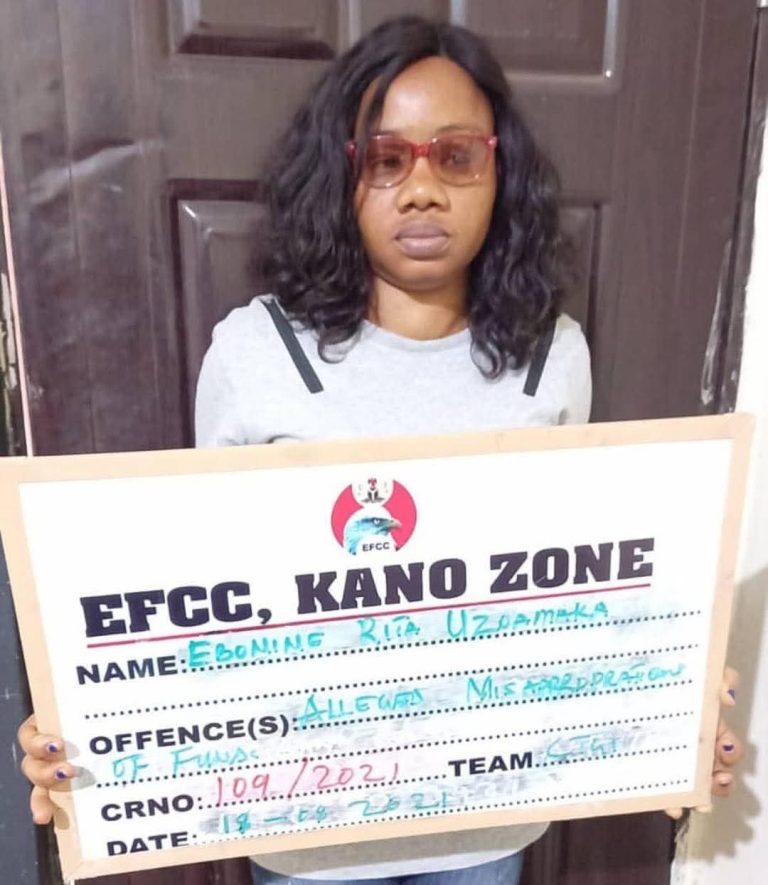
Justice Maryam Sabo of the Kano State High Court sitting in Kano has convicted and sentenced Ebonine Rita Uzoamaka to seven years imprisonment for obtaining the sum of N5,600,000.00k( Five Million, Six Hundred Thousand Naira) by false pretence.

The convict was arraigned on August 18, 2021, on five- count charges of dishonest misappropriation of funds totaling N5,660,000.00 (Five Million, Six Hundred and Sixty Thousand Naira).

One of the charges reads: “That You Ebonine Rita Uzoamaka on the 18th January 2021 at Kano within the jurisdiction of this honorable court with intent to defraud, did obtain the sum of N2,000,000 (Two Million Naira) only from Ochayi Anthony Eneche which you caused to be paid into your bank account number 0093030293 domiciled with Access Bank Plc under the false pretense that you had 500 cartons of D-Rich Baking powder you would sell to him, which pretence you knew to false and thereby committed an offence contrary to Section 1(1)(a) of the Advance Fee Fraud and Other Fraud Related Offences Act 2006 and punishable under section 1(3) of the same Act”


She initially pleaded “not guilty” to the charges when they were read to her, thereby setting the stage for a full trial.

In the course of the trial, prosecution counsel, Salihu Sani, presented a compelling case to establish the defendant’s guilt. He called a total of four witnesses and tendered several documented exhibits, which were admitted as evidence by the court. In her defence, the defendant stood as the sole witness.

Delivering judgment on the matter, Justice Sabo convicted and sentenced the defendant to seven years imprisonment on all five counts of the charges . She, however, granted an option of Five Hundred Thousand Naira (N500, 000) fine.


Uzoamaka bagged her imprisonment when she was arrested for obtaining the sum of N5.6m from her victim under the false pretense of supplying D-Rice Baking Powder from Aba, Abia State. Upon receiving the funds, she failed to fulfill the supply contract, instead converting the funds to her personal use. She was charged to court and convicted.

ARCON Says ADVAN Using Media Campaign to Obstruct Industry Reforms

0


The Advertising Regulatory Council of Nigeria (ARCON) has issued a forceful rebuttal to the Advertisers Association of Nigeria (ADVAN), accusing the group of orchestrating a campaign of misinformation and manipulation aimed at derailing ongoing reforms in the country’s advertising sector.

In a statement dated February 23 and signed by its Director-General, Dr. Olalekan Fadolapo, ARCON described ADVAN’s recent open letter to President Bola Ahmed Tinubu as a calculated attempt to halt reforms tied to the Federal Government’s Nigeria First Policy and new payment directives within the industry.

The regulator rejected what it called “every major claim” in the letter, including allegations that ARCON’s policies have led to declining media spend, investor exits, and overregulation of the sector.

ARCON noted that ADVAN has simultaneously instituted multiple lawsuits at the Federal High Court challenging its regulatory powers, while also prosecuting the same issues in the media.

“If a case is sub judice, why take it to the media?” the statement queried.
The Council argued that ADVAN’s actions reflect a broader pattern of attempting to obstruct reform through public pressure rather than regulatory engagement.

One of the central claims in ADVAN’s letter was that its members account for over 90 percent of Nigeria’s advertising industry spend, which it estimated at more than ₦800 billion annually. The association cited this figure in seeking presidential intervention.

ARCON described the claim as “an outright fabrication.”
“ADVAN members do not contribute 90% of the Nigerian advertising industry spend nor do they conduct business worth ₦800 billion as claimed. ADVAN members contribute less than 10% of the advertising industry spend and its membership has declined in recent times due to poor leadership,” ARCON stated.

In an unusually direct swipe, ARCON referenced ADVAN President Mr. Osamede Uwubanmwen, asserting that his employer “cannot boast of ₦1 million in annual advertising spend.”
The regulator challenged ADVAN to publish its active membership list and verifiable advertising spend data.

ADVAN also alleged that ARCON’s reforms have triggered a decline in advertising investment and caused companies to exit Nigeria.
ARCON demanded evidence of this claim, saying:
“ADVAN is challenged to provide verified data on the alleged decline in advertising spend as well as publish the names of organisations that have exited Nigeria because of the industry reforms,” the statement said.

According to ARCON, industry data does not support ADVAN’s position. The Council disclosed that it collaborated with the Heads of Advertising Sectoral Group to commission PricewaterhouseCoopers to conduct an independent review of advertising industry spend and its contribution to Nigeria’s GDP.
The PwC report, ARCON stated, showed growth rather than contraction and was publicly presented to stakeholders.

The regulator challenged ADVAN to either counter the findings with verifiable data or commission and publish its own independent report.

Another flashpoint in the dispute is a Presidential Enabling Business Environment Council (PEBEC) performance report that rated ARCON at three percent.

ARCON rejected the rating, describing it as biased and part of a coordinated effort to undermine its authority.
“ARCON does not and cannot score 3% in performance as stated by PEBEC and publicised by ADVAN,” the Council said, adding that its official performance records are lodged with the Federal Ministry of Information and National Orientation.
The regulator further alleged that ADVAN has attempted to leverage its relationship with PEBEC to discredit ARCON’s oversight functions.

ARCON reserved particular criticism for the Board of Trustees of ADVAN, led by Aare Fatai Odeshile, for co-signing the open letter.
The Council described it as “rather unfortunate” that a body it termed a council of elders would endorse what it called misleading claims without first engaging the regulator or its supervisory ministry.
“The publication, which is misleading and deceptive, reflects poorly on the entire leadership of ADVAN,” the statement said.

At the heart of the dispute are industry reforms that ARCON says are designed to protect Nigerian creatives, ensure prompt payment to media owners and agencies, resolve longstanding debt issues, and align the sector with the administration’s Nigeria First Policy and Renewed Hope Agenda.

The Council maintained that more than 10 other associations and stakeholder groups operate within the advertising ecosystem and none has adopted what it described as ADVAN’s combative posture.

“The era of lawless advertising with impunity is over,” the statement concluded. “ARCON will resist all attempts and blackmail by ADVAN or any other group(s) to halt the ongoing advertising industry reforms. ARCON will remain focused and resolute in promoting the Nigerian First Policy.”

SGU Offers Medical Students UK Clinical Training Through NHS Affiliates

0


BY TAIWO OGUNMOLA -OMILANI

St. George’s University (SGU) School of Medicine in Grenada has announced that students enrolled in its Doctor of Medicine (MD) programme can now complete part of all of their clinical training in the United Kingdom through 15 affiliated sites within the National Health Service.

According to the university, the initiative is designed to expose students to real-world medical environments and diverse patient populations.

Peter Orton Beaumont, an SGU graduate, said undertaking a significant portion of his clinical rotations in the UK helped him become familiar with the healthcare system, clinical environment and patient care practices before advancing in his career.

The programme places students in high-volume hospitals where they manage a broad range of medical cases, helping them build confidence in clinical decision-making. SGU noted that early exposure to different care pathways prepares participants to transition more smoothly into residency and postgraduate training.

Academic standards and assessment frameworks remain consistent across all SGU clinical locations. For African students in particular, the UK pathway offers experience within a globally recognised public healthcare system and exposure to a different clinical, cultural and regulatory setting.

The university explained that working within structured protocols and multidisciplinary teams improves adaptability and professional versatility. It added that many aspiring international practitioners view overseas clinical training as an important step toward careers in the UK or the United States.
Students also gain cultural competence by interacting with diverse communities, strengthening communication skills and patient-centred care delivery.

Exposure to varied diagnostic approaches further sharpens clinical reasoning and problem-solving abilities.
SGU said the experience equips graduates for cross-border medical practice and broadens professional opportunities. Beaumont added that for committed and adaptable practitioners, a medical career in the UK can be professionally fulfilling and a source of pride.

PRESIDENT TINUBU ACCEPTS EGBETOKUN’S RESIGNATION AS IGP APPOINTS TUNJI DISU IN ACTING CAPACITY

0


President BolaTinubu, has accepted the resignation of the Inspector-General of Police, Mr Kayode Egbetokun, following the submission of his letter citing pressing family considerations.

President Tinubu received Mr Egbetokun’s resignation earlier today and expressed his profound appreciation for Egbetokun’s decades of distinguished service to the Nigeria Police Force and the nation. The President acknowledged his dedication, professionalism, and steadfast commitment to strengthening internal security architecture during his tenure.

Appointed in June 2023, Egbetokun was serving a four-year term scheduled to conclude in June 2027, in line with the amended provisions of the Police Act.

In view of the current security challenges confronting the nation, and acting in accordance with extant laws and legal guidance, President Tinubu has approved the appointment of Assistant Inspector-General of Police Tunji Disu to serve as Acting Inspector-General of Police with immediate effect.

The President is confident that AIG Disu’s experience, operational depth, and demonstrated leadership capacity will provide steady and focused direction for the Nigeria Police Force during this critical period.

In compliance with the provisions of the Police Act 2020, President Tinubu will convene a meeting of the Nigeria Police Council shortly to formally consider the appointment of AIG Disu as substantive Inspector-General of Police, after which his name will be transmitted to the Senate for confirmation.

The President reiterates his administration’s unwavering commitment to enhancing national security, strengthening institutional capacity, and ensuring that the Nigeria Police Force remains professional, accountable, and fully equipped to discharge its constitutional responsibilities.

Bayo Onanuga
Special Adviser to the President
(Information and Strategy)

Tinubu Removes Egbetokun, Appoints Tunji Disu As New Inspector-General Of Police

0


President Bola Ahmed Tinubu has appointed Tunji Disu as Nigeria’s new Inspector-General of Police, replacing Kayode Egbetokun.

A presidency source confirmed the development to ARISE News on Tuesday.

The source confirmed the development, stating that an official announcement would be made shortly. “AIG Tunji Disu is the new IGP. Confirmed,” the source said, adding that the information had received “double confirmation.”

Efforts to obtain a reaction from the Force Public Relations Officer, Benjamin Hundeyin, were unsuccessful at the time of filing this report.
Further details surrounding the leadership change are expected to be released soon.

Disu recently took over as AIG Force CID Annex, Alagbon, Lagos.

He is a thoroughbred police operational officer with proven records of remarkable performance and enduring reforms in previous postings.

credit: Lagos Monitoring team

UK ex-envoy Mandelson released on bail in Epstein case

0


London police released former ambassador Peter Mandelson on bail in the early hours of Tuesday, in a probe into his ties to disgraced US financier Jeffrey Epstein, only days after ex-prince Andrew was arrested.

Mandelson, a pivotal figure in British politics and the UK’s former envoy to Washington, was arrested on suspicion of misconduct in public office around 1700 GMT Monday following allegations arising from the latest set of documents linked to Epstein.

“A 72-year-old man arrested on suspicion of misconduct in public office has been released on bail pending further investigation,” the Metropolitan police said in a statement around nine hours after he was taken in to an unnamed London police station.

Images on UK television earlier appeared to show Mandelson, 72, being driven away from his north London home accompanied by a man and a woman, after police raided his properties earlier this month.

The arrest came days after Andrew Mountbatten-Windsor, King Charles III’s younger brother, was detained on Thursday and released under investigation in a separate misconduct in public office investigation also related to the latest Epstein documents.

Ads by
Mandelson is being probed over allegations that he sent sensitive documents to the late US sex offender when he was a government minister, including during the 2008 financial crash.

Police have not specified which documents are part of the probe.

The veteran ex-politician was sacked by Prime Minister Keir Starmer as envoy to Washington in September when an earlier release of documents linked to Epstein showed the extent of their friendship.

But Mandelson’s appointment has unleashed a political storm with two of Starmer’s top aides resigning over the row.

Starmer apologised to Epstein’s victims for appointing Mandelson, and accused the ex-envoy of lying about the extent of his ties to the financier during the vetting process for his Washington posting.

– Pressure rising –
Law firm Mishcon de Reya, representing Mandelson, said earlier this month that he “regrets, and will regret until his dying day, that he believed Epstein’s lies about his criminality”.

“Lord Mandelson did not discover the truth about Epstein until after his death in 2019,” said the statement.

“He is profoundly sorry that powerless and vulnerable women and girls were not given the protection they deserved.”

The government is to release tens of thousands of emails, messages and documents on Mandelson’s vetting procedure, which could ramp up the pressure on the prime minister and other senior ministers.

Government minister Darren Jones on Monday said the first set of documents relating to Mandelson’s appointment will be published in early March.

Starmer fought off calls to resign earlier this month after he admitted he knew about Mandelson’s ongoing friendship with Epstein — which seemed to continue after the financier was convicted of child prostitution in 2008.

Mandelson, also a former European Union trade commissioner, stood down from parliament’s unelected upper chamber, the House of Lords, earlier this month.

The advisory firm he co-founded, Global Counsel, also approached bankruptcy last week as it stopped trading and appointed administrations in a bid to salvage some assets.

Several major clients, including Barclays, Tesco and English football’s Premier League, have cut ties with the firm in recent weeks, according to press reports.

Officers from the Met’s specialist crime team were deployed earlier this month to search two of his addresses, one in the western English county of Wiltshire and the other in London, according to the police.

AFP

Fear killing more Nigerians than cancer — Dr Omolola Salako

0


Cancer is no longer a distant or rare diagnosis in Nigeria. It is a growing public health emergency quietly reshaping families, straining the health system, and exposing deep gaps in prevention, early detection, and access to treatment.

Nigeria faces a critical shortage of oncologists, radiotherapy centres, and comprehensive insurance coverage, leaving many families to shoulder catastrophic out-of-pocket costs.

Good Health Weekly spoke to Dr. Omolola Salako who has been treating patients over the past two decades,examines the realities behind the statistics, the myths that continue to endanger lives, and the urgent reforms needed to confront Nigeria’s cancer challenge.

She speaks candidly about the cancer crisis in Nigeria, the myths that are costing lives, and why prevention remains one of the country’s greatest missed opportunities. Excerpts:

Cancer in Nigeria

That reality alone is sobering. Over the past two decades, I have committed my life to building ecosystems of hope. I founded Sebeccly Cancer Care in 2006, launched Oncopadi Digital Health in 2017, and opened Pearl Oncology Specialist Hospital in 2021. Through these platforms, we have provided preventive care services to more than 30,000 people and cared for over 5,000 cancer patients and their families. My journey into oncology was shaped by personal loss. I lost my sister to cancer, and that experience transformed my pain into purpose. What my work has exposed is deeply troubling. First, there is the grip of fear. I see patients paralysed by cancer so deep they make life-altering decisions based on spirituality and myths rather than evidence based medicine. Patients are often paralysed by fear so overwhelming that they make life-altering decisions based on myths and spirituality rather than evidence-based medicine.

Second, cancer is never an individual diagnosis; it is a family crisis. The family’s level of understanding and support often determines survival, yet they are usually overwhelmed and under-informed.
Third, we are failing at prevention. Too many Nigerians are dying from cancers that could have been prevented through vaccination or routine screening. We are fighting late-stage diagnoses that should not be happening in 2026.

The family burden

Cancer isn’t an individual diagnosis; it’s a family crisis. The family’s support—or their lack of health literacy—dictates the patient’s survival. They are as much a part of the medical team as I am, yet they are often overwhelmed and under-informed. The Prevention Failure: We are failing to prevent the preventable. Too many Nigerians are dying from cancers that could have been stopped with a simple vaccine or a routine screen. We are fighting a war against late-stage diagnoses that shouldn’t be happening in 2026.We are not preventing the preventable cancers well enough and fast enough.

What are common fears of Nigerians newly diagnosed with cancer? Where do the fears come from?
In their eyes, I often witness the ‘Fear of the Unknown’ locked in a crushing battle with ‘Why me?’. There are days defined by the tears of frustration and overwhelm, and others transformed by tears of joy as we realize we are winning or that the tumor is reducing in size. Yet, I am constantly moved by those who, though shaken, refuse to dwell in fear.

Related News
22 Nigerian women die daily from preventable cervical cancer — NIMR raises alarm
Cancer: Early detection central for patient’s surviva l– UNILAG harp
Firm expands access to cervical cancer screening in Edo State

They manage the complexity of their emotions with a quiet grace, choosing to accept the diagnosis and navigate their journey from a place of resolve rather than give up or be angry or be in denial. But fear is constant.

In some instances, that fear is often fed by the “evil arrow” narrative—the belief that cancer is a spiritual attack from “village people” or enemies. We have to be honest: cancer is the toughest battle a human can face, and fear is a natural physiological response. But here is the shocking truth I see on a weekly basis: Fear is currently killing more Nigerians than the disease itself.

Because many patients are operating from a place of raw emotion rather than information, that fear drives them to make catastrophic decisions. They abandon evidence-based medical treatment for “alternatives” that offer false hope. In other instances, they visit multiple cancer centres and hospitals without staring treatment.

They abandon proven treatments for unverified alternatives that promise false hope. Some visit multiple hospitals without starting therapy. These delays can be deadly.

This is exactly why I wrote The Gifts of Survivorship: You Are Bigger than Cancer. I needed a way to help patients de-escalate that panic. In the book, I distill 10 principles that help people reclaim their power and embrace their purpose. I tell my patients every day: A cancer diagnosis is just a few chapters of your life; it is not the entire book. You are bigger than this diagnosis, and you do not have to let fear write your ending.

In some cases, it is fuelled by the belief that cancer is a spiritual attack from enemies. We must be honest. Cancer is one of the toughest battles a human being can face. Fear is a natural response. However, what I witness weekly is alarming.

Currently, which are the most common cancers in Nigeria, and who is most vulnerable?

The numbers are a wake-up call for every Nigerian. In 2022 alone, over 127,000 Nigerians were diagnosed with cancer. The “Big Five” that dominate our clinics are Breast, Prostate, Cervical, Colorectal cancer, and Non-Hodgkin’s Lymphoma.

What is truly shocking, however, is the gender disparity: Women are disproportionately impacted. Nigerian women account for over 60 percent of all cancer cases and suffer a significantly higher death rate.

While cancer does not discriminate by your bank account, your religion, or your tribe, our vulnerabilities are often shaped by our environment and our choices. For example a silent Environmental Threat: Those living in areas like the Niger Delta, where “black soot” blankets the air, are breathing in carcinogens daily.

We are seeing a direct link between this environmental pollution and diseases including rising cancer risks. Secondly, obesity is a leading risk factor that we must address. Thirdly, while the disease strikes both rich and poor, the poor are most vulnerable to the outcome. Without a robust National Health Insurance Scheme, the majority of our patients will need to pay out of pocket. In reality, many patients abandon treatment because cancer treatment, though life saving and available, is expensive.

Environmental exposure is another serious factor. In regions like the Niger Delta, where black soot and industrial pollution contaminate the air, residents are exposed daily to carcinogens.

We are observing correlations between environmental degradation and rising cancer risks. Obesity and sedentary lifestyles are also contributing significantly.

Breast, cervical, prostate and liver cancers account for a large share of cases. Why are these cancers so prevalent?

Approximately 40 percent of cancers are preventable, yet we are not preventing them effectively or urgently enough. Nigeria is hyper-endemic for Hepatitis B and C, which are major drivers of liver cancer. These infections silently transform healthy liver cells into cancerous ones over decades.

Cervical cancer is almost entirely caused by persistent Human Papillomavirus infection. It is heartbreaking because this is a cancer that should eventually become rare. Young girls from the age of nine should receive the HPV vaccine, and women should undergo regular screening.

For breast and prostate cancers, lifestyle changes are playing a role. Diets high in processed sugars, increasing obesity, and low physical activity contribute to inflammatory and metabolic pathways that drive cancer development.

About 40 per cent of cancers are preventable yet the sheer prevalence of these cancers when we have the tools to prevent many of them. The reasons are a complex mixture of genetics, shifting lifestyles, infections and environmental factors.

But here is the shocking reality that every Nigerian must understand: A significant portion of our cancer burden is actually caused by preventable infections.

We are seeing an explosion of liver cancer because Nigeria is a “hyper-endemic” zone for Hepatitis B and C. These are chronic viral infections that quietly change normal liver cells to abnormal cancerous cells over decades.

The Cervical Crisis

Almost every case of cervical cancer is caused by thechronic infection with Human Papillomavirus (HPV). It is heart-wrenching because this is a cancer that simply shouldn’t exist now or in the future.

All women of reproductive age should have their annual medical checkup including their cancer screening. Getting the HPV vaccine is so crucial especially for young girls from the age of 9.

The Lifestyle Shift

For breast and prostate cancers, we are seeing the impact of “Westernized” lifestyles, diets high in processed sugars, rising obesity, and lower physical activity directly and indirectly amplify inflammation and metabolic pathways for cancer development and progression.

Are cancer cases truly rising, or are we simply diagnosing more due to better awareness?

It is both. On the positive side, more Nigerians are becoming proactive about their health. Employers and insurers are encouraging annual screenings, and that means cancers are being detected earlier. That may make the numbers appear higher, but early detection saves lives. At the same time, risk factors such as pollution, sedentary living, and dietary changes are genuinely increasing cancer incidence.

Which lifestyle habits do Nigerians underestimate most when it comes to cancer risk?

Diet is often underestimated. Excessive consumption of red meat is a concern. Our love for suya, asun, and kilishi is cultural, but moderation matters. Within the intestines lives a complex ecosystem called the gut microbiome.

When large quantities of red meat are consumed, certain gut bacteria convert carnitine into a compound known as TMAO, which has been linked to colon cancer. Food is not just culture; it is chemistry, and what we eat directly affects our biological processes.

We are witnessing a fundamental shift in the Nigerian lifestyle that is fueling an organic rise in cancer cases. For example, consuming red meat in large quantities is unhealthy.

Many Nigerians love their orisirisi, Asun, Suya, Kilishi etc but eating it in high quantities can disturb your intestines. Inside your intestines lives a massive world of bacteria called the gut Microbiome.

It’s a bustling city filled with both Good Bacteria (the protectors) and Bad Bacteria (the troublemakers).
When you eat large amounts of Red Meat, certain bad bacteria in your gut feast on the carnitine.

Carnitine is naturally produced in your liver and kidneys, but it is also found in high concentrations in animal products most notably in red meat. While carnitine is essential for energy, the way our gut bacteria handle a high red meat intake is where the cancer risk comes in. They turn the carnitine in that meat into #TMAO, a chemical linked to colon cancer.

How much do environmental factors contribute to cancer risk in Nigeria?

Environmental factors It contributes to about 40 percent of cancers. If we fix these issues; we can reduce people’s exposure to harmful chemicals and pollutants. We know how to stop 40 percent of cancers from ever developing because decades of research has identified and provided evidence on how air pollution with chemicals or water containing heavy metals and industrial spillage of toxic chemicals are detrimental to people’s health. The media, medical community and government must unite to make our environments safe and clean. To learn more on how to prevent cancer, please source for credible information and you can learn more by searching for #AtoZPreventCancer. Our goal is simple- to simplify the science and help you make better health decisions. If we intensify our public health education, help more people to be aware and apply the knowledge, then oncologists can focus on the cancers we don’t yet know how to prevent.

Cancer treatment is often described as catastrophic for families. Why is care so expensive?

Cancer care involves diagnosis, surgery, chemotherapy, radiotherapy, targeted therapies, and sometimes immunotherapy. Many of these treatments and drugs are imported, and the infrastructure required is costly. Without comprehensive insurance coverage, families bear the burden directly. Some sell assets or crowdsource funds. Others discontinue treatment midway because they can no longer afford it. Cancer is not only a medical emergency; it is a financial crisis for many households.

Is the NHIS effective covering cancer care? Do we have enough facilities and specialists?

Coverage remains limited, and we do not have enough oncologists or radiotherapy centres to meet national demand. When fewer than 100 clinical oncologists serve over 200 million people, access becomes a systemic challenge. We need expanded insurance coverage, increased investment in infrastructure, and strategic policy reform to improve access.

Many Nigerians still believe cancer equals death. What’s your message to those living in fear or denial?

Cancer may be part of your story, but it does not have to define it. Early detection saves lives. Prevention saves lives. Evidence-based treatment saves lives. Do not allow fear to dictate your decisions. You are bigger than cancer. This book is your step-by-step guide to gaining calm and clarity, thriving beyond cancer and creating a life of meaning, peace, and joy.

Vanguard
Bayelsa gets new Deputy Governor, Peter Akpe

0


Governor Douye Diri of Bayelsa State has nominated Pastor (Hon) Peter Pereotubo Akpe, Chief of Staff at the Government House, as Deputy Governor.

The nomination was approved by the State House of Assembly on Tuesday, ending months of speculation over who would succeed the late Deputy Governor, Senator Lawrence Ewhrudjakpo, who passed away on December 11, 2025.

Dr. Akpe, a former Majority Leader of the State House of Assembly, hails from Ebedebiri community in Sagbama Local Government Area, the same area as his predecessor.

Details to follow …….

Vanguard