Home Blog Page 532

London police arrest three over murder of 14-year-old Nigerian

0

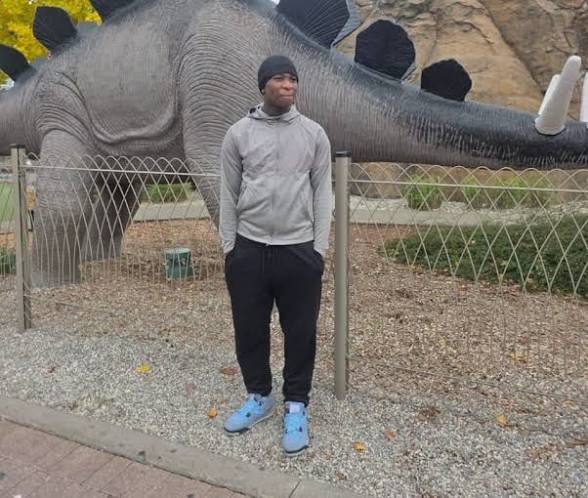
London’s Metropolitan Police Service has arrested three persons over the fatal shooting of 14-year-old British-Nigerian teenager Eghosa Ogbebor.

In a Friday statement, the service said two boys, aged 14 and 16, and an 18-year-old man were arrested over the shooting in the Woolwich area of London.

The service said officers were called to reports of a shooting at about 3:40pm on Thursday, 2 April on Lord Warwick Street.

However, despite the efforts of paramedics, the victim was pronounced dead at the scene.

“Two boys, aged 14 and 16, and an 18-year-old man have been arrested on suspicion of murder in connection with the incident. They remain in custody,” the service said.

Detective Chief Inspector Lucie Card, whose team is leading the investigation, condoled with the family of the victim.

She said, “Our thoughts remain with Eghosa’s family and loved ones, they are being supported by specially trained officers and have asked for privacy at this difficult time.

“I know the concern this has caused within Woolwich and the wider community, particularly considering Eghosa’s young age. We have an increased police presence around the area.

“While we have made three arrests, our investigation continues and I would urge anyone with any information to come forward and speak to officers.”

The service urged anyone with information or footage to reach out.

SunOnline reports that violent crimes involving teenage perpetrators are becoming rampant in the United Kingdom.

In January, the Met Police charged a 17-year-old in connection with a stabbing that led to the death of 23-year-old Nigerian, John Onetufo, in the Lewisham area of London on New Year Eve.

Sun

Black Wednesday: Tears, outrage as Lagos traders killed by police are laid to rest

0


How suspected land-grabber police operatives on illegal duty sent innocent men to early graves


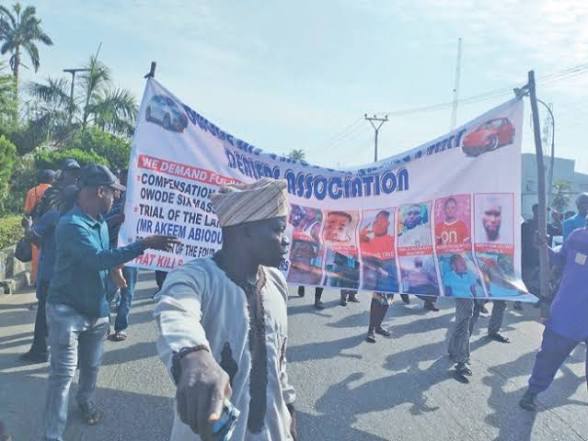
Protesters at the scene
Grief hung thick in the air at Ikorodu General Hospital, Lagos in the morning of Wednesday April 1, as families, friends and fellow traders gathered in quiet anguish to receive the bodies of six motor spare parts dealers killed in a police shooting that has continued to haunt Lagos months after it occurred.

The atmosphere was heavy with sorrow. Clusters of mourners dressed in black and muted traditional attire stood in silence, their faces etched with pain and disbelief.

Even before the coffins arrived, the wailing had begun low, piercing cries rising and falling like waves, echoing through the hospital environment.

For many present, this was not just a burial; it was the reopening of a wound that had refused to heal since August 27, 2025, a day now seared into memory as “Black Wednesday” by traders of the Owode-Onirin Motor Spare Parts Market in Agboyi Ketu Local Council Development Area
According to the traders, what began as resistance against the demolition of over 500 shops spiralled into chaos on that fateful day.

Traders recalled how the familiar rhythm of business, metal clanging, engines revving, bargaining voices was abruptly shattered by gunfire.

In their various account of the incident of that day, men abandoned goods in mid-transaction, as customers and traders alike ran for cover.

Some hid behind vehicles; others fled blindly through narrow paths between stalls. Amid the confusion, gunshots rang out repeatedly.

By the time calm returned, six young men lay dead. They were not strangers. They were known faces; sons, fathers, breadwinners, men who had built their lives within the sprawling commercial hub in Agboyi Ketu LCDA.

The victims were identified as Seyi Akinboye, 39; Adeoye Taiwo, 29; Dare Mufutau, 32; Aderemi Hakeem, 27; Abraham Temoola, 33; and Wale Adebayo, 29.

Months later, their photographs still circulate in WhatsApp groups, hanging quietly in shops across the market, grim reminders of a day traders insist should never have happened.

Owode-Onirin is more than just a marketplace. For over four decades, it has served as a vital commercial artery connecting Lagos to other parts of Nigeria and West Africa.

From sunrise, the market pulses with life. Mechanics, traders and customers converge in search of spare parts, scrap metal and tools. Deals are struck in quick exchanges and livelihoods are built through daily struggles.

According to the traders, the market was originally allocated to them by the state government during the administration of a former military leader, with documentation backing their claim.

The market itself is divided into three sections: Iron Metal, Spare Parts and Agbajowo Scrap, each functioning as an ecosystem within the larger commercial network.

“Our section has no issue with land grabbers. Unfortunately, they encroached on our land, and that dragged us into the matter,” said market chairman Abiodun Ahmed.

At the heart of the crisis is a disputed demolition exercise that traders allege was enforced by a suspected land grabber, identified as Akeem (other names withheld).

According to multiple accounts, he allegedly stormed parts of the market with armed thugs and police officers to carry out what traders described as an illegal demolition.

Witnesses and civil society groups claim the confrontation that followed led to indiscriminate shooting.

The Lagos State Police Command, however, has maintained that the demolition was not carried out by the state government but by a land grabber who unlawfully enlisted police officers from outside the state, an act said to violate directives from the Inspector-General of Police.

Despite these explanations, questions linger.

For the traders, the central issue remains unanswered: Who authorised the use of deadly force?

Legal proceedings have since begun, albeit slowly.

The Lagos Magistrates’ Court sitting in Ebute Metta had ordered the remand of four police officers accused of involvement in the killings.

The officers – Manu Bala, Jibrin Samaila, Ibrahim Garuba and Ibrahim Kashimu are facing a seven-count charge bordering on conspiracy and murder.

They are currently being held at the Kirikiri Custodial Centre pending legal advice from the Director of Public Prosecutions.

According to the charge sheet, the officers, alongside others still at large, allegedly used AK-47 rifles to shoot several traders to death.

However, the alleged mastermind of the operation remains uncharged, a development that continues to fuel anger among victims’ families and colleagues.

Human rights organisations, including the Centre for Human and Socio-economic Rights (CHSR), have described the incident as a “national shame” and called for an independent investigation.

“These were not statistics. They were victims of what appears to be a brutal alliance between land grabbers and compromised security operatives,” said CHSR President Alex Omotehinse.

The group has demanded full prosecution of all those involved, compensation for affected families and stricter laws against land grabbing.

Similarly, the Coalition Against Demolition, Forced Evictions, Land Grabbing and Displacements has urged police authorities to carry out a broader investigation into alleged abuses linked to demolition activities across Lagos.

Lawyer to the traders and the family of the victims, Mr Femi Falana, SAN, said that “charging of the police officers is a pointer to the fact that the Lagos State Police Command is ready and willing to do justice to the memory of the victims who were murdered in cold blood.”

According to him, the souls of the deceased traders are yearning for justice and it is believed that the court will do justice to the case the moment the case is brought to the court.

Falana said as they await the outcome of the DPP’s advice, saying their belief is that the deceased traders will not die in vain.

Back at Ikorodu General Hospital, the grief was raw and immediate. Children clung to grieving adults, their eyes searching for answers no one could provide.

Some were too young to understand the permanence of death; others wept openly, overwhelmed by loss.

One boy, not older than nine, stood quietly beside a vehicle bearing a coffin, staring blankly. The man inside, once his father, was now beyond reach.

Nearby, a woman leaned over one of the vehicles carrying the bodies, her voice breaking as she called her husband’s name.

“He only went to open the shop. He said he would be back,” she cried.

Around her, men who had shared years of labour and friendship wept without restraint. They had endured long days under the same sun, chasing modest profits and bigger dreams.

Now, they stood helpless, watching six of their own being taken away forever.

The procession moved from Ikorodu to Igbogbo, where the victims were laid to rest.

At the burial ground, emotions overflowed.

One widow, barely able to stand, cried uncontrollably as she spoke of her husband, who had left home that morning in search of daily bread but never returned.

Nearby, children watched in confusion as their world quietly unravelled.

“These were not criminals,” a fellow trader said, his voice trembling. “They were hustling to survive. Now six families have been destroyed in one day.”

The market chairman Abiodun Ahmed, who led a peaceful procession to the burial site, reiterated calls for justice and compensation for the victims’ families.

His demands were echoed by relatives of the deceased.

Morufat Oyedeji, sister to one of the victims, described her brother as a responsible father of two.

“He was not a criminal. He was just trying to make a living,” she said.

The mother of Adeoye Taiwo wept bitterly as she spoke of the pain the incident had brought upon her family.

“My son was the breadwinner. He had two children. What will happen to them now,” she asked no one in particular.

Bamidele Arewa, a widow and mother of two, pleaded with the government not to let her husband’s death be in vain.

“I need help to take care of these children,” she said quietly.

Other relatives and guardians joined in the call for justice, their voices forming a chorus of grief and demand.

Beyond the immediate tragedy, the Owode-Onirin incident has reignited the debate over land disputes, urban redevelopment and the use of force in civil matters in Lagos.

Allegations of forced demolitions linked to land grabbing have surfaced repeatedly in recent years, affecting multiple communities.

For rights groups, the issue extends far beyond one market. It touches on systemic concerns accountability within the police force, the role of private interests in public enforcement and the vulnerability of ordinary citizens caught in such conflicts.

As the sun set on the burial ground, mourners slowly began to disperse.

But for many, closure remains elusive.

The empty spaces in the market stalls once occupied by the deceased serve as daily reminders of what was lost.

Mothers continue to mourn. Children continue to ask questions. Colleagues pause, remembering the laughter and conversations that once filled those spaces.

For the traders of Owode-Onirin, justice is no longer just a chant during protests.

It is a quiet, persistent hope.

A hope that one day, someone will be held accountable.

A hope that the blood spilled on their market floor will not be forgotten.

A hope that “Black Wednesday” will not become just another tragic footnote in the long history of unresolved injustices.

Until then, the grief remains—deep, unyielding, and shared by a community still struggling to come to terms with it’s loss.
Kaduna politics: Those relying on godfathers are lazy, selfish – Yerima Shettima

0


A senatorial aspirant for Kaduna Central in the 2027 general elections, Yerima Shettima, has rejected the idea of political godfatherism, insisting that he would rather rely on his track record and popular support than seek endorsements from powerful figures.

Speaking at a press conference in Kaduna on Friday, Shettima said although he has longstanding relationships with key political actors, including President Bola Ahmed Tinubu and the Kaduna State governor, Uba Sani, he would not leverage such ties to secure political advantage.

“I don’t want to use godfathers. Otherwise, Tinubu and Sani are for me. We are ready for the primaries. Give us a level playing field, and we will deliver for the party, for the President, and for the people,” he said

Shettima, who traced his political roots to pro-democracy struggles during Nigeria’s military era, said he worked closely with several activists and leaders, including Tinubu, during what he described as the “dark days” of the country’s history.

According to him, his involvement in politics evolved naturally from years of advocacy rather than personal ambition for power or wealth.

“I never saw myself going into mainstream politics, but I found myself here because of my commitment to the struggle for democracy,” he said.

The aspirant explained that his decision to address the media was prompted by rumours suggesting that certain candidates in Kaduna Central had been “anointed” by powerful figures, including the president.

He dismissed such claims as false and undemocratic, warning that attempts to impose candidates undermine the integrity of the electoral process.

“For me, if you believe in yourself and you have the support of the people, why do you need anybody to anoint you or give you automatic tickets?” he queried.

Shettima argued that godfatherism breeds impunity and weakens accountability, as elected officials who emerge through such arrangements often feel beholden to their sponsors rather than the electorate.

“This is the genesis of the problems we have in our political system. When leaders emerge without a social contract with the people, they have no reason to serve them,” he said.

He called for a more transparent and competitive process ahead of party primaries, urging aspirants to engage directly with voters rather than rely on backdoor endorsements.

On the issue of consensus candidacy, Shettima said the process must be based on mutual agreement among aspirants, not unilateral imposition.

“Consensus should involve all parties sitting together and agreeing. I was never contacted, and I am a leading aspirant in Kaduna Central,” he stated.

The aspirant also cautioned against actions that could create disaffection within party ranks, noting that internal democracy is critical to electoral success.

While reaffirming his support for President Tinubu and the Kaduna State governor, Shettima maintained that fairness and due process must prevail if the party hopes to secure victory in future elections.

Sun

Sanwo-Olu Approves 50-Year Lease Renewal for Ikoyi-Obalende Regeneration Scheme

0

BY TAIWO OGUNMOLA -OMILANI


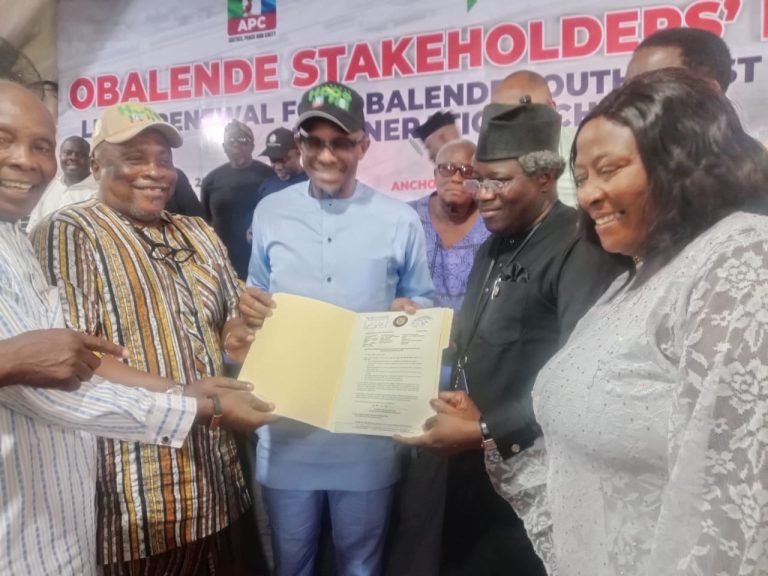
Governor Babajide Sanwo-Olu has approved a 50-year lease renewal for property owners in the Ikoyi-Obalende axis as part of the Obalende South-West Ikoyi Urban Regeneration Scheme.

The development was disclosed during the Obalende stakeholders’ meeting on lease renewal held at the Y-Arena Multipurpose Centre, Ikoyi, Lagos.

Speaking on behalf of the governor, the Special Adviser to the Governor on e-GIS and Urban Development, Dr. Olajide Babatunde, said the approval followed years of engagement between the government and residents of Obalende over the future of the community.

According to him, the Lagos State Government had earlier reached an amicable settlement, described as a consent judgment, which provided for the regeneration of Obalende and the renewal of leases to successors and assigns.

He explained, however, that the process had stalled over the years because the people of Obalende did not sustain engagement with successive administrations.

Dr. Babatunde said the turning point came on October 26, 2021, when stakeholders from Obalende, led by the member representing Eti-Osa Constituency II in the Lagos State House of Assembly, Hon. Gbolahan Yishawu, met with Governor Sanwo-Olu.

“At that meeting, Mr. Governor, as the 15th Governor of Lagos State, decided that he would renew the leases to the people of Obalende,” he said.

He added that the government subsequently began the process of restructuring land parcels in line with the new Lagos State Building Code and urban planning requirements.

According to him, the old plot arrangement in Obalende, where many properties measured about 250 square metres, no longer meets modern planning standards.

He said the government therefore adopted a land pooling strategy, merging smaller plots into larger parcels of about 750 square metres to allow for setbacks, airspace, accessibility and emergency response.

Dr. Babatunde said the same approach had been applied in other parts of Lagos, including Mandilas and Dosunmu, where fire incidents exposed the dangers of overcrowded and poorly planned developments.

He noted that the urban regeneration initiative was aimed at preventing future disasters, improving living conditions and ensuring that Lagos develops in line with a comprehensive master plan.

He stressed that Governor Sanwo-Olu chose not to reallocate expired Obalende leases to other interests, but instead returned them to the original beneficiaries under agreed terms and conditions.
“What Mr. Governor has done for the people of Obalende is that he has not looked away from them and said their leases have expired and decided to allocate the land to other people. He has allocated it back to them,” he said.

He described the move as another example of the Lagos State Government’s commitment to sustainable development through cooperation with communities.
Dr. Babatunde also urged residents of Obalende to remain united, transparent and honest throughout the verification and documentation process, warning that internal disputes could jeopardise the opportunity.

“People should engage the government so that they can have better living spaces,” he said, adding that regeneration efforts are also ongoing in other parts of Lagos, including Oke-Arin, Idumagbo, Jankara and Alaba Rago.

Also speaking at the event, Hon. Gbolahan Yishawu, who represents Eti-Osa Constituency II, described the governor’s approval as a transformational intervention that has removed a long-standing obstacle to development in Obalende.

He said for over a decade, lease renewal issues in the area had remained unresolved, creating uncertainty for residents, property owners and investors, while constraining infrastructure development and limiting the economic potential of the community.
Yishawu disclosed that under the new arrangement, 213 plots have been reconfigured into 100 plots to align with the Lagos Building Code.

He said the scheme would produce residential plots of not less than 744 square metres and commercial plots of not less than 1,160 square metres, replacing the fragmented smaller parcels previously in use.

According to him, the restructuring will encourage modern urban development, reduce congestion, improve setbacks and airspace, and align Obalende with global urban planning standards.

“This is not just a renewal; it is an intentional urban restructuring,” he said.
He noted that the scheme would also boost property values, improve access to financing and investment, increase land use tax compliance, and stimulate economic activities across construction, real estate and allied services.

Yishawu added that the initiative would support improved road networks, drainage, flood management and environmental sanitation, while also restoring confidence among residents and investors.
He said the project aligns with the Lagos State Development Plan 2022 and the administration’s broader agenda on infrastructure, sustainability and economic growth.

The General Manager of the Lagos State Property Corporation (LSPC), Dr. Kolawole Peregrino, praised Governor Sanwo-Olu’s leadership, saying the community would not forget the intervention.

“What you have done for us today in this community, history will never forget the leadership of Governor Babajide Sanwo-Olu,” he said.

Also speaking, Chairman of the Landlords Association, Mrs. Ebun Ekemode, expressed appreciation to the Lagos State Government for the approval and the efforts toward renewing the leases and repositioning Obalende for modern urban development. She encouraged the people to abide by the terms and conditions given by the government.

Easter: CFRA calls for justice, security amid rising insecurity

0


Men look at the sunset on the top of Zinariya hills, in Jos, on February 28, 2025


The Christian Faith Reporters Association has urged Nigerians to embrace peace, justice and unity as Christians mark Easter amid growing security concerns across the country.

In a statement signed by its President, Adeola Ogunlade, the association said the significance of Easter should serve as a reminder for citizens and leaders to uphold justice and protect lives.

The group expressed concern over recent killings in Jos on Palm Sunday, noting that the incident cast a shadow over the Easter celebration.

It stressed the need for urgent action to address insecurity, warning that continued violence threatens national stability and public safety.

The association called on security agencies to intensify efforts in tackling attacks and ensuring that those responsible are brought to justice.

CFRA also urged government authorities to adopt more effective and sustained measures to curb insecurity, particularly in vulnerable communities.

While commiserating with families affected by the violence, the group emphasised the importance of national unity and collective responsibility in overcoming the country’s challenges.

It further encouraged Nigerians to promote peaceful coexistence across religious and ethnic lines during the Easter period.

Sun

What Cardoso’s legacy at CBN would look like

0

By Ehi Braimah

​


When Yemi Cardoso, Central Bank of Nigeria (CBN) Governor, stepped out to take his seat on the stage for a conversation at The Peninsula, London, on a sunny but cold Tuesday afternoon on March 17, 2026, the room already sensed the weight of the moment.

The Africa Capital Forum, held on the sidelines of President Bola Tinubu’s recent historic state visit to the United Kingdom, had drawn bankers, global investors, diaspora fund managers, and development finance experts.

Jointly hosted by the CBN and UK’s Foreign, Commonwealth and Development Office, in partnership with several Nigerian banks and international financial institutions, the event carried a clear theme: Moving Nigeria from economic stabilisation to capital mobilisation.

Cardoso’s mellifluous voice remained calm, and pleasant to the ears, yet it carried across the room a powerful message of assurance. After nearly two and a half years on the saddle as CBN Governor, he spoke with the confidence of a man who had steered Nigeria’s monetary policy through turbulent times.

Cardoso sounded confident and surefooted. You could tell he was not just ticking boxes – he has been methodically building a legacy that would outlast him. On that day in London, Cardoso was joined on the stage for the conversation by Odile Renaud-Basso, a French civil servant who has been serving as President of the European Bank for Reconstruction and Development (EBRD) since 2020.

The theme of the Forum pointed in the direction of wooing investors and attracting capital to Nigeria. Indeed, Cardoso announced during the conversation that 32 Nigerian banks had achieved the recapitalisation threshold.

But just before the Easter weekend, CBN announced that 34 Nigerian Banks had raised their capital to N4.65 trillion, with 28 percent of the funds coming from foreign investors in what has been praised in several quarters as a major consolidation effort in the banking sector.

Cardoso has never declared in a single soundbite, “I want to be remembered for so, so and so,” yet his public statements, from early keynote addresses to the measured updates shared with investors in London, reveal a consistent vision: a transformed Central Bank that prioritises credibility, transparency, and rules-based policy over short-term interventions.

On his watch, CBN has refocused on its core mandates of price stability, financial system integrity, and sustainable growth.Cardoso inherited an institution marked by institutional deficiencies, governance lapses, reduced autonomy, ethical challenges, and a drift from its statutory roles. “I want a level playing field for all players,” he disclosed at the London meeting.

“You do not need to know anyone at CBN or knock on my door to get what you want,” he continued. Cardoso’s clear message was “fairness,” it doesn’t matter who you are, or whether you have access to privileges. That attribute is a key ingredient for excellent reputational management needed to protect the integrity of an organisation.

From the outset, he made it very clear that he would chart a new course. “We will vigorously address institutional deficiencies, restore corporate governance, strengthen regulations, and implement prudent policies,” he stated early on. He positioned the CBN as irrevocably committed to rebuilding public and market trust, shifting away from opacity and quasi-fiscal experiments toward transparency, forward guidance, and accountability.

Analysts have pointed to this philosophical change, from discretionary approaches to rules-based policy, as potentially his most enduring contribution. Cardoso has described his role as “the second hardest job in the world” and a “long-term call,” signaling that he views institutional reset as his central task.

The five pillars of his intended legacy

First comes restoring credibility and trust. Cardoso has repeatedly described the CBN’s recent past as marred by governance failures and deviation from core mandates. His explicit goal: rebuild the institution so that markets and citizens view it as reliable once more.

Second is delivering price stability. Inflation control stands as his paramount mission. In his November 2023 CIBN keynote, he announced the adoption of an explicit inflation-targeting framework, developed in coordination with fiscal authorities.

Conventional tools, including liquidity management, policy rate adjustments, and open market operations, have been applied aggressively to repair transmission mechanisms and anchor expectations, but Cardoso prefers to humanise his strategy.

“The economy belongs to everyone,” he said, emphasising that monetary policy must ultimately ease access to food, shelter, healthcare, education, and financial services for ordinary Nigerians. Price stability becomes not merely a technocratic target but a foundation for improved living standards.

Third is building a stable, transparent, and liquid foreign-exchange market. Early actions, such as clearing FX backlogs, unifying exchange windows, introducing a new FX code and Electronic Matching System, and lifting certain import bans, were framed as cleaning up legacy distortions.

The aim: restore market confidence, rebuild reserves through sustainable accretion, and create a predictable environment that supports genuine investment rather than speculation.

Fourth involves strengthening the banking sector to support Nigeria’s ambition of reaching a one trillion-dollar economy. The 2024 to 2026 bank recapitalisation programme highlighted above raised minimum capital requirements so that banks can finance larger-scale projects in a growing economy. Cardoso has directed bank leaders to prepare explicitly for the one trillion–dollar GDP target within the current administration’s horizon.

A sound, well-capitalised financial system, he argues, is essential for private-sector-led growth, MSME financing, and broader financial inclusion.

Fifth, and perhaps most defining in a philosophical sense, is repositioning the CBN as a catalyst for sustainable and inclusive growth, rather than a direct development financier.Large-scale quasi-fiscal interventions, which had previously exceeded 10 trillion naira across sectors such as agriculture and power, have been wound down.

The bank has refocused on its statutory responsibilities: maintaining price and financial stability, managing external reserves, and providing candid advice to government.

The broader objective is to create an enabling environment for private investment, higher GDP growth, reduced unemployment (benchmarked against BRICS and MINT peers – two different waves of emerging market economies identified by economist Jim O’Neill to highlight countries with significant potential to influence the global economy), and tangible improvements in citizens’ living standards that align with macroeconomic gains.

In London, Cardoso summarised the shift plainly: “The financial system we had is dead and buried. What we have now is a new system that has brought liquidity and transparency.”

The human realities on the ground

None of these reforms, as we are aware, have come without cost. Nigerians continue to grapple with high living expenses at the market, fuel stations, and dinner tables. Inflation, though showing signs of moderation in trajectory, remains elevated.

Poverty levels and the cost-of-living crisis dominate everyday conversations. The security challenges in the North-East and North-Central regions persist, with analysts noting patterns of heightened violence during election cycles as 2027 approaches. Global factors, including geopolitical tensions and rising fuel prices, have added further pressure.

During a Channels TV Sunrise Daily live interview with Maupe Ogun-Yusuf and Ayo Makinde on March 20, I acknowledged these micro-level hardships while highlighting progress at the macro level. Foreign exchange reserves have improved, and the naira has shown greater stability.

I also said that investor sentiment at the London forum was notably positive rather than skeptical. Discussions centered on exchange rate unification, fuel subsidy removal, and their impacts on the economy. They were excited about moving capital into Nigeria.

The recapitalisation numbers offer concrete evidence. If 28 percent of new bank capital was sourced from abroad, it signalsconfidence in the economy which is clear potential for growth.

A patient global financial architect at work

Cardoso’s record aligns closely with the vision he outlined from the beginning: orthodox monetary tightening, FX liberalisation, reserve building, governance reforms, and a banking sector repositioned for ambition rather than crisis management.

He has never claimed quick victories or denied the challenges.Instead, he speaks of patience, adaptability, and the long-term view. The true measure of his legacy, he has suggested, will be whether these changes endure beyond his tenure.

I left the Peninsula forum that March afternoon sensing a subtle but important shift – not a dramatic rhetoric or political spin, but a quiet institutional reform with results. Investors are convinced and ready to engage, rather than be deterred by what others see as risk.

Whether history will ultimately credit Cardoso with taming inflation permanently, helping deliver the one trillion–dollar economy, or simply restoring the guardrails that prevent future crises remains to be seen.

However, what is evident from his words and actions are the legacy he consciously pursues: a Central Bank that is trusted, transparent, and focused on the stability ordinary Nigerians and investors need to plan, build, and thrive.

May Cardoso succeed with his mission and build an enduring legacy.

Braimah is a PR specialist, marketing strategist, and publisher/editor-in-chief of Naija Times (www.ntm.ng) and Lagos Post (www.agospost.ng). He can be reached at ehi.braimah@neomedia.com.ng

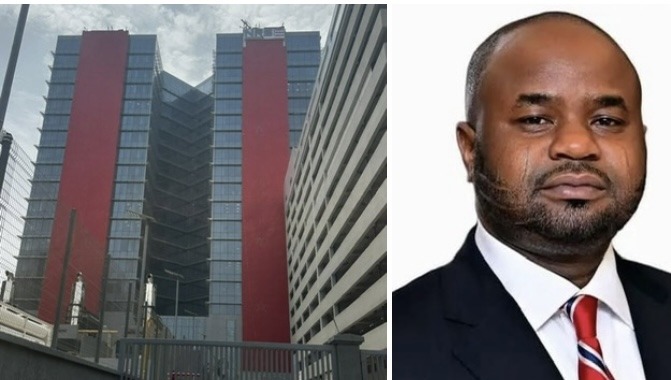
ANOTHER MILESTONE FOR NRS Zacch Adedeji breaks jinx

0

Completes NRS House after 22years

Zacch Adedeji’s Reform Agenda Delivers Historic Headquarters, Builds on Record of Achievements

In what stands as a defining moment in Nigeria’s fiscal administration history, the Nigeria Revenue Service (NRS) is set to witness yet another landmark achievement under the leadership of Zacch Adedeji. After over two decades of institutional uncertainty and infrastructural delay, the agency has finally completed its long-awaited head office bringing to life a vision that lingered unfulfilled for 22 years.

For more than two decades, successive administrations attempted, but failed, to deliver a permanent headquarters for the nation’s foremost revenue institution. The absence of a central, purpose-built facility not only reflected systemic challenges but also symbolised the slow pace of reform within Nigeria’s tax administration architecture.

That narrative has now changed.

Under the reform-driven leadership of Adedeji, the NRS has not only repositioned itself as a modern and efficient revenue authority but has also achieved what many once considered improbable the completion of its permanent head office. The significance of this milestone is further underscored by the planned commissioning of the edifice by President Bola Ahmed Tinubu on April 14.

However, this achievement is not in isolation. It is part of a broader record of reforms and accomplishments that have defined Adedeji’s tenure and strengthened Nigeria’s fiscal landscape.

Since assuming office, Adedeji has spearheaded sweeping tax administration reforms that have significantly improved revenue generation and efficiency. Under his leadership, the transition from the Federal Inland Revenue Service (FIRS) framework into the more robust Nigeria Revenue Service (NRS) has gained momentum, reflecting a bold institutional restructuring aimed at enhancing performance and accountability.

He has also driven aggressive revenue optimisation strategies, closing loopholes in tax collection, expanding the tax net, and improving compliance through technology-driven systems. These efforts have led to notable increases in non-oil revenue an essential shift for an economy seeking to reduce its dependence on crude oil earnings.

In addition, Adedeji has prioritised digital transformation within the tax system, introducing modern platforms that simplify tax filing, payment, and monitoring. This has not only improved ease of doing business but also strengthened transparency and reduced leakages within the system.

Stakeholder engagement has equally been a cornerstone of his approach. By fostering stronger collaboration between government agencies, the private sector, and international partners, Adedeji has helped rebuild trust in Nigeria’s tax administration while encouraging voluntary compliance.

Internally, his leadership has focused on institutional capacity building improving staff welfare, enhancing training, and promoting a performance-driven culture within the service. These reforms have collectively repositioned the NRS as a more responsive and efficient organisation.

Against this backdrop, the completion of the NRS headquarters stands as both a symbolic and practical culmination of these efforts. Beyond providing a permanent home, the facility represents institutional stability, operational efficiency, and a renewed commitment to excellence in public service delivery.

Observers note that the development aligns seamlessly with the broader fiscal reform agenda of the Tinubu administration, which seeks to strengthen revenue mobilisation, improve governance, and lay a sustainable foundation for economic growth.

As Nigeria continues to navigate complex economic realities, milestones such as this offer a glimpse into what is possible when leadership, vision, and execution converge. For the NRS, the completion of its head office is not just the end of a 22-year wait it is the beginning of a new era.

And for Zacch Adedeji, it is yet another powerful addition to a growing legacy of reform, results, and institutional transformation.

Seun Oloketuyi
Publisher of
Naijahottestgist
Writes from Lagos

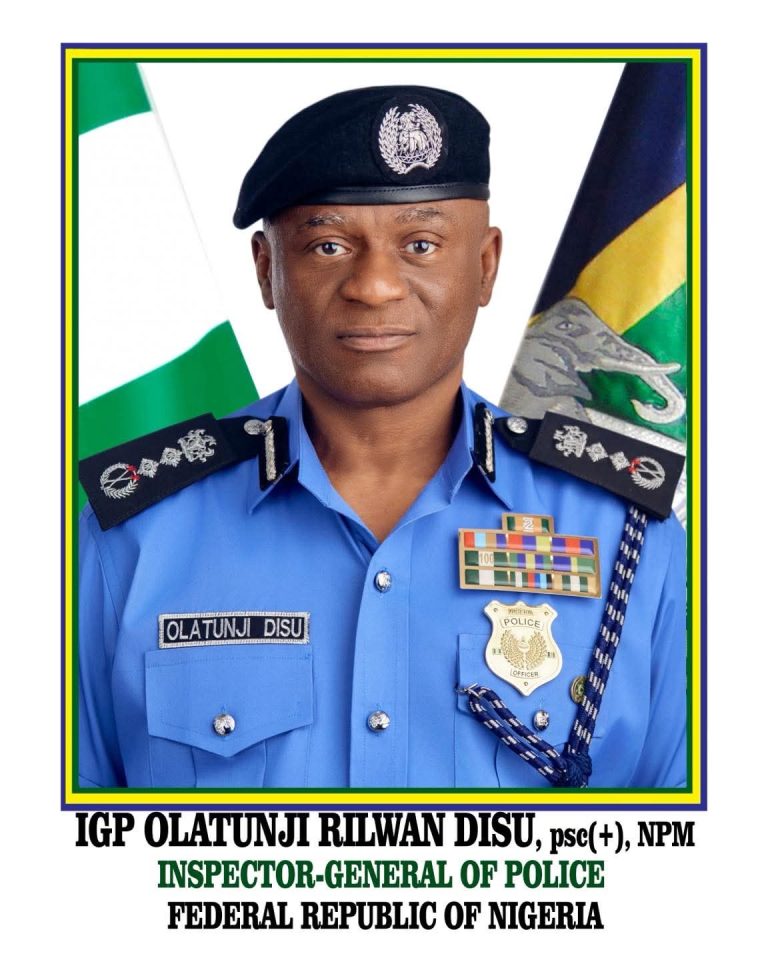
IGP Disu Extends Easter Greetings, Orders Tight Security Nationwide

0


The Inspector-General of Police, IGP Olatunji
Disu, has extended warm felicitations to Christians across Nigeria as they mark Good Friday, Easter Sunday and Easter Monday in commemoration of the death and resurrection of Jesus Christ.

As part of efforts to ensure a safe and secure environment during the festive period, the IGP has directed Commissioners of Police and Tactical Commanders in all states of the federation and the Federal Capital Territory to put in place robust security arrangements.

The operational measures, according to the police chief, include the strategic deployment of tactical teams and intelligence operatives, as well as the mobilization of the Special Intervention Squad and conventional police personnel to worship centres and critical infrastructure.

He also ordered increased police presence on highways, at motor parks, recreational centres and other public spaces to guarantee peaceful and hitch-free celebrations throughout the Easter long weekend.

In addition, the IGP directed heightened visibility policing, coordinated patrols, enhanced surveillance operations and intelligence-led stop-and-search duties aimed at proactively deterring criminal activities and ensuring swift response to any emerging threats during the celebrations.

IGP Disu urged members of the public to remain vigilant, cooperate with law enforcement agencies and promptly report any suspicious activities to the nearest police station or through the following emergency lines: 08057000001, 08057000002, 09133333785 and 09133333786.
He wished all Nigerians a peaceful and joyous Easter celebration.

The statement was signed by the Force Public Relations Officer, DCP Anthony Okon Placid, at the Force Headquarters, Abuja.

Osimhen bags prestigious award in Turkey

0

Super Eagles forward, Victor Osimhen has been named Footballer of the Year at the 72nd Annual Milliyet Sports Awards.

The Milliyet Sports Awards are regarded as one of the most significant honours in Turkey.

Osimhen was a vital player in Galatasaray’s domestic double last season.
The Nigeria international registered 26 goals and four assists in 30 league appearances for the Yellow and Reds.

The 27-year-old added seven more in the UEFA Europa League, and five in the Turkish Cup.

This season, the striker has 19 goals and seven assists in 29 games across all competitions for Galatasaray.

Sun

I’m still behaving myself because of you – Femi Otedola salutes mom at 94

0

Businessman, Femi Otedola said his mother, Dame Doja Otedola’s tutelage has kept him from misbehaving.

He said this in an X post commemorating her 94th birthday on Friday.


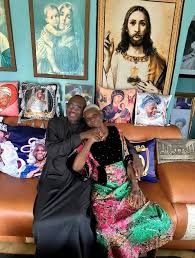
The Group Chairman of First HoldCo Plc shared a photo of himself in a loving embrace with his nonagenarian mother.

He captioned the photo, “Happy 94th birthday to my sweet mother Dame Doja Otedola. 30 years ago you gave birth to this gentleman, I am still behaving myself because of you.”

In October 2025, Otedola donated ₦4 billion to Augustine University, Ilara-Epe, Lagos State, for the construction of a new Electrical and Electronics Engineering block.

Otedola, who serves as the Chancellor of the institution, said the donation would fund the second phase of the Dame Doja Otedola Faculty of Engineering — a project named in honour of his mother.

Sun