Home Blog Page 511

Jilli Is A Boko Haram Stronghold,’ Yobe Govt Reacts To Military Air Strikes

0


The Yobe State Government has said that the Jilli community affected by the military air strikes is a Boko Haram stronghold in the Gubio Local Government Area of Borno State.

The Security Adviser to the governor, Brigadier General Dahiru Abdulsalam (retd.), disclosed this in a press statement to journalists, while clarifying whether the incident happened in Yobe or Borno.

It, however, said that some of the injured came from Geidam but had been moved to a hospital.

Hamzat Begins Consultations with GAC on Lagos Leadership Future

0


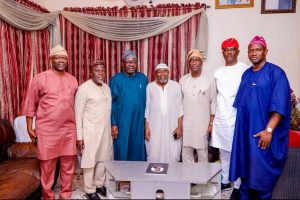
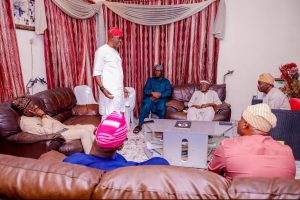
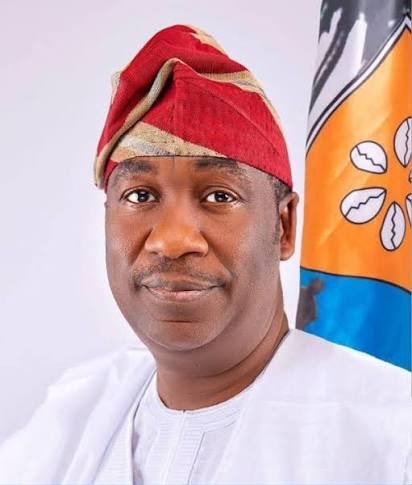
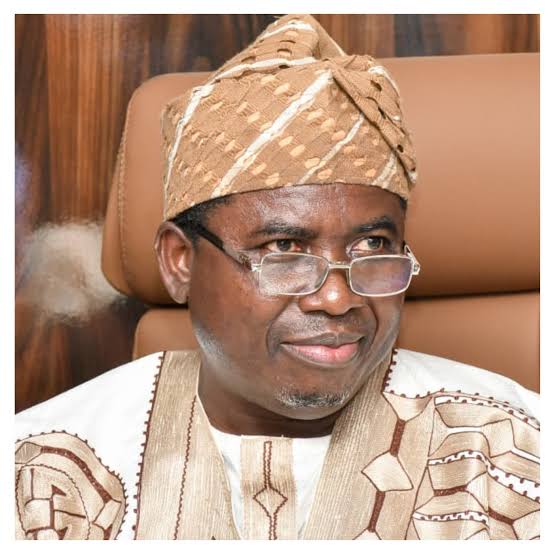
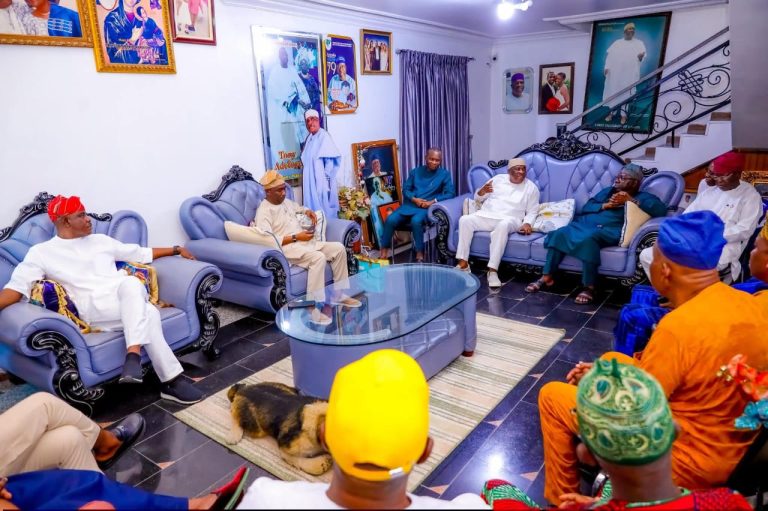
The Deputy Governor of Lagos State, Babafemi Hamzat, has commenced consultations with members of the Governance Advisory Council (GAC) as part of efforts to shape the future leadership direction of the state.

Hamzat disclosed this in a statement on Monday, noting that the engagement involved frank and constructive discussions with respected members of the council on the trajectory of governance in Lagos.
According to him, the consultations focused on the kind of leadership required to sustain and strengthen the state’s development.

He expressed appreciation for the wealth of experience and guidance shared during the meetings, describing the process as an opportunity to listen, learn and collaborate.

Pope Leo XIV Distances Self from Trump, Urges Global Peace

0


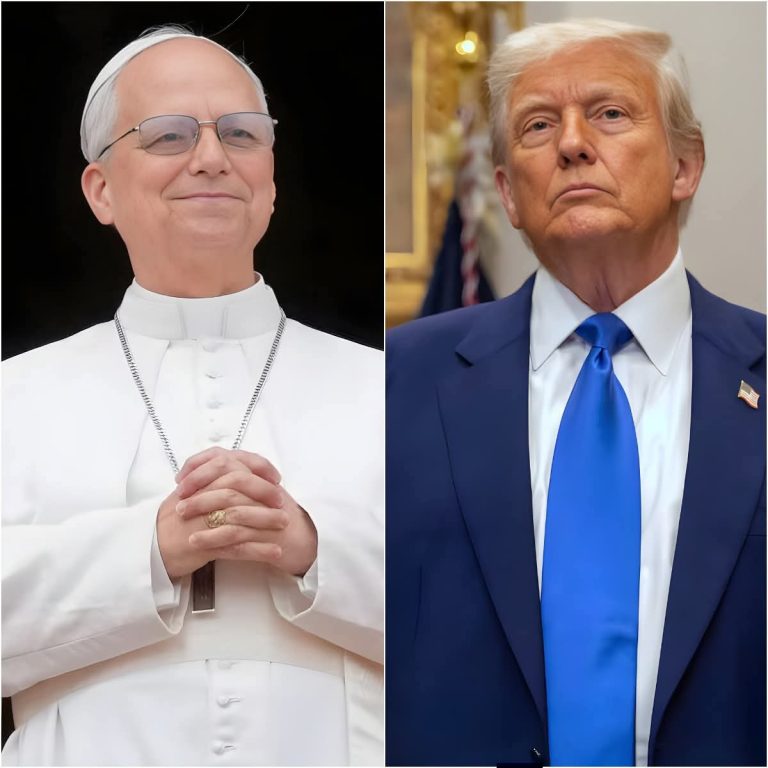
Pope Leo XIV has emphasised that he has no intention of engaging in political debates with former U.S. President Donald Trump, stressing that his mission remains rooted in promoting peace and the message of the Gospel.

In a statement, the pontiff said readers could draw their own conclusions about his remarks, reiterating that he is not a politician and has no desire to be drawn into political exchanges.
“I am not a politician; I have no intention of entering into a debate with him,” the Pope said. “Rather, let us always seek peace and put an end to wars.”

He maintained that he was not intimidated by the Trump administration, but clarified that his focus is on spiritual leadership rather than politics.

“I speak about the Gospel, I am not a politician. I do not think the message of the Gospel should be abused in the way some people are doing,” he added.
Pope Leo XIV further pledged to continue speaking out against war and advocating for peace through multilateral dialogue among nations.

“I will continue to speak out loudly against war, to try to promote peace and encourage dialogue between states in order to find the right solutions to global challenges,” he said.

He concluded by underscoring the core message of the Church, noting that “blessed are the peacemakers,” while lamenting the widespread suffering across the world.

CPPE Faults World Bank’s Push for Increased Fuel, Food Imports

0


The Centre for the Promotion of Private Enterprise (CPPE) has expressed strong reservations over the World Bank’s recommendation that Nigeria should increase the importation of petroleum products and food to address supply-side constraints.

In a statement signed by its Chief Executive Officer, Dr. Muda Yusuf, the organisation described the proposal as “deeply troubling” and misaligned with Nigeria’s current economic realities and reform trajectory.
CPPE noted that Nigeria is making measurable progress in restoring macroeconomic stability, citing improvements in foreign reserves, moderating inflation, a more stable exchange rate regime, and growing capacity for the export of refined petroleum products.

The group argued that encouraging increased importation at this stage could reverse these gains by intensifying foreign exchange pressures, weakening domestic refining investments, and exposing the economy to external shocks, especially among global geopolitical tensions and energy market volatility.

It stressed that Nigeria is gradually transitioning towards self-sufficiency in petroleum products, driven by significant private sector investments in domestic refining, and called for policies that support local production, value addition, and stronger industrial linkages.

According to CPPE, sustainable economic transformation must be anchored on production and industrial capacity rather than import dependence. It warned that import-driven strategies could accelerate de-industrialisation, weaken the real sector, and undermine job creation in a growing economy.

The organisation further highlighted structural challenges facing Nigerian producers, including poor infrastructure, high energy costs, expensive financing, and multiple taxation, noting that these conditions make competition with imports inequitable.

CPPE also raised concerns about the risks of substandard imports and dumping, warning that weak quality control mechanisms could harm consumers, the environment, and local industries.

On energy security, the group recalled that Nigeria’s past reliance on imported petroleum products led to the collapse of domestic refining capacity, created a rent-seeking regime, and imposed an annual import burden estimated at between $10 billion and $15 billion at its peak.
It pointed to recent progress in domestic refining, particularly the operationalisation of the Dangote Refinery, as evidence that Nigeria can achieve self-sufficiency with the right policy support.

The group also cautioned against excessive food imports, stating that they depress farmgate prices, discourage agricultural investment, and weaken rural livelihoods.

CPPE warned that heavy import dependence could strain Nigeria’s foreign exchange reserves, pressure the naira, and heighten exposure to global supply shocks, all of which are inconsistent with the country’s macroeconomic stability goals.

The organisation noted a growing global shift towards strategic protectionism, with advanced economies increasingly prioritising domestic production, supply chain resilience, and economic security.
It described it as paradoxical that developing countries like Nigeria are being advised to adopt policies that many advanced economies are moving away from.

CPPE urged the World Bank to refocus its policy advice on industrialisation-driven reforms, including expanding domestic refining capacity, reducing production costs, strengthening manufacturing ecosystems, boosting agricultural productivity, and promoting local content development.

The group concluded that Nigeria’s long-term growth should be driven by a production-based model built on strong domestic industries, energy and food security, and reduced reliance on imports.

Nigerian Stock Market Opens Week Higher as Benchmark Index Gains 0.34%

0


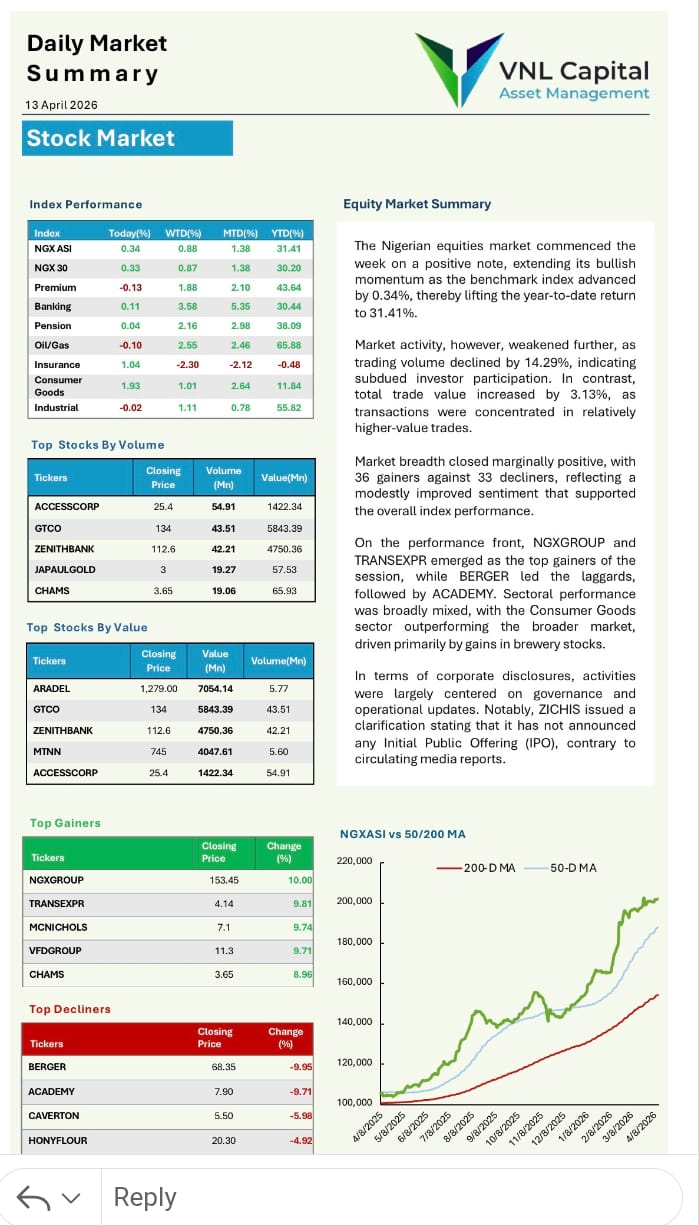
The Nigerian equities market began the week on a positive trajectory, sustaining its bullish run as the benchmark index rose by 0.34 per cent, pushing the year-to-date return to 31.41 per cent.

Despite the upward movement, market activity weakened, with trading volume declining by 14.29 per cent, reflecting reduced investor participation.
However, the total value of trades increased by 3.13 per cent, indicating a concentration of transactions in higher-value stocks.

Market breadth closed slightly positive, recording 36 gainers against 33 decliners, a sign of modest improvement in investor sentiment that supported the overall market performance.

On the gainers’ chart, NGXGROUP and TRANSEXPR led the pack, while BERGER and ACADEMY recorded the most significant losses. Sectoral performance was mixed, with the Consumer Goods sector outperforming the broader market, largely driven by gains in brewery stocks.

Meanwhile, corporate disclosures were dominated by governance and operational updates. ZICHIS issued a clarification denying reports of an Initial Public Offering (IPO), stating that no such announcement had been made.
In the fixed income market, the interbank segment opened on a positive note as the overnight (O/N) rate declined by 16 basis points to 22.19 per cent, while the Open Repo Rate (OPR) remained steady at 22.00 per cent.

The local bond market saw yields drop by an average of 2.9 basis points, driven by positive sentiment at the short end of the curve. The March 2027 and March 2028 bonds recorded the most notable declines, falling by 8 basis points and 2 basis points to 17.82 per cent and 15.92 per cent, respectively. Conversely, yields on the 2030 and 2032 bonds rose by 4 basis points each.

In the Nigerian Treasury bills market, investors showed mild bullishness, resulting in a 2.7 basis points decline in discount rates. The most significant drop was observed in the 8 April 2027 bill, which fell by 9 basis points.
However, the Eurobond market presented a contrasting trend, with Nigerian bond yields rising by an average of 1.3 basis points. Demand was limited to the 2030 and 2032 maturities, where yields declined slightly amid heightened geopolitical concerns.

At the currency market, the naira appreciated marginally against the U.S. dollar by 0.1 per cent to close at ₦1,358.00. The currency has strengthened by 1.7 per cent week-to-date, 1.5 per cent month-to-date, and 5.0 per cent year-to-date.

Nigeria’s foreign reserves remained steady at $48.89 billion, supported by sustained foreign exchange interventions by the Central Bank of Nigeria following a strong recovery earlier in the year.
In the global commodities market, Brent crude oil prices surged by 6.3 per cent, driven by rising geopolitical tensions after the collapse of ceasefire talks between the United States and Iran.

The situation escalated further after President Donald Trump announced a naval blockade targeting vessels linked to Iranian ports and those transiting through the Strait of Hormuz.

Re: The ‘Baba Sope’ trap: Lagos, godfather politics and the man who deserves a second chance

0


By Steve Omolale


As preparations for the May 18 governorship primaries of the ruling All Progressives Congress (APC) gather momentum, all kinds of emergency political analysts, beer parlour commentators and unrepentant charlatans have started coming out of their cocoons, offering moronic arguments on who should fly the party’s flag.

In one of such jaundiced analyses, and writing in “The Best of the West”, an online newspaper, under the title: “The ‘Baba Sope’ trap: Lagos, godfather politics and the man who deserves a second chance”, a certain self-styled political analyst, Usman Adewale, while trying to make a case for the second coming of former Governor Akinwunmi Ambode, concocted a cock and bull story disingenuously tagged “analysis”, and spewed falsehoods about Deputy Governor Dr. Kadri Obafemi Hamzat.

His so-called analysis, which is laced with all manner of innuendos against the person of Hamzat, Hon. James Faleke, representing Ikeja Federal Constituency in the House of Representatives, the highly respected Governance Advisory Council (GAC) and President Bola Tinubu GCFR, ranks among the worst analyses of Lagos politics one has read in recent times.

It is full of outright lies, half-truths and sheer mudslinging. Clearly, the trash is a by-product of a shallow mind, masquerading as an analyst. It is an unintelligent presentation from a demented soul. I will explain.

Firstly, Adewale vehemently condemned GAC, whose members he disrespectfully described as spent political forces, for holding a meeting with President Tinubu where he reportedly said Hamzat should be supported to succeed Governor Babajide Sanwo-Olu, as hinted by Faleke. To him, this is not democracy, but a “Baba Sope Trap”.

I do not blame him. Perhaps, he was asleep in 2015 when the same GAC that he now derogatorily refers to as “Baba Sope” brought in Ambode, who some people said was not the most qualified of all the aspirants then, as governor. While the decision of GAC was democratic in 2015 and its members were not “spent political forces” then because they favoured Ambode, the same Council with a similar decision today is undemocractic because it endorsed Hamzat. What a pity! Was Adewale hallucinating when he wrote this trash? Most likely!

Still in his dreamland, and in his futile attempt to question the roots of the deputy governor, he mischievously asked: “Where, precisely, does Dr. Kadri Obafemi Hamzat come from?”

To him, this is not a “trivial question” because he, obviously, has lost his wandering mind when writing his so-called analysis. But, to discerning Lagosians, who are in their millions, his question is the most trivial and most senseless ever. Saying Hamzat is not a “genuine indigene” of Lagos, whatever this means, is a submission of a man under the influence of some substance.

Unlike Adewale the “political analyst”, all discerning Lagosians know that Hamzat was born into the family of the late Oba Mufutau Olatunji Hamzat and the late Alhaja Kehinde Hamzat from Iga Egbe, Lagos Island. His father served as a member of the Lagos State House of Assembly and a Commissioner for Transportation in the state between 1979 and 1983 before becoming the Vice-Chairman (South-West) of the then Alliance for Democracy (AD). The deputy governor’s father later became the Lagos West Senatorial District leader of the Action Congress (AC) and a monarch through his maternal royal lineage. He was also a member of GAC that Adewale derided so much in his write-up.

With this, Hamzat is clearly not what the Yoruba will call “Omo Atounrinwa” (a total stranger) in Lagos because he is “Omo Eko Gangan” (an original Lagos indigene).

Why would Adewale have problems with Hamzat’s Epe roots? Did Epe people tell him the deputy governor is not one of their own?

In case he did not know, the first military administrator of Osun State, General Leo Ajiborisha (rtd) from Epe, is Hamzat’s uncle. His late father changed his name when the family stopped idol worshipping and when he became a monarch, hence his title was Ajiborisha I. The fact that Hamzat’s late mother hailed from Lagos Island has eminently qualified him for the exalted seat of the governor of the Centre of Excellence.

And in case Adewale, with his bitter mind, still did not know, a prominent Lagosian, Senator Musiliu Obanikoro, recently reaffirmed that “Hamzat is a bonafide Lagos indigene”, citing the examples of some past and present Obas of Lagos, including Dosunmu, Akintoye and Oluwole, as well as Akiolu, who were and are from the female lineage and were still crowned as kings. Besides, he could as well be sleeping when Oba Akiolu acknowledged that the Lagos monarchy is from Benin, while the Benin monarchy is from Ile-Ife.

He was also not in this world when the revered elder statesman, Chairman of GAC and Ado-Ekiti chief, whose mother also hailed from the Ekiti State capital, Prince Tajudeen Oluyole Olusi, said the prominent Ojora Chieftaincy Family of Lagos have their roots in Aramoko-Ekiti. It is also an open secret that Akinwunmi Ambode himself has his roots in Ondo State. Many prominent Lagos families today have their roots elsewhere in Yorubaland and outside the shores of Nigeria before their forefathers came to Lagos. Yet, like Hamzat, they are all indigenes of Lagos. The drinking joint analyst can definitely not know better than Oba Akiolu, Prince Olusi, the distinguished senator and former minister, Obanikoro, and many other respected Lagos indigenes.

Where was Adewale when Hamzat’s father was part of the pro-democracy forces that fought the late Gen. Sani Abacha and his evil regime to a standstill? Where were his sponsors who keep on, as they say, hiding behind a finger.

Although pretending to be unperturbed by religious sentiments, Adewale still revealed his biases in his banal analysis. Common sense should have dictated to him that religion has nothing to do with performance. There is no governor of Lagos State, right from 1999 to date, who has not done exceedingly well, irrespective of his religion.

Besides, in one breath, he acknowledged that “deputy governors in Nigeria occupy a peculiar constitutional purgatory,” in another, he contradicted himself by saying, “From Agege to Ajah, from Badagry to Ikorodu, what can any resident of Lagos point to and say with confidence, ‘That is Hamzat’s work?'”

He should check Chapter 6, Part 2, Section 193 of the Nigerian Constitution to read and comprehend the duties and limitations of a deputy governor. With the duties and responsibilities of a deputy governor clearly spelt out in the Constitution, what specific work does he expect the Lagos deputy governor to do “from Agege to Ajah, from Badagry to Ikorodu”?

Since Hamzat is a very loyal deputy and party member to the ever-performing Governor Sanwo-Olu, both of them and their team of commissioners and other political appointees have taken Lagos to greater height. They are a winning team any day. A governor’s achievement is shared by his deputy; it is a joint ticket. To ask what Hamzat done, smacks of pure illiteracy on the part of the unknown Adewale, a hired gun.

However, and as part of his achievements as the Lagos State Commissioner for Science and Technology in the Tinubu administration between 2005 and 2011, Hamzat enforced the application of modern technology in ministriesand agencies, thus changing the face of data and record keeping and at the same time eliminating the trend of ghost workers. That was why the revenue of Lagos State went up and Asiwaju Tinubu, the then governor, became the champion of financial re-engineering.

And as the Commissioner for Works and Infrastructure under the then Governor Babatunde Fashola SAN between 2011 and 2015, Hamzat initiated and completed several projects that actually changed the face of Lagos, one of the reasons Fashola again appointed him as Special Adviser (Technical) when he was the Minister of Power, Works and Housing under the late former President Muhammadu Buhari. And since 2019, he has been the deputy governor of Lagos State. Therefore, Hamzat is not a novice to public service where his image has never been tainted by any scandal.

Yes, Ambode did well as the governor of Lagos State. But insisting that, that is the only position he could occupy and perform well is diminishing his status. If given the opportunity, he can also perform well at the national level, as some former governors have found their ways to the Senate and the Federal Executive Council (FEC) where they are contributing to national development.

Those who are close to Hamzat have been speaking glowingly about his impeccable character, his dedication to duty, his compassion and his brilliance, among other good attributes.

One of them, Mr. Moshood Gbadamosi, a lawyer, in a thank you message to the deputy governor, as he approaches the party primaries, recalled how he did not know him before but still supported him financially, just after making a phone call to him, when he (Gbadamosi) was admitted to the Nigerian Law School. In his words, “That gesture is still fresh in my memory. I can’t forget it.”

This is just one of the many testimonies from one of the many known and unknown people about Hamzat.

Even Adewale in his myopic “analysis” acknowledged that, “Party insiders describe Hamzat as cerebral, educated and policy-oriented.”

Therefore, if the deputy governor possesses all these attributes enunciated above, and even acknowledged by his arch-enemies and political opponents, nobody should deny him his inalienable right to the governorship seat in Lagos State by saying he is a non-indigene.


Omolale, a seasoned journalist, writes from Lagos.
The Bolt Principle: Hamzat’s Race to Marina House

0


When we talk about the Olympics, we think of ancient Greece, Mount Olympus, Pierre de Coubertin, the Olympic Rings, and athletes. Beyond being the biggest sporting event in the world, many stories are woven into that laurel wreath. They are stories of grit, determination, disappointment, and triumph.
Every Olympics announces the arrival of young hopefuls, the emergence of new stars, the meteoric rise of champions, the sparkling dominance and consolidation of great athletes, the dimming of fading stars, and finally, the swan song of legends. One strand of the story woven into the iconic laurel wreath started in 2004 at the Athens Games. It was here that Usain Bolt—a young hopeful—graced the tracks, finishing fifth in his heat and not making the finals.
Away from the public glare, Bolt incorporated the Wayne Goldsmith formula of ‘Train the brain. Train emotion management. Train the ability to perform when and where it matters—no matter what the event throws at you.’ His efforts started bearing fruit at the 2005 World Championships in Helsinki, where he made the 200 metres final, but a hamstring injury ruined his parade.
Thereafter, Usain Bolt had moments of standing at the centre, right, and left sides of the podium at the Grand Prix in Lausanne (2006), World Championships in Osaka (2007), the 2008 Beijing Olympics, and the 2009 World Championships, breaking the world record at Beijing and breaking his own record in Berlin.
The story of Usain Bolt shows that the journey to the top starts with a step. It vividly supports the popular aphorism that Rome was not built in a day. A popular Yoruba adage says, “Ikoko ti yio je ata, idi e gbona,” meaning, a pot that eats soup cannot escape the heat of fire. This adage is an evergreen homily that cuts across all tracks of titans and public spheres.
This theme, exemplified in Usain Bolt’s journey from ex nihilo to the top in the sports world, fits perfectly with the trajectory of Dr. Obafemi Hamzat, the current Deputy Governor of Lagos State. With a sparkling doctorate and a scintillating career working in A-list organisations like Oando, Morgan Stanley, and Merrill Lynch, Obafemi was appointed as Commissioner for Science and Technology in 2005 by Governor Bola Tinubu.
Under his watch, the digitalisation of all processes through the Oracle ERP system was achieved. This brought corporate governance—the holy grail of the private sector—to the public sector. Also, as Commissioner for Works and Infrastructure (2011–2015) during the Babatunde Fashola administration, he supervised the expansion, upgrading, and completion of many roads.
His hiatus in public service was the period when Akinwunmi Ambode presided over the affairs of the Centre of Excellence. A hiatus here is not a period of idleness; rather, it is a period of taking stock, refreshing, and devising new ways of doing things. The hiatus period was short, as he served briefly as Special Adviser on technical matters to Fashola in his federal ministerial capacity, before eventually emerging as Babajide Sanwo-Olu’s Deputy Governor after victory at the polls.
For almost everything Usain Bolt experienced, except injuries, Obafemi Hamzat has had a parallel. Bolt earned a mixture of bronze, silver, and gold; Hamzat served in different capacities. Bolt learnt from the masters before breaking the world record at Beijing; Obafemi has learnt from three different governors of Lagos before becoming the Deputy Governor.
The Bolt and Obafemi trajectories in sports and the public service are not absurd. Such trajectories are explained in psychology, as elucidated in the work of Anders Ericsson, a Swedish psychologist famous for his work on expert performance and the concept of deliberate practice. His Delayed Mastery Curve framed learning as progressively slow and invisible at the inertia stage. However, through constant practice, the jagged edges are gradually smoothed out. With consistency in skill acquisition, through repetition and correction, an accumulation resulting in enhanced performance becomes evident at the later stage. Obafemi, over time, as a two-time commissioner, Special Adviser, and Deputy Governor, has mastered the curve of governance and is ready to peak like Usain Bolt did at Beijing.
While peaking at the right moment is germane in sports, the road to the podium is not a given. No free food even in Freetown, like they say on the street. Even if you peak at the right time, you still have to compete with others. For the 2008 Beijing Olympics, Usain Bolt did. And for the Berlin 2009 record-breaking time, Usain Bolt competed with Asafa Powell, Tyson Gay, Marc Burns, and Daniel Bailey, among others. Already, many names are being touted as the next occupant of Marina House, including Dr. Obafemi Hamzat’s name.
For Dr. Obafemi Hamzat and other names being touted, a short story from another sporting event is instructive. It shows the importance of practice and innovative strategy over speed.
John Landy, an Australian, was a bronze medallist in the 1,500 metres at the 1956 Olympic Games held in Melbourne. In 1953, he wanted to be the first man to do a sub-4-minute mile, setting a world record. Much as he tried, his efforts ended in a fiasco. Then came Roger Bannister, an Englishman who was creative about the sub-4-minute mile task. Bannister welcomed help, and used two Olympic runners, Chris Chattaway and Chris Brasher, as pacemakers; by running with the pacemakers, Bannister became the first to break the four-minute mile feat—a feat that John Landy broke six weeks later. So, one may ask: who was the better runner?
The better runner is not necessarily the fastest, like John Landy, but Roger Bannister, who understood how to take advantage of his pacemakers. This advantage Dr. Obafemi Hamzat has had in abundance from Tinubu to Fashola and Sanwo-Olu.
All the names being touted have sweat on their temples too from persistent training. But training alone does not win a race. You must execute a game plan. Do you go for a bullet start, or pull away from the pack at a decisive moment? Yet there must be something in Hamzat, having run alongside three different pacemakers in governance—Bola Tinubu, Babatunde Fashola, and Babajide Sanwo-Olu. The “JAMB question” begging for an answer is whether Hamzat will take advantage of the rhythm and lessons of these pacemakers.
If he does, he will have taken a sip from the fountain of knowledge captured by the advertising legend Bill Bernbach, who once said: “It may well be that creativity is the last unfair advantage we’re legally allowed to take over our competitors.”
Can Obafemi Hamzat take this “legal unfair advantage” and stand at the centre of the podium?
I siddon look!

Toluwalope Shodunke , a Media Practitioner, Can be reached via tolushodunke@yahoo.com

No Request From Any ADC Faction To Use Eagle Square, Wike Says Claims Baseless

0


The Minister of the Federal Capital Territory (FCT), Nyesom Wike, on Monday dismissed claims that any political party was denied the usage of the Eagle Square, insisting that no formal application was submitted.

“Who denied them? I am not aware of any such development, and I don’t even know which party you are referring to. If it is the African Democratic Congress (ADC), such claims are their usual attempt to gain public sympathy,” Wike said.

He explained that the use of Eagle Square is subject to due process, which includes formal application through the Abuja Investments Company Limited, which is charge of the facility and payment of required fees.

The Minister also pointed out that the Moshood Abiola National Stadium Velodrome is not under the Federal Capital Territory Administration, but the Sports Commission.

“As we speak, no formal application has been submitted to the Abuja Investments Company Limited. When the APC used the venue and PDP used the Stadium Velodrome, they complied with the process. We do not deny anyone access if the rules are followed,” he added.

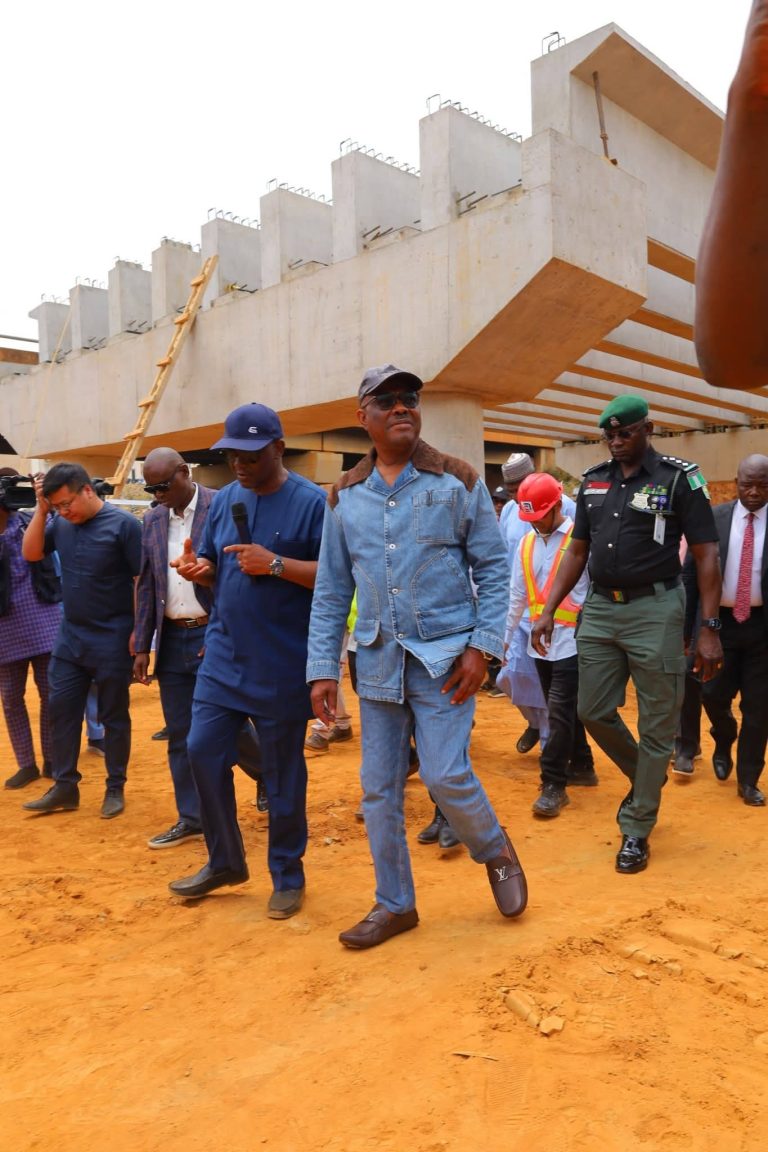
Wike spoke during an inspection of ongoing projects in Abuja, where he expressed satisfaction with the level of work done, noting that key road projects would be completed by May 15.

“The contractors have assured us that road works will be completed by May 15, while streetlight installations will be finalised before the end of May,” he said.

The minister also disclosed that at Gaduwa, he had directed the installation of protective mesh to prevent encroachment on road corridors, while works on streetlights were progressing.

At Wassa, Wike said the administration was set to relocate informal sector operators, particularly Apo Mechanic Village Traders, to a new facility equipped with necessary infrastructure.

“This project is aimed at improving the working conditions of artisans and fulfilling long-standing promises to the informal sector,” he stated.

On reports the windstorm that affected the roof of the Kugbo Bus Terminal, the minister said it was a natural disaster that no one had control over, explaining that only roofing sheets were affected, and the damages are already being fixed.

“The terminal did not collapse. The structure is intact. What happened was that strong winds blew off parts of the roof. Repairs are ongoing,” Wike said, noting that no lives were lost.

He attributed the steady progress of projects in the FCT to effective collaboration between the government and contractors, supported by prompt payment of contractual obligations.

Okowa Declares Delta North Senate Bid on APC Platform

0


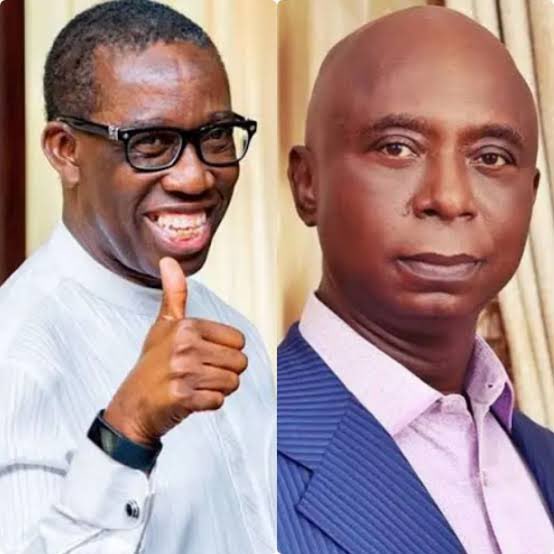
Former Delta State Governor and Peoples Democratic Party (PDP) 2023 vice-presidential candidate, Ifeanyi Okowa, has declared his intention to return to the National Assembly by contesting for the Delta North Senatorial seat in the 2027 general elections on the platform of the All Progressives Congress (APC).

The seat is currently occupied by Senator Ned Nwoko.

Amupitan doesn’t maintain any personal X account – INEC

0


The Independent National Electoral Commission (INEC) has clarified that its chairman, Joash Amupitan, does not maintain a personal X account, distancing him from controversial posts that resurfaced and were linked to an account allegedly associated with him.

Speaking on Channels Television’s Morning Brief, INEC ICT Director Lawrence Bayode said the commission had already issued an official statement last week, making its position clear.

According to Bayode, any content attributed to such an account should not be regarded as originating from the chairman, as the commission does not recognise the account as authentic.

“Based on the official statement issued by the commission, sometimes last week, the chairman does not maintain any personal X account. Any content attributed to such an account is not recognised by the commission as originating from him,” Bayode said.

He stressed that the issue goes beyond one individual, warning that digital impersonation and misinformation pose serious risks to public institutions and can easily mislead citizens.

“And for me, this is not about an individual; this is about how digital impersonation and misinformation can target public institutions,” he added.

Bayode said INEC’s responsibility is to safeguard truth, verify facts, and protect Nigerians from false information capable of undermining trust in democratic institutions.

“And for me, this is not about an individual; this is about how digital impersonation and misinformation can target public institutions.”

The clarification follows controversy over resurfaced tweets linked to an X account falsely alleged to belong to the INEC chairman.

Sun