Home Blog Page 398

ADC crisis: Aregbesola asks new judge to withdraw from Gombe’s suit

0


National Secretary of the African Democratic Congress (ADC), Ogbeni Rauf Aregbesola, has asked Justice Peter Lifu of the Federal High Court in Abuja to recuse himself from the party’s leadership crisis suit reassigned to him.

Aregbesola’s application came barely less than a day to the hearing in the suit filed by Mr Nafiu-Bala Gombe to stop Sen David Mark-led leadership of the ADC from parading themselves as valid leaders of the party.

Justice Lifu had fixed tomorrow for the hearing of the case after the Chief Judge of the court, John Tsoho, reassigned the matter to him.

The case filed by Gombe, the aggrieved former National Deputy Chairman of the ADC, was earlier before Justice Emeka Nwite of a sister court. The matter was, however, reassigned to Justice Lifu, after Nwite’s name was announced among the 12 new justices whose names were sent to President Bola Tinubu for approval as judges of the Appeal Court.

Meanwhile, Aregbesola, in a motion on notice dated June 1 but filed June 2, asked Justice Lifu to withdraw from the case and transfer the suit back to the CJ for reassignment to another judge.

The ADC national secretary, through his lawyer, Mohammed Sheriff, cited lack of confidence in the judge, in his seven-ground argument.

He submitted that the 1999 Constitution (as amended) guarantees every litigant a hearing before an independent and impartial panel.

“Certain circumstances have arisen in this matter which creates a reasonable apprehension of lack of confidence by the third defendant which may undermine public confidence in the administration of justice.”

Aregbesola said the court, in a suit number: ABJ/CS/2637/2026 between the Incorporated Trustees of the National Forum of Former Legislators Vs. INEC and six others, where his party (ADC) was the third defendant in the suit, had shown a likelihood of lack of confidence.

He said this was so because the court “had given rulings against established principles of law and advice to the applicant and his party in that suit.

“Ordered an accelerated hearing when the matter was not in fact a pre-election matter or a matter of urgency.

“Refused two motions for stay of proceedings and directed parties to enter their defence, adopt their processes and adjourned for judgment, despite being informed of a pending appeal entered before the Court of Appeal and an affidavit of fact showing the same before it.”

He said at the proceedings of May 22 in appeal number: CA/ABJ/CV/569/2026, “counsel for the appellant informed the Court of Appeal of this court’s refusal to stay proceedings, and in complete indignation and irritation at this court’s refusal to stay further proceedings, the Court of Appeal granted an order for stay of further proceedings.

“The applicant has no confidence in this court to administer justice in these proceedings.

“It is in the interest of justice that the matter be heard by another judge.

“The applicant believes that a fair-minded observer would reasonably apprehend a lack of confidence in proceedings before this honourable court.”

The hearing of the case is scheduled for tomorrow.

Gombe, in the suit, is seeking an order restraining Mark, the embattled National Chairman of ADC; Aregbesola, the National Secretary and members of their interim National Working Committee (NWC), from parading themselves as the party’s leaders.

He had argued that the emergence of Mark, Aregbesola and other NWC members as party’s leaders breached the provisions of the party’s constitution and the Electoral Act.

Gombe had sued ADC, Mark, Aregbesola, Independent National Electoral Commission (INEC) and Ralph Nwosu as first to fifth defendants respectively in the suit marked: FHC/ABJ/CS/1819/2025.

Nwosu was the former ADC National Chairman, who stepped down for Mark’s leadership of the party.

Former Vice President Atiku Abubakar emerged as the ADC presidential candidate on May 27 after defeating two other aspirants, including Rotimi Amaechi, former minister of transportation, at the party’s national convention.

Also, Dumebi Kachikwu, in a national convention conducted by another faction of the ADC, emerged the presidential candidate of the party for the 2027 general election.

The 2023 presidential candidate of the party was adopted by factional members of the party as sole presidential candidate on May 24.


INEC probes CRV database breach, candidates’ information publication

0

• You’ve questions to answer, Atiku says

Former vice president, Atiku Abubakar, has said the Independent National Electoral Commission (INEC) has questions to answer over unauthorised disclosure of information from its Continuous Voter Registration (CVR) database.

Atiku, presidential candidate of the African Democratic Congress (ADC), said while INEC has tried to to reassure Nigerians that there was no external hacking of its Information Communication Technology (ICT) infrastructure, the Commission admitted that sensitive voter information was accessed through valid official credentials and released without authorisation.

INEC has admitted that it has commenced an investigation into the unauthorised access to its Continuous Voter Registration (CVR) database and subsequent publication of information of a candidate in the recent political party primaries in the Federal Capital Territory (FCT).

INEC allayed the fears of Nigerians by explaining that the incident under investigation relates to the retrieval of a specific voter’s records and does not indicate any compromise of the commission’s broader voter registration infrastructure or the personal data of over 90 million registered voters.

It also revealed that the Department of State Services (DSS), has, on its own accord, commenced an independent investigation into the matter, assuring that the commission would continue to cooperate fully with all relevant security agencies and would not hesitate to refer any person found culpable for appropriate legal action.

The commission equally noted that “preliminary findings from the audit trail indicate that there was no external breach of the CVR database, no hacking incident and no unauthorised external access to its ICT infrastructure. However, the information in question was accessed through valid user credentials assigned to personnel participating in the ongoing CVR exercise but released without authorisation.”

Atiku, in a statement by his media aide, Phrank Shaibu, said it was disturbing that the material in question was voluntarily published by Lere Olayinka, spokesman to the Minister of the Federal Capital Territory, Nyesom Wike.

“INEC’s statement has moved this issue beyond conjecture. The Commission has now confirmed that voter information was accessed through credentials assigned to personnel participating in the ongoing CVR exercise and that such information was released without authority. That admission alone should concern every Nigerian.

“What Nigerians want to know is simple: how did information that resides within a restricted electoral database find its way into the hands of political actors and their associates? The fact that there was no external hack does not diminish the gravity of the incident. If anything, it raises even more troubling questions about internal controls, institutional safeguards, and the possibility of political interference.

“INEC has confirmed that this information was retrieved using authorized credentials. Nigerians deserve to know how material obtained from a restricted electoral platform found its way into the public domain through individuals closely associated with a serving minister. That question remains unanswered.

“What makes this entire episode impossible to ignore is that the information in question did not emerge from a whistleblower, an investigative journalist, or an anti-corruption agency. It was publicly released by Mr. Lere Olayinka, spokesman to the Minister of the Federal Capital Territory, Nyesom Wike.INEC has now admitted that the information originated from its restricted voter registration database and was accessed using valid official credentials.”

Olayinka had, in a social media post, last weekend, shared the voter details of a Nigeria Democratic Congress ( NDC) House of Representatives aspirant, Emeka Ike.

Atiku added that Nigerians deserve to know information stored within a supposedly secure electoral database travel from INEC’s internal system into the possession of the aide of a serving minister.

“That question becomes even more compelling when viewed against the backdrop of recent political events. Only days before this controversy erupted, Minister Wike publicly declared with remarkable certainty that Atiku Abubakar would not secure up to 10 percent of the votes in Rivers State in the 2027 presidential election. It was an astonishing claim. Not because politicians are forbidden from making predictions, but because of the confidence, precision, and finality with which it was delivered.

“Ordinarily, such comments could be dismissed as political bravado. However, Nigerians are now confronted with a disturbing reality: individuals operating within the Minister’s political circle have been found in possession of information sourced from INEC’s restricted database.

“The question therefore arises: what was the basis of such extraordinary confidence? Was it merely political chest-thumping, or does it reveal a mindset that believes certain political actors possess privileged access to institutions that are constitutionally required to remain neutral?” he queried.

He noted that democracy cannot survive on assurances alone, stating that electoral integrity does not only depend on the

According to him, once political actors begin to appear unusually familiar with information that ordinarily should not be accessible to them, public trust inevitably suffers.

“This is why the issue can no longer be reduced to the unauthorized disclosure of a single voter record. It has become a test of whether Nigeria’s electoral institutions are truly insulated from political influence or whether politically connected individuals enjoy access and advantages unavailable to ordinary citizens.

“The Nigerian people deserve to know the complete chain of custody. Who accessed the information? Who requested it? Who received it? How did it leave INEC’s custody? And why did the trail lead directly to political actors associated with a serving minister who has repeatedly made unusually confident pronouncements about the outcome of a future election?

“These are not partisan questions. They are questions about the integrity of the democratic process itself. Until they are fully answered, concerns about political interference, privileged access, and the neutrality of key institutions will continue to grow,” Atiku said.

The ADC candidate, who welcomed the the involvement of the Department of State Services (DSS), which electoral body says has commenced an independent investigation, insisted that the complete findings from the investigation must be published.

“The credibility of the 2027 election will not be determined solely on election day. It is being shaped right now by the willingness of institutions to demonstrate transparency, accountability, and independence.

“Nigeria cannot afford a situation where confidence in electoral institutions is weakened before campaigns have even properly commenced. The Nigerian people deserve to know that their data is protected, that electoral systems remain secure, and that no politician—regardless of influence or position—enjoys privileged access to the machinery of democracy.

“If there has been no compromise, let the facts be made public. If electoral institutions are truly independent, let them demonstrate that independence. Democracy flourishes in transparency, accountability, and public trust—not in secrecy and unanswered questions.”

The electoral umpire, in a statement by Mohammed Kudu Haruna, National Commissioner and Chairman, Information and Voter Education Committee (IVEC), further explained that as part of the ongoing CVR exercise nationwide, authorised INEC Registration Officers were granted controlled access to specific components of the CVR system to enable them register new applicants, process requests for transfer of registration and update voter records where necessary.

It noted that such access, restricted to official duties only, was, however, withdrawn at the conclusion of the exercise, revealing that relevant personnel had been questioned and all units connected with the incident were cooperating fully with the investigation.

“The attention of INEC has been drawn to allegations currently circulating regarding the alleged unauthorised access to the CVR database and the subsequent publication of information on a candidate in the recent primaries of a political party in the FCT.

“The commission takes this allegation seriously and has immediately commenced a thorough investigation to establish the facts surrounding the incident. The audit trail from the preliminary investigation has enabled the commission to identify the user account through which the information was accessed,” the commission noted in the statement.

Reacting further, the commission has also examined all technical, administrative and operational factors associated with the matter in order to establish individual responsibility, determine the circumstances surrounding the use of those credentials and identify any breach of internal access-control protocols before taking appropriate action against anyone involved.

“The commission wishes to state categorically that it takes the security, confidentiality and integrity of voter data with the utmost seriousness and remains committed to transparency, institutional integrity and the protection of voters’ personal information.

“Furthermore, the DSS has commenced an independent investigation into the matter. The Commission will continue to cooperate fully with all relevant security agencies and will not hesitate to refer any person found culpable for appropriate legal action.

“Members of the public and the media are, therefore, urged to disregard unfounded speculations while investigations remain ongoing. The commission will continue to keep the public informed of its final findings and any measures taken in response to the incident in due course,” the electoral umpire reassured.
 

Jonathan’s path to 2027 still open, says PDP chieftain

0

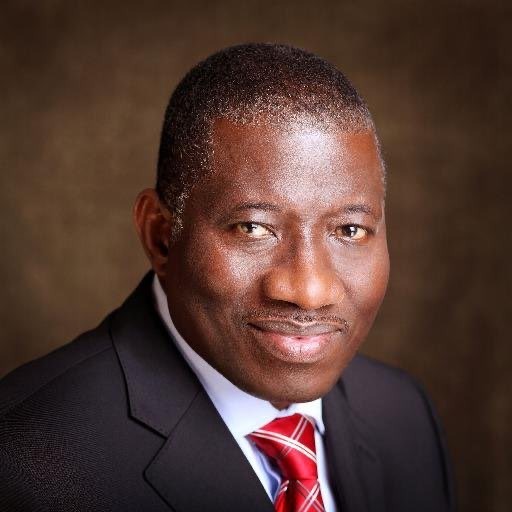
A chieftain of the Peoples Democratic Party, Umar Sani, has argued that reports of former President Goodluck Jonathan being reluctant to seek the presidency in 2027 should not be interpreted as a sign that he is out of the race.

Speaking during an interview on ARISE News, Sani said Nigeria’s political history is filled with examples of leaders who initially appeared unwilling to pursue public office but eventually accepted leadership responsibilities when called upon.

According to him, reluctance has never been a barrier to attaining the nation’s highest office.

“Political reluctance has never stopped leaders from emerging,” he said.

Sani pointed to the emergence of former President Olusegun Obasanjo as an example, recalling that he accepted national leadership roles despite not aggressively seeking them.

“When Obasanjo was asked to succeed Murtala Mohammed, he reluctantly accepted and became president,” Sani stated.

He also referenced Obasanjo’s return to power in 1999, arguing that the former military ruler was persuaded to serve rather than actively campaigning for the position at the outset.

“Obasanjo’s 1999 comeback was also with reluctance. He was called upon to serve,” he added.

The PDP chieftain maintained that discussions surrounding Jonathan’s possible return to the presidential race should focus more on his eligibility and political relevance than on speculation about his willingness to contest.

“The issue of whether Jonathan is reluctant does not arise,” he said.

Sani noted that Jonathan remains a significant figure in Nigeria’s political landscape, having previously served as president, and argued that his experience continues to make him a subject of national political interest.

He also referred to past legal debates over Jonathan’s eligibility, insisting that recent court decisions have strengthened arguments in favour of his right to contest should he choose to do so.

“The court has dismissed the case,” he said.

According to Sani, attention should now shift to broader political considerations ahead of the 2027 election rather than questions about Jonathan’s personal disposition toward another presidential bid.

He concluded that history has shown that national leadership can emerge from consensus and circumstance, making Jonathan’s reported hesitation insufficient grounds to rule out a future presidential contest.

Sun

ORIYOMI HAMZAT DECLARED AUTHENTIC ACCORD PARTY GOVERNORSHIP CANDIDATE FOR OYO STATE

0


Abuja, FCT – June 1, 2026

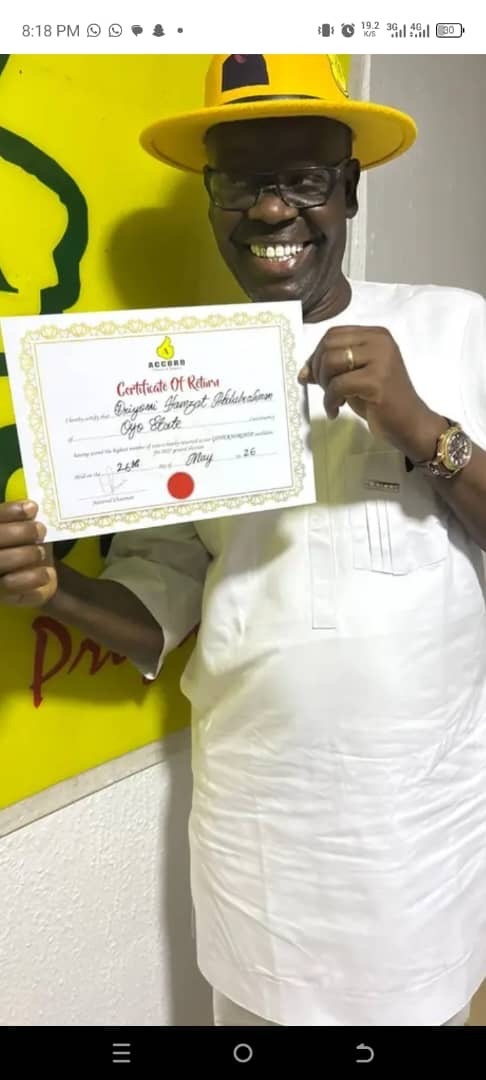
Dr. Oriyomi Hamzat has been officially declared the authentic Governorship Candidate of Accord Party for Oyo State by the party’s National Leadership in Abuja today.

*Certificate of Return Issued* ll
This afternoon at the National Secretariat of Accord Party in Abuja, Dr. Oriyomi Hamzat was issued his Certificate of Return in a ceremony attended by other elected candidates of the party for the Senate and Federal House of Representatives, alongside state party leaders.

The event serves as final confirmation of Dr. Hamzat’s candidacy by the National Headquarters, putting to rest earlier claims by another aspirant to the governorship ticket.

With the presentation, Dr. Oriyomi Hamzat is now fully endorsed as the flagbearer of Accord Party in Oyo State for the 2027 gubernatorial election.

In the same ceremony, the 3 senatorial candidates and all Federal House of Representatives candidates elected under Accord Party also received their Certificates of Return.

News of Dr. Oriyomi Hamzat’s endorsement has sparked widespread jubilation across Oyo State. Supporters and citizens have taken to the streets and social media to celebrate what many are calling “a victory for the people.”

*Call for Unity*
The National Chairman of Accord Party, Dr. Maxwell, enjoined the new governorship candidate to prioritize reconciliation. He charged Dr. Hamzat to ensure all aggrieved party members are brought together for the progress and success of Accord Party in Oyo State.

The declaration is expected to consolidate Accord Party’s structure and strengthen its campaign machinery ahead of the elections.

More details to follow…_

Recap: Adeboye to Govt, Security Chiefs: Eliminate Terrorists in 90 Days or Resign

0


Pastor Enoch Adeboye, the General Overseer of the Redeemed Christian Church of God (RCCG) has spoken on the growing challenge of banditry and terrorism in Nigeria, calling for decisive action by the country’s security leadership while stressing the limits of public commentary on executive authority.

The cleric noted that while citizens and religious leaders can offer advice to the Commander-in-Chief, they cannot issue commands to him, warning that such would be inconsistent with constitutional order.

“You can only advise the Commander-in-Chief,” he said, adding that attempting to command the president “doesn’t make sense,” while affirming that he had spoken with sincerity.

However, Adeboye also made a strong appeal to the Federal Government and security chiefs, suggesting that urgent steps be taken to eliminate terrorist threats within a defined timeframe.

“If I were asked to make a suggestion, I would say quietly to our government and security chiefs: get rid of these terrorists within 90 days or resign,” he stated.

His remarks, delivered as part of broader reflections on national security, underscore growing public concern over insecurity and renewed calls for more decisive counter-terrorism measures.

Reno Omokri Faults Adefarasin’s “Nigeria Is Dead” Remark, Defends Tinubu’s Economic Policies

0


Political commentator and Ambassador-designate to Mexico, Reno Omokri, has criticized Senior Pastor of House on the Rock Church, Paul Adefarasin, over remarks suggesting that Nigeria is “dead,” insisting that the country remains “very much alive and thriving.”
In a strongly worded statement, Omokri argued that religious leaders should refrain from using their pulpits to endorse, attack, or campaign against political leaders and governments while carrying out their ministerial duties.

According to him, countries such as the United States and the United Kingdom place restrictions on political activities by religious organizations, noting that clerics who engage in partisan political advocacy from the altar could face sanctions, including the loss of tax-exempt privileges.

Omokri maintained that pastors and imams are free to participate in politics as private citizens or members of political parties but should not use religious platforms to make politically charged statements capable of undermining public confidence in the country.

He described comments such as “Nigeria is dead” as irresponsible and harmful to national unity, stressing that places of worship should serve as centers of faith, hope, and spiritual guidance rather than platforms for political agitation.

The former presidential aide also challenged Adefarasin’s apparent comparison between present-day Nigeria and the economic conditions of the early 1980s, when his father, the late Justice Joseph Adetunji Adefarasin, served as Chief Judge of Lagos State.

Omokri argued that despite the relatively strong value of the naira during the administration of former President Shehu Shagari, the Nigerian economy experienced significant difficulties, including negative GDP growth rates and austerity measures introduced in 1982.

He attributed those economic challenges to the policy of pegging the naira to the United States dollar, which he said placed pressure on the nation’s foreign reserves and contributed to increased borrowing.

Defending the economic reforms of President Bola Tinubu, Omokri said the administration’s decision to float the naira had helped stimulate economic growth, improve trade balances, and strengthen Nigeria’s economic outlook.

He cited recent GDP growth figures and projections by international financial institutions, claiming that the country has recorded sustained economic expansion since the implementation of the policy.

According to him, Nigeria’s economy has grown significantly in recent years, while trade surpluses and increased economic activity demonstrate that the nation is progressing despite current challenges.

Omokri further questioned the characterization of Nigeria as a failed state, pointing to the wealth and lifestyles of several prominent religious leaders as evidence that economic opportunities still exist within the country.

He urged Pastor Adefarasin to focus on factual economic analysis and avoid what he described as misinformation capable of discouraging Nigerians.

“Nigeria is not dead,” Omokri stated, adding that the country remains resilient and positioned for continued growth under the current administration.

MAN Says Manufacturers Bore Brunt of Economic Reforms Despite Long-Term Benefits

0


The Manufacturers Association of Nigeria (MAN) has said that while the economic reforms introduced by the Federal Government over the past three years were necessary to address long-standing structural challenges, manufacturers have borne a disproportionate share of the resulting adjustment costs.

In a review of the administration’s economic policies, MAN Director General, Segun Ajayi-Kadir, described the period as one of “difficult but consequential economic transition,” noting that reforms such as fuel subsidy removal, foreign exchange liberalisation, electricity tariff adjustments and tight monetary policies significantly reshaped the operating environment for businesses.

According to the association, the immediate removal of fuel subsidy in May 2023 led to a surge of more than 300 per cent in logistics and distribution costs within weeks. This was compounded by increases in electricity tariffs for Band A consumers from about ₦68 per kilowatt-hour to between ₦209 and ₦225 per kilowatt-hour, despite continued instability in power supply caused by recurring grid failures and system disruptions.

MAN noted that manufacturers were forced to rely heavily on alternative energy sources, including diesel, gas and premium motor spirit, to sustain production. Expenditure on alternative energy rose from ₦781.68 billion in 2023 to ₦1.11 trillion in 2024 and further increased to ₦1.34 trillion in 2025.

The association said the rising energy costs weakened industrial competitiveness and contributed to a decline in manufacturing capacity utilisation, which dropped from 61.3 per cent in the first half of 2025 to 57.7 per cent in the second half of the year. More than 18,900 jobs were also affected during the period under review.

On foreign exchange reforms, MAN acknowledged that the unification of exchange rate windows improved transparency and sought to eliminate market distortions.

However, it said the rapid depreciation of the naira sharply increased the cost of imported industrial inputs.
The exchange rate moved from about ₦463 to the dollar in June 2023 to ₦899 by December 2023, before reaching approximately ₦1,535 by December 2024.

Consequently, the cost of imported raw materials increased from ₦3.04 trillion in 2023 to ₦6.64 trillion in 2024, representing a rise of about 118 per cent.

The association added that manufacturing value-added declined from $45.2 billion in 2023 to $21.84 billion in 2024, while access to foreign exchange at the official market remained inadequate, with less than half of industrial demand reportedly being met despite the introduction of the Electronic Foreign Exchange Matching System.

MAN also expressed concerns over the impact of tight monetary policies, noting that repeated increases in the Monetary Policy Rate and the scaling back of direct credit intervention programmes raised borrowing costs significantly.

As of March 2026, prime lending rates averaged 24.4 per cent, while maximum lending rates reached 33.8 per cent in some commercial banks. The association said these conditions made long-term industrial investment increasingly unattractive, contributing to a decline in credit to the manufacturing sector from ₦10.88 trillion in February 2024 to ₦6.6 trillion by December 2025.

The group further highlighted challenges arising from fluctuating customs duty assessments linked to exchange rate volatility, which complicated pricing and business planning for manufacturers importing machinery and raw materials.

However, MAN acknowledged several recent government initiatives that could support industrial recovery and long-term growth.

These include the Naira-for-Crude initiative, which it said has eased foreign exchange pressure in the downstream petrochemical and plastics value chain, as well as fiscal measures that zero-rated VAT and excise duties on pharmaceutical raw materials and medical devices.

The association also welcomed provisions in the 2025 Tax Reform Act, including withholding tax exemptions, expanded VAT deductibility on fixed assets and services, phased reductions in Companies Income Tax, tax incentives for research and development, and relief measures for small and medium-scale industries.
MAN said ongoing efforts to harmonise levies across states, the Nigeria Industrial Policy, the Nigeria First local content procurement framework, and the National Single Window platform all have the potential to strengthen domestic industrial capacity, improve market access for locally manufactured goods and enhance trade efficiency.

While acknowledging that the reforms have laid the foundation for long-term economic restructuring, the association stressed that the next phase should focus on industrial recovery and growth.

It called on the government to implement targeted measures that would ensure affordable access to foreign exchange for productive sectors, provide concessionary financing for industrial investment, improve electricity supply and guarantee predictable trade policies.

“Nigeria cannot achieve sustainable economic prosperity without a strong manufacturing base,” Ajayi-Kadir said, adding that the country’s long-term resilience depends on its ability to produce competitively, create jobs and expand industrial value addition.

He maintained that the ongoing reforms could still deliver meaningful industrial transformation if implementation becomes more coordinated, responsive to productive sectors and focused on addressing structural constraints affecting manufacturing performance.

BITTER HEART, BROKEN LIFE: RE-HAMZAT AND THE FUTURE OF LAGOS. NOT YET LAST WORDS, SANUSI

0

By Steve Omolale

American author of many Christian fiction novels and serial award winner Lynn Austin once said, “Bitterness is like a weed. Remember how hard it always was to pull out thistles once they rooted? Remember how deep those roots grow, and how if you just snapped off the end of it, the plant would grow right back? You have to dig down deep inside. Let God search your heart. Let Him show you what’s there and help you root out all that bitterness. Then you can pray for forgiveness.”

Bitterness is a very dangerous disease. If not quickly tackled, it can damage the heart. This disease is what Bolaji Sanusi, a lawyer and former managing director/chief executive officer of Lagos State Signage and Advertisement Agency (LASAAA), suffers from. Pitifully enough, Sanusi has refused to take the healing pill in the wise counsel of Austin by unburdening his heart of bitterness.

Those who know the trajectory of his interesting career, including a few associates who still find him redeemable, are now shocked to discover that his deep bitterness and frustration may have turned him into a dunderhead who has lost his mind.

This, he glaringly displayed in a write-up titled, “Hamzat and the future of Lagos”, which was run by some online platforms on May 29. A follow-up came yesterday, titled, “Re – Hamzat and the future of Lagos. Sycophants at work – my final words.” Final words? Not so fast sir. First, the first article, which was delivered partly in faltering English and in which the attention-seeking lawyer and political wannabe launched vitriolic and multi-pronged attacks on the Governor Babajide Sanwo-Olu administration, Hon James Faleke, as well as the general political system in Lagos State. As expected, the Faleke camp responded with a sledge hammer, pounding some sense into Sanusi’s head.

He was unsparing in his attack on Governor Sanwo-Olu. What exactly is the source of Sanusi’s bitterness against the governor, the one many have hailed as a true “omoluabi” whose sterling performance has been widely hailed by discerning commentators.

Well, Mobolaji Sanusi was removed from office by Sanwo-Olu in December 2019. Officially, his exit was framed as a tenure expiration. Sanusi was appointed by former Governor Akinwunmi Ambode in September 2015 for a four-year term that technically wound down on September 13, 2019.
Rather than renewing his appointment for a second term, Sanwo-Olu replaced him with Prince Adedamola Docemo. Do you now see why the hatchet writer is so bitter about the governor? While the government cited the natural end of his tenure, reports from the political and marketing sectors highlighted several underlying conflicts and controversies that contributed to his unceremonious exit.
Sanusi’s tenure was heavily criticized by the Outdoor Advertising Association of Nigeria (OAAN) and the Advertising Practitioners Council of Nigeria (APCON). Stakeholders accused him of high-handedness, refusing to settle outstanding debts owed to practitioners, and introducing hefty fees that threatened local businesses.

Having lost his seat at LASAA, the ever-desperate guy that he is, Sanusi attempted to become the Chairman of Ojokoro LCDA. Knowing his unsavoury and toxic antecedents, political leaders and stakeholders in the All Progressives Congress (APC) frustrated the plan. Can you now see why the stomach infrastructure writer is so bitter with the party structure in Lagos State?
Now, back to the trash in which he tried to be clever by half, the nincompoop and arrogant fellow took a swipe at the Sanwo-Olu administration, accusing it of non-performance. Nonetheless, he praised the Deputy Governor and APC gubernatorial candidate in next year’s gubernatorial election, Dr. Obafemi Hamzat, to high heavens, as if both men were running different administrations. He did this because he lost out in the political chess game in Lagos. Who would want to associate with a man without any political value anyway?

Sanusi shamelessly displayed his sycophantic behavior, obviously with the hope that Dr. Hamzat would offer him an appointment when he (by the grace of God) eventually becomes the governor from May 29, next year, as if the deputy governor cannot read between the lines. Sanusi is like a double-faced rodent biting somebody’s foot and blowing breeze at the wound!

While pretending to be a lover of Hamzat and a hater of Sanwo-Olu, he could also be called “Ganusi” (apologies to Fuji maestro Wasiu Ayinde) because of the gluttonous behaviour he displayed. He writes, “Now, whether or not Sanwo-Olu likes it, Hamzat is, God willing, going to be his successor. Such is the unpredictability of life’s trajectory!”.

Anyone who is not really versed in the political makeup of the state might think that Sanwo-Olu is against Hamzat’s candidacy. But that is far from the fact. Affirming his support for Hamzat’s nomination after the governorship primary that eventually affirmed him, Sanwo-Olu said, “We have worked side by side for years, and I know first-hand his deep love for Lagosians, his brilliance, and his unwavering dedication to progress. The work ahead is massive, but with Femi, I am absolutely confident that our state will reach even greater heights. Let us stay united and keep moving Lagos forward.” It is, therefore, the figment of Sanusi’s wonky imagination that Sanwo-Olu does not want Hamzat to succeed him.

In another display of tomfoolery, Sanusi writes, “Shockingly, the Sanwo-Olu administration in which he (Hamzat) is currently serving as deputy governor does not possess the endearing sterling legacies of the three daring governors (sic); referring to President Bola Ahmed Tinubu and former governors Akinwunmi Ambode and Babatunde Fashola, SAN)… Nothing is infrastructurally new or socio-economically remarkable about Sanwo-Olu’s tenure, so far.”

In his demented mind, Sanusi has forgotten that Sanwo-Olu was backed to be governor by Asiwaju’s indefatigable political machine in Lagos. Therefore, every attack on Sanwo-Olu is indirectly an attack on Tinubu. Simple logic. ​As they say, you cannot love me and hate my dog!

To claim that “nothing is infrastructurally new or socio-economically remarkable about Sanwo-Olu’s tenure” is the highest level of feebleness from a demented head who claims to be living in Lagos.

Only a frustrated devil’s advocate like Sanusi would not see the giant strides of the Sanwo-Olu administration in all facets of life. Until his deep-seated delusion abates and he wakes up from the slumber he was thrown into by obstinacy, Sanusi will never know that the Sanwo-Olu administration has grown the state’s Gross Domestic Product (GDP) to a staggering $259 billion in the last seven years, representing 20 per cent of the country’s total GDP, and making Lagos the second largest city economy in Africa, after Cairo, Egypt.

Since he pretends not to see any infrastructural development in the Centre of Excellence, the dumbhead needs to be told that several new housing estates have sprung up in different parts of Lagos in the last seven years, courtesy of the Sanwo-Olu administration. They include the housing estates at Sangotedo, Amuwo-Odofin, Ikate, Lekki, Igando, Ogba, Agbowa, Lekki Phase Two, Surulere, Ikorodu, and others.
Sanusi mischievously refused to acknowledge Sanwo-Olu’s great achievements in transportation, where he has completed and commissioned the Lagos Blue Line rail as well as the Lagos Red Line Rail. Tinubu laid the foundation, Fashola built on it, and Sanwo-Olu completed it. The two lines have since been moving over 100,000 Lagosians daily.
This is complemented by the building of 362 roads (approximately 347.17 km) and bridges, such as the iconic Opebi – Ojota link bridge, a record 23 housing estates (10, 623 home units), 433 classroom blocks and the provision of hundreds of new BRT buses. Twenty-eight jetties have been completed. Ogombo Community Schools in Eti-Osa and Vetland in Agege are a testimony to the creativity of the Sanwo-Olu Administration. The beautiful Tolu Group of Schools (36 in one community) are unrivalled in aesthetics, a true reflection of architectural and engineering ingenuity.

Hypocritical writers like Sanusi will never see or feel the establishment of nine schools with a combined population of 4,588 pupils, the recruitment of over 2,000 teachers, the building of the largest school complex in Africa, the rehabilitation of 433school buildings and the establishment of two more universities.
In the health sector, the story is also great. The Sanwo-Olu administration has built five Mother and Child Centres (MCCs). This is in addition to the ongoing construction of a General Hospital in Iba, as well as the ongoing construction of the Massey Street Children Hospital, which, upon completion, will be the biggest pediatric centre in West Africa. Over 2,200 health professionals have been recruited to man the state’s health facilities.
Food security is also a priority of the administration, as it completed the Lagos Rice Mill in Imota, Ikorodu, the biggest in Africa. The Food and Logistics hub in Epe is on.
In terms of security, Lagos remains the safest – thanks to the Sanwo-Olu administration’s unflinching support for security agencies.
The administration’s achievements are so multitudinous that one is shocked by the deliberate stupidity of Sanusi not to acknowledge them. It is a display of intellectual dumbness on his part.

According to Dr. Martin Luther King (Jr), “Nothing in the world is more dangerous than sincere ignorance and conscientious stupidity.” His views also tally with Albert Einstein’s: “The only thing more dangerous than ignorance is arrogance.”

Unfortunately, Sanusi combines both infamous qualities. Whoever knows any cure for these debilitating ailments should lend him; Sanusi is in dire need of redemption.

•​Omolale, a journalist, sent this piece from Lagos.

Troops Neutralise Four Criminals, Rescue Kidnap Victims, Bust Drug Syndicate in Benue, Taraba

0


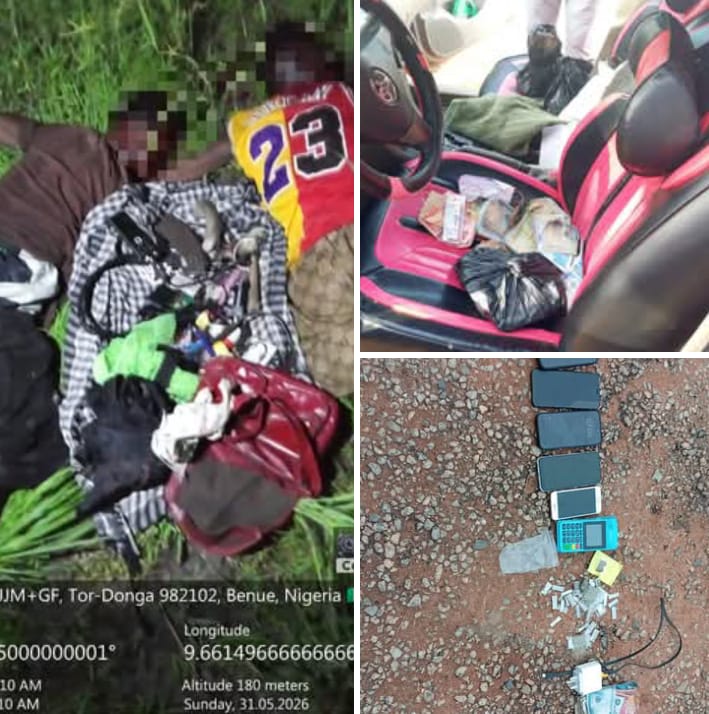
Troops of Operation WHIRL STROKE (OPWS) have recorded major operational successes across Benue and Taraba states, neutralising four criminals, rescuing two kidnapped victims, recovering arms and ammunition, and dismantling a notorious illicit drug network between May 24 and May 31, 2026.

According to a statement issued by the Acting Media Information Officer of OPWS, Lieutenant Ahmad Zubairu Zubairu, the operations were carried out in response to security threats and intelligence reports within the Joint Operations Area.

On May 24, troops responded to reports of an armed herder attack along the Gbajimba–Agasha Road in Guma Local Government Area of Benue State. Upon arrival, they found two injured residents, who were immediately evacuated to the Primary Health Centre in Gbajimba for medical treatment. Security forces have since launched a manhunt for the attackers.

On the same day in Taraba State, troops acting on an armed robbery alert along the Rafin Kada–Donga Road engaged suspected robbers in a gun battle. During the encounter, two armed robbers were neutralised, while troops recovered one AK-47 rifle, three magazines, ammunition and N39,950 in cash.

In another operation on May 25, troops responded to a kidnapping incident along the Antegh–Zongo Road in Makurdi Local Government Area of Benue State. The abductors abandoned two victims and fled after sighting the troops. One suspect was arrested, and the rescued victims were safely reunited with their families.

As part of efforts to curb criminal activities linked to illicit drug trafficking, troops conducted an intelligence-led operation against a suspected drug syndicate. During a search of a recovered vehicle in Makurdi on May 23, troops recovered 641 pieces of illicit drugs and N781,000 in cash.
A follow-up operation on May 27 led to the arrest of three additional suspected drug peddlers. Security personnel also recovered more illicit substances, a motorcycle and N40,000 in cash.

The suspects are being processed for handover to the National Drug Law Enforcement Agency (NDLEA) for further investigation and prosecution.

In the latest operation on May 31, troops acting on credible intelligence raided a suspected bandit hideout at Imande Igigh in Katsina-Ala Local Government Area of Benue State. During the raid, two bandits were neutralised, while ammunition and other related items were recovered.

The Force Commander of OPWS, Major General Moses Gara, commended the troops for their dedication and professionalism. He urged them to sustain the momentum in ongoing operations aimed at restoring peace and security across the region.

General Gara also appealed to residents to continue providing timely information on suspicious activities to security agencies, warning individuals who collaborate with criminal elements to desist or face the consequences of their actions.

Lagos, Ogun, Kaduna Top Nigeria’s 2025 Governance Ranking – pSPI Repor

0


Phillips Consulting has released its 2025 State Performance Index (pSPI), ranking Nigeria’s 36 states based on governance quality, fiscal management, and development outcomes, with Phillips Consulting adopting a revised methodology that blends hard data and citizen perception.

The report assessed states using a weighted model comprising 70% objective indicators—such as audited financial statements, infrastructure delivery, fiscal sustainability, and service delivery performance—and 30% public perception drawn from a nationwide survey.

This year’s edition also introduced a five-star rating system to provide a clearer performance classification.

The Federal Capital Territory (FCT) was excluded from the ranking due to the absence of published audited financial reports.
Top Performers in 2025 pSPI
1st – Lagos State (5-star rating)
Lagos State emerged as the overall best-performing state in the country, topping the index.
2nd – Ogun State (4-star rating)
Ogun State secured second place, maintaining a strong performance across key indicators.
3rd – Kaduna State (4-star rating)
Kaduna State ranked third overall in the national assessment.
4th – Adamawa State (4-star rating)
Adamawa State followed in fourth position.
Other states in the top 10 include Niger State, Nasarawa State, Gombe State, Jigawa State, Plateau State, and Abia State, which rounded out the tenth position.
The 2025 pSPI report highlights widening differences in governance performance across Nigeria, with leading states demonstrating stronger fiscal discipline and improved service delivery outcomes compared to lower-ranked counterparts.