Home Blog Page 361

Lagos Taskforce Impounds 278 Motorcycles, Vows Sustained Crackdown on Illegal Okada Operations

0


The Lagos State Taskforce has intensified enforcement operations against commercial motorcycle operators, popularly known as Okada, in line with the Lagos State Government’s ban on their activities on highways and other restricted routes across the State.

The enforcement drive, carried out under the provisions of the Lagos State Transport Sector Reform Law, 2018, is part of ongoing efforts to strengthen the state’s security architecture, protect lives and property, and curb criminal activities.

The operation also aligns with the renewed commitment of the Commissioner of Police, CP Fatai Tijani, to maintaining public safety and order throughout Lagos.

According to the agency, the weeklong exercise followed an earlier clampdown conducted weeks ago and reflects the government’s determination to sustain pressure on violators of Okada restrictions, environmental regulations, and security laws.

The enforcement team covered several strategic locations across the state, including Ikorodu, Agric Bus Stop, Festac First Gate, Mazamaza, Iyana School, Iyana-Iba, Idimu Road, Egbeda, Kola Bus Stop, Iyana Ipaja, Ikotun Roundabout, Ijaiye in Ojokoro, Berger Bus Stop, Ojodu, Akowonjo Roundabout, Igando Bus Stop, LASU-Iba Road and Pipeline Road in Idimu, among others.

During the operation, numerous commercial motorcycle operators were apprehended for illegally plying highways and restricted routes in violation of existing regulations. Officials said some riders were caught transporting illicit substances and hazardous materials, including petroleum products and gas, while others were found conveying schoolchildren and toddlers in unsafe conditions along major roads.

At the end of the exercise, a total of 278 commercial motorcycles were impounded, a development the agency said had helped restore order and improve compliance in the affected areas.

The Taskforce reiterated that all impounded motorcycles would be processed for forfeiture to the state through the courts, in accordance with the provisions of the Lagos State Transport Sector Reform Law, 2018.

Chairman of the Lagos State Taskforce, CSP Adetayo Akerele, reaffirmed the agency’s commitment to sustaining the enforcement operations until full compliance is achieved.

“We will not be cowed or fold our arms and allow people of criminal intent to overrun Lagos or surrender to their illegalities,” Akerele said.
He added that the Taskforce would continue to enforce relevant laws to ensure public safety, improve traffic management and maintain security across the State.

Fayemi Congratulates Gov Oyebanji On Re-election, Calls On Rivals, Ekiti People to Rally Round Governor

0


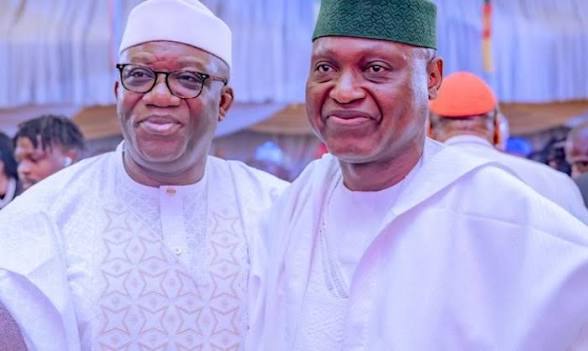
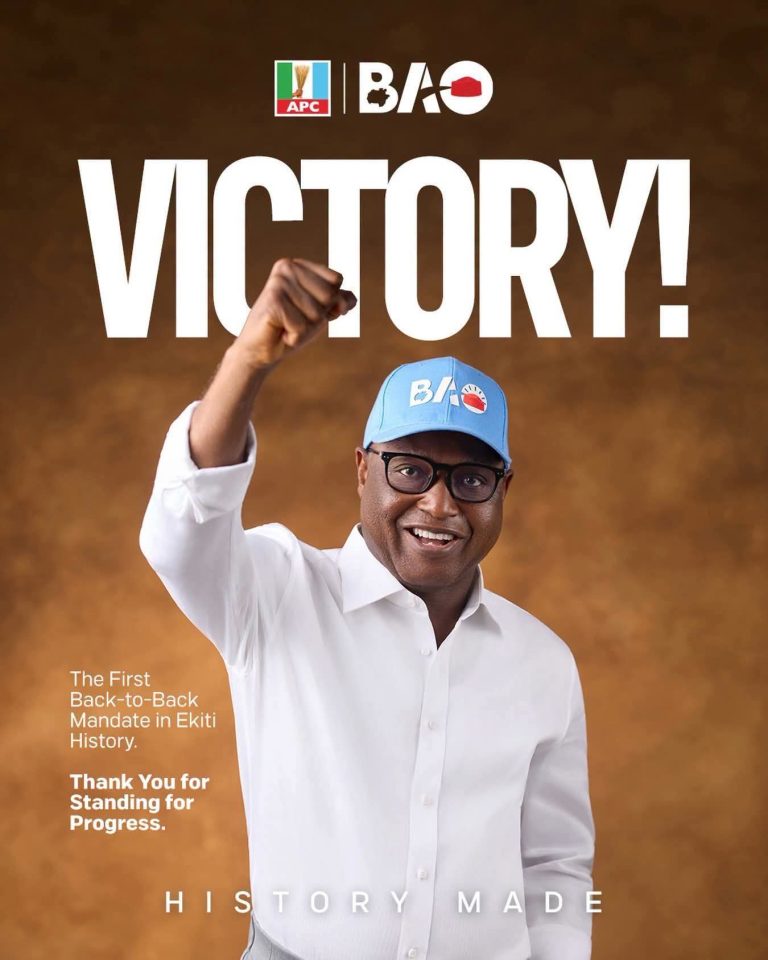
Dr Kayode Fayemi, the immediate past Governor of Ekiti State and former Chairman of the Nigeria Governors’ Forum (NGF), has congratulated Governor Biodun Oyebanji on his re-election as Governor of Ekiti State, describing the victory as a clear endorsement of his administration’s performance by the people of the state.

In a statement issued on Sunday by the Fayemi Media Office, Fayemi said the outcome of Saturday’s governorship election, in which Governor Oyebanji of the All Progressives Congress (APC) swept all sixteen Local Government Areas of the state, was a resounding vote of confidence that reflected the high regard in which Ekiti people hold his leadership.

“I join other well-meaning Ekiti citizens and friends of our dear state in congratulating Governor Biodun Oyebanji on his decisive re-election. This victory is a powerful statement by our people that they recognise and appreciate purposeful governance.

‘’I commend the people of Ekiti for coming out, once again, to exercise their civic responsibility peacefully,” Fayemi said.

The former governor commended the Independent National Electoral Commission (INEC) and security agencies for the largely peaceful conduct of the election, and urged the governor not to relent in the task of consolidating the gains already recorded in his first term, particularly in the areas of infrastructure, healthcare, agriculture and human capital development.

Fayemi also extended a hand of fellowship to the candidates who contested the election, including those of the Peoples Democratic Party (PDP), the African Democratic Congress (ADC) and other political parties, urging them to see the outcome of the election as the verdict of the people.

“Elections are contests, not wars. I urge the other candidates who contested this election to take the lessons from it in good faith and join hands with Governor Oyebanji in the task of building our state.

‘’Ekiti is bigger than any one of us, and it is only by working together, across party lines, that we can give our people the development they deserve and which they have consistently asked for at the polls,” he stated.

He further called on all Ekiti people, irrespective of political affiliation, ethnic or religious leaning, to rally round Governor Oyebanji and support his administration in the new term, stressing that the unity and cooperation of the people remain indispensable to the state’s progress.

“Our state has always thrived when we set aside our political differences and worked together for the common good. I therefore call on all Ekiti sons and daughters, at home and in the diaspora, to continue to support Governor Oyebanji and his administration as he begins this new term, so that together we can sustain the legacy of good governance that our people have come to expect of Ekiti Kete,” Fayemi added.

Ekiti: Sanwo-Olu Congratulates Oyebanji

0


…Says His Re-Election Reflects Overwhelming Support

Lagos State Governor, Mr Babajide Sanwo-Olu has congratulated Ekiti State Governor, Mr Biodun Oyebanji, on his well-deserved victory in the Saturday’s governorship election.

Sanwo-Olu said the overwhelming support received by Oyebanji reflects the confidence the people of the state have in his administration.

“The overwhelming support he received across all 16 local government areas reflects the confidence the people of Ekiti have in his leadership and the work his administration has done over the past four years.

“I thank the people of Ekiti State for the peaceful conduct of the election and for once again placing their trust in our great party, the APC. I also commend our party leaders and members at every level whose commitment and unity contributed to this success.

“As Governor Oyebanji begins a new term, I am confident he will remain focused on delivering even greater progress and prosperity for the people of Ekiti State,” Governor Sanwo-Olu said.

By-elections: Full list of winners in Enugu, Rivers, Ondo, Kano

0


By-elections results

The Independent National Electoral Commission has announced the outcomes of by-elections held on Saturday in several federal and state constituencies, with the All Progressives Congress recording victories in Enugu, Kano, Kebbi and Ondo, while the Peoples Democratic Party won the Rivers South-East Senatorial District seat.

The by-elections results were declared by returning officers after the conclusion of collation in the affected states.

Below is the list of by-elections winners:

Enugu North Senatorial District

The APC candidate, Ikeje Asogwa, was declared the winner of the Enugu North Senatorial District by-election after polling 162,360 votes.

Asogwa defeated the PDP candidate, Chief Nestor Ezeme, who secured 9,299 votes.

The election was held to fill the vacancy created by the death of Senator Okey Ezea on November 18, 2025. Ezea died at the age of 62.

Rivers South-East Senatorial District

Olaka Nwogu of the PDP emerged the winner of the Rivers South-East Senatorial District by-election.

Nwogu polled 47,961 votes to defeat the APC candidate, Osar Erewari, who received 1,647 votes.

The senatorial seat became vacant following the death of Senator Barry Mpigi in February.

Ondo South Senatorial District

The APC candidate, Dayo Faduyile, won the Ondo South Senatorial District by-election with 68,474 votes.

His closest rival, Adeolu Akinwunmi of the Allied People’s Movement, scored 1,411 votes.

The poll was conducted after Senator Jimoh Ibrahim was appointed Nigeria’s Permanent Representative to the United Nations, leaving the seat vacant.

Dawakin Kudu/Warawa Federal Constituency, Kano

Rabiu Shuaibu of the APC emerged winner of the Dawakin Kudu/Warawa Federal Constituency by-election in Kano State.

Shuaibu scored 35,356 votes, ahead of Lawal Garba-Haruna of the Allied Peoples Movement, who polled 268 votes, and Abubakar Yahaya-Muhammad of the Labour Party, who recorded 98 votes.

The by-election followed the death of the constituency’s former representative, Muhammad Danjuma-Hassan of the New Nigeria Peoples Party.

Zuru State Constituency, Kebbi

In Kebbi State, Rabiu Garba Aiki of the APC won the Zuru State Constituency by-election into the State House of Assembly.

Aiki polled 4,887 votes, while Aliyu Galadima Muhammad of the Labour Party secured 168 votes.

The vacancy arose after the death of the former Speaker of the Kebbi State House of Assembly, Muhammad Usman Zuru.

Nasarawa North Senatorial District

Meanwhile, the result of the Nasarawa North Senatorial District by-election has yet to be announced by INEC.

The election is being conducted in Nasarawa Eggon, Akwanga and Wamba Local Government Areas to fill the seat left vacant by the death of Senator Godiya Akwashiki after a prolonged illness.

Sun

Conflicting accounts emerge over alleged release of Oyo kidnap victims

0

…..authorities insist abductees remain in captivity despite Igboho’s ultimatum


Confusion has continued to surround the fate of victims abducted in Igboho, Oorelope Local Government Area of Oyo State, as the council chairman, Jacob Ogundiran, and the Oyo State Police Command have dismissed widespread reports claiming the captives had regained their freedom.

The development came amid growing controversy following claims that Yoruba Nation agitator, Chief Sunday Adeyemo, popularly known as Sunday Igboho, facilitated the victims’ release after issuing a two-hour ultimatum to suspected kidnappers and Fulani community leaders in the area.

Reports had emerged on social media and in sections of the media that the kidnapped victims, including a woman, her children and a sibling, were released shortly after Igboho threatened to confront those allegedly responsible for the abduction if they failed to free the captives within two hours.

The reports triggered jubilation across Igboho town, with residents seen in viral videos singing, dancing and celebrating what many believed was the successful return of the victims after days of uncertainty.

However, the Oorelope Local Government Chairman has now refuted the claims, insisting that the victims remained in captivity.

In a statement issued on Sunday, Ofundiran described reports of the victims’ release as false and misleading.

“The kidnapped victims are yet to regain their freedom. We urge members of the public to disregard any information suggesting otherwise unless it emanates from official and credible sources,“ he said.

According to him, security agencies at both the state and local levels are making concerted efforts to secure the safe rescue of the victims.

He noted that relevant authorities had continued to deploy necessary resources and strategies to ensure a positive outcome.

While acknowledging the anxiety generated by the incident, Ogundiran expressed confidence in the commitment and collaboration among security agencies and individuals supporting ongoing rescue efforts.

The chairman also commended security agencies, stakeholders, community leaders and residents who have provided intelligence, prayers and other forms of support.

“The protection of lives and property remains a top priority of this administration, and no effort will be spared in ensuring the safe return of the victims,” he said.

He further appealed for calm, vigilance and responsible dissemination of information as efforts continue to secure the victims’ release.

The chairman’s position aligned with that of the Oyo State Police Command, which earlier dismissed reports linking the alleged release of the victims to Sunday Igboho’s intervention.

Reacting to viral videos and social media claims, the police said there was no official confirmation that the victims had been rescued and maintained that there was no evidence connecting Igboho to any rescue operation.

“The Nigeria Police Force has officially debunked claims that the hostages have been safely released,” the police stated.

The command added that “the Oyo State Commissioner of Police has explicitly denied that Sunday Igboho was involved in recent rescue operations.”

Describing reports circulating online as unsubstantiated, the police urged members of the public to rely only on official sources for updates on the situation.


Confirming the position of the command, the Oyo State Police Public Relations Officer, DSP Olayinka Ayanlade, said: “Yes, but it was just a reaction.”

The controversy followed a strongly worded warning by Igboho, who accused criminal elements of turning Igboho town into a centre for kidnapping activities and blamed some members of the Fulani community for harbouring those responsible.

Addressing Fulani leaders and traditional representatives in a viral video, he declared: “You can’t be kidnapping in my father’s land and expect me to keep quiet. I’m an original indigene of Igboho land.”

“You kidnapped a pregnant woman, and the person who brought the ransom, you killed him and killed the pregnant woman, for what? In Igboho? You people are not even afraid of me in my father’s land?”

“This should be the last and it must end. My father has urged me to address you people patiently. What I’m fighting in other people’s land, you can’t come here and be doing it in my father’s land.”

Igboho further alleged that those behind the abduction were known within the Fulani community and accused community leaders of failing to check criminal activities.

“You people kidnapped a pregnant woman, killed the person that brought the ransom and left one person. You are not even afraid of God. It’s your boys that did the job,” he said.

Questioning what he described as a pattern in the abductions, he added: “Since you have been kidnapping here, have they ever abducted Fulani?”

“No, it’s the Yorubas they have been kidnapping and it should not be like that. This should be the last, and let us stay in harmony.”

As tension mounted in the community, the activist issued a two-hour ultimatum for the release of the remaining captives.

“I give you people two hours to release the woman, her children and her sibling who were kidnapped in the middle of the night. If I don’t see them within the next two hours, we will face each other,” he warned.

Igboho also claimed that efforts to trace the kidnappers led to locations allegedly connected to prominent individuals within the community.

“When we first tracked that number, it led us to Alhaji’s residence and they removed them from there in the middle of the night to Bani’s compound. They took them to Baale’s compound, where they currently are,” he alleged.

Rejecting any suggestion that the victims’ relatives should pay ransom, he said: “We don’t have any ransom to pay. You Fulanis should raise that ransom among yourselves and pay because we don’t have such money to pay. They started from N300 million and brought it down to N150 million.”

“Fulanis should contribute the ransom and get the woman, children and her sibling released. If they are killed, we will have a problem,“ Igboho said.

The abduction had sparked outrage in the community after gunmen reportedly kidnapped members of a family during a midnight attack and demanded huge sums as ransom.

According to reports, the kidnappers initially demanded N300 million before reducing the amount to N150 million during negotiations.

Public anger intensified following allegations that a pregnant woman and a ransom bearer were killed despite efforts to secure the release of the captives.

While celebrations had broken out in parts of Igboho following reports that the victims had been freed, both the Oorelope Local Government and the Oyo State Police Command insisted that there is currently no official confirmation of their release, urging residents to remain calm and avoid spreading unverified information as rescue efforts continued.

Vanguard

I want to industrialise Africa, not chase billions — Dangote

0

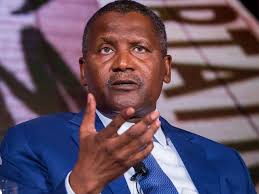
Dangote Group’s CEO Aliko Dangote

Africa’s richest man and President of the Dangote Group, Aliko Dangote, has said his greatest ambition is not to accumulate wealth but to leave a lasting legacy by helping to industrialise Africa.

Dangote made the remarks during an interview with James Dumoulin, founder of the School of Hard Knocks platform, where he spoke about his business journey, wealth, legacy and the future of Africa’s economy.

Asked how he would like to be remembered, the Nigerian billionaire said: “I have actually passed the stage of just doing business to make money. I want to leave a legacy. I want to be remembered as somebody who has industrialised Africa.”

The businessman, whose investments span cement, sugar, salt, fertiliser and petroleum refining, said creating industries that transform economies and generate jobs across the continent matters more to him than his position on global rich lists.

Dangote also suggested that current estimates of his wealth do not fully reflect the value of his business empire because some of the group’s largest assets are yet to be publicly listed. Responding to a question about his net worth, he said: “What are they saying? I don’t really look at those things. They say I’m worth $38 billion, but most of our businesses are not listed yet.”

He added: “It will come out soon.”

His comments come amid growing expectations that the Dangote Petroleum Refinery and other major assets could eventually be listed on the stock market, a move analysts believe could significantly increase the market value of the group.

Making a strong case for investment on the continent, Dangote described Africa as the world’s next major growth destination. According to him, the continent’s youthful population presents enormous opportunities for economic expansion.

“The real future is Africa,” he said, noting that about 70 per cent of Africans are under the age of 30 and that the continent’s population is projected to reach 2.5 billion by 2050.

Dangote also revealed that his companies generated about $10 billion in revenue during the first quarter of the year, highlighting the scale of operations across the group’s various businesses.

On his faith, the industrialist reaffirmed his belief in God, saying: “If I look at myself, I know that God is real.”

According to recent estimates, Dangote’s wealth stands at about $31.6 billion on Forbes’ Real-Time Billionaires List and roughly $36.5 billion on the Bloomberg Billionaires Index. However, the eventual listing of key assets such as the refinery and fertiliser business could further reshape perceptions of his fortune.

For Dangote, however, wealth appears secondary to impact. As Africa seeks greater industrial capacity and economic independence, he says his focus remains on building industries that will outlive him and help drive the continent’s development for generations to come.

Sun

TheGazelleNews to Honour Ganiyu Solomon, Olorunfumi Bashorun, Waliu Ojuko as Sunday Dare Delivers Lecture

0

TheGazelleNews, popular Lagos based online newspaper is set to honour the trio of Senator Ganiyu Olanrewaju Solomon, Asiwaju Olorunfumi Bashorun and Chief Waliu Ojuko for their contribution to democracy and governance in Nigeria.

Solomon, Bashorun and Ojuko will be honoured with the flagship award of the online newspaper, the Lifetime Achievement Award at the 2026 Annual Public Lecture and Award of the newspaper scheduled to hold on Wednesday, 15 July, 2026.

The lecture with the theme: Driving Grassroots Governance with Public-Private Partnership: The Gains, the Pains, the Prospects will be delivered by Chief Sunday Dare, Special Adviser to the President on Media and Public Communication

According to a statement by the Chairperson of the Organising Committee for the event, Mrs Adetutu Audu-Adebisi, the Lifetime Achievement Award is the flagship award for politicians who have distinguished themselves and contribute immensely to the democracy and governance in the country.

“Our President, Asiwaju Bola Ahmed Tinubu won the maiden award in 2022 while the Chairman of the influential Governance Advisory Council (GAC), Prince Tajudeen Oluyole Olusi won it in 2024.

“This year we are honouring three distinguished Nigerians who have played major roles in governance and sustenance of democracy in the country,” Mrs Audu-Adebisi said.

Senator Ganiyu Olanrewaju Solomon popularly called GOS by many is a deeply rooted grassroots politician.

Senator Solomon has developed a political career that has made him a man of the people.

He was former Executive Chairman of Mushin Local Government, was a member of the House of Representatives between 2003 and 2007 where he represented Mushin Federal Constituency I.
Between 2007 and 2015, Senator Solomon represented Nigeria’s biggest Senatorial District, Lagos West where he rose to become the Minority Whip of the Upper Chamber.

A Rotarian, Solomon is very popular among the people particularly those at the grassroots.

Presently, he is a member of the very influential Governance Advisory Council (GAC) and is the APC Apex Leader for Mushin combining the two Federal and State Constituencies.

Elder Statesman, Asiwaju Reuben Olorunfumi Bashorun is the first Secretary to the State Government (SSG) when he served the administration of the late Lateef Kayode Jakande between 1979 and 1983.

A former banker and highly referred politician, Asiwaju Olorunfumi Bashorun was an active player in the aborted Third Republic.

A member of the Social Democratic Party (SDP), Chief Bashorun was one of the leaders who contributed to the success of late MKO Abiola in the SDP presidential primary in Jos.

The Igbogbo-born politician was in the forefront of the struggle for the actualisation of the June 12 election.

Presently, he is a member of the GAC.

Chief Waliu Olajide Ojuko is a highly respected Awori politician.

Born in Ota, Ogun State, Chief Ojuko had a highly distinguished civil service life in both state and federal civil service in Lagos and Ogun states before venturing into politics.

He was a director at Gateway Hotels during the administration of late Chief Olabisi Onabanjo

He was Ogun state Secretary of the Social Democratic Party where he played key role in delivering Moshood Kashimawo Olawale Abiola at the Jos Convention and his electoral victory alongside former Governor Olusegun Osoba.

He was Commissioner for Commerce, Cooperative & Tourism under Olusegun Osoba;
Commissioner for Local Government and Chieftaincy Affairs under Senator Ibikunle Amosun; and
Senior Special Adviser Political Affairs under Gov. Dapo Abiodun

Chief Ojuko is the
Olotu of Ota Aworiland;
Balogun Ojokoro, Lagos;
President, Iganmode Club, Ota;
Member, Abeokuta Sports Club;
Member, Lagos Island Club; and
National President, Iganmode Grammar School Old Students Association

The Three-Month Sprint (2): Vocabulary. Concepts. Metaphors

0

THE SUNDAY STEW – 16


By Max Amuchie | The Sunday Stew

Every serious intellectual undertaking eventually reaches a threshold where it can no longer rely entirely on inherited language. It must create its own vocabulary.
The three-month sprint that produced The Insecurity Triad, the Trinity of State Decay (TSD), and the Decoupling Sovereignty Index (DSI) crossed that threshold repeatedly. New realities demanded new concepts, and new concepts demanded new names.
Some of those names describe the architecture of collapse. Others describe the mechanisms that sustain it. Still others describe what recovery requires. Together, they form a vocabulary of sovereignty — its decay, its distortion, and its possible reconstruction.

The Grammar Beneath the Vocabulary

Before naming the concepts, it is worth naming the architecture that organises them.
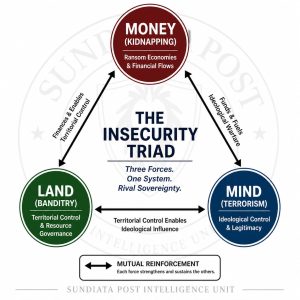
The Insecurity Triad identified three vectors through which rival sovereignty is produced: Money, Land, and Mind. Kidnapping finances violence through ransom economies — that is Money. Banditry governs territory and controls the means of production — that is Land. Terrorism reshapes the ideological order, rewriting who commands loyalty and who commands fear — that is Mind.
These three vectors do not operate in isolation. They converge. And their convergence is what makes The Insecurity Triad a system rather than a catalogue of threats.

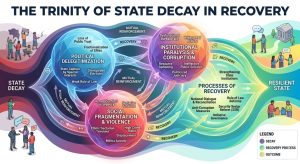
What the Trinity of State Decay reveals is what happens to a state when that convergence is sustained. Money drains the state’s fiscal and security capacity. Land slips from its territorial grip. Mind withdraws — citizens, communities, and eventually institutions themselves stop believing that the state is the relevant authority. The Trinity maps the structural consequences of what the Triad set in motion.

The Decoupling Sovereignty Index then asks the measurement question: how far has each vector decoupled? M1 tracks the Money dimension — the degree to which ransom economies and rival revenue systems have displaced the state. L tracks the Land dimension — the erosion of territorial authority and enforceability. M2 tracks the Mind dimension — the collapse of psychological allegiance and institutional legitimacy.
Every concept that follows in this column lives inside that architecture. The Institutional Mirage is what the Mind dimension produces at the level of governance. The Shadow Order is what Land and Money produce when they combine to constitute rival authority. The Ransom Economy is Money in its most organised form. Constitutional Erasure is Land rewritten at gunpoint. The Psychology of the Table is Mind in its most exclusionary expression.
Money. Land. Mind. That is the grammar. What follows is the vocabulary it generates.

The Architecture of Collapse

Among the formulations that emerged was the Trinity of State Decay.
Consider what happens when a state begins to lose its grip.
It does not lose one thing. It loses three — simultaneously, and in ways that accelerate each other.
Territory slips first, or perhaps institutions do, or perhaps the people withdraw their faith before either of the others move. The sequence varies. What does not vary is the convergence.

The first dimension is territorial: the state’s control of physical space becomes contested, fragmented, then absent in places it once claimed without effort.
The second is institutional: governance structures remain formally intact — ministries open, officials report, procedures are observed — but effectiveness drains away, and with it, public confidence.

The third is psychological: citizens stop believing. Not all at once. Not loudly. But progressively, they withdraw their emotional allegiance from the state and redirect their trust toward other identities, other authorities, other protections.
And then the loop closes.
Land is lost because institutions have weakened. Institutions weaken because citizens no longer trust them. Citizens withdraw their trust because the state can no longer protect the land.
Each failure licenses the next. Each decay deepens the others. The trinity does not merely describe deterioration — it drives it.
That is what makes it a trinity rather than a list.

But what fills the space that the decaying state vacates? Two concepts answer that question, and they must be understood together.
The first is the Institutional Mirage. When a state loses empirical authority — the actual capacity to protect, compel and deliver — its formal structures do not always disappear. They persist. Ministers are appointed. Budgets are passed. Ceremonies are conducted. The architecture of governance remains visible, sometimes impressively so. But it no longer functions as architecture. It functions as scenery.
The Institutional Mirage is the state performing sovereignty it no longer possesses.

The second concept is the Shadow Order. Into the spaces the Mirage cannot reach, alternative authority structures move. They may be armed groups, criminal networks, ethnic militias, or insurgent organisations. They collect their own revenues, enforce their own rules, and provide their own version of protection — however brutal or extractive. They do not merely fill a vacuum. They constitute a rival sovereignty.

The Institutional Mirage and the Shadow Order are not opposites. They are a system. One performs authority without possessing it. The other possesses authority without performing it in the language of the state. Together, they represent the decoupling at the heart of the Trinity of State Decay: the separation of juridical sovereignty from empirical sovereignty, of the state that exists on paper from the state that exists on the ground.

The Mechanisms of Sustenance

Collapse of this kind does not sustain itself through inertia alone. It requires mechanisms — arrangements, transactions and distortions that keep the system operational even as it deteriorates.
Three concepts describe these mechanisms.
The first is the Ransom Economy. In zones where the Shadow Order operates and the Institutional Mirage cannot reach, kidnapping ceases to be merely criminal. It becomes economic. Ransom payments circulate as a form of revenue — funding armed groups, sustaining supply chains of complicity, and generating employment in the logistics of abduction and negotiation. The Ransom Economy is not a disorder within the economy. In the territories where it operates, it is the economy.
The second mechanism is Pacification Bargaining. Faced with armed groups it cannot defeat militarily, the state — or the communities caught between the state and the Shadow Order — enters into informal negotiations. Cattle corridors are quietly conceded. Seasonal movements are permitted. Attacks pause in exchange for unspoken accommodations. The bargaining is never acknowledged publicly, because acknowledging it would require admitting the limits of state authority. But it happens. And each round of bargaining, however tactically rational, extends the life of the arrangement it was meant to manage.

The third is Constitutional Erasure. This is not a legal phenomenon. It does not occur in courtrooms or parliamentary chambers. It occurs on the ground, at gunpoint. This is, in the most precise sense, a Violent Amendment of the Constitution — not through any legitimate process of revision, but through the barrel of a gun. The armed group does not petition the state to redraw its map. It redraws it unilaterally, inscribing its own authority where the constitution once held.

Constitutional Erasure is the illegal process by which armed non-state actors unmake the official state map and replace it with their own sovereign order. Where the state’s constitution says one thing about who governs a territory, the gun says another — and the gun wins. The armed group does not merely occupy the space. It renames it. It redraws it. It inscribes its own authority onto territory that the constitution still claims but can no longer hold.
This is counter-constitutional inscription: a rival cartography written in violence.
The constitution remains on paper. But on the ground, a different document governs — unwritten, unratified, enforced by the threat of death. What is erased is not the text of the state’s founding law but the physical reality it was meant to describe.

The Psychology of Recognition

Beneath the structural and economic dimensions of decay lies something harder to measure but no less consequential: the question of who belongs.
Political power is frequently imagined through offices, armies and constitutions. Yet societies often possess another, less visible metric of authority.
Who sits at the table?
Who is invited?
Who is absent?

The Architecture of Resurrection

Perhaps the most hopeful formulation to emerge from the sprint was the idea of the Architecture of Resurrection.
Most analyses of state fragility devote considerable attention to decline and collapse. Far less attention is given to recovery. Yet history repeatedly demonstrates that societies possess remarkable capacities for renewal.
The Architecture of Resurrection refers to the institutional, psychological and political design necessary for rebuilding state effectiveness and legitimacy after periods of profound disruption.
Resurrection is not restoration.
A building that has partially collapsed cannot simply be painted and declared repaired. It requires redesign. Its foundations must be reassessed. Structural weaknesses must be corrected. New load-bearing systems must be introduced.
The same principle applies to states.
The Architecture of Resurrection therefore concerns the deliberate reconstruction of authority, trust and institutional capability. It asks difficult questions.
How is territorial control re-established?
How is confidence in institutions rebuilt?
How are psychologically alienated populations reintegrated into a common political project?
How does sovereignty become recoupled — the Institutional Mirage dissolved into functional authority, the Shadow Order displaced, the Ransom Economy dismantled, Pacification Bargaining replaced by genuine security provision, Constitutional Erasure reversed by the renewed enforceability of rights?
How are communities that have been excluded from the table brought back — not as afterthoughts but as constitutive members of the political project?
The metaphor is intentionally architectural because durable recovery requires design, sequencing and structural coherence. Political resurrection cannot be improvised.

These concepts did not emerge in isolation. They emerged in conversation with one another— each one clarifying, qualifying or extending the others.
States do not live merely through constitutions and coercive instruments. They also live through perceptions. They survive because people believe institutions matter, believe they belong at the table, and believe collective political life remains worth investing in.

Conversely, states decay when these sustaining beliefs weaken—when the Institutional Mirage replaces genuine authority; when the Shadow Order occupies the spaces the state has abandoned; when the Ransom Economy becomes normalised; when Pacification Bargaining substitutes for security provision; when Constitutional Erasure progressively empties the law of its force; and when the Psychology of the Table degenerates into a psychology of permanent exclusion.
That is why vocabulary matters. These are not merely descriptive terms; they are diagnostic concepts that identify the mechanisms through which sovereignty decouples from authority and states slide along the continuum of decay.

The Trinity of State Decay reveals the multidimensional nature of collapse. The Institutional Mirage and the Shadow Order name the twin faces of decoupled sovereignty. The Ransom Economy, Pacification Bargaining and Constitutional Erasure describe the mechanisms that sustain it. The Architecture of Resurrection directs attention toward the design principles of renewal.
Together, they demonstrate that scholarship is not simply the accumulation of information. It is also the invention of language capable of capturing realities that old vocabularies struggle to describe.
For sometimes the first step toward understanding a crisis is learning to name it.
And sometimes the first step toward renewal is discovering the words that make recovery imaginable.

Trust is sacred. Stay seasoned.

•Dr. Max Amuchie is an Independent Scholar-Journalist, Media CEO, and Lead Researcher at the Sundiata Post Intelligence Unit (SPIU). He is the architect of The Insecurity Triad framework for African security analysis, the Trinity of State Decay theory, and the Decoupling Sovereignty Index (DSI)—original, indigenous analytical frameworks for understanding, categorising, and measuring conflict, state decay, and sovereignty in the Global South. He writes The Sunday Stew, a weekly syndicated column on faith, character, and the structural forces that shape society, with a focus on Nigeria, Africa, and the Global South in a changing world.
X (formerly Twitter): @MaxAmuchie | Email: max.a@sundiatapost.com | Tel: +234(0)8053069436

2027: Fresh worries for opposition parties

0

•Court ruling deepens ADC crisis, sends shockwaves to Accord, others
•There’s nothing to worry about, ADC, Accord assure Nigerians

The recent judgment by Justice Peter Lifu of the Federal High Court, Abuja, deregistering the African Democratic Congress (ADC), Accord and others, is as intriguing as it is unsettling. On one side, many Nigerians see a conspiracy. ADC leaders frame the ruling through the lens of President Bola Ahmed Tinubu’s alleged grand plan to foist a one-party system on Nigeria. For them, this is politics by judicial fiat. Former Vice President Atiku Abubakar reinforced that fear, warning shortly after the judgment that “deregistering opposition parties through judicial fiat is the fastest route to dictatorship” and accusing the ruling All Progressives Congress (APC) of working to eliminate political alternatives ahead of 2027.


On the other side, legal purists call it constitutionalism. Section 225A of the 1999 Constitution (as amended), mandates the Independent National Electoral Commission (INEC) to deregister parties that fail to meet clear electoral thresholds. It states: “The Independent National Electoral Commission shall have power to deregister a political party on any of the following grounds: (a) the breach of any of the requirements for registration of such political party; (b) failure to win at least 25 per cent of the votes cast in one State of the Federation in a Presidential election or 25 per cent of the votes cast in one Local Government Area of a State in a Governorship election.”


A legal practitioner and Attorney General and Commissioner for Justice of Ondo State, Dr Kayode Ajulo (SAN), countered the conspiracy argument in a published article titled, Deregistration of ADC and Others: Why Justice Lifu’s Judgment is Constitutionalism in its Purest Form: “Political parties are required to attain stipulated electoral thresholds or face deregistration by INEC. There is no room for sentiment. No constitutional exemption for political nostalgia. No special immunity for political convenience. Even more importantly, these provisions did not suddenly emerge from the desk of President Tinubu. They were products of constitutional amendments assented to in 2018 by the late President Muhammadu Buhari. The legal architecture predates this administration and belongs not to any individual but to the Nigerian state itself.

“Political parties unable to command meaningful electoral support cannot insist upon an eternal constitutional right to remain on the ballot. Democracy is strengthened by institutions with legitimacy, not by an endless multiplication of political signboards.”

He urged politicians to do thorough background checks before jumping ship: “Before any serious Nigerian joins or builds a political party, the first obligation ought to be legal due diligence. Is the platform constitutionally compliant? Does it possess legal viability? Is it a genuine political institution or merely a temporary vehicle for ambition? Boarding a politically defective platform after constitutional warning signs have already appeared is like boarding a vessel after inspectors have declared it unseaworthy. Surprise at the outcome becomes difficult to justify,” he added.

Yet even if the law is clear, the process was not. Justice Lifu delivered the judgment despite a subsisting stay of execution from the Court of Appeal, raising more questions than answers. It blurs the line of authority in Nigeria’s court hierarchy and leaves the judiciary open to accusations of forum-shopping and haste. The ruling forces a national question: Is INEC enforcing constitutional standards, or is the judiciary being used to thin Nigeria’s party system ahead of 2027?

ADC crisis deepens

For the ADC, the stakes are immediate and existential. The party’s survival is currently being choked by a pincer movement of two parallel legal wars: the deregistration battle and the leadership tussle. While Justice Lifu ordered INEC to immediately deregister the ADC alongside the Accord Party, Action Alliance, Action Peoples Party and Zenith Labour Party for failing to hit the 25 per cent electoral benchmark, the party has secured a temporary breather. The Court of Appeal in Abuja swiftly stepped in, issuing a stay of execution on Justice Lifu’s judgment and flagging procedural irregularities in how the lower court handled the matter while related aspects were pending.

However, this lifeline is fragile. The Court of Appeal has slated the substantive hearing for October 2026. Until then, the ADC exists in a state of legal purgatory, legally alive by virtue of the stay, but functionally handicapped under the shadow of permanent elimination.

Compounding its external threat is a bitter internal factional war for the soul of the party. The tussle pits a faction led by former Senate President Senator David Mark, which features former Osun State Governor Ogbeni Rauf Aregbesola as National Secretary, against a counter-faction led by Nafiu Bala Gombe. Nafiu Gombe filed the Suit FHC/ABJ/CS/1819/2025 before Justice Emeka Nwite of the Federal High Court, Abuja, challenging the legitimacy of David Mark’s leadership takeover. Following a March 2026 Court of Appeal order telling parties to maintain the status quo ante bellum, INEC abruptly removed David Mark and Rauf Aregbesola’s names from its official portal. This triggered a fierce counter-protest in Abuja by Gombe’s faction demanding full formal recognition, while the Mark-led National Working Committee filed an accelerated motion to force INEC to restore their details, asking the court to dismiss Gombe’s suit entirely based on Section 83 of the Electoral Act.

For both legal hurdles, time is of the essence. Justice Nwite has fixed June 23, 2026, to hear all pending motions regarding this leadership paralysis. The convergence of these legal crises yields severe structural implications for the 2027 electoral cycle. The Court of Appeal’s October 2026 date to decide the deregistration order sits dangerously close to INEC’s statutory deadlines for candidate nominations and substitutions for the 2027 polls. If the appellate court upholds Justice Lifu’s deregistration, the ADC will be automatically barred from the 2027 ballot, rendering any primary elections it conducts before October completely null and void.

In a search for a formidable alliance, the ADC has been adopted as a potential vehicle or coalition partner for high-profile opposition tickets like Atiku Abubakar and former Rivers State Governor Rotimi Amaechi. With its registration facing an October guillotine and its leadership split between David Mark and Nafiu Gombe, the ADC is currently toxic for mega-merger negotiations. No serious political heavyweights will risk their ambitions on a platform whose legal viability is on trial. Until Justice Nwite resolves the leadership dispute, INEC cannot legally accept candidate lists, congress reports, or statutory notifications from the ADC. If the factional war drags late into the year, the party will run out of time to field candidates for governorship, National Assembly and presidential slots. Ultimately, the ADC is caught in a race against time. It must salvage its internal leadership structure by late June, while praying the Court of Appeal permanently dismantles the deregistration order in October. Failure on either front means the party will enter 2027 not as a vibrant third-force alternative, but as a fractured platform for the opposition coalition.

Shockwaves rattle Osun Accord Party

While the ADC battles structural and leadership issues at the federal level, Justice Lifu’s judgment has dropped like a political nuclear bomb on Osun State. Among the five listed for INEC’s hammer, the Accord carries the heaviest immediate political burden. The deregistration has sent shock waves through the political camp of Osun State governor, Ademola Adeleke. Following deep-seated, prolonged internal crises within the Peoples Democratic Party over the control of the state party structure, Governor Adeleke dumped the PDP and officially defected to the Accord to seek his second-term mandate. With the off-cycle Osun governorship election scheduled for August 15, 2026, Justice Lifu’s order effectively throws the governor’s new political vehicle off balance even if temporarily. The legal torpedo hitting the Accord dramatically alters the stakes for the upcoming Osun poll and reverberates toward 2027. The ruling struck precisely as Governor Adeleke flagged off his high-profile re-election campaign at the Freedom Park in Osogbo. Confronted by a mammoth crowd, including heavyweights like Senator Iyiola Omisore’s political structure and former APC commissioners who just defected to Accord, Adeleke was forced to spend his speech reassuring voters rather than focusing on his scorecard. While Adeleke has vehemently dismissed the judgment as “an open threat against the integrity of the electoral process” and an affront to a subsisting Court of Appeal stay, the psychological damage among voters is done.

In a statement issued in Osogbo on Monday by the governor’s spokesperson, Olawale Rasheed, the governor’s camp doubled down: “I call on Osun people to remain calm and be assured that our rights will be affirmed and our party, the Accord, will be on the ballot on August 15th. We will not only be on the ballot, we will win overwhelmingly the forthcoming governorship election. We should remain calm and forge ahead with mobilisation of our people.”

The opposition APC will undoubtedly weaponise this judgment, telling voters that casting a ballot for the Accord is a wasted vote. Adeleke’s legal team is banking heavily on the Court of Appeal to set aside Justice Lifu’s judgment. However, the appellate court’s substantive hearing regarding the broader deregistration matter is slated for October 2026. This creates a catastrophic timeline mismatch, especially given that the Accord Party in Osun has become a formidable refuge for aggrieved politicians. The defection of key loyalists of former Governor Gboyega Oyetola and Senator Omisore to the party is meant to build an impregnable fortress against the APC. By legally dismantling the party, the judiciary has effectively scattered this grand coalition, leaving Adeleke in a state of uncertainty until the appellate court reverses the deregistration order of the Federal High Court.

The timing mismatch poses a direct constitutional risk for Osun. If Adeleke wins the August 15 election but the Court of Appeal upholds the deregistration order in October 2026, his mandate faces immediate legal jeopardy. Section 221 of the 1999 Constitution states that “no association other than a political party shall canvass for votes for any candidate at any election.” Once INEC deregisters Accord, it ceases to exist as a political party in law. That means Adeleke would have been elected on the platform of a non-existent party. The APC would likely challenge the result at the Election Petition Tribunal, citing the Zamfara 2019 precedent where the Supreme Court sacked all APC candidates because the party failed to hold valid primaries.

The tribunal could nullify Adeleke’s victory and order a fresh election within 90 days. With Accord dead by then, Adeleke would have to defect to PDP or another registered party and start over. INEC would face its own dilemma: whether to issue a Certificate of Return to a candidate of a party it must deregister two months later. The “wasted vote” narrative APC is pushing would then be legally validated, deepening public distrust in the process.

For Adeleke, victory at the ballot may not translate to victory in law unless he defects before inauguration and the courts accept that remedy.

The blame game

Like the familiar accusation of conspiracy, the ruling APC has been fingered by the opposition for the raging controversy. A chieftain of the ADC in Lagos, Tunji Shelle, described the judgment as an abuse of power. He said in a telephone conversation with Sunday Sun: “I think it is just a mere distraction. It is an extension of what is going on in the APC in terms of the plan toward a one-party state. But we have already passed that stage, either legally or otherwise. I do not know about other parties, but there is nothing threatening the ADC. The ADC has crossed the threshold. We have members of the House of Representatives and State Assembly from the last general election. The requirement is just an ordinary councillor, a seat in the National Assembly or state House of Assembly.

“It is as if somebody is doing their bidding. The law is very clear on the matter, so the ADC is not looking in that direction at all. One cannot expect somebody to come up with such an abuse of power. The ADC is confident that its name will be on the ballot in the general election.

” The court is being used to truncate democracy. The judiciary should be careful. Their sponsors, too, if any, should also be careful. The judgment is not healthy. We are not running a one-party state. Opposition parties should not be threatened or prevented from participating in elections. It does not speak well of our democracy. INEC has already seen the handwriting on the wall that it cannot stop the ADC from participating in the elections. We are waiting for the election to come; they will see the dexterity in the ADC. The strength of the party will be shown in the 2027 elections.

“The judgment is being used by some political groups to cause crisis in the party. The busybody behind the whole scenario is being sponsored to cause unnecessary controversy. Otherwise, what has a group of former lawmakers got to do with party registration? They are only being sponsored, and we know them.”

Speaking further on the lingering leadership tussle, he added: “Concerning the man who wanted to take over the party, records show that he has officially resigned from the party. He was there when the party was being transferred from the old order to the new one. He was part and parcel of it.”

A constitutional lawyer, Dr Tunji Abayomi, in a counter argument, dismissed as nonsensical the accusation of conspiracy: “I do not agree with the accusation that the judiciary is being used for a personal agenda. That is not correct. It is wrong for anybody to blame the ruling party for everything that is going on in the opposition. If you have a quarrel in your house, it is the ruling party. The ruling party is responsible for everything. Tell me one party that is not divided. You leave your own party, take over another political party without due process, and then you complain that it is the ruling party causing the crisis. I think that is nonsense.”

For both the ADC and the Accord, time is of the essence. While the ADC scrambles to resolve its David Mark versus Nafiu Gombe leadership paralysis before Justice Emeka Nwite on June 23, 2026, the Accord Party is fighting an immediate battle for survival in the trenches of Osun State. The convergence of these legal crises yields severe structural implications. If the Court of Appeal does not permanently dismantle the deregistration order, the ripple effects will be devastating. High-profile alternative tickets involving Atiku Abubakar and former Rivers State Governor Rotimi Amaechi will lose viable backup platforms. Until the courts clear these parties, INEC cannot legally accept candidate lists or congress reports, running them out of time for the 2027 general elections. Ultimately, both parties are caught in a vicious race against time.

For the ADC, it is a battle to remain viable for 2027. For Governor Ademola Adeleke and the Accord, it is a literal fight to survive the August 2026 ballot. Failure on either front means the opposition will enter the next major electoral cycles not as vibrant third-force alternatives, but as a cautionary tale of institutional fragmentation.

Sun

Tanker explosion sparks 24-hour gridlock on Lagos-Ibadan expressway

0


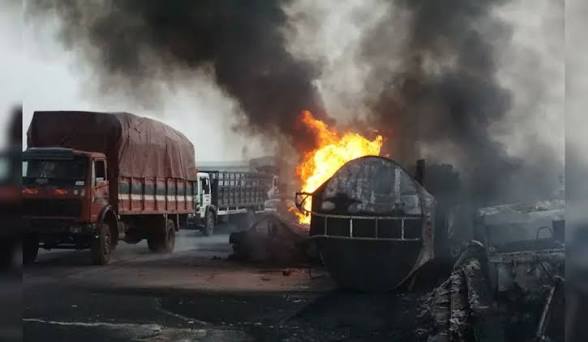
A fuel tanker explosion at the tollgate axis inward Ibadan on the Lagos-Ibadan Expressway has triggered a massive traffic gridlock, which began on Friday evening and persisted till yesterday evening.

Thousands of motorists and commuters have been stranded with security agencies, including the military, police, Amotekun Corps, Federal Road Safety Corps (FRSC), and Oyo State Road Transport Management Authority (OYRTMA) making frantic effort to solve the puzzle as of press time yesterday evening.

The explosion, which occurred very close to the base of the overhead bridge before Guru Maharaji place at the busy tollgate corridor, disrupted traffic flow along one of Nigeria’s most important highways.

An eyewitness, Mrs. Grace Aduke, who sells boiled corn by the roadside, very close to the scene of the incident, told Sunday Sun: “When the tanker exploded, it was as if the fire would jump to other vehicles on the road. Many motorists abandoned their vehicles and ran away for safety. It was much later they came to carry their vehicles. Two other trucks were also involved in the accident.”

This resulted in a vehicular backlog stretching several kilometres and affecting movement into Ibadan and adjoining routes.

As of 5:30pm yesterday, traffic remained largely at a standstill, with frustrated commuters spending several hours on the road, while many motorists sought alternative routes to their destinations.

Other eyewitnesses described the situation as chaotic, saying the explosion sparked panic among road users and created a major obstruction that quickly snowballed into a severe traffic crisis.

“The traffic is terrible. People have been trapped here for hours without any clear indication of when the road will be free,” a stranded motorist said.

Another commuter lamented the hardship caused by the congestion, noting that journeys that would ordinarily take minutes had stretched into several hours.

Commercial transport operators were also among those worst hit, with many passengers reportedly forced to endure long delays under difficult conditions.

The traffic spillover extended to adjoining roads within the Ibadan metropolis, worsening congestion across several parts of the city and creating additional challenges for road users.

For people travelling from Lagos to Ibadan, the traffic stretched from Circular Road flyover to the flyover before Guru Maharaji and for those moving from Ibadan to Lagos, the logjam stretched from the base of Challenge Link Bridge to almost the circular road bridge again.

Although emergency responders and relevant authorities were said to be monitoring the situation, details regarding the cause of the explosion and any possible casualties were not immediately available.

Sun