Home Blog Page 235

LASU to Graduate 20,604 Students at 29th, 30th Combined Convocation, name Best Graduating Student

0


BY TAIWO OGUNMOLA -OMILANI


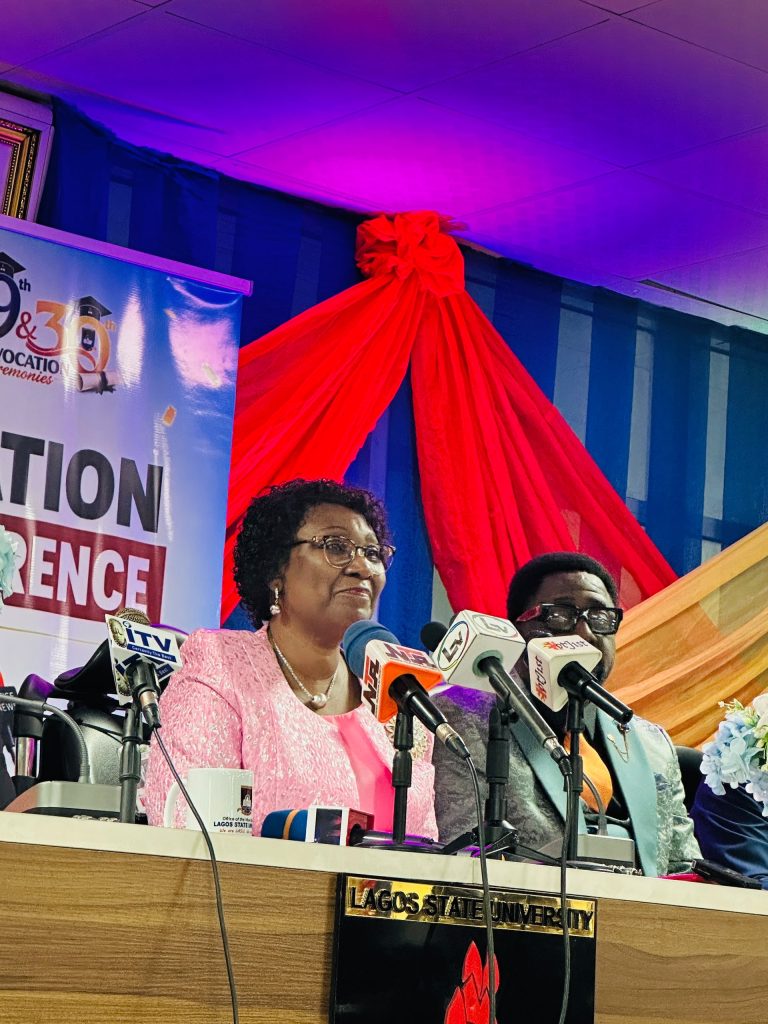
Lagos State University (LASU) will graduate a total of 20,604 students at its 29th and 30th Combined Convocation Ceremonies for the 2024/2025 and 2025/2026 academic sessions.

The Vice-Chancellor, Prof. Ibiyemi Olatunji-Bello, disclosed this on Wednesday at a press conference held at the Senate Chamber of the Babatunde Raji Fashola Senate Building, LASU Main Campus, Ojo.

According to her, the combined convocation is a historic milestone for the university and the final convocation ceremony she will preside over as Vice-Chancellor.
She said the ceremonies would showcase the achievements of the graduating students while highlighting the university’s academic, infrastructural, research and innovation milestones recorded over the past year.

For the 2024/2025 academic session, Olatunji-Bello said 947 students graduated from the diploma programmes, comprising 65 with Distinction, 521 with Upper Credit, 354 with Lower Credit and seven with Pass.
She added that 7,621 students graduated from first-degree programmes during the session, comprising 262 First Class graduates, 106 unclassified MBBS/BDS graduates, 3,155 Second Class Upper, 3,439 Second Class Lower, 622 Third Class and 37 Pass graduates.

The overall best graduating student for the 2024/2025 session, she announced, is Ayilara Lawal Olawale of the Department of Project Management, who achieved a CGPA of 4.96.

For the 2025/2026 academic session, the Vice-Chancellor said 44 students graduated from diploma programmes, with 33 obtaining Upper Credit and 11 Lower Credit.
She said 8,653 students graduated from first-degree programmes, including 232 First Class graduates, 3,545 Second Class Upper, 4,157 Second Class Lower, 678 Third Class and 31 Pass graduates.

Adebanjo Samuel Oluolamide of the Department of Aerospace Engineering emerged as the overall best graduating student for the 2025/2026 session with a CGPA of 4.97.

Olatunji-Bello further disclosed that 3,383 postgraduate students would graduate across the two academic sessions.
The postgraduate graduands comprise 618 Postgraduate Diploma students, 1,508 Academic Master’s degree graduates, 900 Professional Master’s degree graduates, 238 PhD graduates and 119 Professional Doctoral degree graduates.

She said the Senate had approved the conferment of honorary doctorate degrees on three distinguished Nigerians: Akin Kekere-Ekun, Harriet-Ann Omobola (Bola) Adesola and Aliko Dangote.

The university will also elevate Prof. Rafiu Olaoluwa Okuneye and Prof. Ibiyemi Olatunji-Bello to the rank of Distinguished Professor in recognition of their contributions to teaching, research, mentorship and advancement of knowledge.

The convocation activities began on Wednesday with the press conference and will continue with the Convocation Staff Sports Competition.
On Thursday, August 13, the university will hold its first-ever Staff Celebration Day at the Buba Marwa Auditorium.
The Coconut Breaking and Cultural Day will take place on Friday, August 14, at the university’s main gate, followed by the Convocation Jumat Service at the university mosque.

On Monday, August 17, diplomas, first degrees, postgraduate diplomas and master’s degrees in Engineering and Agricultural Sciences will be conferred at the Olatunji-Bello Auditorium, Epe Campus.
The convocation lecture, titled “From LASU to the World: Harnessing the Nigerian Diaspora as the 7th Region for National Development,” will be delivered on Tuesday, August 18, by the Chairman and Chief Executive Officer of the Nigerians in Diaspora Commission (NiDCOM), Abike Dabiri-Erewa.

The university will also confer degrees on graduands from the remaining faculties after the lecture at the Buba Marwa Auditorium, Ojo.

The conferment of Professional and Academic Doctorate degrees, as well as honorary doctorate degrees, will take place on Wednesday, August 19.
The ceremonies will officially end on Sunday, August 23, with a Special Convocation Thanksgiving Service at the University Chapel of Light, Ojo.

LASU Records Major Institutional Achievements

The Vice-Chancellor also highlighted several achievements recorded by the university during the past year.
She disclosed that LASU secured professional accreditation from the Council for the Regulation of Engineering in Nigeria (COREN) for its Bachelor of Science programmes in Chemical and Process Engineering and Mechanical Engineering under the Outcome-Based Education framework.

She added that the National Universities Commission (NUC) approved 17 new academic programmes, including Cyber Security, Software Engineering, Data Science, ICT, Journalism and Media Studies, Film and Multimedia Studies, Broadcasting, Public Relations, Strategic Communication, Entrepreneurship, Tourism and Hospitality Management, among others.

According to her, additional programmes including Special Education, Library Science, Architecture, Fine Arts, Linguistics, Taxation and Communication and Media Studies also secured full accreditation.
Olatunji-Bello said the commissioning of the Babajide Sanwo-Olu Library Complex marked another major milestone, describing it as the largest and most digitalised university library in West Africa.


She said LASU also attracted more than 84,000 first-choice applications in the 2026 Unified Tertiary Matriculation Examination, making it the most subscribed university in Nigeria for the second consecutive year.
The Vice-Chancellor said the university retained its position as the Best University in West Africa in the Universitas Indonesia GreenMetric World University Rankings for the fourth consecutive year.

She also highlighted the success of LASU alumna Aminat Yusuf, who became the university’s first graduate to attain a perfect 5.00 CGPA and was named the 2026 Rhodes Scholar for West Africa.

She said nine LASU Law graduates also obtained First Class honours at the 2026 Nigerian Law School Bar Examination.
In research and innovation, Olatunji-Bello disclosed that two LASU students, Faaiz Abdul-Liadi and Taiwo Goodness Ukwedje, won two consecutive N50 million venture capital grants in 2026 in a national programme that attracted more than 30,000 applicants.

The university also established a Tier III Data Centre with support from the World Bank Africa Centre of Excellence for Innovative and Transformative STEM Education (ACEITSE).

It further secured TETFund approval for a N3 billion Centre of Excellence for Artificial Intelligence, Robotics and Cyber Sciences, which the Vice-Chancellor said was the only one of its kind in South-West Nigeria.
On infrastructure, she disclosed that construction had commenced on a 1,500-bed student hostel under a TETFund-facilitated public-private partnership valued at about N4 billion.

The university also secured Federal Government approval for a 15-megawatt Independent Power Project and commissioned a 600-seat auditorium at the Epe Campus donated by Tunji Bello, Chairman of the Federal Competition and Consumer Protection Commission.

She said work was also ongoing on the School of Tourism, New Centre for Planning Building and Faculty of Engineering Building at the Epe Campus, while other facilities were undergoing renovation and upgrades.
In sports, Olatunji-Bello said LASU recorded its best-ever outing at the Nigerian Universities Games, winning 10 gold, 14 silver and 15 bronze medals.

She expressed appreciation to Lagos State Governor and Visitor to the university, Babajide Sanwo-Olu, the Governing Council, Senate, management, staff, students, alumni, development partners and the media for their contributions to the university’s progress.

The Vice-Chancellor said the combined convocation would provide an opportunity to celebrate the graduates while reaffirming LASU’s commitment to academic excellence, innovation and its position as a leading institution in Nigeria and Africa.


How kidnappers threatened to sell us to ritualists – Kogi abductees

0

Two of the 16 victims rescued from kidnappers in Kogi State have recounted their harrowing experience in captivity.

The victims were abducted on Sunday when armed criminals attacked commuters along roads in Ofu Local Government Area.

They were rescued on Monday during a joint operation involving the Nigerian Army, Navy, police and local vigilantes.

Ngozi Stephen, one of the rescued victims, said the kidnappers forced her to interpret their ransom demands because she speaks Hausa.

She said the abductors demanded different amounts from victims’ families, with some ransoms reaching N100 million.

“So they told me, tell this person N50 million, tell this person N100 million, tell this person N70 million. That was how they were sharing it,” she recalled.

“So I would tell them, okay, this is what they said, this is the amount they said you should bring.”

Ngozi said the kidnappers also demanded N70 million from her.

She said her attempt to negotiate the ransom attracted threats from the abductors.

“Even me, they said N70 million. So even when I tried to plead and ask them to reduce it a little, they threatened to beat me up because they were beating people and all that.”

According to her, the abductors seized the victims’ phones and switched them off.

The kidnappers later returned the phones whenever victims needed to contact relatives about ransom payments.

Ngozi said the captors threatened to sell the victims to ritualists if ransom demands were not met.

“At some point, they were even threatening that if we were not able to provide the money, they would just sell us to ritualists and all that,” she narrated.

She said the abductors fled after hearing gunshots from security operatives, leaving behind phones and laptops seized from the victims.

“We were able to get back our phones. We were also able to get back the laptops. Thank God. We are now safe,” she said.

Another victim, Joshua Daniel, said he sustained a serious injury while attempting to escape from the kidnappers.

He said one of the abductors chased him and attacked him with a cutlass.

“That is when the cutlass landed here and cut my vein. So, I was bleeding throughout the night,” he said.

Daniel said he later applied herbs to the wound, which helped stop the bleeding.

He identified one of the abductors as Peter and said the kidnappers spoke Igala, Fulani and Hausa among themselves.

Despite his injury, Daniel said he helped evacuate an injured police officer during the rescue operation.

“Even when I had this cut on my hand, I helped in carrying the officer from where we were held captive to the main road where we entered the car. My hand was swelling,” he added.

A local hunter was killed during the rescue operation, while a police officer sustained injuries.

The rescued victims comprised six adult men, six women and four children and were undergoing documentation, medical assessment and reunification with their families.

NANS demands release or prosecution of detained Osun student leader

0

The leadership of the National Association of Nigerian Students (NANS) has expressed concern over the continued detention of Comrade Alalade Bukola Felix, popularly known as ‘Machiavelli’, by the police in connection with an alleged political crisis in Osun State.

NANS called for his immediate release or arraignment in court within 24 hours if the police have evidence linking him to any offence.

In a statement issued by the NANS Southwest Coordinator, Comrade Adeyemo Josiah, and Public Relations Officer, Comrade Olugbemi Timothy, the student body said it visited the Osun State Police Command in Osogbo over the matter.

The association said several aspects of the explanation provided by the command were “deeply troubling” and required urgent clarification.

According to the statement, Machiavelli’s wife told NANS that police operatives arrived at their residence at about 1am, allegedly forced their way into the house and took him away without properly informing his family of his destination.

NANS said the suspect was initially traced to the Area Command in Ilesa before he was later transferred to the State Criminal Investigation Department in Osogbo.

The association said the police had alleged that Machiavelli was connected to a violent incident during a political procession and claimed that video evidence existed to support the allegation.

NANS, however, demanded that any such evidence be presented before a competent court.

“Our position is that if such evidence exists, place it before a competent court and prosecute him according to law,” the statement said.

The student body urged the police to respect due process and ensure that the suspect’s fundamental rights were protected throughout the investigation and any subsequent legal proceedings.

“During our engagements at the Police Command, we sought clarity and credible material supporting the allegations. No such material was presented to me. The mere existence of an allegation cannot become a substitute for judicial scrutiny or an excuse for prolonged detention.

“We acknowledge the responsibility of the Nigeria Police Force to investigate crime and arrest persons where there is reasonable suspicion of an offence. What we will not accept is a situation where allegation gradually becomes punishment through continued detention without the intervention of a court.

“An allegation is not a conviction, we therefore call directly on the Inspector-General of Police to urgently take interest in this matter and ensure that the Osun State Police Command and all officers involved act strictly within the law, professionally and without political influence.

“This is particularly important at a time when Osun State is approaching a sensitive election and public confidence in the neutrality of security agencies must not be allowed to deteriorate.

“NANS has consistently demonstrated its willingness to work with security agencies for peace. Only recently, the student leadership partnered with the Police through POCACOV in advocacy against electoral violence and social vices.

“Such cooperation can only survive where there is mutual trust, transparency, professionalism and fairness. Let it also be clearly stated that our intervention has nothing to do with Comrade Machiavelli’s employment, political association or relationship with any government official.

“He is a former NANS JCC Osun PRO, a former Convention Planning Committee Chairman, an alumnus of the University of Ilesa and an active stakeholder in the student movement.

“Whatever political interests may surround the allegations against him are secondary to us. Our concern is that a recognised student leader must enjoy the same due process guaranteed to every Nigerian citizen.

“Our position is simple, within the next 24 hours, either bring Comrade Alalade Bukola Felix “Machiavelli” before a competent court and place the allegations and available evidence before the judiciary, or release him in accordance with the law.

“We also call on the Commissioner of Police, Osun State Command, and the senior officers overseeing election security in Osun State to demonstrate, in practice, the fairness and professionalism Nigerians have been promised.

“Should this situation continue without lawful judicial intervention or satisfactory resolution, NANS will consult its structures and commence lawful, peaceful and organised mass action to demand respect for due process and the fundamental rights of one of our own.

“We will neither defend wrongdoing nor obstruct a legitimate criminal investigation. But neither will we sit idle while political tension becomes an excuse for the rights of student leaders to be disregarded.

“Investigate if you must. Prosecute if you have evidence. But let the law, not allegation, determine guilt. The credibility of our security institutions in the days approaching this election will be judged not only by what they say about neutrality, but by what Nigerians see them do.”


FG charges bakers, operators on production process, right labelling

0

The Federal Competition and Consumer Protection Commission (FCCPC) has charged bakers, manufacturers, operators on production process, right labelling, urging them to examine their products to determine if it meets Government standards.

Tunji Bello, the Chief Executive Officer FCCPC gave this charge yesterday in Lagos at the stakeholder engagement forum with bakery and confectionery operators organized by the FCCPC’S South West Zonal office with theme ‘Building consumer trust through quality and safety: A regulatory mandate for industry operators.

Speaking at the event which theme is ‘‘Building consumer trust through quality and safety: A regulatory mandate for industry operators’, he urged every operator to examine their products especially in five areas; reviewing ingredients and inputs, production process, audit what you tell the consumer, strengthen traceability and complaint handling, prepare for the possibility that something may go wrong.

“After reviewing these areas, there is one useful question every producer can ask: if I knew everything about how this product was made, would I confidently serve it to my own family”?

“If the answer is yes”, said the CEO, represented by the South West Zonal Coordinator of FCCPC, Dr. Olubumi Otti “maintain that standard. If there is any hesitation, identify the reason and address it. That is where your compliance work should begin”.

Mr. Bello stressed that consumer trust is not built by advertising alone but also earned through the way a business conducts itself.

He said that consumers develop confidence when the product inside the package corresponds with what is stated on it, when the quantity supplied matches the quantity promised, and when businesses accept responsibility and act promptly when problems arise.

“That confidence is sustained when standards are maintained consistently, not only when a regulator is present.

“The bakery and confectionery industry have an unusually close relationship with the Nigerian consumer. Your products enter our homes, schools, offices and celebrations, and ultimately, they are consumed by our families. That creates enormous commercial opportunity, but it also carries a significant responsibility”.

Bello said the FCCPC wants businesses in this sector to prosper. “We want to see them expand, innovate, employ more Nigerians and build brands that endure. Sustainable businesses, however, depend on consumer confidence, and that confidence rests on quality, safety, honesty and accountability”.

“The commitment I ask you to take away from this engagement is therefore practical. Make quality part of your everyday operations. Treat safety as non-negotiable. Be truthful with consumers and give them what you have promised. Above all, make compliance part of the way you do business, rather than something you prepare for only when a regulator is coming” said the FCCPC CEO.

According to him, If we can establish that culture across this industry, consumers will be safer, responsible businesses will be stronger and public confidence in the sector will grow.

Speaking further, he noted “It is particularly important for us to engage with an industry whose products are part of the daily lives of millions of Nigerians. From the neighbourhood bakery serving its community every morning to the large-scale producer supplying thousands of retail outlets, you are entrusted with something very important: the confidence that what you produce and sell is safe for consumption”.

He noted that bread and other baked products are among the most familiar items on Nigerian tables, yet every purchase requires the consumer to place considerable trust in the producer. Consumers do not ordinarily know where the ingredients came from, how they were stored, or the conditions under which the products were made. They do not inspect the production environment or equipment. They depend on the producer to maintain proper hygiene, use appropriate ingredients, represent the product truthfully and supply the quantity promised”.

“Our purpose here today is to reinforce a simple principle: that trust must be justified by conduct. The theme of this engagement, “Building Consumer Trust Through Quality and Safety: A Regulatory Compliance Mandate for Industry Operators,” therefore goes beyond the subject of today’s meeting. It speaks directly to the standard expected of every operator in this industry”.

Furthermore the FCCPC CEO said “We often speak about consumer protection in terms of complaints and redress. However, by the time a consumer has eaten unsafe food and suffered harm, the most important opportunity to protect that consumer has already been lost”.

“Effective consumer protection must therefore begin before the product reaches the shelf. It starts with the source and quality of ingredients and continues through production, hygiene, handling, packaging, labelling, storage, transportation and display. It also covers what businesses tell consumers about their products, the quantity they promise and actually supply, and how they respond when something goes wrong”.

According to Bello, “This is particularly important in your industry because your products are ingested and consumed every day by adults and children alike. A defective non-food product may inconvenience a consumer or result in economic loss. Unsafe food can cause injury or serious harm. For that reason, food safety cannot be compromised in the pursuit of profit”.

He said the provisions of the Federal Competition and Consumer Protection Act, 2018 gives consumers the right to receive goods that are reasonably suitable for the purposes for which they are generally intended, are of good quality, in good working order and free of defects, and comply with applicable standards set by industry sector regulators.

“For bakery and confectionery operators, these are not abstract legal principles. They should be reflected in the everyday operation of your businesses adding that every input matters: its source, condition and storage. The cleanliness of your equipment matters. The hygiene of personnel matters, as do the integrity of your packaging, handling and transportation processes”.

He said that Consumer protection does not benefit consumers alone but “Effective regulation also protects businesses that invest in doing things properly. Consider two bakeries”

The executive Vice chairman of the Commission therefore warned that where businesses expose consumers to unsafe products, engage in deceptive practices, disregard applicable standards or otherwise violate consumer rights, the FCCPC will act within its statutory mandate and, where appropriate, in coordination with the relevant sector regulator.

Bello reiterated that our “objective is not to punish legitimate enterprise. It is to protect consumers and ensure that businesses do not gain an unfair advantage by violating their rights. Responsible operators should expect effective regulation because every business allowed to profit from misconduct places those who bear the legitimate cost of compliance at a disadvantage”.


Police arrest two suspected drug dealers, recover N6.2m illicit drugs in Anambra

0

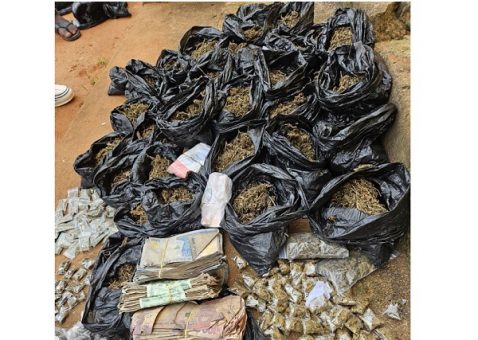
The Anambra State Police Command has arrested two suspected illicit drug dealers operating in Obosi, Idemili North Local Government Area of the state.

The suspects, identified as Nzube Onyedikachukwu, 47, alias ‘Onyeoma’, and Ugochukwu Azia, 20, were arrested by operatives of the command while combing a suspected criminal hideout in Obosi.

The command’s spokesperson, Tochukwu Ikenga, disclosed this in a statement, saying the operatives recovered a large quantity of substances suspected to be Cannabis sativa, methamphetamine and other illicit drugs valued at N6.2 million.

He said the operatives also recovered N598,400 in cash during the raid.

According to Ikenga, some of the suspects fled the scene after sighting the police, while those arrested remained in police custody.

He said investigations were ongoing to identify and apprehend other suspects linked to the illicit drug operation.

He said, “Following credible intelligence on the activities of suspected illicit drug dealers operating in Obosi, Idemili North Local Government Area, operatives of the Command, attached to the Rapid Response Squad Awkuzu, in the early hours of August 11, 2026, stormed a suspected criminal hideout in Obosi.

“Preliminary investigation indicates that the suspects are allegedly involved in the distribution of illicit drugs, while the location is being used as a gathering point by suspected criminal elements after carrying out their operations.

“Some of the suspected criminals reportedly fled the scene upon sighting the Police.

“The suspects are currently in Police custody, while investigation has commenced to establish the source and distribution network of the suspected illicit drugs, identify other persons connected to the operation and ascertain the circumstances surrounding the cash recovered.

“To this end, CP Nnanna Oji Ama reiterated that the Command will sustain intelligence-led raids, targeted operations and proactive policing aimed at dismantling criminal hideouts and denying criminals safe havens within the State.

“The Commissioner further urged residents, traditional institutions, community leaders and other stakeholders to continue supporting the Police with credible and timely information on suspicious persons, criminal activities and identified criminal hideouts.”


Safe schools: FG to strengthen security in vulnerable communities with Man O’ War volunteers

0

The Federal Government is expanding its Safe Schools intervention beyond school premises to vulnerable host communities, borderlands and riverine areas, the National Coordinator of the Safe School Initiative Nigeria, Hajiya Halima Iliya Ibrahim, has said.

Ibrahim said members of Man O’ War Nigeria were being trained to support the initiative by helping to strengthen community resilience and improve the capacity of local communities to identify and respond to security threats.

She spoke on Tuesday at the 4th National Camp of Man O’ War Nigeria at the Citizenship and Leadership Training Centre (CLTC), Mountain School, Shere Hills, Jos.

According to her, the new strategy was designed to address school security holistically by securing the wider environment in which schools operate.

“One of the objectives of the new arrangement is to cascade it down to the schools, state and community levels to strengthen the resilience of the entire host community because it is our collective responsibility,” she said.

Ibrahim said Man O’ War was being engaged as a partner to take the Safe Schools framework to the grassroots and build the capacity of communities to respond to security threats.

“It is a multi-agency collaboration where you see a lot of agencies working together to drive and ensure the implementation of Safe Schools across the country,” she said.

She said Plateau State had been selected for the initial mapping exercise, covering schools and communities across the three senatorial zones of Plateau North, Plateau Central and Plateau South.

The coordinator said the exercise would not be restricted to schools but would extend to the wider host communities.

“We are mapping out schools across the three senatorial zones to build the resilience of the entire host community, not just the school community,” she said.

She explained that security threats affecting schools often originated from the communities surrounding them, making community resilience a critical component of the Safe Schools strategy. “These actors stay within the community. These actors pass through the community before they attack schools, and some of these actors are external by nature.

“So, we are also trying to see how we can strengthen the borderland communities,” she said.

Ibrahim said children in some riverine communities were exposed to additional risks because they had to travel through waterways to access education.

She said such communities would therefore form part of the intervention, adding that the government would work with the Nigeria Immigration Service and other relevant agencies to strengthen security in vulnerable areas.

The National Coordinator said the Federal Government was also identifying and supporting vulnerable borderland and riverine communities as part of its transition plan for the Safe Schools programme.

She said the involvement of security agencies and the Armed Forces demonstrated that the initiative was being implemented as a national security strategy rather than merely an education-sector programme.

According to Ibrahim, the programme is being coordinated through relevant government structures, including the Office of the National Security Adviser, while provision has been made for Safe Schools interventions in the 2026 national budget.

She stressed the need for financial prudence, accountability and transparency in implementing the programme, adding that the Ministry of Finance remained the coordinating authority for its financing component.

National Commander of Man O’ War Nigeria, NC Adedamola Gbenga, said the organisation was strengthening the capacity of its volunteers to support safer schools and more resilient communities across the country.

Gbenga said the theme of the camp, “Strengthening Community-Based Safe School Framework for a Secure and Resilient Nigeria,” with the sub-theme, “Building Safer Schools through Partnership, Preparedness and Collective Responsibility,” was timely.

The Federal Government launched the Safe Schools Plan in 2022, while full implementation of the National Plan on Financing Safe Schools commenced in 2023 as a framework for addressing school security challenges on a holistic and sustainable basis.

Sun

2027: ADC unveils governance code, vows to play different politics

0

The African Democratic Congress (ADC) has unveiled its “Orange Book”, containing the party’s Governance Principles and Code of Ethics for public officials elected on its platform, promising to break from what it described as Nigeria’s culture of self-serving politics.

The development came as the All Democratic Alliance (ADA), one of the political associations prequalified by the Independent National Electoral Commission (INEC) for registration as a political party, issued a 48-hour ultimatum to the electoral body to comply with a Federal High Court order on its Access Code or face contempt proceedings.

The two developments have brought questions of political accountability, electoral participation and the conduct of political actors to the fore ahead of the 2027 elections.

Speaking at the unveiling of the Orange Book at the ADC National Secretariat in Abuja on Tuesday, the party’s National Publicity Secretary, Bolaji Abdullahi, said the document was designed to establish ethical standards for elected officials and provide Nigerians with a basis for holding them accountable.

Abdullahi said the coalition that gave birth to the ADC had recognised that Nigeria’s current condition was partly a product of the kind of politics practised in the country and that changing the situation required a different political culture.

“When the coalition movement started, there was one fundamental realisation, which is: why are we here? Why are we in this coalition? Why are we trying to build a political party? “The answer was very clear: Nigeria is the state we are in today because of the kind of politics we are playing. And if we are to solve the problems Nigeria is facing, we have to play a different kind of politics.”

He said the Orange Book was necessary because politics and politicians had become widely discredited, while honest behaviour was not adequately rewarded and bad conduct was not sufficiently punished.

According to him, the document would provide a framework for holding ADC members in public office to agreed standards of governance and ethics. “We needed a book that would articulate the governance and ethical principles for a political party on the basis of which you hold members accountable. No party before us since 1999 has done it. I doubt if any political party in the history of politics in Nigeria has had anything like this.”

Abdullahi said the code would apply to ADC members elected into the National Assembly, state Houses of Assembly, governorship and presidential offices.

He said elected officials on the party’s platform should be able to reject actions inconsistent with the code simply because they were bound by the ethical standards of the ADC.

The spokesman said Nigeria had become conditioned to separating morality from politics, resulting in systemic corruption, impunity and declining public trust.

“We have got to a point where we have been socialised as Nigerians to think that morality and ethics cannot go together.”

He described the Orange Book as a “binding covenant” between the ADC and Nigerians, disclosing that the party’s three presidential aspirants had signed the code and taken an oath to uphold it.

Abdullahi said the document was more than a declaration, describing it as a departure from the culture of self-serving politics and a framework centred on ethical leadership, public accountability and the common good.

He said the code would empower party members and the wider public to question the conduct of ADC officials in government.

“We have got to a point in this country where we don’t ask questions anymore. So the ADC is saying that when we come into government and you see an individual, an ADC official, in a 14-car convoy, you have to write as an ADC member to say no. This is not what we promised. We said it would be different,” he said.

The party said the Orange Book would remain a framework for ensuring that its commitment to ethical leadership and accountable government applied to its elected officials at every level.

Meanwhile, the ADA has threatened to commence contempt proceedings against the INEC Chairman, the Director of the Department of Election and Party Monitoring (EPM) and other relevant officials unless the commission complies with a Federal High Court order directing it to issue an Access Code to the association’s authentic leadership.

In a statement signed by its Protem National Secretary, Dr Aminu Ahmed, the ADA said INEC’s alleged failure to comply with the order had stalled its registration process and prevented it from uploading details required to complete its registration as a political party.

The association, which is one of eight political associations prequalified by INEC for registration, said it had given the commission’s chairman 48 hours from August 10, 2026, to release the Access Code.

“Based on the order of the court to issue an Access Code to us within 72 hours from the date of the court’s judgement, INEC was supposed to have issued the Access Code latest by 4th August 2026.

“INEC has now been in continuous defiance of a valid court order for a period of 39 days today and counting,” the party said.

The ADA said the code was required to enable it to upload its list of party officials, office addresses, administrative staff and other information prescribed by INEC for the registration process.

It described the alleged non-compliance as an assault on the rule of law and an attempt to frustrate its registration and deny its members and supporters the opportunity to participate in the electoral process.

The dispute arose from a suit filed by ADA leaders, Chief Akin A. Rickets and Dr Aminu Ahmed, through their counsel, M.U. Kumalia, against INEC and Dr Umar Ardo over the issuance of an Access Code to Ardo.

The plaintiffs had argued that Ardo was neither the National Chairman nor Secretary of the association and was therefore not entitled to receive the code.

In a judgment delivered on June 29, Justice Peter Lifu ruled that INEC’s issuance of the Access Code to Ardo, whom the court held was not a recognised protem secretary of the political association, was illegal, wrongful, null and void.

The court also ordered INEC to open its portal for one week to enable the ADA leadership to upload the required documents, including a digital register of members and other registration information.

It further directed INEC to generate another Access Code for the association within 72 hours and issue it to the protem chairman or secretary named in a letter dated October 10, 2025, and received by INEC on October 13, 2025.

The letter was tendered as Exhibit ADA 3 in the plaintiffs’ amended originating summons.

The ADA said it would commence contempt proceedings if INEC failed to comply with the court order within the stipulated period.

As of press time, INEC had not issued a public response to the ADA’s latest demand.

Sun

Obasanjo, Jonathan, Obi raise alarm over democratic decline, demand urgent reforms

0

* Obasanjo attacks imported model; Jonathan decries election litigation; Obi warns of weakening institutions

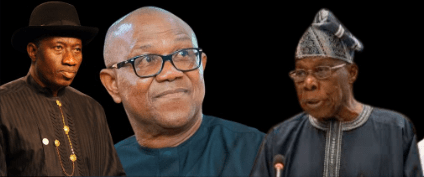
Two former presidents, Olusegun Obasanjo and Goodluck Jonathan, alongside former governor and presidential candidate of the Nigeria Democratic Congress (NDC) Mr. Peter Obi, have raised a fresh alarm over the state of Nigeria’s democracy, warning of a deepening institutional decline and demanding urgent reforms to safeguard the country’s democratic future.

The trio spoke at the 2026 Goodluck Jonathan Foundation Democracy Dialogue in Bauchi, yesterday, where political leaders, constitutional experts and civil society actors examined the challenges confronting democracy in Nigeria and across Africa.

Their interventions focused on different aspects of the democratic system but converged on a troubling picture of a political order struggling with electoral credibility, excessive post-election litigation, weakening institutions, political exclusion and a winner-takes-all culture.

While Obasanjo questioned the suitability of the Western liberal democratic model adopted by African countries, Jonathan decried Nigeria’s growing dependence on the judiciary to settle electoral and political disputes. Obi, on his part, warned that the weakening of electoral and judicial institutions was putting the country’s democratic future at risk.

Obasanjo, who chaired the dialogue, argued that Nigeria and other African countries had largely inherited a democratic model that was not designed around their historical, cultural and political realities.

“The democracy we practice has no African context, no African content,” he said.

According to him, the imported model has encouraged a winner-takes-all political culture in which opponents are treated as enemies rather than legitimate participants in governance. “When you talk about loyal opposition in an African setting, opposition means enemy. Then do you have a loyal enemy? So, what do you do with your enemy? You crush him and destroy him, and that is what we have.”

He also criticised the first-past-the-post electoral system, arguing that a candidate could win by a narrow margin and subsequently exercise virtually total control over political power. “If you beat me by one vote, then you take it all and whatever I have does not matter.”

Obasanjo called for a broader rethink of democratic governance in Africa, insisting that the system must reflect the continent’s history, culture and values rather than simply replicate foreign political structures.

He also warned against allowing Nigeria’s diversity to become a source of division, saying the country’s ethnic, religious and cultural differences must be deliberately protected and managed.

“Nigeria is what it is because of our diversity. Remove diversity out of Nigeria and you will probably have the Republic of Oduduwa or the Republic of Danfodio. That will not be Nigeria. That diversity must be nourished and taken care of,” he said.

The former president further criticised the influence of money and inducements in politics and lamented the limited representation of women in political leadership since the beginning of the Fourth Republic.

Jonathan, however, focused on what he described as Nigeria’s unusual culture of post-election litigation and the growing role of the judiciary in determining political outcomes.

The former president said election disputes had become so common that politicians now appear to factor litigation into their electoral calculations.

“The Nigerian situation is extremely different from most other African countries. The kind of election litigation we experience here is uncommon. I can describe the Nigerian situation as a very anomalous one.” Jonathan recalled that a former deputy president of South Africa had expressed surprise during his tenure as vice-president that Nigerian politicians routinely challenged election results in court after losing elections.

Jonathan acknowledged the importance of an independent judiciary but expressed concern over declining public confidence in some political judgments.

He particularly criticised judicial intervention in internal party affairs, including disputes over party primaries.

“Courts now determine who becomes a party’s candidate and, in some cases, which political party should be recognised,” he said.

According to him, political parties should retain primary responsibility for selecting their candidates, while the judiciary should intervene where there are clear breaches of the law.

Jonathan suggested that in some highly controversial cases, returning the matter to voters could be preferable to allowing prolonged litigation to determine electoral outcomes.

“In some highly controversial cases, it is better for the election to go back to the people,” he said.

Obi, in his intervention, warned that the weakening of Nigeria’s electoral and judicial institutions could have consequences far beyond the current political generation.

Recalling his experience of challenging his presidential election result in court, Obi said the judiciary had previously demonstrated sufficient independence to give citizens confidence that justice could prevail irrespective of political interests.

He said he spent three years challenging his presidential election and obtained favourable judgments from judges he said he had never met.

However, Obi expressed concern that institutions established to protect democracy were increasingly being weakened by political interests.

He raised questions over alleged electoral malpractice involving academics, changes to electoral laws, religious leaders openly supporting politicians accused of wrongdoing and judicial decisions that, in his view, raised questions about institutional independence. “Where is our nation going?” Obi asked.

He warned that allowing democratic institutions to continue deteriorating would impose a burden on future generations.

“We need to reverse this, because the abuse we are allowing today will take its revenge on our children,” he said.

The three interventions came against the backdrop of continuing concerns over the credibility of elections, political accountability, institutional independence and public confidence in Nigeria’s democratic process. Taken together, their warnings went beyond calls for electoral reform, raising fundamental questions about the entire architecture of Nigerian democracy — how political competition is conducted, how opposition is treated, how elections are won and contested, how disputes are resolved and how democratic institutions can be protected from political interference.

Jonathan stressed that democracy functions as an ecosystem involving political parties, electoral bodies, security agencies, the judiciary, civil society, the media, election observers and voters.

The speakers therefore called for a broader reform agenda capable of restoring confidence in democratic institutions and ensuring that political power is determined by credible elections rather than money, institutional manipulation or prolonged courtroom battles.

The dialogue was attended by former Vice-President Namadi Sambo, Bauchi State Governor Bala Mohammed, constitutional experts and civil society representatives from across Africa.

Sun

Osun election: Police invite Fadahunsi over threat to kill Accord members

0

The Osun State Police Command has summoned Francis Fadahunsi, the senator representing Osun East Senatorial District, over his viral comment in which he called for the killing of members of the Accord Party.

The invitation followed widespread reactions to the senator’s remarks, in which he was accused of directing supporters of the All Progressives Congress (APC) to “kill” Accord members if they encountered them during the electoral process in parts of the state.

The police summons comes amid growing concerns over the senator’s remarks and their potential implications for the conduct of the electoral process.
In a letter dated August 11, 2026, the police invited the senator to “clarify the circumstances” surrounding the statements allegedly made during an APC campaign in Ilesa on Tuesday.

The letter, signed by Samuel Etaifo Erale, the commissioner of police elections in Osun State, ordered Fadahunsi to report to the State Criminal Investigation Department (SCID) in Osogbo on Wednesday, August 12, at 11:00 am.

“The invitation is premised on information in possession of the Nigeria Police alleging that during your address at the aforementioned programme, you made statements considered to be threatening, inciting and intimidating in nature, and the statement has already been in circulation on various electronic and social media platforms,” the document reads.

Sun

Lagos Taskforce Impounds 66 Okadas Over Traffic Violations

0

The Lagos State Environmental and Special Offences Enforcement Unit (Taskforce) has intensified enforcement operations across Lagos Island, impounding 66 commercial motorcycles, popularly known as Okadas, for violating the state’s transport regulations.

The operation, carried out on Monday, August 10, 2026, is part of the agency’s ongoing efforts to rid the State of recalcitrant commercial motorcycle operators, street traders, illegal ticket collectors and other activities constituting a nuisance and security threat across the metropolis.

The enforcement team visited CMS Bus Stop, Obalende, Osborne Roundabout, Abraham Adesanya Road, Lekki-Ajah Expressway and the Lagos Coastal Road, where illegal Okada operators were found operating on restricted routes and constituting a nuisance to motorists and other road users.

At the end of the operation, 66 commercial motorcycles were impounded, while normalcy was restored in the areas visited.

Speaking at the agency’s headquarters at Safety Arena, Bolade, Oshodi, after the enforcement exercise, the Chairman of the Lagos State Taskforce, CSP Adetayo Akerele, said the agency had intensified its intelligence gathering and tactical operations to completely eliminate illegal Okada operations from restricted highways, bridges and other prohibited routes across the State.

According to him, although some recalcitrant operators have devised different tactics to evade enforcement, the agency’s intelligence-driven approach and tactical superiority would soon make it impossible for them to continue operating illegally.

Akerele further warned that subsequent enforcement operations would not only target illegal motorcycle operators but would also lead to the arrest and prosecution of both riders and passengers found violating the law.

He reiterated that all impounded motorcycles would be forfeited to the Lagos State Government through the courts in accordance with the Lagos State Transport Sector Reform Law, 2018.

The agency reaffirmed its commitment to sustaining enforcement operations across the state until full compliance is achieved.